




Concierge travel emergency help means your travel advisor steps in the moment something goes wrong, contacts suppliers directly, and protects your next critical reservation while you handle anything that requires your personal presence. The immediate outcome is stabilization: a clear next step within minutes, not hours of hold music. This explainer draws on U.S. State Department guidance, ASTA industry reporting, and Elite Travel’s 24/7 advisor support model.
TL;DR:
- Concierge support can rebook flights, hold hotel rooms, and activate local contacts within minutes, but cannot issue passports, provide medical treatment, or replace government functions.
- Reporting a lost or stolen passport online cancels it within one business day, and a new passport is typically issued the next business day after in-person embassy processing.
- In a medical emergency, call local emergency services immediately for life-threatening situations and use concierge advice for vetted local clinics afterward.
- Contact the embassy directly for urgent government-related issues like serious crimes or life-threatening emergencies, while your advisor handles disruptions involving suppliers or travel arrangements.
- Preparing copies of documents, sharing full itineraries, and enabling alerts before departure significantly reduce response times during crises.
Table of Contents
- What concierge emergency support covers (and what it doesn’t)
- What to do first when a travel emergency happens
- What your advisor does behind the scenes
- Lost or stolen passport: the exact consular steps
- Preparing before you travel so emergencies resolve faster
- When to call the embassy versus when to call your advisor
- Handling credit cards, passports, and ID issues abroad
- Medical emergencies: protocols and when to seek direct help
- How travel insurance claims work during an emergency
- Staying connected with family during a crisis
- Reaching local emergency services and embassies abroad
- Realistic timelines and who controls which costs
- How Elite Travel approaches emergencies in practice
- Why Elite Travel is built for concierge emergency coverage
- FAQ
- Sources
What concierge emergency support covers (and what it doesn’t)
A concierge-level advisor earns their keep during the moments a booking confirmation never prepares you for. Core responsibilities include:
- Proactive communication the moment a disruption appears on an airline or hotel dashboard, often before you notice it yourself.
- Direct supplier contact to rebook flights, hold rooms, or shift tour departures without you waiting in a call queue.
- Activation of on-the-ground partners (drivers, local fixers, concierge desks) who can respond faster than a hotline.
- Sequencing official steps, such as telling you when and where to show up for a consular appointment, so you do not waste a trip day guessing.
What concierge support does not do matters just as much. Advisors cannot issue a passport, provide medical treatment, or stand in for consular authority. Those remain government or medical functions. Elite Travel has operated this way for 35 years with 24/7 support, which is a capability claim about availability, not a substitute for official processes.
What to do first when a travel emergency happens
The first ten minutes set the tone for everything that follows. Work through these steps in order:
- Secure yourself and your companions, then note your exact location, including the building, terminal, or street address.
- Preserve evidence: photograph damaged luggage, stolen-item scenes, or police reports, and keep every receipt.
- Call or message your advisor with specifics: location, reservation numbers, passport status, any health concerns, and photos if relevant.
- While your advisor works the phones, enable airline and hotel app alerts, photograph your passport and visas, move essentials into your carry-on, and check alternate routes or airports yourself.
- If the situation involves a lost passport, serious crime, or a life-threatening emergency, call the nearest U.S. embassy or consulate; your advisor can prepare documents and scheduling in parallel but cannot replace that call.
Pro Tip: Save your advisor’s direct line and your embassy’s address in your phone’s lock screen notes before you ever leave home, not after something goes wrong.
What your advisor does behind the scenes
Once you report a problem, a concierge advisor runs a fairly consistent triage sequence. First comes location and priority: which reservation, if missed, causes the most damage downstream. The advisor contacts that supplier first, whether it is an airline, a hotel, or a tour operator, and proposes alternative routing before the original booking lapses.
ASTA guidance recommends several practices advisors lean on during active disruptions:
- Monitor airline status dashboards continuously rather than waiting for a passenger notification.
- Check hotel cancellation and flexibility terms before assuming a booking is lost.
- Use Department of Transportation resources when an airline, not the traveler, caused the disruption.
- Keep updating the client frequently, even with partial information, instead of waiting for a full resolution.
What an advisor can usually secure: a protected onward connection, a comparable hotel room, or a held cruise departure. What an advisor cannot change: government processing times, visa rules, or airline liability determinations. Those outcomes depend on the agency or carrier, not the advisor’s effort.
Lost or stolen passport: the exact consular steps
If your passport disappears, speed matters more than anything else. The State Department’s reporting page specifies that reporting it lost or stolen online cancels the document within one business day, which protects you against identity theft even before you apply for a replacement.
One business day is the standard cancellation window once you submit the online report, and that confirmation email becomes useful documentation for your advisor and any insurance claim.
From there, the lost-or-stolen passport guidance lays out the rest:
- You must appear in person at a U.S. embassy or consulate; there is no mail-in or proxy option abroad.
- In most cases, a replacement or limited-validity emergency passport is issued quickly, though weekends and holidays can slow routine issuance.
- A reported lost passport becomes permanently invalid, even if you later find it, so plans must be rebuilt around the new document’s timeline.
Your advisor’s job here is logistics, not paperwork authority: confirming appointment times, prepping photocopies and photos you will need, and rebuilding flights and hotel nights around the replacement timeline rather than the original itinerary.
Preparing before you travel so emergencies resolve faster
The best outcomes trace back to groundwork done weeks before departure. Before you leave:
- Confirm your current phone number and email with your advisor, and enable airline and hotel push alerts.
- Share your full itinerary and any local partner contacts with your advisor so they can act without you explaining context mid-crisis.
- Pack a carry-on emergency kit: medication, chargers, a printed itinerary, and copies of your passport and visas.
- Store digital copies of key documents in a secure cloud folder you can access without your physical devices.
- Review travel insurance coverage limits and the claims contact sequence with your advisor before you need either.
- Book flexible fares on critical connections and build buffer time between flights, especially around milestone events like weddings or cruise embarkation.
Pro Tip: Ask your advisor to flag which of your reservations are refundable and which are not; that single list saves real time during a disruption.
When to call the embassy versus when to call your advisor
Not every problem needs the same first call. A quick way to sort it:
- Call the U.S. embassy or consulate directly for a lost passport, a serious crime, an arrest, or a life-threatening emergency requiring government action.
- Call your advisor first for flight cancellations, hotel issues, tour disruptions, or anything involving supplier negotiation and rebooking.
- The official emergency contact numbers, per the State Department’s help-abroad page, are 888-407-4747 from the U.S. and Canada and +1-202-501-4444 from overseas.
Your advisor and the consulate are not competing channels: they typically work in parallel, with the advisor rebuilding your trip around whatever timeline the consulate confirms.
Handling credit cards, passports, and ID issues abroad
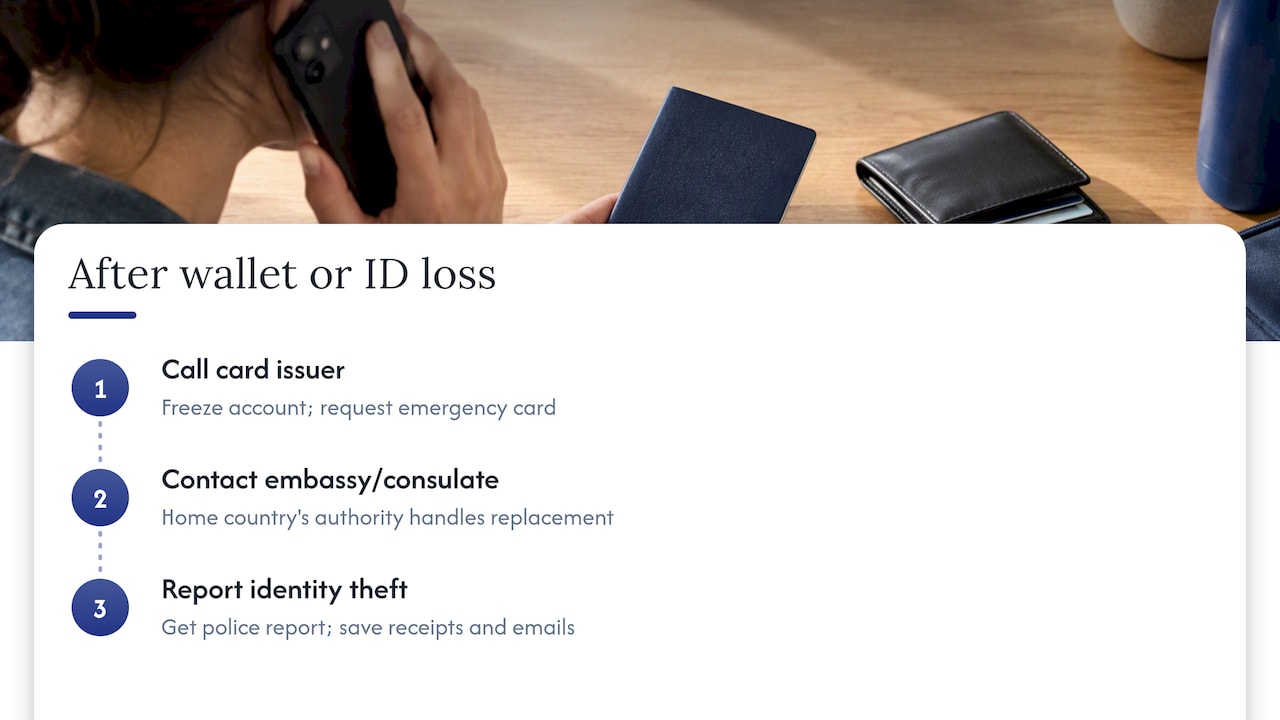
A missing wallet rarely means just a missing passport. If your credit cards disappear alongside your identification, call your card issuer’s international collect number immediately, both to freeze the account and to request an emergency card, which many major issuers can deliver to a hotel or consulate within a day or two. Keep a photo of the card’s back (with the issuer’s number) stored separately from the card itself.
If you are not a U.S. citizen traveling on a foreign passport, the process runs through your own country’s embassy or consulate rather than a U.S. one, and timelines vary by nationality. Your advisor can still coordinate hotel holds, transportation, and rebooking while you handle that country-specific process, but document replacement authority always sits with your home government, never with the advisor.
For any form of identification theft, including cloned cards or stolen ID numbers, report it to local police for a report number, since insurers and card issuers often require it before processing a claim. Keep every police report, receipt, and confirmation email in one folder: it becomes the backbone of both your identity-theft resolution and any travel insurance claim tied to the same incident.
Medical emergencies: protocols and when to seek direct help
A sprained ankle and a chest pain episode call for very different responses, and knowing the difference saves critical time. For anything life-threatening, call local emergency services first, the same way you would at home; your advisor cannot dispatch an ambulance and should never be the first call in a true medical crisis.
For less urgent but still concerning symptoms, concierge advisors can point you toward vetted local clinics or hospitals through on-the-ground partners, which often beats a generic hotel referral. Once you are stable, your advisor’s role shifts to the trip itself: rebooking missed connections, extending hotel stays, and notifying tour operators or cruise lines that you will arrive late or not at all.
Travel insurance intersects heavily here. Most policies require you to contact a 24/7 assistance line before incurring major medical expenses, so keep that number alongside your advisor’s contact information, not instead of it. Your advisor can help you sequence those two calls and keep your itinerary moving while you focus on recovery.
How travel insurance claims work during an emergency
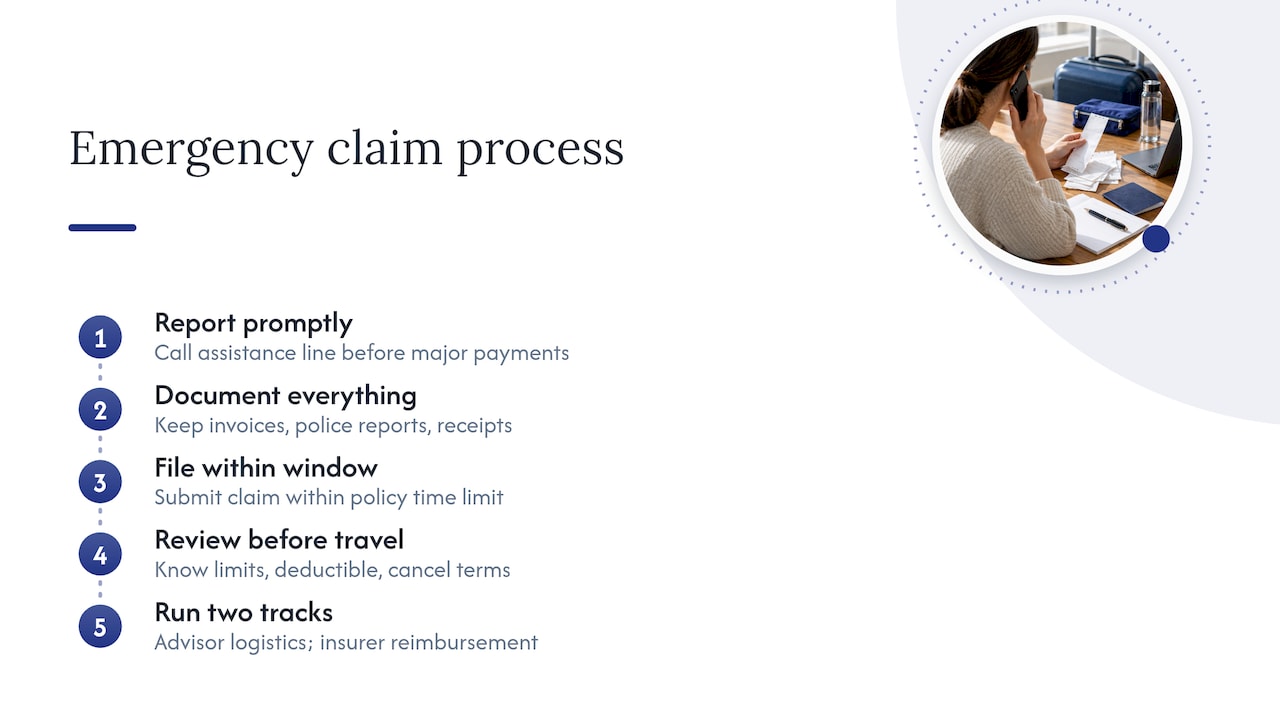
Travel insurance claims for emergencies generally follow the same structure regardless of carrier: report the incident promptly, document everything, and file within the policy’s stated window. The moment something happens, whether it is a medical event, a canceled trip, or lost baggage, call the insurer’s assistance line before making major financial decisions, since many policies require pre-authorization for reimbursable medical care.
Keep every piece of paper: hospital invoices, police reports for theft, airline cancellation notices, and receipts for anything you paid for because of the disruption. Insurers typically ask for all of this when you submit the claim, and missing documentation is the most common reason claims stall.
Reviewing your policy basics with your advisor before departure means you already know your coverage limits, your deductible, and whether “cancel for any reason” applies to your trip. During the emergency itself, your advisor’s role is logistical, rebuilding the itinerary around the disruption, while the insurer’s role is financial, reimbursing what the policy covers. Those two tracks run simultaneously, not sequentially, so keep both parties updated in real time rather than waiting for one process to finish before starting the other.
Staying connected with family during a crisis
Family members worry more from silence than from bad news, so a short, factual update beats no update every time. Before you travel, agree on a simple check-in rhythm with the people most likely to worry, even something as basic as a daily text at a set time.
During an active emergency, prioritize your advisor and any emergency services first, then send a brief message to your emergency contact confirming you are safe and what you expect to happen next. International roaming can fail at the worst moments, so download a messaging app that works over WiFi, such as WhatsApp or iMessage, before you leave home, and share your hotel’s landline as a backup contact method.
If a situation extends over multiple days, such as a passport replacement process, set a daily update time with family rather than responding only when something changes. That small habit reduces the number of anxious calls you receive while you are already managing a stressful situation on the ground.
Reaching local emergency services and embassies abroad
Emergency numbers are not universal, and assuming 911 works everywhere is a common and costly mistake. Many countries use different numbers for police, fire, and medical response, so check your destination’s emergency number before departure rather than during a crisis, and save it alongside your embassy contact.
For U.S. citizens, the State Department’s help-abroad page lists the nearest embassy or consulate for every country, along with after-hours duty officer numbers for genuine emergencies outside business hours. Save that specific country page, not just the general number, since local embassy contact details change.
Your advisor’s on-the-ground partners can often supplement official channels, particularly in less-visited regions where the nearest consulate may be hundreds of miles away. A concierge network that includes local drivers, fixers, or hotel contacts can get you reliable guidance faster than a general hotline in those situations, even though the embassy remains the authority for document and legal matters.
Realistic timelines and who controls which costs
Emergencies resolve on two separate clocks: one set by government or supplier policy, and one your advisor can actually influence. Passport replacement, for instance, typically takes until the next business day once you have appeared in person, per the State Department’s guidance, and no amount of advisor effort changes that government timeline.
What an advisor can influence is everything around that fixed point: securing a comparable hotel room for the extra nights, protecting a cruise departure or tour slot, and negotiating waived change fees with airlines or hotels that have flexible policies. Official fees, such as passport application costs or visa processing charges, are set by government agencies and do not vary by advisor.
During the 2025 and 2026 government shutdowns, ASTA reporting found that many advisors absorbed significant unpaid hours rebooking clients and managing delayed passport and visa processing while official guidance was limited. That pattern illustrates why advisor availability matters most precisely when government timelines slow down: the advisor cannot speed up a federal process, but can keep every other part of your trip moving while you wait.
How Elite Travel approaches emergencies in practice
Our approach centers on coordination, not improvisation. When a client reports a lost passport, we typically confirm the nearest consulate’s appointment process, prepare the documentation checklist in advance, and rebuild hotel and transportation plans around the replacement timeline rather than the original schedule. In parallel, we contact cruise lines or tour operators to protect the next reservation, so a delayed start does not cascade into a canceled trip.
With 35 years of experience and 24/7 availability, we built this workflow around the reality that emergencies rarely happen during business hours. Reaching us starts the same way any planning conversation does: a direct line to a person who already knows your itinerary.
— tammylevent@gmail.com
Why Elite Travel is built for concierge emergency coverage
Peace of mind during a crisis comes down to one question: can you reach someone who already knows your trip, your preferences, and your suppliers. That is the gap concierge-level support closes. We provide concierge-level support aiming for seamless service and stay reachable around the clock because disruptions do not wait for business hours.

Whether you are planning a honeymoon, a milestone celebration, or a multi-stop luxury itinerary, our vacation gift planning workflow is built with emergency coordination in mind from the first conversation, not added as an afterthought. If you are curious whether a specific trip qualifies for full concierge coverage, reach out to confirm what 24/7 activation looks like for your itinerary before you book.
FAQ
What should I do first in a travel emergency abroad?
Secure your safety, note your exact location, and contact your advisor with specifics: reservation numbers, passport status, and photos if relevant. If the situation involves a lost passport or life-threatening emergency, also contact the nearest U.S. embassy or consulate directly.
How long does it take to replace a lost passport abroad?
Reporting a passport lost or stolen cancels it within one business day, and after an in-person embassy visit, a replacement or limited-validity emergency passport is often issued the next business day. Weekends and holidays can extend that timeline for routine cases.
Can a travel advisor replace my passport for me?
No, a travel advisor cannot issue official documents or appear at the consulate on your behalf. An advisor can prepare documentation, schedule appointments, and rebuild your itinerary around the replacement timeline while you handle the required in-person consular visit.
Does Elite Travel charge extra for emergency support?
No, service fees may not be charged and support may be available as part of a concierge approach, with pricing details available from the provider. Coverage specifics depend on your itinerary, so confirming activation details with your advisor before departure is worthwhile.
When should I call the embassy instead of my travel advisor?
Call the embassy or consulate directly for a lost passport, a serious crime, or a life-threatening emergency requiring government action, using the numbers listed on the State Department’s help-abroad page. Call your advisor first for flight disruptions, hotel issues, or anything involving supplier rebooking.
Sources
- Lost or Stolen Passport Abroad
- ASTA issues guidance to travel advisors amid disruptions
- Examining the effects of the 2025 and 2026 government shutdowns
