



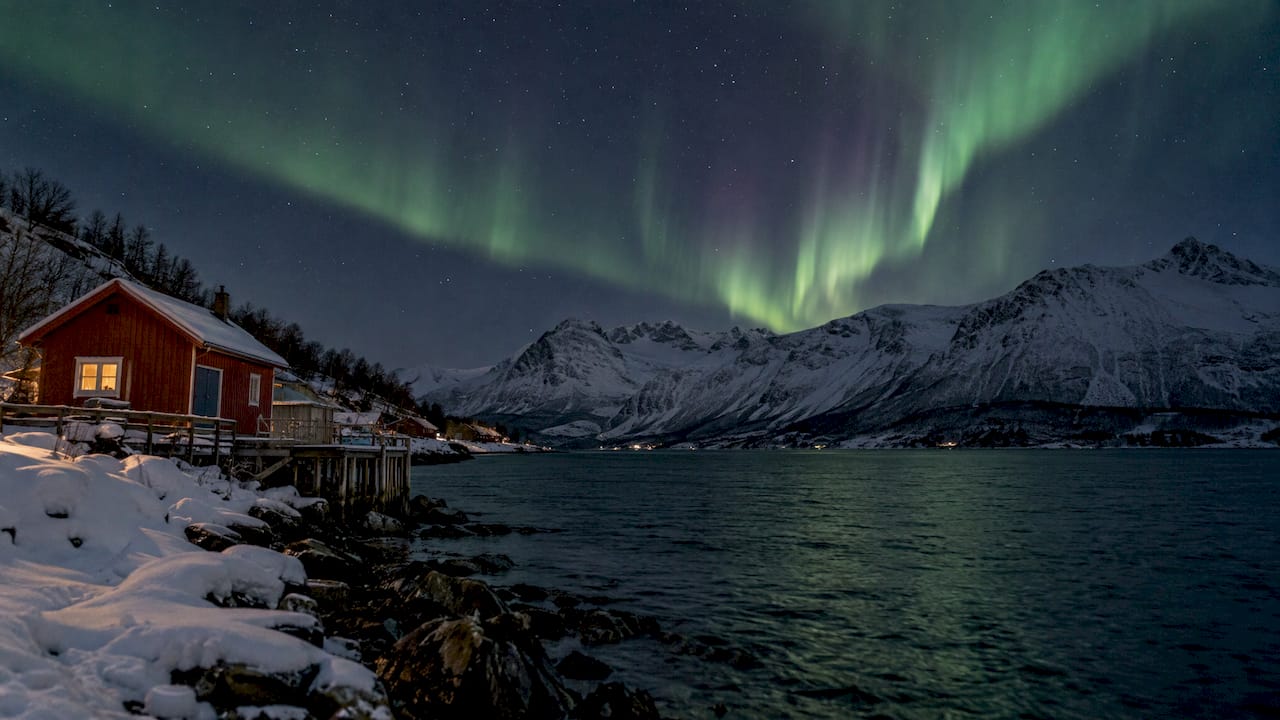
Choose Norway, and Tromsø in particular, if you want a base that sits well inside the auroral zone, with easy public transport and plenty of winter activities. Choose Iceland if you want the aurora alongside waterfalls, glaciers, lava fields and geothermal water, and you are happy to drive or join guided excursions. Neither country can promise a sighting, because clear skies matter as much as location. The real decision is which landscape and travel style you want around the lights.
TL;DR
- Both countries sit in the auroral zone. Darkness, solar activity and, above all, clear skies decide whether you see the lights, not the flag on the map.
- Norway’s Tromsø region has a season of roughly late August to early April. Iceland’s runs from late August to late April. Plan at least three or four nights in either place.
- Norway is easier without a car thanks to trains, buses, ferries and the Coastal Express. Iceland outside Reykjavík rewards a rental car or a private guide.
- Iceland is the stronger pick for dramatic scenery combined with the aurora. Norway is the stronger pick for fjords, cruises and a deep winter-activity menu.
- Leave the city. Light pollution in Reykjavík and Tromsø hides all but the brightest displays.
Table of Contents
- How the two countries compare at a glance
- Your odds of seeing the lights
- When to go: season and timing
- Where to stand: cities versus dark skies
- Getting around: the biggest practical difference
- Scenery and winter experiences around the lights
- What it costs to compare
- Which should you choose?
- Perspective: how we plan an aurora trip
- Let us plan your aurora trip
- FAQ
- Sources
How the two countries compare at a glance
| Factor | Iceland | Norway (Tromsø and northern Norway) |
|---|---|---|
| Aurora season | Late August to late April | Late August or September to early April |
| Best-known base | Reykjavík, then the south coast or Snæfellsnes | Tromsø, plus Lofoten and inland areas |
| Getting around | Rental car, private driver or guided tours | Trains, buses, ferries, internal flights; car optional |
| Main weather risk | Wind, storms, road closures, cloud | Coastal cloud, cold |
| Scenery to pair with the lights | Waterfalls, glaciers, black sand beaches, geothermal spas | Fjords, Arctic coastline, reindeer, dog sledding, whale watching |
| Trip feel | Compact road trip | Arctic city base with day excursions, or a fjord voyage |
Your odds of seeing the lights
The aurora is driven by geomagnetic activity and your latitude. NOAA’s National Centers for Environmental Information says visibility depends mainly on geomagnetic activity and where you are, while weather, light pollution and the moon decide whether you can actually see it. Both Iceland and northern Norway are well placed on the first count. The difference is mostly about clouds.
Researchers at the University of Tromsø note that cloud cover is the greatest obstacle in northern Norway and that it is heaviest near the coast, so inland areas are often better suited. Iceland is an island with its own coastal weather, and an overcast night there can block the sky just as completely. Visit Iceland’s guidance makes the same point: a long winter night can still be completely clouded over.
What this means for you: neither country is a safe bet on any single night. Your odds improve with the number of nights you stay and your willingness to move. A travel guide comparing the two recommends at least three or four nights on the ground and being ready to drive to find a gap in the clouds. The same guide points out that Tromsø in midwinter is no drier than Reykjavík, with both averaging around 15 wet days a month from November to January.
When to go: season and timing
Norway
In northern Norway, the lights are practically limited to the period from early September to mid-April, because nights must be dark enough. Tromsø’s tourism office says they may be visible from late August to early April, provided skies are clear and dark. The Arctic Norway tourist board describes the season as mid-September to early April, with November through February the darkest months, and says peak activity typically falls between 10 p.m. and 1 a.m.
Iceland
Visit Iceland describes the viewing season as late August to late April, and stresses the edges are gradual rather than fixed dates. In summer, bright nights are the obstacle. Its advice is to read the cloud forecast separately from the activity forecast, using the Icelandic Met Office tools. No month guarantees anything.
What the equinoxes do
NOAA says the most favorable months for stronger auroras are March and September, and that the best viewing hours are around midnight, roughly 10 p.m. to 2 a.m. local time. That is a useful tiebreaker. A September or March trip gives you active skies without the deepest winter cold, and it often pairs better with daytime sightseeing because the days are not as short. Our guide to Europe in shoulder season explains how we think about those in-between months.
Where to stand: cities versus dark skies
A common question is whether you can see the lights from Reykjavík or from a Norwegian city. Sometimes, on a strong night. Visit Reykjavík points to spots close to town, such as Grótta Lighthouse, where sparse buildings help the northern horizon, though the path to the lighthouse is submerged at high tide. For a darker sky, the same kind of guidance suggests Thingvellir National Park, under an hour from the capital.
The principle holds in Norway too. The University of Tromsø page advises you to avoid cities and areas with much street lighting to experience the lights fully. Tromsø’s tourism office also frames the season around clear skies and darkness, and it offers guided tours that take you out of town.
For a practical Iceland pattern, spend one or two nights in Reykjavík, then move to the south coast, based around Vík or Höfn, or west to Snæfellsnes. In Norway, base in Tromsø and head out on a night excursion, or add Lofoten or an inland stay when the coast is socked in.
Getting around: the biggest practical difference
This is where the two countries feel most different in winter.
- Iceland: Outside Reykjavík there is no reliable public transport network for sightseeing in winter, so you either rent a car or join guided tours. Winter driving can involve black ice, strong winds, storms and road closures. If you do not want to drive yourself, a private driver-guide changes the experience, and our page on Iceland private guide costs explains what shapes the price.
- Norway: Public transport is strong, with trains, buses, ferries, the Coastal Express and internal flights, so a car is optional. A Tromsø stay works comfortably on foot and with tours.
On a guided aurora night, local guides typically watch real-time weather and Kp forecasts and may drive 100 to 200 kilometers or more to reach clear sky. That flexibility is the single biggest advantage of going with a guide, in either country.
Scenery and winter experiences around the lights
The lights occupy a few hours at night. The rest of your trip is what you will remember, so this is often the real deciding factor.
Iceland packs a lot into a short drive: the Golden Circle, south coast waterfalls, glacier and ice cave excursions, black sand beaches and geothermal bathing. It suits a compact four- or five-day trip. We have a luxury Iceland 4-day vacation package built around this kind of itinerary, and our Iceland vacation planning page covers the wider options.
Norway offers Arctic city life in Tromsø, fjord scenery, reindeer encounters, dog sledding and whale-watching seasons in the north. It also opens the door to a ship-based winter or fjord experience. See our Norway vacation planning page and our approach to Norway fjords cruises.
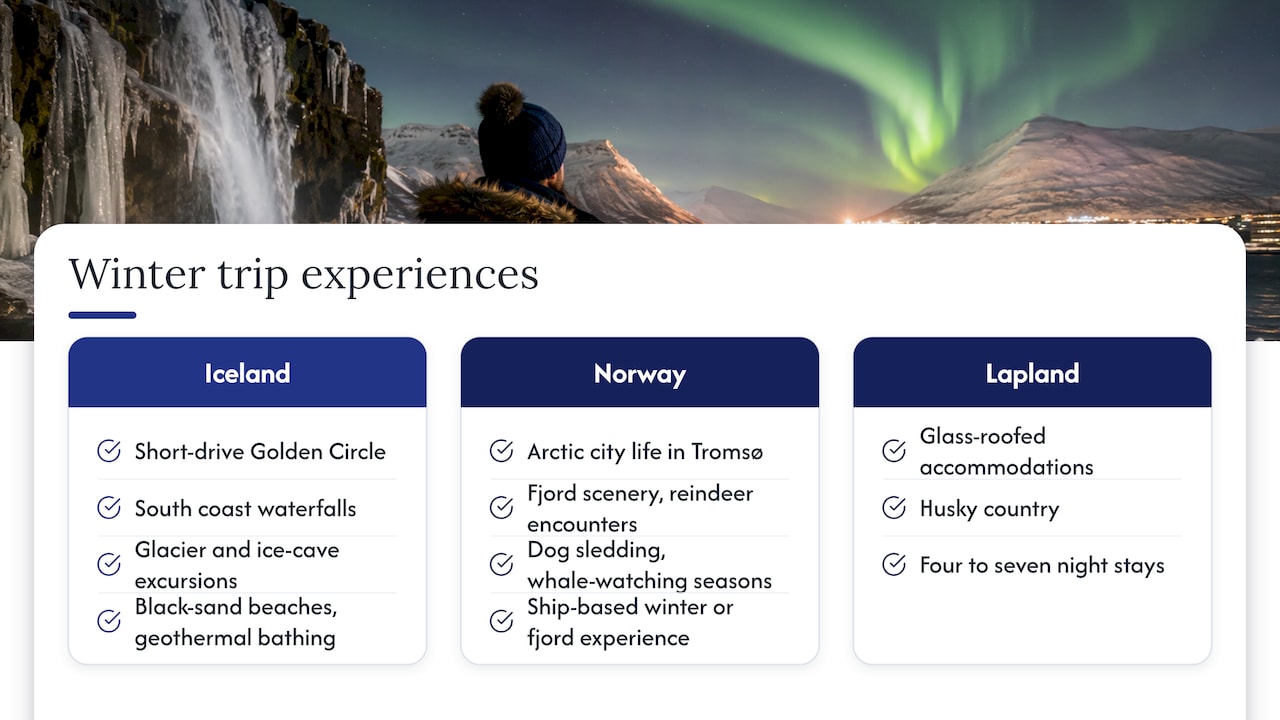
A third option: if you want a snow-and-aurora trip with a very different feel, such as glass-roofed accommodations and husky country, consider Lapland in Finland, where we design four to seven night stays around the lights with concierge support.
What it costs to compare
The honest answer is that cost depends more on your style than on the country. Flights from the U.S. to Reykjavík are typically shorter than to northern Norway, which often needs a connection and a domestic flight to Tromsø. On the ground, the drivers are lodging category, tours, vehicle or driver, and how many nights you want. One cost comparison puts everyday budgets in Norway slightly below Iceland, but any figure is a general guide for independent travelers, not a quote for a luxury itinerary. For a bespoke trip, the sensible approach is to price your actual hotels, guides and dates side by side.
Which should you choose?
- First aurora trip, short on time: Iceland. Reykjavík is a quick flight, and the south coast delivers scenery by day.
- Want a city base and no driving: Norway, based in Tromsø.
- Honeymooners: Either works. Iceland pairs the lights with geothermal spas and private excursions, while Norway pairs them with a fjord or Arctic coastal voyage. Our honeymoon packages page shows how we shape these trips.
- Photographers: Iceland offers more varied foregrounds. Norway offers an Arctic coastline and mountain backdrops. Either way, you need dark sites away from lights.
- Families and multigenerational groups: Norway’s public transport and organized tours simplify logistics, while Iceland suits families who want a private driver.
- Mixed priorities: Some travelers combine both over an extended trip, though that adds flights and time.
Perspective: how we plan an aurora trip
After 35 years of designing high-end travel, we have learned that the lights are the one thing in a trip you cannot schedule. So we plan around that uncertainty instead of pretending it away.
We build in more nights than a standard package would, place you in areas away from city glow, and line up on-the-ground partners who can adjust plans night by night as the weather shifts. A private guide who watches the cloud forecast and is willing to drive to a clearer sky is worth more than any hotel upgrade.
We also think the destination should be chosen for the days, not just the nights. Iceland and Norway both deliver the aurora in the right conditions. What differs is the rest of the journey, and that is where a concierge-level approach earns its keep: the right hotel, the right timing, the right guide.
tammylevent@gmail.com
Let us plan your aurora trip
We design customized luxury journeys to Iceland, Norway, Finland and beyond, with one-on-one concierge-level itinerary design, on-the-ground partners, no service fees, a price match guarantee and 24/7 support. Tell us your dates, your travel style and who is coming, and we will shape an itinerary that gives you the best chance at clear skies, with the comfort you want between aurora nights.
Start with our luxury vacation packages or get in touch through our main site to begin planning.
FAQ
Is Iceland or Norway better for seeing the northern lights?
Neither is guaranteed. Both lie in the auroral zone, and clear, dark skies decide the outcome. Norway’s Tromsø region is a well-known aurora base with strong infrastructure, while Iceland combines the lights with striking scenery. Allow at least three or four nights in either one.
Can you see the northern lights from Reykjavík?
Sometimes. Strong displays can show through city glow, but weaker ones are often washed out downtown. Spots such as Grótta Lighthouse or a short drive out of town give you darker skies and better odds.
What is the best month for the northern lights?
NOAA identifies March and September as the most favorable months for stronger auroras. Deep winter gives the longest nights but not necessarily the most activity. Check the current forecast and cloud outlook for your exact dates.
Is it cheaper to visit Iceland or Norway?
It depends on your style. Flights, lodging level, vehicle or driver, and tours matter more than the country. A custom itinerary lets you compare both destinations with your real preferences priced in.
Do I need to rent a car?
In Norway, no: public transport is good, and Tromsø is walkable with tours. In Iceland, winter conditions outside Reykjavík make a private driver or guided tours a comfortable alternative to driving yourself.
Sources
- NOAA NCEI: Chasing the Northern Lights
- University of Tromsø: The Northern Lights, where, when and what
- Arctic Norway tourist board: Northern Lights in Norway
- Visit Tromsø: Northern lights in Tromsø
- Visit Iceland: When to see the northern lights
- Visit Reykjavík: Where to see northern lights near Reykjavík
- Iceland or Norway for the Northern Lights? A comparison
- Norway vs Iceland in winter
