



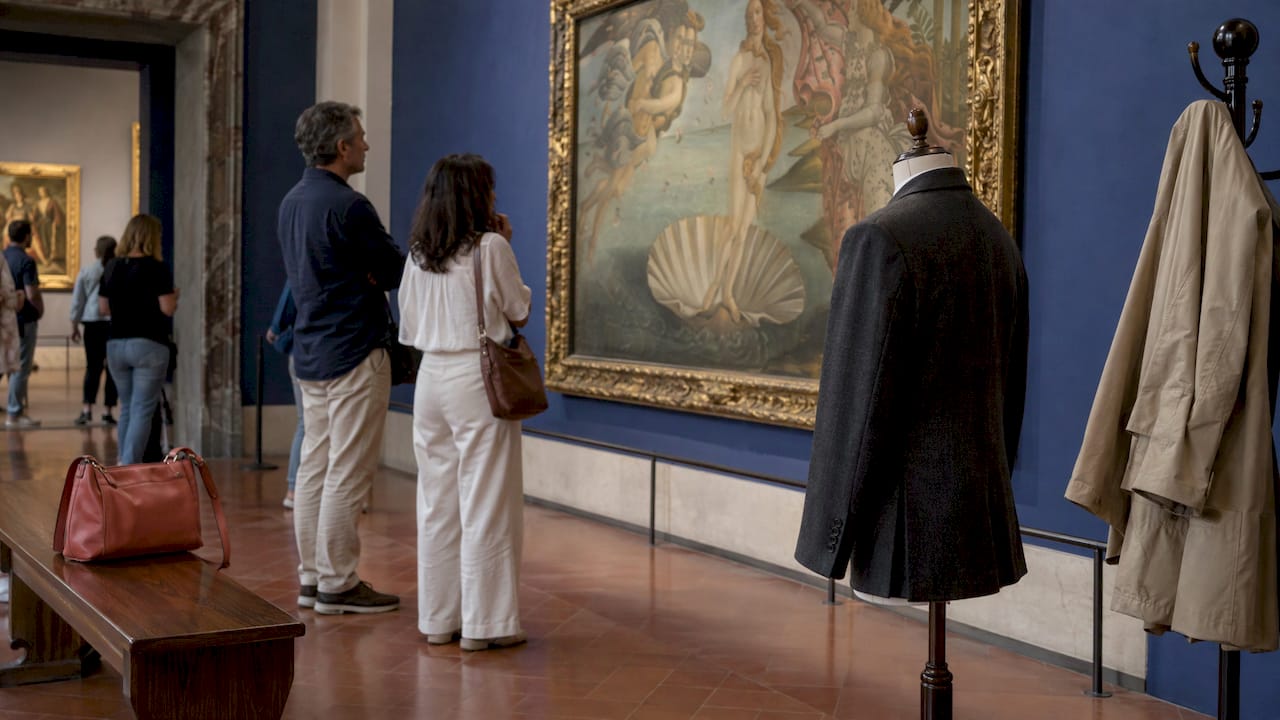
The best private guide in Florence is a licensed, official tourist guide matched to your interests and your pace, booked as part of a plan that already solves tickets, timing and transfers. The guide is only one piece. A great guide lets you see the Duomo, the Uffizi and the Accademia as stories rather than queues. That only works when the entry slots, the walking distances and the rest of your day are arranged around the guide. We design Florence trips this way at Elite Travel, so the private guide is built into the itinerary rather than bolted on the morning you land.
TL;DR
- Hire an official, licensed guide. The city of Florence publishes a list of authorized and qualified guides, and the local guides’ association admits only licensed members.
- Match the guide to your goal: Renaissance art, architecture, food, families with children, or a Tuscan day trip. A generalist and a specialist give very different days.
- Book museum entry in advance. The Uffizi and the Accademia sell timed tickets with a reservation surcharge, and the dome needs its own paid pass.
- Confirm duration, group size, meeting point, what is included, and the cancellation terms in writing before you pay.
- Let a travel designer sequence guides, hotels and transfers so you never lose a morning to logistics.
Table of Contents
- What a private guide actually adds in Florence
- How to check that a Florence guide is licensed
- Matching the guide to what you want
- Planning the big three: Duomo, Uffizi and Accademia
- Private tours for families
- What a private tour costs and what it should include
- What to confirm before you book
- Fitting the guide into the whole trip
- Our perspective
- Plan your Florence days with Elite Travel
- FAQ
- Sources
What a private guide actually adds in Florence
Florence is compact, and that is the trap. You can walk from the Duomo to the Ponte Vecchio in fifteen minutes, so it feels easy to do alone. But the city’s value is concentrated in a few places that are crowded, timed and densely layered: Brunelleschi’s dome, the Uffizi’s Botticelli rooms, Michelangelo’s David, the Bargello, the Medici chapels, the Oltrarno workshops.
A private guide changes three things.
Interpretation. Without context, a room of Renaissance panels is a blur. A good guide tells you why the Medici paid for it, why the perspective in a painting was radical in its day, and which three works are worth your twenty minutes. You leave with a narrative rather than a list.
Pace and focus. On a shared tour, the group moves at the speed of its slowest member and the script is fixed. In a private tour you decide whether to spend an hour in front of one altarpiece or skip a room that bores you.
Access to the less obvious. Guides know when courtyards are quiet, which workshops welcome visitors, where to stop for a coffee that is not a tourist trap, and how to route you so you are not doubling back across the Arno.
What can the day include? Common building blocks are:
- Duomo complex: cathedral, dome climb, Baptistery, Giotto’s bell tower and the cathedral museum.
- Uffizi Gallery: Botticelli, Leonardo, Caravaggio and the Renaissance in sequence.
- Accademia Gallery: Michelangelo’s David and the unfinished Prisoners.
- Piazza della Signoria, Palazzo Vecchio and the Ponte Vecchio.
- Oltrarno artisan walk: leather, paper, gold, and the Pitti and Boboli area.
- Food-focused walks through the central market and the neighborhood trattorias.
- Day trips to Siena, San Gimignano, Pisa, Chianti or a winery.
How to check that a Florence guide is licensed
This is the question that separates a good booking from a risky one. Italy regulates the profession, and in Florence you can verify credentials rather than rely on a website’s star rating.
- Start with the city’s own list. The City of Florence has compiled a roster of authorized and qualified tourist and environmental guides through its FeelFlorence tourism portal.
- Look for association membership. The Florence Tourist Guides Association (AGT) represents the guides of Florence and its province. Only official tourist guides can be members, meaning people licensed under current legal rules (a training course plus an exam, or under earlier rules, the exam alone). The association was founded in 1986 and belongs to the national guides’ association and to European and world federations.
- Ask for the guide’s name and license details before booking. A legitimate guide will give them without hesitation. A vague “our expert team” with no named person is a signal to ask more questions.
- Be careful with “tour hosts” and “escorts.” Someone who is charming, local and knowledgeable is not necessarily licensed to guide inside museums and monuments. Ask directly whether the person is an official guide.
This is one of the quiet reasons we arrange guiding through trusted on-the-ground partners rather than leaving clients to sort through hundreds of listings. Our team knows the destination and the partners, so you are not left to audit credentials on your own.
Matching the guide to what you want
A private tour is only as good as the brief. Before you hire anyone, settle these four questions.
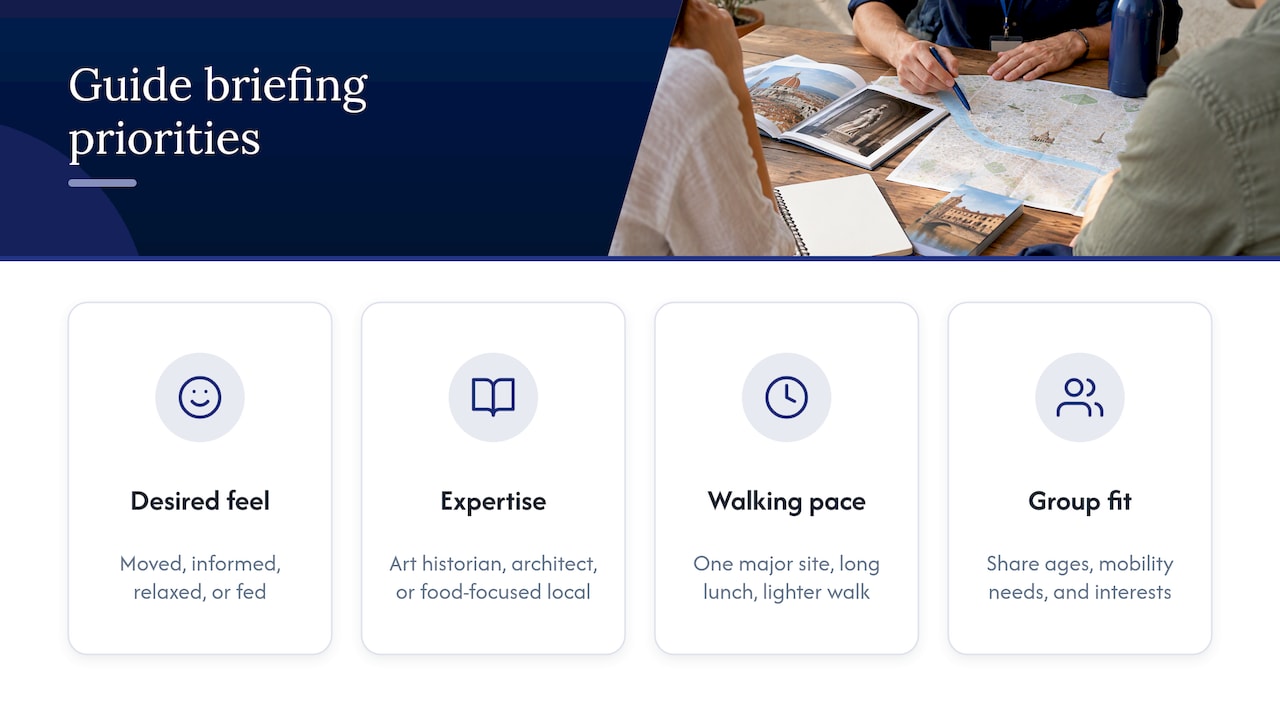
What do you want to feel at the end of the day? Moved, informed, relaxed, fed? An art historian suits a Uffizi morning. A guide who trained as an architect is better for the dome and the city’s urban design. A food-focused local suits the market and the Oltrarno.
How much walking is realistic? Florence is flat but cobbled, and a full day in museums is exhausting. A realistic plan is one major site in the morning, a long lunch, and a lighter afternoon walk. Overpacking a day is the most common mistake.
Who is in the group? A couple celebrating an anniversary wants something different from three generations traveling together. Tell your guide ages, mobility needs and interests in advance so the route and the pacing fit.
What time of year are you visiting? Summer heat and crowds argue for early starts and indoor afternoons. Winter and shoulder seasons allow slower, more outdoor itineraries.
Themes that work well
- Renaissance essentials: the Duomo, Piazza della Signoria and the Uffizi, ordered so the story builds.
- Michelangelo in depth: the Accademia, the Medici Chapels and San Lorenzo, plus the Piazzale Michelangelo view.
- Hidden Florence: workshops, small churches and quiet courtyards away from the main flow.
- Food and wine: market tastings and a trattoria lunch. For ideas on enjoying local food experiences well, the principle is the same anywhere: go with someone who knows what is worth ordering.
- Tuscan countryside: Chianti, Siena and a winery day. We have written a separate guide on how to plan a private Tuscany wine tour.
Planning the big three: Duomo, Uffizi and Accademia
These are the sites most travelers want a guide for, and they are also the ones where timing and tickets decide the day.
The Uffizi and the Accademia
Both museums sell timed entry. According to Visit Tuscany, booking through the official website carries an additional 4 euro fee on any type of ticket. Reserving ahead is how you avoid the long walk-up lines, especially from spring through early autumn.
A private guide builds the visit around your slot. For the Uffizi, a sensible plan is ninety minutes to two hours, concentrated on the early Renaissance rooms, Botticelli’s mythological paintings and a handful of High Renaissance masterpieces. Trying to see every room is how people end up numb by the second corridor. For the Accademia, the museum is small, so a guide can cover the David, the Prisoners and the context of the sculpture in under an hour, leaving the rest of the morning free.
The Duomo complex
Entering the cathedral itself is one thing. Climbing the dome, the bell tower or entering the Baptistery and museum requires a separate paid ticket under the cathedral complex’s pass system, sold through the cathedral’s official ticketing channel. Dome entry is on a timed slot, and the climb is a narrow staircase of several hundred steps, so it is not suited to every traveler. A guide can tell you the history of the dome’s construction at the base and then let you climb at your own pace, or choose the bell tower for a more open view.
A sample day
| Time | Plan | Why it works |
|---|---|---|
| 8:30 | Duomo and dome, with guide | Early slot, lighter crowds, cooler climb |
| 11:00 | Coffee and walk to Piazza della Signoria | Gentle transition, context for the Medici |
| 12:00 | Uffizi, focused visit | Timed ticket, curated route |
| 14:00 | Long lunch | Rest before the afternoon |
| 16:00 | Oltrarno stroll or free time | Light finish, sunset at the river |
The Accademia works as a second morning, or as a late-afternoon slot when it is quieter.
Private tours for families
Florence can be wonderful with children if the tour is built for them, and rather draining if it is not.
- Shorten the blocks. Two hours of guided time with a break works better than a four-hour marathon.
- Make it a story. Guides who work with families turn the Duomo into a puzzle about how the dome was built, or the Palazzo Vecchio into a hunt for secret passages and faces in the stone.
- Plan the sensory breaks. Gelato, a carousel at Piazza della Repubblica and a picnic by the river reset energy faster than any lecture.
- Mind the climbs. The dome stairs are narrow and steep, so consider the bell tower or a ground-level focus for small children.
- Choose the right museum. The Accademia is often easier for kids than the Uffizi because it is compact and the David is an instant draw.
Tell your planner the children’s ages when you request the guide. It affects which guide, which sites and how long the day lasts.
What a private tour costs and what it should include
Private guide pricing in Florence is set by the guide or the supplier and depends on duration (half day or full day), group size, language, the type of tour and whether it is combined with transport. Day trips outside the city cost more than city walks because of vehicle and time.
What matters more than the headline number is what it covers. Ask for a written breakdown that states:
- the guide’s fee and how many hours it covers;
- whether museum and monument tickets are included, or paid separately, and who books them;
- any reservation surcharges, which at the Uffizi and Accademia add 4 euros per ticket when booked officially;
- transport, if the day goes beyond the city center;
- gratuities, meals and tastings;
- what happens if you are late, or if the weather turns.
With Elite Travel you pay no service fees, and we back our trips with a price match guarantee, so when we put a Florence guide into your itinerary you see the whole picture in one place rather than a patchwork of separate quotes. We earn from the travel suppliers for booked travel, not from a fee on you.
What to confirm before you book
Use this list with any guide or any planner.
- License and name. Confirm the guide is an official tourist guide, and ask for the name.
- Language and style. Fluent English is a minimum. Ask whether the guide has experience with your type of group, such as families, honeymooners or first-timers.
- Duration and start point. Agree the meeting location and the exact hours.
- Group size. A private tour means your party only. Confirm no one else joins.
- Tickets. Who buys them, what time slots, and whether the cost is in the price.
- Accessibility. Mention mobility needs, strollers or limited stamina in advance.
- Itinerary. Request a draft route with timings, and make sure there is slack between sites.
- Cancellation and weather. Understand refund terms and what a rescheduled day looks like.
- Payment. Know the deposit, the balance due date and the payment method.
- Contact on the day. Have a phone number that works if you are lost or delayed.
That last point is where we put real weight. We are open 24/7, because a delayed flight or a missed meeting point does not wait for office hours.
Fitting the guide into the whole trip
The guide is a few hours of a trip that also includes a hotel, transfers, dinners and probably a day or two outside the city. Sequencing matters. A morning Uffizi slot the day after a transatlantic flight is a poor idea. A Chianti day right after a late dinner is a long one.
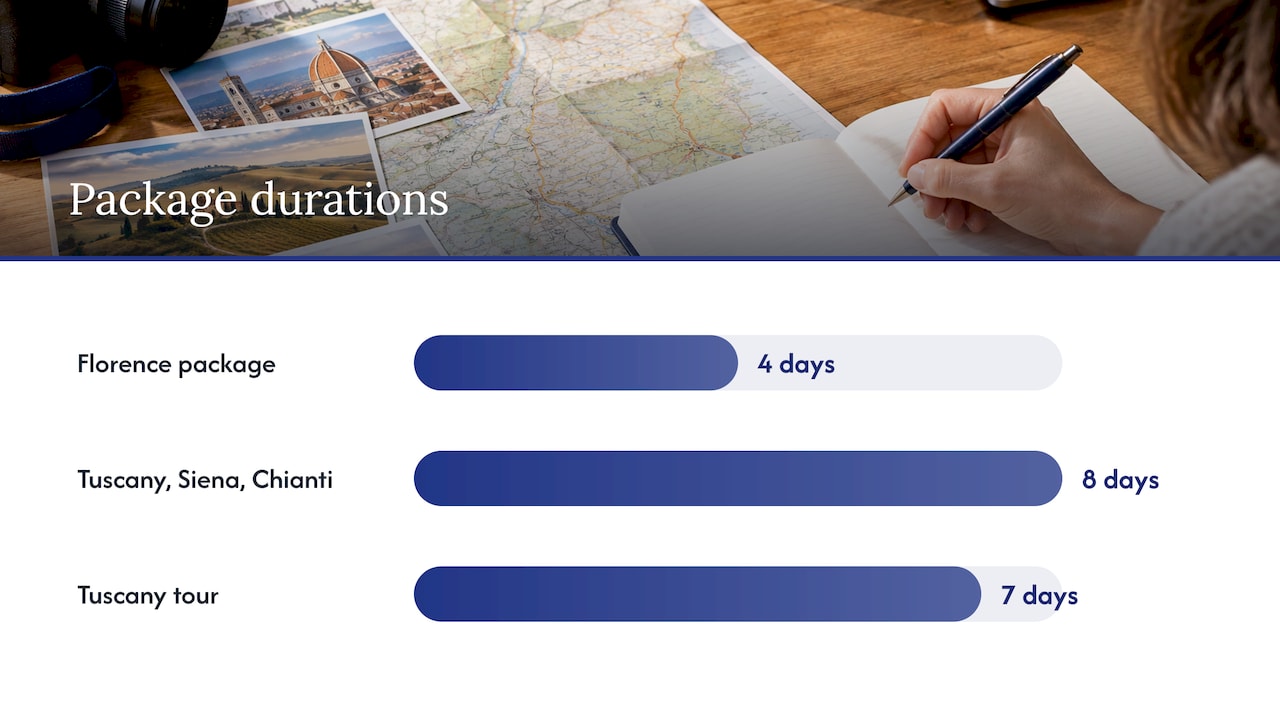
Our Florence itineraries are built so the pacing makes sense. If you want a structured starting point, look at our 4 day Florence vacation package, the longer Tuscany, Siena and Chianti 8 day package, or the 7 day Tuscany tour. Each can be customized, including the guiding. If Italy is a longer trip for you, our Rome private guides playbook covers the same questions for the capital, and our comparison of Tuscany and Umbria helps if you are still choosing a region.
Our perspective
We have spent 35 years designing high-end journeys, and in Italy the lesson is consistent: the guide makes or breaks a day, but only if everything around the guide is already handled.
A brilliant art historian cannot fix a missed ticket slot, a transfer stuck in traffic or a schedule that puts a four-hour museum visit straight after an overnight flight. That is why we treat a private guide as one decision inside a larger plan. We know the destinations and we know the right on-the-ground partners, so the guide, the hotel, the driver and the dinner reservation are matched to the way you like to travel.
We also think travelers deserve to see the full cost without surprises. We charge no service fees, we offer a price match guarantee, and we are available around the clock. For a first Florence trip, a honeymoon, a milestone birthday or a multigenerational holiday, that means you spend your time standing in front of the David, not solving logistics.
tammylevent@gmail.com
Plan your Florence days with Elite Travel
If you want a private guide in Florence without piecing together tickets, transfers and hotels yourself, our team designs customized itineraries around your interests, your group and your calendar. Explore our Florence vacation packages or start with our luxury vacation packages, and we will build the days with you.

Celebrating something special? We also plan honeymoons and destination weddings in Tuscany and across Europe.
FAQ
Is a private guide in Florence worth it?
For first-time visitors and anyone who wants to understand what they are seeing, yes. A private guide shapes the day around your interests, keeps you moving through timed entries and adds the stories that make the art memorable. It is especially valuable at the Uffizi, the Accademia and the Duomo complex, where context matters and time is limited.
How do I know a Florence guide is legitimate?
Ask for the guide’s name and confirm that they are an official tourist guide. The City of Florence maintains a list of authorized and qualified guides, and the local guides’ association admits only licensed professionals. A planner who knows the local partners can also handle this check for you.
Do private tours include museum tickets?
It depends on the arrangement, so ask for it in writing. Tickets are often sold separately, and booking officially for the Uffizi or Accademia adds a 4 euro reservation fee per ticket. The Duomo dome requires its own paid pass.
How long should a private tour in Florence be?
Two to three hours suits a single major site or a focused neighborhood walk. A half day of about four hours can combine a museum with a short city walk. Full days work best when they include a long lunch and a lighter afternoon, and are better for travelers with high stamina.
Can I take children on a private tour?
Yes, and it often works better than a group tour because the pace and stories can be adapted to their ages. Keep guided blocks short, build in gelato and playground breaks, and tell your planner the children’s ages so the route avoids steep climbs where needed.
Sources
- Guided tours, experiences, itineraries | FeelFlorence
- AGT for Guides, Florence Tourist Guides Association
- Uffizi and Accademia: tickets and booking | Visit Tuscany
- How to Enjoy Local Food Experiences Like a Pro
