




TL;DR:
- /7 travel assistance provides real-time support during emergencies, unlike insurance that reimburses after the event. It covers medical, logistical, security, and document recovery needs, handling multiple issues simultaneously. Travelers should proactively save hotlines, share itineraries, and understand that assistance complements insurance by actively protecting safety and trip continuity.
24/7 travel assistance is a real-time, round-the-clock support service that connects travelers with live experts during emergencies, disruptions, and logistical crises anywhere in the world. Unlike travel insurance, which pays you back after something goes wrong, travel assistance services intervene while the problem is happening. Providers like ATPI, TravelInsured, and Safe Harbors Corporate Travel Management operate dedicated support centers staffed around the clock, covering everything from emergency medical referrals to flight rebooking and lost passport recovery. If you have ever been stranded at midnight in a foreign airport with no idea who to call, this is exactly the service that changes that outcome.
What is 24/7 travel assistance and what does it cover?
24/7 travel assistance is defined by the industry as a non-insurance logistical service that provides active, real-time intervention during a travel event. That distinction matters. Insurance reimburses you after the fact. Assistance coordinates the solution in the moment.
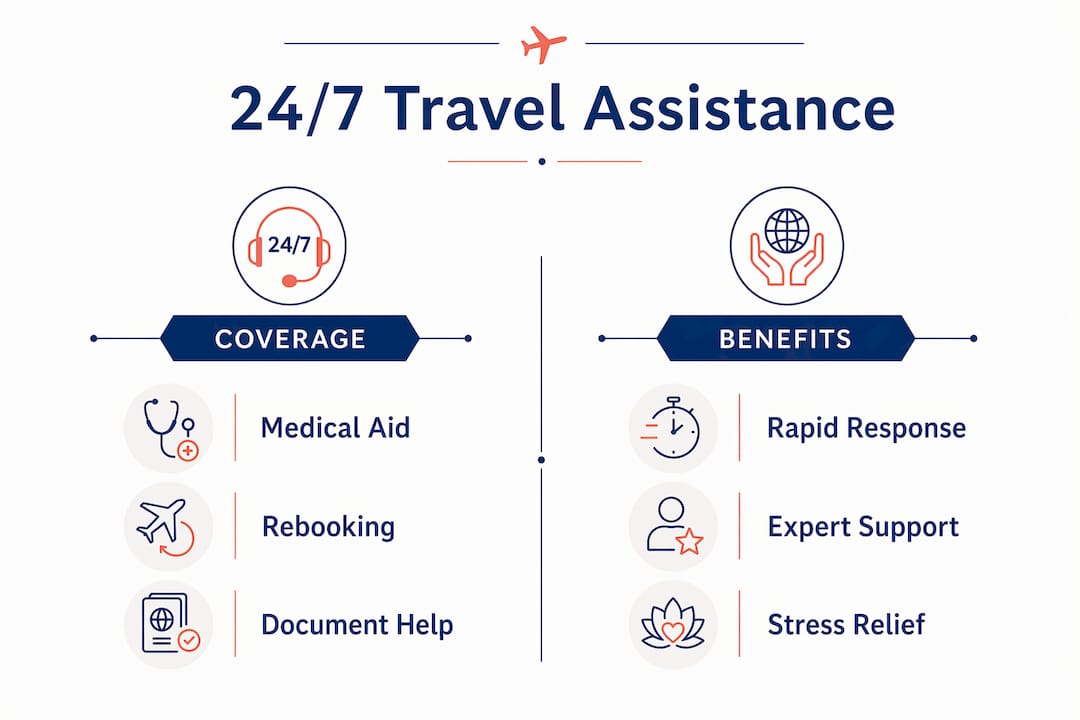
The scope of services is broader than most travelers expect. A quality travel assistance program covers:
- Medical emergencies: Referrals to vetted local physicians, hospital coordination, prescription refill support, and emergency medical evacuation
- Flight disruptions: Emergency rebooking during cancellations, missed connections, and weather delays
- Document recovery: Guidance and coordination for lost passport support and emergency replacement documents
- Security and political situations: Evacuation support and real-time risk alerts during unrest
- Legal and visa assistance: Connecting travelers with local legal resources and visa coordination, which requires deep supplier networks
- Personal logistics: Hotel rebooking, ground transportation, and family notification services
The breadth of this coverage reflects a core truth: travel emergencies rarely fit a single category. A medical crisis in Bangkok can simultaneously require a hospital referral, a flight change, and a hotel extension. Round-the-clock travel help handles all three at once.
Pro Tip: Save your travel assistance hotline number in your phone before departure, not after. Searching for it during a crisis costs you time you may not have.

The main value of 24/7 support is stress reduction through rapid, expert coordination in situations where travelers lack local knowledge. That is the service’s defining purpose.
How does 24/7 travel assistance differ from travel insurance?
Travel assistance and travel insurance are complementary services, not the same product. Confusing them is one of the most common and costly mistakes travelers make.
The table below shows the core differences:
| Feature | 24/7 Travel Assistance | Travel Insurance |
|---|---|---|
| Response type | Active, real-time intervention | Reactive, claim-based reimbursement |
| Timing | During the event | After the event |
| Human element | Live agents, medically trained staff | Claims adjusters, paperwork |
| Scope | Logistical, medical, security coordination | Financial compensation |
| Proactivity | Yes, monitors and intervenes | No, waits for a filed claim |
Reliable assistance centers are staffed by medically trained professionals who provide accurate initial advice and coordinate care in real time. An insurance policy cannot tell you which hospital to go to at 2 a.m. in Lisbon. A trained assistance agent can.
The practical implication is clear: travel insurance protects your money, while travel assistance protects your trip and your safety. Travelers who carry both are covered on both fronts. Those who carry only insurance may find themselves reimbursed weeks later for a crisis they had to navigate alone.
Pro Tip: When comparing travel packages, check whether 24/7 assistance is included or sold separately. Many premium travel programs bundle both, which is the stronger option for international trips.
Experts at Hickory Global Partners note that 24/7 human support is non-negotiable precisely because digital platforms cannot replicate complex decision-making during emergencies. A chatbot cannot negotiate a last-minute hospital admission. A trained agent can.
How do you access and use 24/7 travel assistance effectively?
Knowing the service exists is not enough. How you access it under pressure determines whether it actually helps you.
Most providers offer multiple contact channels including phone hotlines, email, and mobile apps, so travelers can reach support from anywhere with any device. AXA Travel Insurance, for example, routes travelers through a triage system that identifies urgency level and connects them to the right specialist within minutes.
Here is how to prepare before you travel and respond effectively when something goes wrong:
- Save the hotline in multiple places. Store it in your phone, print it, and note it in your travel app. Experts at Safe Harbors recommend keeping contacts accessible in at least three locations to avoid delays during a crisis.
- Share your itinerary with your provider. Many platforms use itinerary visibility to monitor your travel in real time, flagging disruptions before you even notice them.
- Know your tier of service. Premium and VIP tiers use supplier relationships for faster resolutions and exclusive benefits beyond standard rebooking. If you are a luxury traveler, confirm whether your program includes concierge-level access.
- Use the app for routine requests. Smart technology triages routine requests while trained agents handle complex interventions requiring judgment and compassion. Let the app handle flight status; call a human for a medical emergency.
- Call early, not late. Contact your assistance provider the moment a situation develops. Waiting until a problem is fully escalated limits the options available to your agent.
The technology integration behind modern assistance programs is more advanced than most travelers realize. Platforms like Navan use smart triage systems that route requests based on urgency, location, and traveler profile. That means faster, more personalized support from the first contact.
What real problems does 24/7 travel assistance solve?
The value of emergency travel assistance becomes concrete when you look at the types of situations it resolves every day.
Flight cancellations and missed connections are the most common trigger. A traveler connecting through Frankfurt during a winter storm faces a cascade of problems: a missed flight, a lost hotel booking, and a meeting the next morning. A 24/7 assistance team handles the rebooking, secures a hotel, and confirms the new itinerary in a single call.
Medical emergencies abroad are the highest-stakes scenario. A traveler who falls ill in a country where they do not speak the language needs a vetted hospital referral, a translator, and potentially an air evacuation. These are not tasks a traveler can manage alone at midnight.
Lost or stolen documents create a different kind of crisis. Replacing a passport in a foreign country involves local consulates, police reports, and emergency travel documents. Assistance teams coordinate document recovery by connecting travelers with the right local resources immediately.
Weather delays and natural disruptions require fast rebooking across multiple carriers and hotels. The speed of response here is measurable. ATPI, one of the leading corporate travel management firms, reports 56-second call answer times during global disruptions. That response speed is the difference between catching the last available seat and sleeping on an airport floor.
| Situation | Assistance Response | Outcome |
|---|---|---|
| Flight cancellation | Emergency rebooking across carriers | Traveler rerouted same day |
| Medical emergency | Hospital referral, evacuation coordination | Care secured within hours |
| Lost passport | Consulate coordination, emergency docs | Travel resumed within 48 hours |
| Weather delay | Hotel and rebooking secured | Traveler comfortable and informed |
The pattern across all these scenarios is the same: the traveler does not have to figure it out alone. That is the product. That is what you are paying for.
Key takeaways
24/7 travel assistance is the most critical safety net a traveler can carry because it provides active, real-time coordination during emergencies that insurance cannot resolve in the moment.
| Point | Details |
|---|---|
| Assistance vs. insurance | Assistance intervenes during an event; insurance reimburses you after it ends. |
| Scope of coverage | Services include medical, logistical, security, document, and legal support around the clock. |
| Access preparation | Save hotline numbers in three locations before departure to avoid delays during a crisis. |
| Technology and human balance | Use apps for routine requests; call a trained agent for complex or medical emergencies. |
| Response speed matters | Top providers like ATPI answer calls in under 60 seconds during global disruptions. |
Why i think travelers still underestimate this service
Most travelers I work with have heard of travel insurance. Very few have thought carefully about travel assistance until they needed it and did not have it.
The gap in understanding is real. People assume that having insurance means having support. Those are two different things. Insurance is a financial product. Assistance is a human service. When you are in a hospital in a country where you do not speak the language, you do not need a claims form. You need someone who knows the local medical system, speaks the language, and can make calls on your behalf at 3 a.m.
What I have observed over years of working with travelers is that the complexity of international travel has grown faster than most travelers’ awareness of the risks. Flight networks are more interconnected, which means a single disruption in one hub ripples across an entire itinerary. Political situations shift quickly. Medical systems vary wildly by country. None of that is manageable through a mobile app alone.
The expert travel advisors who deliver the best outcomes in these situations combine deep destination knowledge with real supplier relationships. That combination is what makes the difference between a crisis resolved in two hours and one that takes two days. Digital platforms are useful for routine tasks. They are not equipped for the judgment calls that real emergencies require.
My honest recommendation: treat 24/7 travel assistance as a non-negotiable part of your travel planning, not an optional add-on. The cost of not having it shows up exactly once, at the worst possible moment.
How Elitetravelgroup delivers round-the-clock travel support
Elitetravelgroup is open 24/7 because travel emergencies do not follow business hours. Every client who books with Elitetravelgroup has direct access to real travel experts at any hour, whether they are managing a disruption in Rome or a last-minute change in Phuket.

Elitetravelgroup specializes in luxury adventure travel packages, Europe vacation packages, destination weddings, and VIP experiences, all built with concierge-level support woven into every detail. Clients never navigate a crisis alone. From the first itinerary conversation to the moment you return home, Elitetravelgroup provides the kind of worry-free travel support that turns a potential disaster into a minor inconvenience. No service fees. No guesswork. Just real expertise, available whenever you need it.
FAQ
What is the difference between travel assistance and travel insurance?
Travel assistance provides real-time, active intervention during a travel emergency, while travel insurance reimburses financial losses after the event. Both serve different functions and work best when used together.
How does 24/7 travel assistance work in a medical emergency?
A trained agent connects you with vetted local physicians or hospitals, coordinates care, arranges translation if needed, and manages medical evacuation when required. The goal is to get you the right care as fast as possible.
What contact channels do travel assistance providers use?
Most providers offer phone hotlines, email, and mobile apps, so you can reach support from any device in any location. Phone is recommended for urgent or complex situations requiring immediate human judgment.
Do i need 24/7 travel assistance if i already have travel insurance?
Yes. Insurance covers financial reimbursement after a claim is filed. Assistance coordinates the actual solution during the event, including rebooking, medical referrals, and document recovery, which insurance policies do not provide.
How do i prepare to use travel assistance before my trip?
Save the provider hotline in your phone, print a copy, and store it in your travel app before departure. Share your full itinerary with your provider so they can monitor disruptions and reach you proactively if needed.
