



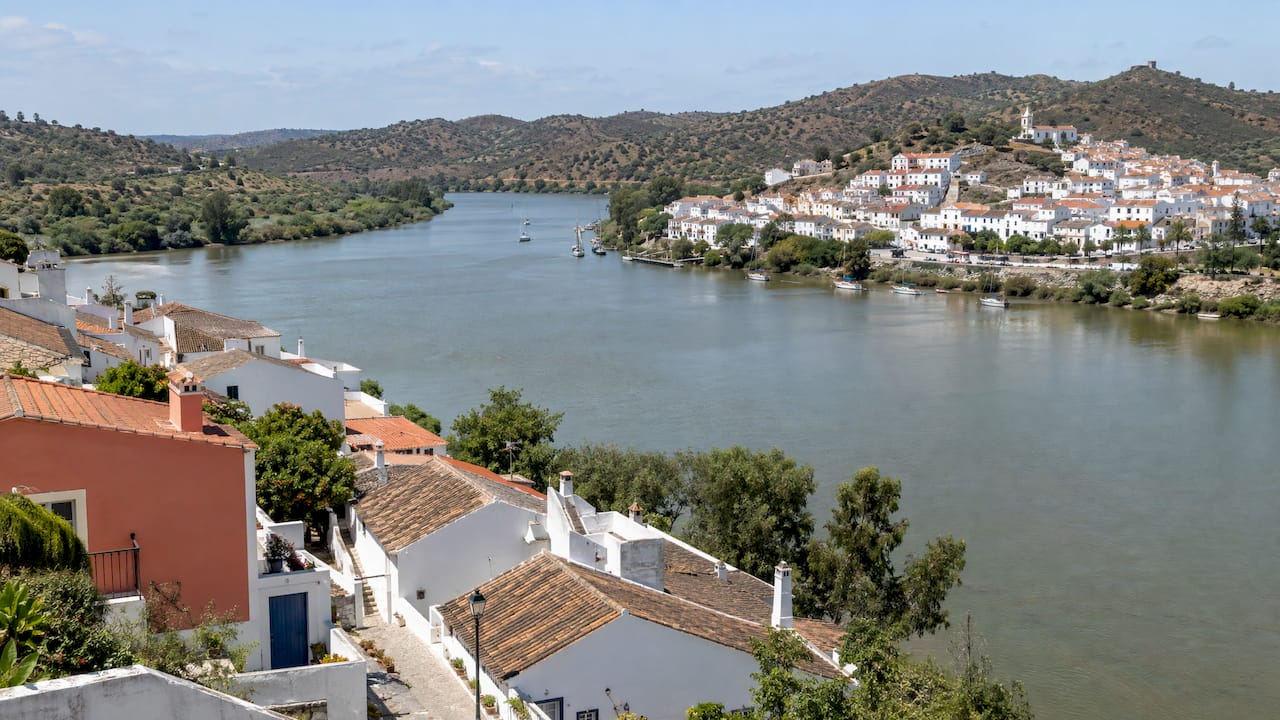
Choose Spain if you want variety, big cities, festivals and a late-night food culture. Choose Portugal if you want a slower pace, Atlantic coastline, wine country and a trip that is easy to cover in a week. Spain is the larger and more varied country, and Portugal is the more compact and intimate one. Many travelers with ten days or more combine them. Below, we compare the two on what actually shapes a luxury trip: geography, cost, culture, food, safety and the kind of celebration you are planning.
TL;DR
- Pick Portugal for a relaxed, coastal, wine-and-seafood trip of 7 to 10 days, with Lisbon, Sintra, Porto and the Douro Valley close together.
- Pick Spain for breadth: Madrid, Barcelona, Andalusia and the Basque coast reward 8 to 12 days or more.
- Costs: Spain’s restaurant prices run about 17% higher than Portugal’s, so your budget stretches further in Portugal, though hotel choices decide the final figure.
- Ten days or more? Consider both, starting in Portugal and finishing in southern Spain.
- Honeymoons, milestone trips and groups work well in either country when the hotels, guides and timing are arranged by someone who knows the ground.
Table of Contents
- Size and geography: why trip length matters
- Climate and the best time to go
- Coastlines and beaches
- What it costs: Portugal vs. Spain
- Landmarks and culture
- Food and daily rhythm
- Safety and what U.S. travelers should know
- Which is better for your type of trip?
- How to combine Portugal and Spain
- Plan your Portugal or Spain journey with Elite Travel
- FAQ
- Sources
Size and geography: why trip length matters
The biggest practical difference is scale. Spain is far larger than Portugal, so it holds more regions with distinct identities: Catalonia, Andalusia, the Basque Country and the Canary Islands, among others. Mainland Portugal, by contrast, is 218 kilometers wide and 561 kilometers long, with 832 kilometers of Atlantic coast, and offers an unusual range of landscapes a short distance apart.
That compactness changes how you plan. In Portugal you can sleep in Lisbon, spend a day in Sintra, then reach Porto and the Douro without long, tiring transfers. In Spain, a single week usually means choosing one region or two cities. Trying to see Madrid, Barcelona and Andalusia in seven days leaves you in transit more than in the places you came for.
A workable rule of thumb from our planning experience:
| Trip length | Portugal | Spain |
|---|---|---|
| 5 to 7 days | Lisbon, Sintra and Porto | One region, such as Andalusia, or Madrid plus one city |
| 8 to 10 days | Add the Douro Valley, plus a coastal stay | Barcelona, Madrid and the south at a measured pace |
| 11 days or more | Add the Algarve, Alentejo or the islands | Add the Basque coast or the Canary Islands |
| 10 days or more, both countries | Begin in Lisbon and Porto | Finish in southern Spain |
If you want to see how a well-built route looks, our Portugal vacation packages and Spain vacation packages pages show the destinations we design around.
Climate and the best time to go
Both countries have Mediterranean-influenced climates, but they behave differently. Portugal’s climate varies by region and is shaped by relief, latitude and distance from the sea. According to Turismo de Portugal, coastal temperatures are slightly lower in summer, while inland areas are hot and dry, and northern and inland winters are colder. Madeira stays mild year-round, averaging about 24°C in summer and 19°C in winter.
Spain’s size makes its weather swing more widely from one region to the next. The south and the islands stay mild in winter, while the north is cooler and wetter. Inland Spain, especially Andalusia, gets very hot in July and August. If you are traveling in peak summer, Portugal’s Atlantic coast is the gentler option, and in Spain you will want to plan around the heat with early mornings, long lunches and pool afternoons.
Spring and fall are the sweet spots for both. Sightseeing is comfortable, crowds are thinner, and restaurants and hotels have more availability for the room categories you actually want.
Coastlines and beaches
Spain has more total coastline, but Portugal’s smaller size means you reach the sea quickly from almost anywhere. Lonely Planet’s editors point to Portugal for wild Atlantic beaches, solitude and the Douro vineyards, while Spain brings a wider mix: Mediterranean resorts, the Basque coast and the volcanic landscapes of the Canary Islands.
For travelers who like to arrive in style, coastal access matters beyond the beach itself. Readers who fly privately will find the coastal airport advantage explains why airports near the water are so useful for reaching resorts quickly. Both Iberian countries have plenty of coastal airports, which is one reason a beach stay slots easily into a longer itinerary.
What it costs: Portugal vs. Spain
Portugal generally costs less. Numbeo’s November 2026 comparison reports that restaurant prices in Spain are 17.2% higher than in Portugal, and consumer prices excluding rent are 5.2% higher.
Those are everyday-price differences, and a luxury trip is shaped more by other things:
- Hotel category and location. A palace hotel in Sintra and a design hotel in Madrid are priced by season and room type, not by the national average.
- Number of transfers. Moving every two nights costs money and energy. A compact Portugal route usually has fewer.
- Experiences. Private guides, wine estate visits, chef’s tables and boat days are priced individually.
- Season. Summer in the popular cities costs more everywhere.
The fair way to compare is like for like: the same dates, number of nights, room type and meal style. Be aware too that Lisbon and Porto have become pricier as tourism has grown, so Portugal’s advantage is real but smaller than it once was.
One point on our side of the desk: we do not charge service fees, and we offer a price match guarantee, so the planning expertise does not add a line to your bill. We earn from the travel suppliers for booked travel. You can read more about the range we arrange on our luxury vacation packages page.
Landmarks and culture
Spain wins on sheer number of headline sights. Lonely Planet counts 49 UNESCO World Heritage sites in Spain against 17 in Portugal. Spain brings the Alhambra, Gaudí’s works in Barcelona, world-class museums such as the Prado in Madrid, flamenco and a calendar of festivals. Portugal’s strengths are the palaces of Sintra, tiled streets, the river and wine landscapes of the north, and fado, the Portuguese music of longing, heard best in a small room in Lisbon.
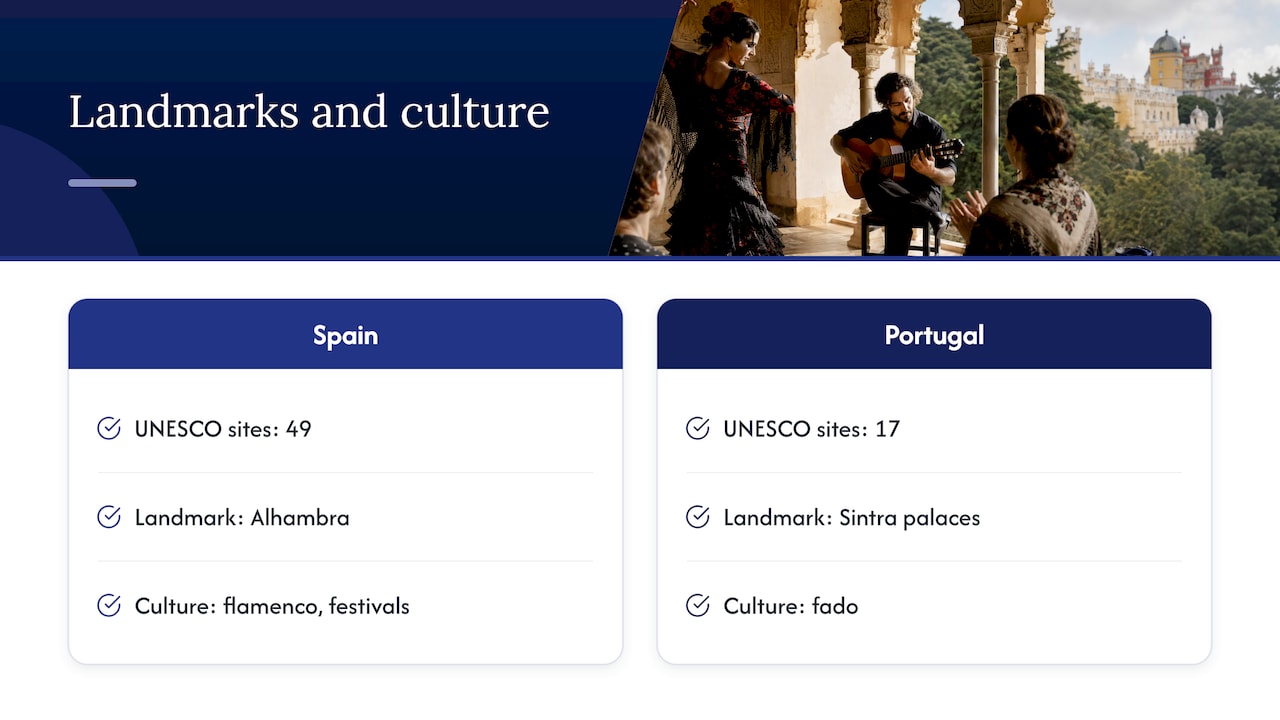
A useful way to think about it: Spain is a country of big, high-energy set pieces, and Portugal is a country of atmosphere. Spain rewards a first Iberian visit because there is so much to see. Portugal tends to appeal to those who want to slow down, or who have already seen Spain.
City by city
- Lisbon is hilly, walkable and sunlit, with excellent seafood and easy day trips. See our Lisbon vacation packages.
- Porto and the Douro pair a river city with terraced vineyards, and port wine cellars and estate lunches are the draw. Explore Porto and the Douro Valley.
- Madrid is the capital of art, late dinners and grand hotels: our Madrid packages are built around it.
- Granada gives you the Alhambra and the Moorish south: see Granada.
- Valencia offers a sunny Mediterranean city with rice dishes and modern architecture: see Valencia.
Food and daily rhythm
Spain’s food culture is social and late. Dinner often starts well after 9 p.m., tapas move you from bar to bar, and each region has its own cuisine, from Basque pintxos to Andalusian fried fish. Spain’s official tourism material encourages visitors to explore urban markets for food and a chance to mingle with locals. San Sebastián is known for its Michelin-starred dining, according to Lonely Planet.

Portugal runs on a gentler clock. Seafood is the center of the table, from grilled fish to salt cod in its many forms, and the pastry shops are a pleasure in their own right. Port from the Douro and the table wines of the Alentejo round out the experience. If your ideal day is a long lunch and an early evening, Portugal suits you. If it is a late dinner and a night out, Spain does.
Safety and what U.S. travelers should know
Both countries are popular with American visitors and are generally considered very safe for tourists, with low rates of violent crime. As with any major European city, petty theft in crowded areas such as transit hubs and tourist sights is the realistic risk, so keep valuables secure and be alert in crowds.
For official guidance, check the U.S. Department of State. As of August 2026, it classifies Spain at Level 2, advising travelers to exercise increased caution because of terrorism and unrest. Check the advisory pages for both countries and confirm passport and entry requirements before you book, because they can change.
Which is better for your type of trip?
This is the question that matters most, and the answer depends on who is traveling and why.
| Your trip | Better fit | Why |
|---|---|---|
| First trip to Iberia | Spain | More sights, more variety, more to talk about afterward |
| Slow, restful luxury | Portugal | Compact routes, fewer transfers, a calmer rhythm |
| Honeymoon | Either | Portugal for wine, coast and privacy; Spain for Andalusian romance and city energy |
| Food-focused trip | Spain, with Portugal for seafood | Regional cuisines and tapas culture |
| Wine lovers | Portugal | The Douro Valley and its estates |
| Multigenerational family | Either | Spain for variety, Portugal for easy distances |
| Milestone celebration | Either | Choose the venue and the mood first, then the country |
| Group trip | Either | Spain for big-city energy, Portugal for a boutique feel |
| 10 days or more | Both | Begin in Portugal and finish in southern Spain |
A few notes behind the table.
Honeymoons. Portugal offers privacy and scenery: a quinta in the Douro, a coastal stay, a private boat on the Tagus. Spain offers drama: the Alhambra at dusk, a sherry-and-flamenco night in Andalusia. For ideas, see our honeymoon vacation packages and our guide to luxury romantic getaways.
Families. Portugal’s short distances help with children and grandparents. Spain’s variety helps when ages and interests differ: beaches, castles, cities and theme-worthy experiences all in one country.
Groups and celebrations. The right choice is usually dictated by the venue and the group size. Our approach to group travel is to build the itinerary around what the group wants to feel, not a fixed template.
How to combine Portugal and Spain
With ten days or more, a combined trip can be the best answer. A practical sequence is to begin in Portugal and end in southern Spain: Lisbon and Sintra first, then Porto and the Douro, then a flight or a private transfer to Seville or Granada. Ending in Andalusia gives your trip a dramatic finish.
Three principles keep a two-country trip comfortable:
- Stay at least two or three nights in each major city. One-night stops turn a vacation into a series of check-outs.
- Limit the number of bases. Three or four hotels in ten days is plenty.
- Plan the border crossing deliberately. A private transfer or a well-timed flight avoids a lost day.
Our perspective
After 35 years designing high-end journeys, we have learned that the Portugal-or-Spain question is rarely about the countries. It is about the traveler. Someone who wants to feel the energy of a great city at midnight and someone who wants a vineyard terrace at sunset are both right, and they are choosing different countries.
What we do is make either choice feel effortless. We know the destinations, we know the on-the-ground partners, and we know which hotel, which guide and which month will turn a good trip into an exceptional one. We design each itinerary one on one, with a concierge-level approach, and we are available around the clock because travel does not wait for office hours.
If you cannot decide, tell us what you want to feel on the trip. We will propose a route, whether it is Portugal, Spain or both, and refine it with you until it is right.
tammylevent@gmail.com
Plan your Portugal or Spain journey with Elite Travel
If you are weighing the two countries for a honeymoon, a family reunion, a milestone birthday or a group escape, we can build the itinerary around your dates and your style. We design customized luxury trips with concierge-level service, charge no service fees, offer a price match guarantee and are open 24/7.
Start a conversation with us through our luxury vacation packages page, or visit Elite Travel to tell us about your trip.
FAQ
Which is better, Spain or Portugal?
Neither is better in general. Spain is better for a first Iberian trip, with more sights, regional variety and nightlife. Portugal is better for a slower, coastal, wine-focused trip that is easy to cover in a week. Your travel style decides it.
Is Portugal cheaper than Spain?
Generally yes. Numbeo’s November 2026 data shows restaurant prices about 17% higher in Spain. On a luxury trip, your hotel category, transfers and private experiences affect the total more than national averages do.
How many days do I need for Portugal or Spain?
A week covers Lisbon, Sintra and Porto comfortably in Portugal. Spain rewards about ten days or more because its regions are far apart. Combining both countries works best with at least ten days.
Is Spain safe for American travelers?
Spain is a very popular destination for U.S. visitors. The State Department currently lists it at Level 2, meaning increased caution. Check the advisory before you book and watch for petty theft in crowded places.
Sources
- Turismo de Portugal: About Portugal
- Lonely Planet: Portugal vs Spain
- Numbeo: Cost of living comparison, Portugal and Spain
- U.S. Department of State: Spain travel advisory
- Spain.info: España tourism brochure
- Bluebird: The coastal airport advantage
