

The most reliable way to lock in a Michelin reservation in Paris is to check the restaurant’s own booking page first, then layer in third-party platforms, timed alerts for release windows, and a waitlist request in parallel. For the handful of tables everyone wants, a concierge or luxury travel agency with existing relationships usually beats even the fastest human on a keyboard. The rest of this guide walks through exactly how each of those pieces works, restaurant by restaurant.
TL;DR:
- Reservation slots at Paris’s top restaurants can fill within seconds of opening, making timing and quick action crucial.
- Confirm the exact opening times in Central European Time and prepare multiple devices and browsers to increase booking chances.
- Using a hotel concierge or a luxury travel agency often provides access to preferred tables through established relationships, especially for high-demand reservations.
- Online booking windows vary from three weeks to nearly a year, requiring early planning and vigilance for in-demand restaurants.
- Third-party platforms supplement direct reservations but cannot replace the effectiveness of personalized relationships or insider connections.
Table of Contents
- Which Booking Channels Actually Work for Michelin Reservations in Paris?
- How Do You Get a Table at the Hardest Restaurants to Book?
- Should You Use a Hotel Concierge or a Travel Agency for Reservations?
- What’s the Ideal Timeline for Booking a Michelin Table in Paris?
- Do Credit Cards or Loyalty Programs Help With Reservations?
- Is It Legal and Ethical to Use a Booking Agent or Concierge?
- What Elite Travel Has Learned From Booking Impossible Tables
- Let Elite Travel Handle Your Paris Reservations
- Sources
Which Booking Channels Actually Work for Michelin Reservations in Paris?
Start with the restaurant’s own digital reservation system. Most Michelin-starred houses in Paris link directly to their reservation system from the homepage, and that link is the authoritative source for release times, party-size limits, and cancellation policy. The Michelin Guide’s Paris directory is the fastest way to confirm current star status and find that official contact point, since restaurants gain, lose, and regain stars every year.
Third-party platforms fill the gap when a restaurant doesn’t run its own system. Many Michelin-starred spots in Paris, including hotel-anchored dining rooms like Le Meurice Alain Ducasse, post live availability on OpenTable, and similar reservation networks operate for smaller bistronomic addresses too. These platforms are worth checking daily rather than once, since cancellations post in real time.
Phone calls and emails still matter, especially for restaurants that intentionally keep a portion of their book off any digital platform. And for guests staying at a full-service hotel, the concierge desk should often be the very first call, not the last resort.
A few practical rules for choosing a channel:
- Confirm the restaurant’s current star rating before you build plans around it. Guide updates happen annually and status changes fast.
- Use the official site whenever one exists. It is the only channel guaranteed to reflect real-time inventory.
- Treat third-party platforms as a supplement, not a replacement, for the restaurant’s own system.
- Call ahead if a restaurant’s site says reservations are “by phone only.” Many two- and three-star rooms in Paris still operate this way.
How Do You Get a Table at the Hardest Restaurants to Book?
Rolling booking windows are the mechanic behind almost every “impossible” reservation in Paris. A restaurant opens a new day of availability on a fixed schedule, often three weeks out, and that day’s slots can vanish in under a minute once the window opens. Septime, one of the city’s most requested tables, releases reservations exactly three weeks ahead at 10:00 AM CET, and The Infatuation has documented that slots there disappear almost as fast as they appear. Other houses run on entirely different clocks. Some hotel-linked dining rooms open a 90-day window, while a marquee tasting-menu destination like Plénitude may require many months of lead time, including up to nearly a year or more or a spot on a running waitlist.
Statistic Callout: Reservation slots at Paris’s most in-demand restaurants can fill within seconds of the booking window opening, which means a five-second delay in refreshing a page can mean the difference between a table and a waitlist spot.
Here’s a sequence that actually improves your odds:
- Confirm the exact release time and time zone. Paris runs on Central European Time, and a booking window that opens at 10:00 AM CET is 4:00 AM Eastern. Set the alarm accordingly, not for “morning.”
- Have two devices ready. Attempt the booking simultaneously on a laptop and a phone, on different browsers if possible, since some booking systems queue requests differently by session.
- Build in party-size flexibility. A table for two often opens up faster than a table for four; if your group can split or shift by one person, do it.
- Join the waitlist immediately if the first attempt fails. Cancellations happen constantly in the 48 hours before a reservation, and waitlists move faster than most people expect.
- Try in person during the week of your visit. Walking in to ask about last-minute cancellations works often enough, particularly for restaurants that hold back a few tables for walk-ins.
Group bookings sometimes bypass the entire online bottleneck. Several high-demand restaurants handle parties of six or more through direct email rather than the public booking calendar, which can mean shorter effective wait times for larger groups than for a table of two fighting over the same three weekly slots.
Should You Use a Hotel Concierge or a Travel Agency for Reservations?
A concierge’s advantage isn’t magic, it’s relationships. Luxury hotels maintain direct lines to maître d’s at the restaurants their guests request most, and those relationships often surface tables that never appear on any public calendar. Concierges also get first notice when a VIP cancels, which is how a “fully booked” restaurant suddenly has room for a hotel guest on 24 hours’ notice.
To get the most out of that relationship, hand the concierge specifics, not vague requests:
- Exact dates and a range of acceptable times, not just “dinner on Thursday.”
- Party size and whether it’s fixed or flexible.
- Which restaurant is the priority and which are acceptable alternatives for the same evening.
- Dietary restrictions or allergies, stated plainly, since some tasting menus can’t accommodate late changes.
- Budget expectations, particularly if wine pairings or a private room are part of the ask.
Pro Tip: Give your concierge or agent two backup restaurants for the same night before you leave home. Requests move faster when the person making calls has options to offer instead of one restaurant to beg for.
A hotel concierge is often enough for a single hard-to-get dinner. A luxury travel agency earns its fee when you’re coordinating multiple Michelin dinners across a trip, need everything timed around other reservations and transport, or you simply don’t want to be the one setting a 4:00 AM alarm on vacation.
What’s the Ideal Timeline for Booking a Michelin Table in Paris?
Work backward from your travel dates, and treat each restaurant’s booking rhythm as its own clock rather than assuming one calendar fits all of them.
For restaurants requiring nine to twelve months of lead time, start the moment your travel dates are set, even before flights are booked. For the very popular three-week-window restaurants, mark the exact release date and time as soon as you know it, and treat that morning like an appointment. For everything else, most bistronomic spots and one-star neighborhood restaurants take reservations two to four weeks out with far less drama.
A short checklist to keep the whole process from slipping through the cracks:
- Set phone alarms for every release window, labeled with the restaurant name and time zone, not just “reservation.”
- Have a payment method ready and confirmed, since some Michelin restaurants now require a card on file or a prepaid deposit to hold the table.
- Save the confirmation email and reconfirm 48 hours ahead if the restaurant requests it. No shows are taken seriously, and some venues charge a cancellation fee if you skip this.
- Check the dress code and transport time from your hotel. A number of Paris’s best rooms are small and formal, and turning up in the wrong attire or ten minutes late can cost your table.
- Know the restaurant’s cancellation policy before you book, particularly the deposit terms for tasting-menu-only rooms.
Do Credit Cards or Loyalty Programs Help With Reservations?
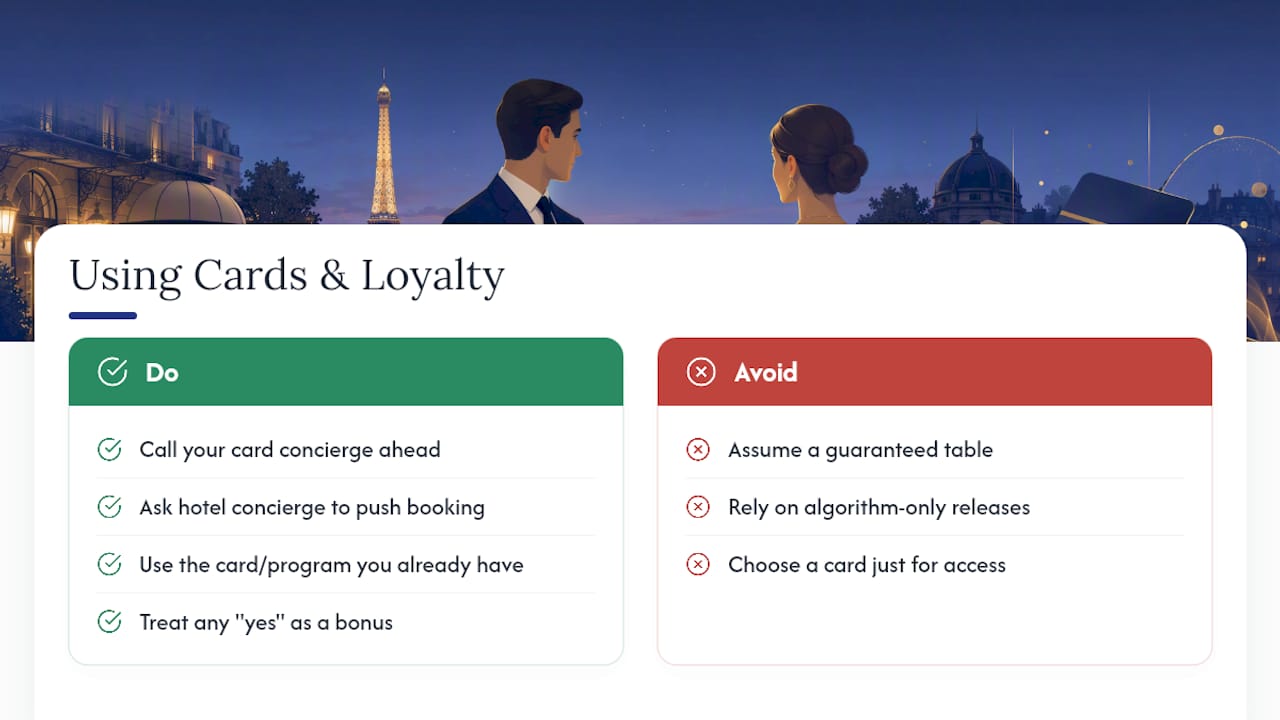
Some premium credit cards and hotel loyalty tiers do open doors that public booking calendars don’t. A handful of travel-focused card issuers run concierge desks that maintain their own restaurant relationships in major cities, including Paris, and can request tables through those channels rather than the public system. The value varies a lot by issuer and by the specific restaurant, so it’s worth calling your card’s travel concierge line before you assume a benefit exists.
Hotel loyalty programs work similarly, but the leverage usually comes through the property, not the loyalty tier itself. A top-tier status level at a major hotel group can get you flagged as a priority guest, which then feeds into how hard the concierge desk pushes for you at a restaurant. The status number on your account matters less than whether the hotel you’re staying at has an existing relationship with the restaurant you want.
None of this replaces the fundamentals. A credit card concierge or hotel status tier is an extra lever to pull, not a guarantee, and it rarely helps at all for restaurants that run a strict, algorithm-driven online release with no back channel. For those, timing and persistence still do most of the work. Where these perks genuinely shine is at hotel-adjacent restaurants and at properties where the hotel itself has skin in the game, since staff have a direct incentive to make the reservation happen for a guest they’re already hosting.
If you’re weighing which card or program to lean on for a Paris trip, the honest answer is: use whichever one you already have, call ahead, and treat any “yes” as a bonus rather than a plan.
Is It Legal and Ethical to Use a Booking Agent or Concierge?
Using a hotel concierge, a paid concierge service, or a licensed travel agency to secure a restaurant reservation is standard practice and entirely legitimate. Restaurants expect a portion of their bookings to come through hotels and agencies, and most maintain relationships specifically because it smooths their own operations, giving them a trusted point of contact instead of hundreds of one-off calls.
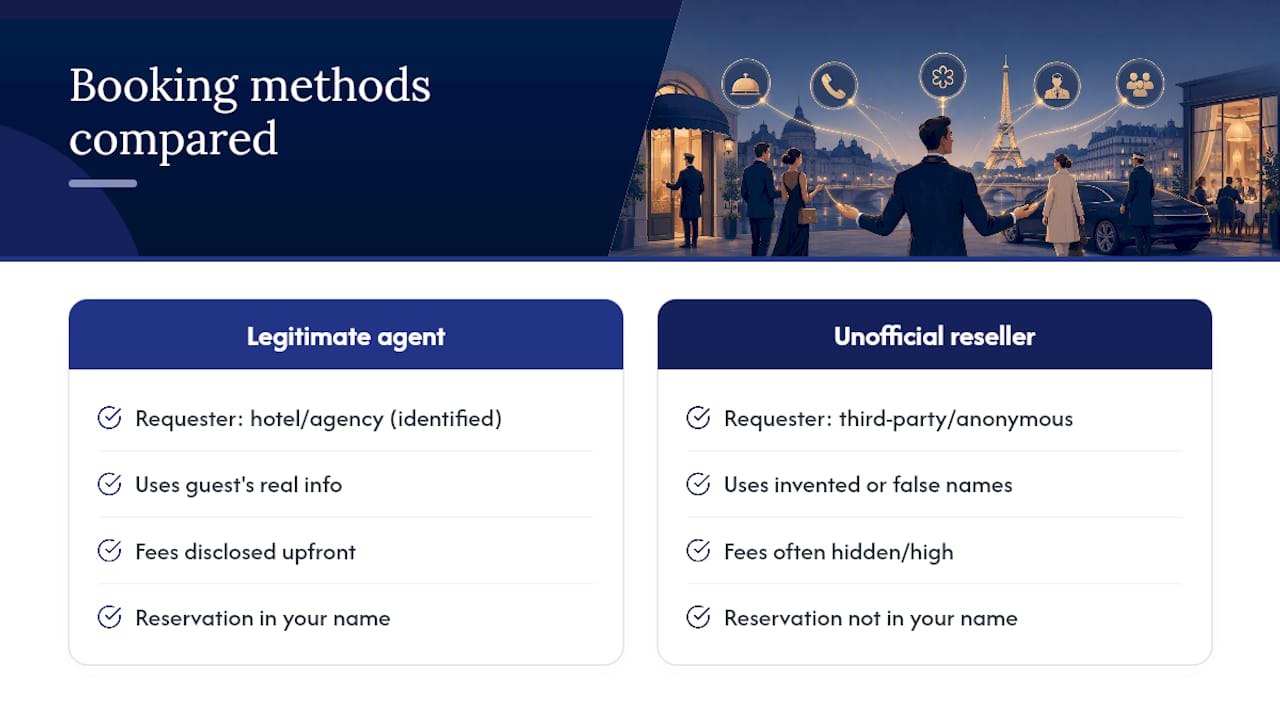
The line gets murkier with unofficial resale. A cottage industry of third-party apps and individuals books tables under invented names, then resells the reservation for a fee, sometimes hundreds of dollars for a single slot at a marquee restaurant. Some restaurants explicitly prohibit this in their reservation terms and have started requiring ID or a credit card match at the door specifically to shut it down. If a table was booked under a name that isn’t yours and you’re asked to prove identity, you can be turned away, deposit and all.
The distinction that matters is who’s doing the requesting and why. A concierge or agent working openly, using your real name and information, and disclosing their fee structure to you upfront is a legitimate service. A stranger reselling access to a reservation system they’ve gamed through bulk bookings is a different thing entirely, and it puts your evening at risk along with your money. When in doubt, ask any paid service exactly how they secure the table and whether the reservation will be in your name.
What Elite Travel Has Learned From Booking Impossible Tables
Michelin dining in Paris is one of those categories where effort and outcome don’t scale the way people expect. You can do everything right, set the alarm, use two devices, and still lose the table to someone with a faster connection or an existing relationship with the maître d’. That gap is exactly what 35 years of European travel work has been built to close.
A typical brief looks like this: a client gives us their dates, flexibility, and a wish list of two or three restaurants. We reach out through existing contacts at those restaurants and at our partner hotels across Europe, follow up within 48 hours, and confirm or pivot to a strong alternative before the client has to think about it again. Clients should expect to hand this over a few weeks ahead of travel when possible, though our 24/7 availability means last-minute requests aren’t off the table.
— tammylevent@gmail.com
Let Elite Travel Handle Your Paris Reservations
You’ve now seen what it actually takes to land a Michelin table in Paris: exact-second timing, backup restaurants, waitlist persistence, and often a phone call from someone the maître d’ already knows. Elite Travel exists so you don’t have to be that someone. Our concierge-level planning secures dining reservations as part of a full Paris itinerary, not a separate scramble, and we charge no service fees and back every booking with a price match guarantee.

Tell us your travel dates, your restaurant wish list, and any dietary needs, and we’ll start outreach immediately, ideally a few weeks before your trip for the hardest tables, though our team is available 24/7 for tighter timelines. From a single impossible dinner to a full week of Paris dining paired with the right hotel, our Europe vacation planning team builds the itinerary around the reservations, not the other way around. Reach out through our Paris vacation packages page to start the conversation, and let us handle the calls while you plan the rest of the trip.
Sources
- How to score reservations in Paris – Paris by Mouth
- The Toughest Reservations In Paris Right Now (And How To Get Them) – The Infatuation
- Le Meurice Alain Ducasse — OpenTable reservation page
