




The fastest way to cut business-class costs is a three-part move: keep your dates flexible, target routes with real competition, and monitor both cash sales and award space at the same time. Expect real fares to run from roughly $2,500 on a promotional bucket to $6,000 or more in peak windows, so timing and route choice do more for your wallet than any single trick.
TL;DR:
- Genuine fare dumps are rare, short-lived, and usually tied to specific saver booking classes, vanishing within days once demand increases.
- Cross-checking fare basis codes and ticketing sources is essential to verify real discounts and avoid non-refundable or restricted private fares.
- Most significant savings come from midweek departures, low-demand months, and routing tricks like splitting one-ways or open-jaw itineraries.
- Long-haul discounted business fares can start as low as $2,500, but prices often jump to $4,000–$6,000 for peak routes, with route competition and seasonality playing big roles.
- A concierge agency can simplify complex bookings, secure genuine fares, and verify seat quality, especially for multi-city itineraries or guaranteed flat-bed seats.
Table of Contents
- What Are the Best Business Class Fare Sales to Watch For?
- Which Search Tools Actually Surface Cheap Business Class Fares?
- How Much Should a Business Class Ticket Cost?
- Is Premium Economy a Better Value Than Business Class?
- What Advanced Tactics Lower Business Class Fares Further?
- When Do Points Beat Cash for Business Class?
- How Do You Verify the Business Class Seat You’re Actually Buying?
- Elite Travel’s View: When a Concierge Agency Adds Real Value
- Let Elite Travel Handle the Complicated Business Class Booking
- Sources
- FAQ
What Are the Best Business Class Fare Sales to Watch For?
Cash-fare hunting rewards people who move fast and verify everything. Airlines quietly drop deeply discounted business inventory, sometimes called a “fare dump,” when they need to fill seats on a route facing new competition or softer demand. These fares often surface without fanfare on the airline’s own site rather than through a splashy sale banner.
A genuine fare dump usually shows signs such as significantly undercutting the route’s typical price and being tied to a specific saver booking class rather than the airline’s standard business fare, and it tends to vanish within days once demand catches up. If a fare looks too good and stays bookable for weeks, it’s probably a standard promotional fare, not a true dump.
Consolidators and private fares add another lane. These are unpublished business-class rates that travel agencies and wholesalers access through direct relationships with airlines, often 10% to 20% below the lowest public fare on the same flight. The catch: private fares frequently carry stricter change and refund rules, and not every consolidator ticket earns full frequent-flyer mileage or elite-qualifying credit. Ask specifically before booking.
Price alerts do the daily work for you. Set alerts on Google Flights for your target routes and dates, and consider joining a fare-alert email list that specializes in premium-cabin mistakes and flash sales, since business-class error fares and short-lived sales often get flagged there before they hit mainstream travel news.
Before you buy anything, run this verification checklist:
- Confirm the fare basis code matches a real saver or discount business bucket, not a placeholder.
- Check the ticketing stock to see whether the fare tickets on the airline’s own paper or through a third party, which affects your leverage if something goes wrong.
- Read the refund and change fine print before you commit, since some deeply discounted fares are entirely non-refundable.
- Ticket directly with the airline whenever possible, even if you found the fare through a consolidator, so you keep full control over cancellations and rebooking.
Pro Tip: Screenshot the fare rules the moment you find a deal. Consolidator and OTA-published fares sometimes change silently between search and checkout, and having proof of the original terms helps if you need to dispute a discrepancy.
Which Search Tools Actually Surface Cheap Business Class Fares?
Most travelers rely on one search engine and miss fares that a slightly different tool would have caught. Each tool below plays a distinct role.
- Google Flights is your starting point. Use the Explore map to spot cheaper alternate airports or nearby cities, the date grid to see a full month of pricing at a glance, and the price history graph to judge whether today’s fare is actually low or just average. Google Flights also tags some itineraries with lie-flat seat icons, though that label isn’t always reliable on every route, so treat it as a starting clue, not confirmation.
- ITA Matrix (Google’s own fare-construction tool) is where serious fare hunters go next. It shows the exact fare basis code, routing rules, and booking class an airline is selling, which lets you replicate that same fare directly on the carrier’s website instead of paying an OTA markup.
- Online travel agencies and consolidators are worth checking for price comparison, but always cross-check the final price on the airline’s own site before ticketing. OTAs sometimes bundle in service fees or restrict your ability to make schedule changes without a lengthy phone call.
- Seat maps and ExpertFlyer-style seat-monitoring tools confirm what you’re actually buying. Aircraft swaps happen more often than travelers expect, and a seat that shows as lie-flat when you book can become a recliner if the airline changes equipment closer to departure.
Pro Tip: Run the same itinerary through ITA Matrix and Google Flights side by side. If ITA shows a lower fare basis available, that’s your signal to call the airline or try booking direct, since the online engine may not have refreshed yet.
How Much Should a Business Class Ticket Cost?
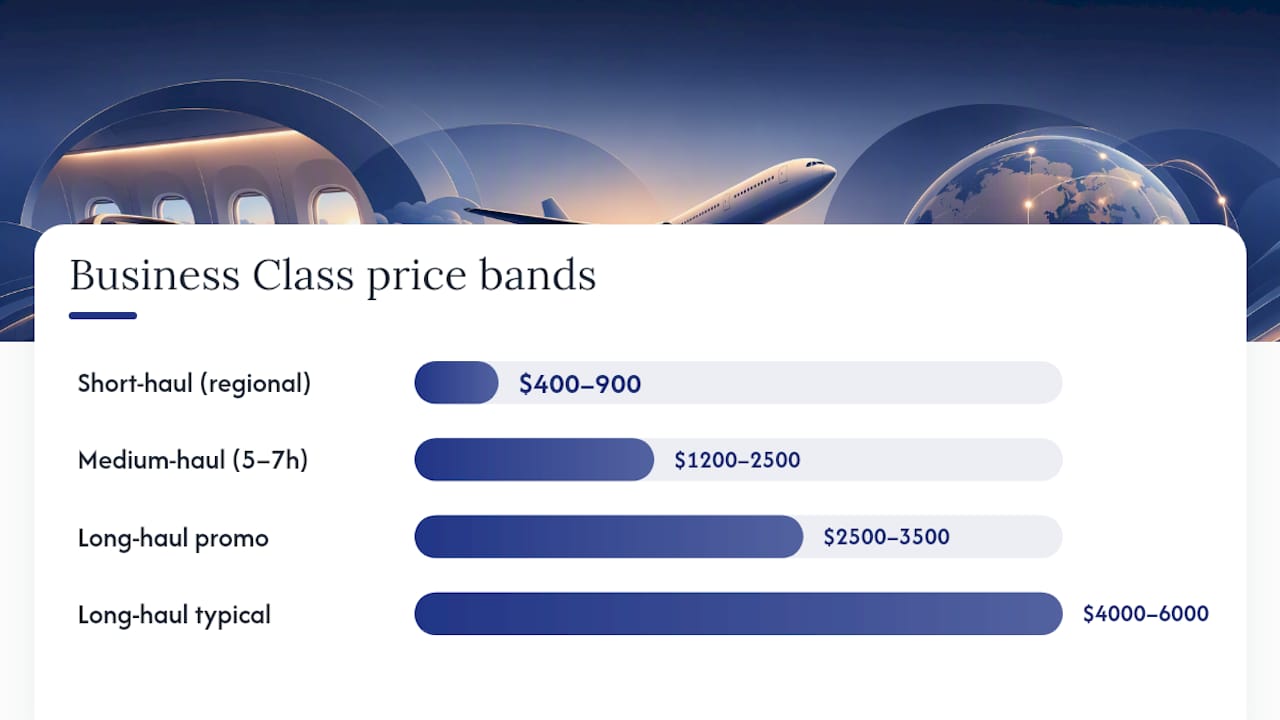
Price bands vary enormously by distance and route competition. Short-haul business fares within a single region often run $400 to $900 one-way, largely because the “business” cabin on those routes is frequently just a blocked middle seat in economy rather than a true premium product. Medium-haul routes, say five to seven hours, tend to land between $1,200 and $2,500 one-way depending on season.
Long-haul intercontinental business fares show the widest spread. Discounted fares on promotional booking buckets can start around $2,500 to $3,500 one-way, while the more common price on a typical intercontinental route sits closer to $4,000 to $6,000 one-way, according to pricing analysis on Emirates’ A380 business cabin. The same nonstop route, booked six months out versus six days out, can differ by thousands of dollars.
Why fares swing so widely: Airlines manage business class through fare buckets, often labeled with letters like Z, I, or J, and each bucket has a fixed number of seats at a fixed price. Once the cheapest bucket sells out, the fare jumps to the next tier, sometimes overnight. Route competition matters just as much. A route with three or four airlines flying nonstop tends to have deeper and more frequent fare buckets than a route served by only one carrier.
Seasonality compounds all of this. Peak summer transatlantic routes and December holiday departures routinely price 40% to 60% above the same route in a slow month like February. Point of sale matters too. The identical flight can price differently depending on which country’s website you search from, since airlines file separate fare classes by market. On top of the base fare, expect airport taxes, carrier-imposed fuel surcharges (still common on certain international carriers), and sometimes a security or departure fee that can add several hundred dollars to the total, especially on fares originating in Europe.
Is Premium Economy a Better Value Than Business Class?
Premium economy earns its keep on shorter overnight flights where you don’t need a fully flat bed to function the next day. Business class earns its keep when the flight is long enough that a flat bed changes how your entire trip starts.
Premium economy typically costs 50% to 60% more than economy, while business class fares generally run two to three times the price of premium economy, or three to six times the price of economy on the same route. That gap is the real decision point.
- Under six hours, daytime departure: premium economy’s roughly 38 inch seat pitch and extra recline usually covers your comfort needs without paying the business-class premium.
- Overnight flights of eight hours or more: business class’s fully flat bed becomes the deciding factor, since arriving rested for a meeting or a milestone trip is worth more than the fare gap.
- Paying with points instead of cash: the mileage cost between premium economy and business class is often smaller than the cash gap, since airlines don’t always scale award pricing the same way they scale cash fares.
- Amenities beyond the seat: business class typically adds lounge access, priority boarding and baggage handling, and a proper multi-course meal service, features premium economy rarely matches even on long-haul aircraft.
Run this quick check before booking either cabin: how many hours is the flight, do you land and go straight into activity, and are you paying cash or points? If two of those three point toward comfort mattering, business class is worth the premium.
What Advanced Tactics Lower Business Class Fares Further?
Once you’ve covered the basics, a handful of higher-skill tactics can push your fare lower still, though they demand more flexibility and more homework.
Midweek departures consistently price lower than weekend flights on the same route, since business travelers, who make up the bulk of premium-cabin demand, cluster their trips around a Sunday-to-Thursday or Monday-to-Friday pattern. Booking a Tuesday or Wednesday departure, and targeting historically low-demand months like January, February, or early September, can meaningfully undercut peak pricing, according to research on finding affordable business class fares.
Routing tricks add another layer of savings, with real tradeoffs attached:
- Paired one-ways (booking two separate one-way business fares on different airlines) sometimes beat a single round-trip fare, especially when one airline’s outbound fare is deeply discounted and another’s return leg is cheap in the opposite direction.
- Open-jaw itineraries, flying into one city and home from another, can unlock cheaper fare combinations when your trip already involves multiple destinations.
- Hidden-city ticketing, buying a fare to a city beyond your real destination because the through-fare is cheaper than a direct one, is a real workaround, but it violates most airlines’ contracts of carriage and can void your remaining tickets and frequent-flyer account if discovered. Treat it as a last resort, not a default strategy.
Fare construction replication is the technical version of fare-basis matching. Once you find a strong published fare using ITA Matrix, the goal is to copy that exact fare basis code and routing on the airline’s own website rather than booking through a third party. A documented New York to Paris fare replication case showed a traveler locating a round-trip business fare near $1,895 by matching the ITA fare basis directly on the carrier’s site rather than accepting a higher OTA quote for the same seat.
Pro Tip: If you fly for work often enough to negotiate directly with an airline’s corporate sales desk, ask about negotiated fares. Companies with even modest travel volume can sometimes secure business-class discounts that beat any public sale, plus added flexibility on changes.
When Do Points Beat Cash for Business Class?
Award seats make the most sense when the cents-per-point value clears roughly 1.5 to 2 cents, a rough industry benchmark for solid redemption value. Below that, you’re often better off paying cash and saving the points for a better opportunity.
- Short-haul lie-flat redemptions are frequently the best-kept secret in the miles world. A short regional lie-flat seat booked on points plus modest taxes can produce outsized cents-per-point value compared to the same points spent on a long-haul economy ticket, based on guidance on booking lie-flat seats with points.
- Long-haul peak-season cash fares are where points shine brightest, since a $5,000 to $6,000 cash fare in July or December often converts to the same points price as a $3,000 fare in a slow month, meaning your points buy proportionally more value exactly when cash prices spike.
- Cash tends to win when a promotional fare dump undercuts the typical points-plus-taxes cost, or when your redemption would clear less than a cent per point.
- Practical sequence: search partner airline award calendars first to confirm real seat availability, then transfer flexible points from a bank or card program only after you’ve locked in that space, since points transfers are usually instant but sometimes irreversible.
Pro Tip: Never transfer points speculatively. Confirm the exact award seat is bookable on the partner airline’s own site or through a phone agent before you move a single point, since award space can disappear in the time it takes to complete a transfer.
Dynamic upgrade offers deserve a mention here too. Airlines sometimes price a paid upgrade from economy or premium economy into business dramatically low when inventory is soft, occasionally dropping to just a few dollars on a long-haul flight. These offers are unpredictable, but checking your airline’s app in the days before departure costs nothing and occasionally pays off enormously.
How Do You Verify the Business Class Seat You’re Actually Buying?
The label “business class” doesn’t guarantee a lie-flat bed. Many short-haul and regional business cabins are simply a blocked middle seat in a standard economy row, with no additional recline or privacy beyond a curtain and a better meal, according to analysis of lie-flat business seating on European routes.
Run through this before you pay a business-class premium:
- Confirm seat type directly: lie-flat, angled lie-flat, or recliner are three very different products, and only true lie-flat guarantees a flat sleeping surface for long overnight flights.
- Check for direct aisle access, since some older business configurations still require climbing over a seatmate to reach the aisle.
- Verify the aircraft type and seat map using the airline’s own booking tool or a seat-monitoring service, and recheck within 48 to 72 hours of departure, since aircraft swaps commonly convert a booked lie-flat seat into a recliner without much warning.
- Confirm ground benefits separately: lounge access, priority check-in and boarding, and checked baggage allowance vary by airline and even by fare class within business, so don’t assume every business ticket includes all three.
If the price delta between a true lie-flat product and a recliner-style business cabin is small, pay for the better seat. Accept the lesser product only when the price gap is large and your trip is short enough that comfort matters less than the savings.
Elite Travel’s View: When a Concierge Agency Adds Real Value
Business-class shopping rewards patience and screen time, right up until your itinerary gets complicated. A single round-trip on one route is a solvable puzzle for a motivated traveler with a few hours to spare. A multi-city honeymoon routing through three airlines, a group of eight colleagues who all need to sit together, or a trip where a guaranteed lie-flat seat is non-negotiable, that’s a different problem entirely.
That’s where a concierge-level agency earns its fee, or rather, doesn’t charge one. Elitetravelgroup has spent 35 years building direct relationships with airlines and consolidators, which sometimes means access to private fares a public search engine never surfaces. More importantly, an experienced agent knows how to verify a fare basis, catch an aircraft swap before it ruins a trip, and rebook instantly if a schedule changes mid-itinerary. That kind of post-booking support is the part DIY fare hunting can’t replicate once something goes wrong at the airport.
Luxury travel agents don’t replace the search skills covered above. They add a layer of expertise and leverage for the trips where the stakes, and the complexity, are simply higher.
— tammylevent@gmail.com
Let Elite Travel Handle the Complicated Business Class Booking
Everything above works when you have the time to chase fare buckets and double check seat maps yourself. A luxury travel agency exists to manage complex trips for clients who prefer to rely on experts to identify genuine fares and verify the quality of business-class products. With 35 years of concierge-level experience, no service fees, a price match guarantee, and support available 24/7, A concierge-level agency can help secure premium-cabin bookings, reducing the need for frequent monitoring of fare-alert emails.

Where this matters most: complex multi-city routing, group trips where everyone needs matching seats, and any journey where a confirmed lie-flat seat is the whole point, like a honeymoon or a milestone celebration you’re not willing to risk on a dynamic aircraft swap. If your trip fits that description, explore Elite Travel’s luxury vacation packages or browse the full range of services offered to see how a concierge-booked itinerary compares to what you’d piece together on your own. Start with a conversation about your dates and destination, and let an agent do the fare verification for you.
Sources
- Here’s how much a business class ticket on Emirates’ Airbus A380 actually costs in 2026
- Finding affordable business class fares
FAQ
How Much Does a Business Class Ticket Typically Cost?
Short-haul business fares often run $400 to $900 one-way, while long-haul intercontinental fares typically land between $4,000 and $6,000 one-way, with discounted promotional fares sometimes starting around $2,500 to $3,500. The exact price depends heavily on route competition, season, and how far in advance you book.
What Is the Cheapest Way to Get a Business Class Seat?
The most reliable low-cost paths are catching a genuine fare dump on a saver booking bucket, using ITA Matrix to replicate a low published fare directly on the airline’s site, or transferring points toward a high-value award seat when the cents-per-point math clears roughly 1.5 to 2 cents. Midweek departures and low-demand months, per SmarterTravel’s research, also consistently price lower than weekend peak travel.
Should I Book Business Class With Cash or Points?
Cash tends to win on discounted promotional fares and on routes with strong competition, while points deliver stronger value on peak-season long-haul flights and on short-haul lie-flat redemptions with low taxes. Compare the cash price against your points balance’s cents-per-point value before deciding either way.
Does a Luxury Travel Agency Help With Business Class Bookings?
Yes, particularly for complex multi-city routing, group trips, or itineraries where a guaranteed lie-flat seat matters. Elitetravelgroup offers concierge-level booking with no service fees and a price match guarantee, which can be worth pursuing when a trip’s complexity outweighs the time it takes to search fares yourself; current pricing for specific packages is available directly on the Elite Travel site.
