




Credit card travel protections work as a helpful backstop for straightforward, largely domestic trips where your bookings are refundable and your health coverage travels with you. Standalone travel insurance is usually the better call for international medical risk, high-cost nonrefundable trips, cruises, or anything involving adventure activities. The deciding factors are destination, trip value, medical exposure, activity risk, and how refundable your bookings already are. Start by pulling up your card’s guide to benefits before you book anything else.
TL;DR:
- Credit card protections often have low caps and strict thresholds, making them insufficient for high-cost or complex international trips.
- Standalone policies provide broader coverage, higher limits, and customizable options, especially for medical emergencies, evacuations, and nonrefundable deposits.
- For international travel or high-value bookings, a standalone policy usually offers more reliable, faster claims processing and comprehensive protection.
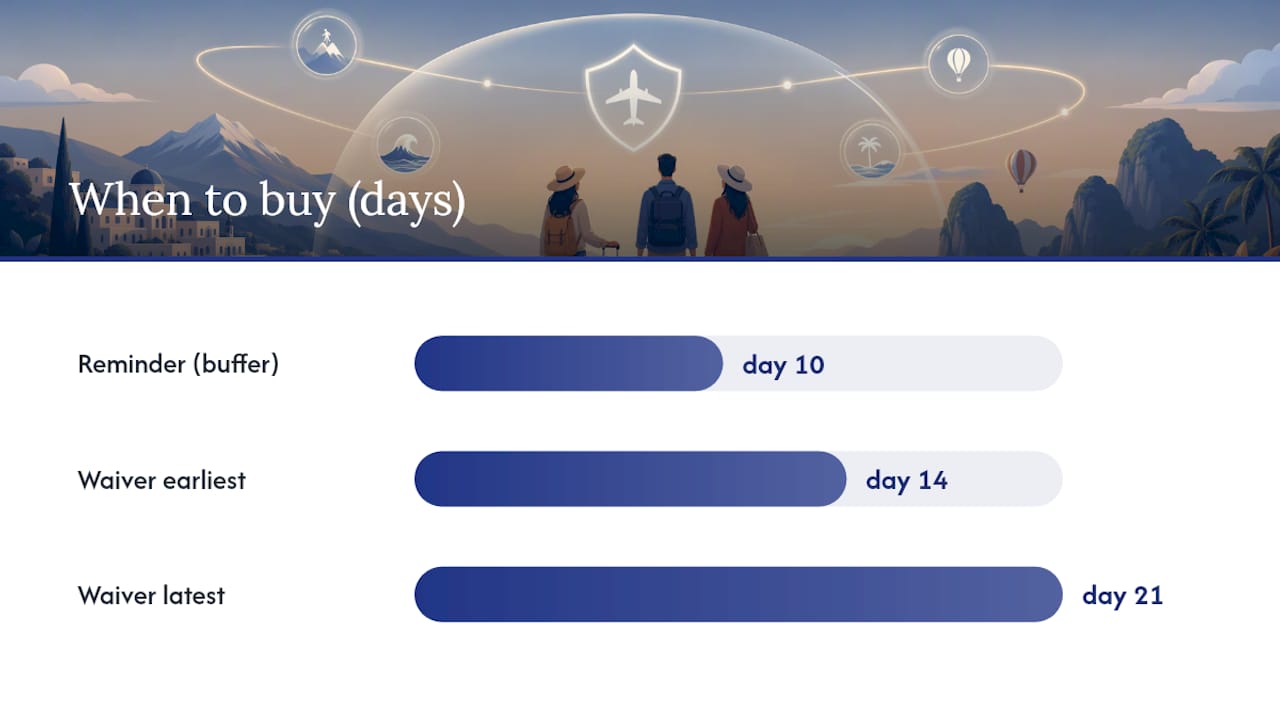
- Preexisting-condition waivers and cancellation advantages in standalone insurance require early purchase within 14 to 21 days of deposit.
- Carefully review your card’s benefits guide before booking, and consider stacking both options if your trip involves high risks or expenses.
Table of Contents
- What Do Credit Card Travel Protections Typically Cover?
- What Does Standalone Travel Insurance Actually Cover?
- Where Do Cards and Standalone Policies Actually Differ?
- How Do You Decide Between Card Coverage and Standalone Insurance?
- How Do You Read Your Card’s Guide to Benefits Before You Travel?
- How Elite Travel Approaches Travel Protection for Bespoke Trips
- Where to Read More Before You Decide
- Why This Decision Deserves More Than a Default Answer
- Sources
What Do Credit Card Travel Protections Typically Cover?
Most premium travel rewards cards bundle a handful of protections that kick in automatically when you pay with that card, no extra premium required. The coverage tends to cluster around predictable travel headaches rather than catastrophic risk.
Typical benefits include:
- Trip delay reimbursement for meals and lodging when your flight is delayed past a set threshold, often six or twelve hours
- Baggage delay or loss coverage for essentials while your luggage is missing
- Rental car collision damage waiver if you decline the rental company’s coverage and pay with the card
- Trip cancellation/interruption for a narrow list of covered reasons, usually far shorter than what a standalone policy offers
- Travel accident insurance, a fixed payout for death or dismemberment tied to a covered carrier
- Evacuation coverage, though this shows up less consistently and usually caps out lower than dedicated medical evacuation plans
The trigger mechanics matter more than people expect. You generally need to have paid for the trip (or a significant portion of it) with the eligible card, and coverage often extends only to the cardholder and immediate family traveling together. Award tickets booked with points sometimes fall outside these protections entirely, depending on the issuer.
The limits are where cards show their age. Per-person caps on trip cancellation might run a few thousand dollars, well under what a luxury itinerary actually costs. Delay-hour thresholds mean a four-hour delay might get you nothing while a seven-hour one does. And that travel accident benefit isn’t health insurance. It pays a fixed lump sum for catastrophic outcomes but does not reimburse routine hospital bills or medical care costs.
Credit card protections also frequently lack customization. You generally cannot raise coverage limits for an expensive trip or add a rider for a specific high-risk activity, which is exactly why standalone policies tend to fit bespoke itineraries better.
Pro Tip: Check whether your card’s rental car coverage is primary or secondary. Secondary coverage means you file with your personal auto insurer first, which can slow down a claim after an accident abroad.
What Does Standalone Travel Insurance Actually Cover?
Standalone policies are built around the risks that actually bankrupt a trip: getting sick or hurt far from home, or losing a large nonrefundable deposit. The coverage is broader by design, and you’re paying a premium specifically because it is.
Core coverages generally include:
- Trip cancellation and interruption for a longer list of covered reasons than any credit card offers
- Emergency medical coverage, often $50,000 to $500,000 or more, since domestic health insurance rarely follows you overseas
- Medical evacuation, which can run into six figures for a helicopter rescue or medical flight home
- Baggage loss and delay, similar to card benefits but usually with higher limits
- Supplier financial default protection, covering you if a tour operator or cruise line goes under before departure
Beyond the base policy, several add-ons matter for the kind of trips Elite Travel plans most often. Cancel For Any Reason (CFAR) lets you cancel for a reason not otherwise covered, often reimbursing a substantial portion of your trip cost. A preexisting-condition waiver protects travelers with a health history that would normally void a claim. Adventure-sports riders extend coverage to activities like scuba diving, skiing off marked trails, or mountaineering that base policies usually exclude.
Standalone insurance typically offers broader cancellation reasons, higher medical and evacuation limits, and these optional add-ons that a credit card simply doesn’t have room to include. Read the policy’s effective dates and definitions closely. A policy that starts coverage the day after purchase, rather than immediately, can leave a gap if something happens between booking and the waiting period ending. For international medical needs, cruises, or a five-figure nonrefundable deposit, a standalone policy is generally the more reliable choice.
Where Do Cards and Standalone Policies Actually Differ?
Laid side by side, the gap between card protections and standalone insurance isn’t uniform. It widens or narrows depending on the specific risk you’re insuring against.
| Coverage area | Credit card behavior | Standalone policy behavior | Where the gap bites |
|---|---|---|---|
| Medical & evacuation | Rare, low caps if present at all | $50,000 to $500,000+ medical, evacuation often unlimited or six figures | International trips, remote destinations, cruises |
| Trip cancellation | Narrow list of covered reasons | Longer list, plus optional CFAR | Nonrefundable luxury packages, multi-stop itineraries |
| Trip delay | Reimbursement after 6 to 12 hour threshold | Similar or lower threshold, often higher dollar caps | Tight connections, cruise embarkation windows |
| Baggage | Modest caps, delay and loss both covered | Higher caps, broader loss definitions | High-value luggage, photography or dive gear |
| Rental car | Often strong (CDW), frequently primary | Rarely the focus, sometimes excluded entirely | Long rentals, luxury or exotic vehicles |
| Claims process | Frequently secondary, file with primary insurer first | Frequently primary, direct reimbursement | Any claim needing fast cash, especially medical |
The delay and baggage rows aren’t theoretical, reflecting how convenience is the top priority in business travel. Consumers filed a steady stream of delay and mishandled-baggage complaints in the Department of Transportation’s most recent air travel consumer report, which is exactly the kind of everyday disruption card benefits were built to absorb.
A few edge cases deserve their own callout. Adventure sports are excluded by both cards and most base travel policies. Specialized coverage for activities like scuba diving is often sold separately by activity-specific groups, such as Divers Alert Network for diving incidents, because neither cards nor generic policies want that risk without a rider. Cruises deserve standalone coverage almost by default, given how narrow shipboard medical care is and how expensive emergency evacuation from open water can get. Older travelers should check preexisting-condition waiver eligibility carefully, since age and health history both affect pricing and qualification. High-value luxury packages with five-figure deposits rarely fit inside a card’s cancellation cap.
The claims process itself is its own hidden cost. Card benefits are frequently secondary, meaning you file with your primary insurer or another applicable policy first, and only claim the remainder from the card issuer. That adds paperwork and time. Standalone policies, especially for medical claims, often function as primary coverage, which means faster reimbursement when you need cash quickly.
How Do You Decide Between Card Coverage and Standalone Insurance?
Run through this order and you’ll land on one of three outcomes: rely on the card, buy standalone insurance, or stack both.
- Is the trip domestic with fully refundable bookings? If yes, card protections are likely sufficient on their own.
- Does the trip involve international travel, a cruise, or remote destinations? If yes, price a standalone policy for the medical and evacuation coverage your domestic health plan won’t provide.
- Is your nonrefundable spend above a few thousand dollars? If yes, standalone cancellation coverage, and possibly CFAR, becomes worth the premium.
- Are you planning adventure activities like diving, skiing off-trail, or high-altitude trekking? If yes, look for an activity-specific rider or specialized policy rather than assuming either the card or a base policy covers it.
- Do you or a travel companion have a preexisting health condition? If yes, timing your purchase matters more than anything else on this list.
That last point deserves emphasis. Many insurers require you to buy coverage within about 14 to 21 days of your first trip deposit to qualify for a preexisting-condition waiver, and CFAR eligibility often has the same or a similar window. Missing the early purchase window can mean losing access to some important coverage options for that trip.
If you land on “rely on the card,” your next step is reading the guide to benefits in full. If you land on “buy standalone,” start comparing quotes on an insurance marketplace immediately. If you land on “stack both,” treat the card as your delay and baggage layer and the standalone policy as your medical and cancellation layer.
Pro Tip: Set a calendar reminder for day 10 after your deposit if you’re still deciding. That gives you a buffer before the 14 to 21 day window closes on preexisting-condition waivers.
How Do You Read Your Card’s Guide to Benefits Before You Travel?
Every card issuer publishes a guide to benefits, usually a PDF buried in your online account under “benefits” or “protections.” Pull it up before you book, not after something goes wrong.
Scan specifically for these phrases: eligible reasons (the exact list that triggers cancellation coverage), coverage limits (per-person and per-trip caps), who is covered (cardholder only, or family too), and where evacuation applies (some cards limit this to specific regions or emergencies).
Before departure, save these documents in one place, ideally an offline folder on your phone in case connectivity fails:
- Proof of payment showing the eligible card was used
- Booking confirmations for flights, hotels, and tours
- Any relevant medical records if you have a preexisting condition
- Receipts for anything you’d need to claim, like a delayed-bag replacement purchase
- Police or airline incident reports if applicable
Issuer claims tend to move slower than standalone insurer claims because of that secondary-coverage structure, so having documentation ready in advance shortens the wait. Insurer and issuer guidance both stress reading your exact benefit language before you assume a protection applies, rather than after you need it.
How Elite Travel Approaches Travel Protection for Bespoke Trips
We’ve spent 35 years designing itineraries where the stakes are higher than a delayed suitcase, honeymoons, milestone trips, and multi-country journeys where a missed connection cascades into a ruined week. Our rule of thumb: for any bespoke or high-value trip, we always price a standalone policy for medical and evacuation coverage, and we walk clients through CFAR when nonrefundable spend runs high.
Concierge planning means we compare policies against the actual itinerary, confirm preexisting-condition waiver eligibility while there’s still time, and stay available for claims support if something goes sideways. With no service fees and a price match guarantee, that same attention extends to the adventure travel itineraries where activity riders matter most. We’re reachable 24/7, because a coverage question at midnight before an early flight shouldn’t wait for business hours.
[CTA IMAGE PLACEHOLDER: Elite Travel concierge consultation graphic]
Where to Read More Before You Decide
For deeper detail on this topic, The Points Guy’s breakdown of card versus standalone coverage and Squaremouth’s credit card insurance guide both walk through real trigger language. Forbes Advisor’s comparison covers add-ons in more depth, and our own piece on the role of travel insurance for every trip rounds out the fundamentals.
Why This Decision Deserves More Than a Default Answer
Most advice on this topic collapses into one of two lazy positions: cards are enough, or always buy insurance. Neither survives contact with an actual itinerary. The honest answer depends on variables that shift trip to trip: where you’re going, what you’ve already paid for, and whether your health coverage has any teeth once you leave the country.
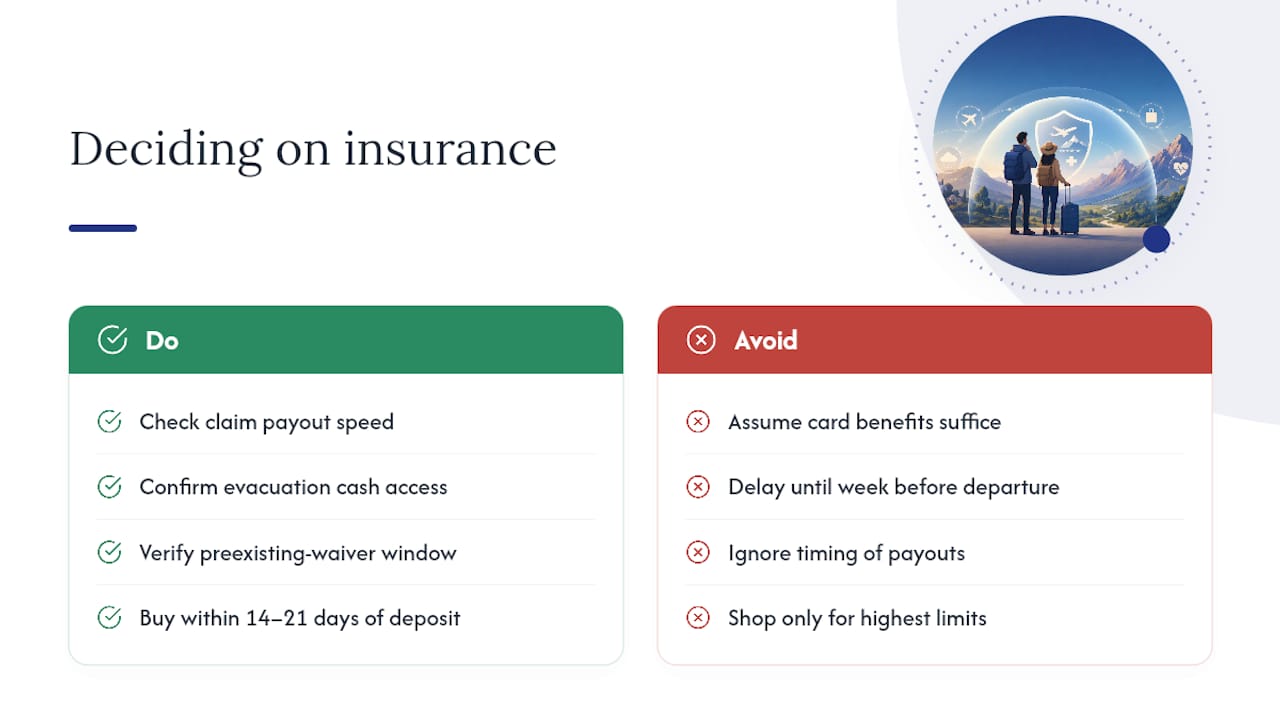
What gets underestimated is how much the claims process itself changes your real-world experience of “coverage.” A card benefit that pays out in eight weeks after you’ve filed with two other insurers first isn’t the same protection as a standalone policy that reimburses your medical evacuation while you’re still in the hospital. On paper, both might list “evacuation coverage.” In practice, only one of them shows up when you need cash fast.
The other blind spot is timing. Travelers price insurance the week before departure, assuming it’s a commodity they can shop whenever. But the preexisting-condition waiver and CFAR windows close early, often within three weeks of the first deposit. By the time most people start comparing policies, the best options are already taken. That single detail, more than any coverage limit, is what separates travelers who get the protection they actually wanted from those who settle for whatever’s left.
— tammylevent@gmail.com
Sources
- What to know about travel insurance and credit card protection – The Points Guy
- Guide to credit card travel insurance (Squaremouth)
- Credit Card Travel Insurance Vs. Separate Policy – Forbes Advisor
- Air travel consumer report – U.S. Department of Transportation
