



Book a five-star hotel through a luxury travel advisor enrolled in a preferred partner hotel program and you typically get a room upgrade, daily breakfast for two, a property credit commonly around $100, early check-in, late checkout, and a welcome amenity, at the same flexible rate you’d pay booking direct. The real payoff isn’t the perk list. It’s the advisor relationship behind it, which decides whether those perks show up reliably or get lost in a shuffle of anonymous reservations.
TL;DR:
- Booking through a preferred hotel program typically includes upgrades, breakfast, property credit, and early check-in at no extra cost, with the real value depends heavily on advisor relationships.
- The amenities are only guaranteed when the reservation is made via the right channel, with detailed confirmation and prior relationship increasing the chances of VIP treatment.
- Preferred bookings pay the hotel’s best available rate, with no extra cost to the guest, and usually earn full loyalty points unless booking conditions exclude point earning.
- The actual perk value varies by program and property, often exceeding $550 per stay on average, but depends on availability and rate codes attached during booking.
- A strong relationship with an experienced advisor who stays at properties and maintains direct contacts usually results in better perks and more flexibility than a simple portal booking.
Table of Contents
- What Do Preferred Partner Hotel Programs Actually Include?
- How Do Advisors and Consortia Actually Secure These Perks?
- Do You Pay More for These VIP Hotel Perks?
- What Should You Ask Your Advisor Before Booking?
- Which Preferred Hotel Programs Should You Know About?
- How Do These Programs Change the Overall Trip?
- What Do Real Advisor Bookings Look Like in Practice?
- What Restrictions Come With Preferred Hotel Benefits?
- Agency perspective: layering preferred access into full-service planning
- Let Elite Travel Attach These Benefits to Your Next Stay
- Sources
- FAQ
What Do Preferred Partner Hotel Programs Actually Include?
Every major consortium, Virtuoso, Signature Travel Network, Ensemble, along with hotel-side programs like Hyatt Privé and Preferred Hotels & Resorts, negotiates a version of the same core amenity package. The specifics shift by property and brand, but the shape stays consistent.
Here’s what typically lands on a preferred booking confirmation:
- Room upgrade on arrival, subject to availability, often one category above what was booked
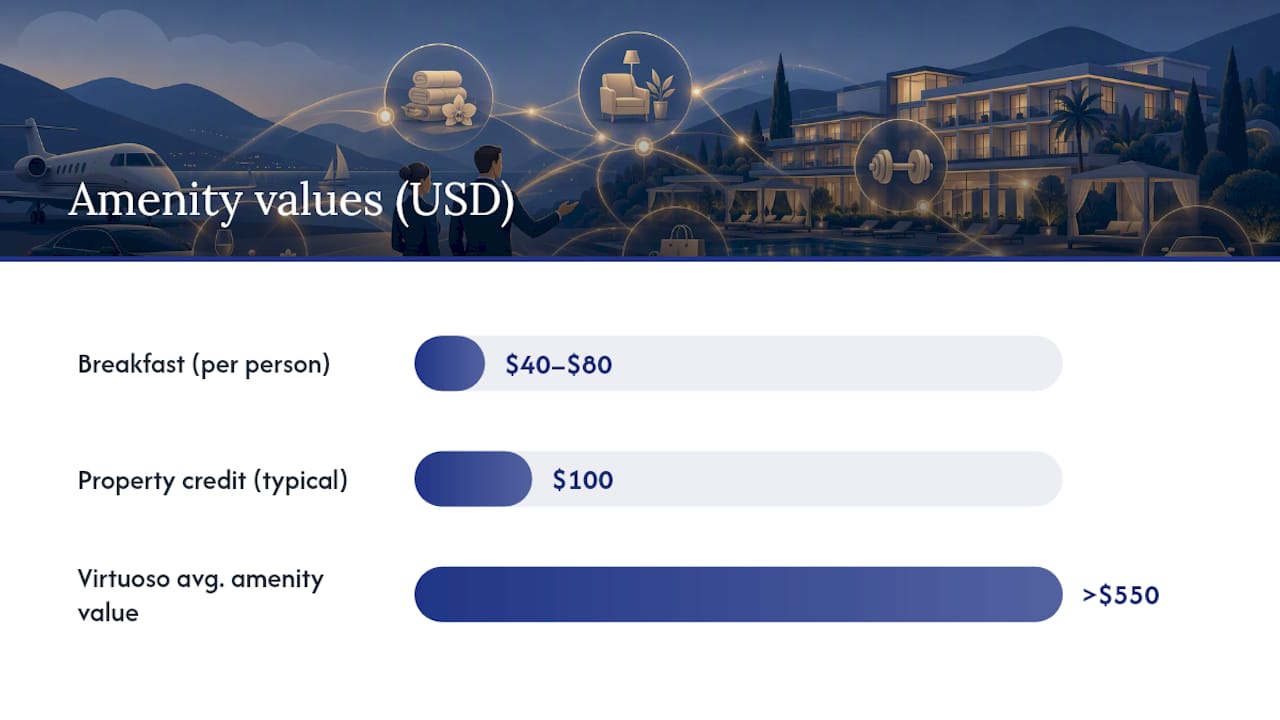
- Daily breakfast for two, a benefit that alone can run $40 to $80 per person at a five-star property
- Property credit, commonly around $100, applicable toward spa treatments, dining, or resort activities
- Early check-in and late checkout, guaranteed rather than requested
- A welcome amenity, ranging from a bottle of champagne to a personalized note from the general manager
Virtuoso reports that its network’s average amenity value exceeds $550 per stay, a figure that accounts for the cumulative worth of upgrades, dining credits, and add-ons across a typical multi-night stay. On suite or villa bookings, some properties extend the package further: private check-in, complimentary airport transfers, or an in-room amenity tied to the occasion, a honeymoon, anniversary, or milestone birthday.
Not every program delivers identically. Hyatt Privé tends to emphasize suite upgrades and F&B credits at its luxury collection properties, while Preferred Hotels & Resorts, working across a more fragmented set of independent hotels, varies more by individual property relationships. That variance is exactly why the advisor matters more than the program name on the confirmation.
How Do Advisors and Consortia Actually Secure These Perks?
The amenity package only becomes real when a booking travels through the right channel. A reservation made through an advisor’s dedicated portal, the systems tied to Hyatt Privé, Marriott STARS, or a Virtuoso-affiliated agency, carries full reservation context to the property, not just a name and a credit card number.
That context matters. A portal booking flags the reservation for the hotel’s VIP or guest relations desk, which typically means:
- The advisor’s notes (anniversary, dietary restriction, prior stay history) reach the property before arrival
- A named contact on the advisor’s side can message the hotel’s VIP team directly if something needs adjusting
- The general manager’s office often reviews VIP arrivals daily, prioritizing flagged reservations for room assignment
Consortia networks like Virtuoso, Signature, and Ensemble add another layer: they vet hotels for quality and negotiate the amenity structures advisors then apply on a client’s behalf, which is why an advisor’s consortium affiliation is worth asking about directly.
Familiarization visits, where advisors stay at partner properties firsthand, and repeat direct outreach to hotel sales contacts build the kind of relationship that turns a standard perk list into something closer to VIP treatment. An advisor who has stayed at a property, met its GM, and sent a dozen clients there over the years gets faster responses and more flexibility than one submitting a first-time request.
A typical workflow looks like this: the advisor books through the preferred portal, as explained in how to book a weekend stay and get the best deal, the property’s reservations team routes the file to the VIP desk, a manager preps the arrival (upgrade assignment, amenity order, welcome note), and the guest experiences what reads as spontaneous hospitality but was actually arranged days in advance.
Pro Tip: Ask your advisor whether they’ve personally stayed at or visited the property. A firsthand relationship with the hotel’s sales or GM team consistently produces better outcomes than a purely transactional portal booking.
Do You Pay More for These VIP Hotel Perks?
No. Rate parity means you pay the hotel’s best available flexible rate whether you book direct or through an advisor. The hotel, not the guest, pays the advisor’s commission, typically about 10% of the room revenue.
A few things to keep straight on the loyalty side:
- Most preferred bookings still earn full loyalty points and elite-night credit toward programs like Marriott Bonvoy or World of Hyatt
- A small number of boutique or independent brands occasionally opt out of point-earning on preferred rates, so it’s worth confirming for niche properties
- Certain non-commissionable or corporate-restricted rate codes can quietly exclude the amenity package entirely, even if the room price looks similar
That last point trips up more travelers than any other. A rate that looks identical on paper can carry completely different entitlements depending on the booking code attached to it.
What Should You Ask Your Advisor Before Booking?
Verification separates a genuine preferred booking from a hollow one. Before confirming a reservation, ask your advisor three direct questions:
- Which preferred programs are you affiliated with for this property — Virtuoso, Signature, Ensemble, Hyatt Privé, or a direct hotel relationship?
- Can you confirm the amenity attachment in writing before I travel, not just verbally?
- Is this rate commissionable, and will I still earn loyalty points and elite-night credit?
Push for an annotated confirmation that names the specific amenity codes attached to your reservation, along with a VIP contact on property you or the advisor can reach if something goes sideways at check-in. A pre-arrival note sent to the hotel, confirming your amenities and any special occasion, is standard practice for advisors who work these programs consistently.
Watch for red flags: vague answers about which program applies, an advisor pushing a proprietary rate that turns out to be non-commissionable, or an inability to produce written confirmation of the amenity package. If your advisor can’t show you the paperwork, the perks likely aren’t attached, regardless of what was promised on the phone.
Pro Tip: Request the amenity confirmation before final payment, not after. Once a non-preferred rate is locked in, adding the perks retroactively is rarely possible.
Which Preferred Hotel Programs Should You Know About?
Five names come up repeatedly in this space, each with a distinct footprint. Virtuoso is the largest luxury consortium, with thousands of member agencies and hotel partners worldwide, and its amenity structure is the industry benchmark most other programs get compared against. Signature Travel Network operates similarly but skews toward independently owned agencies, often with strong regional relationships in destinations like Italy and Southeast Asia. Ensemble rounds out the major consortia, with a footprint that overlaps Virtuoso and Signature in many markets while carrying its own negotiated rates at select properties.
On the hotel side, Hyatt Privé gives advisors a dedicated portal across Hyatt’s luxury collection, with amenities that tend to emphasize suite upgrades and dining credits. Marriott STARS and its sister program, Luminous, cover Marriott’s luxury and premium brands with tiered advisor recognition based on production volume. Preferred Hotels & Resorts works differently: rather than a single brand, it’s a global collection of independently owned luxury properties, which means the amenity experience varies more by individual hotel than by program-wide standard.
The practical takeaway: no single program guarantees the best outcome everywhere. A villa in Tuscany might come through Ensemble’s regional relationships, while a Maldives overwater suite is better served through Virtuoso’s negotiated agreements with that resort group. An advisor who works across multiple consortia can match the property to whichever program produces the strongest amenity package for that specific hotel.
How Do These Programs Change the Overall Trip?
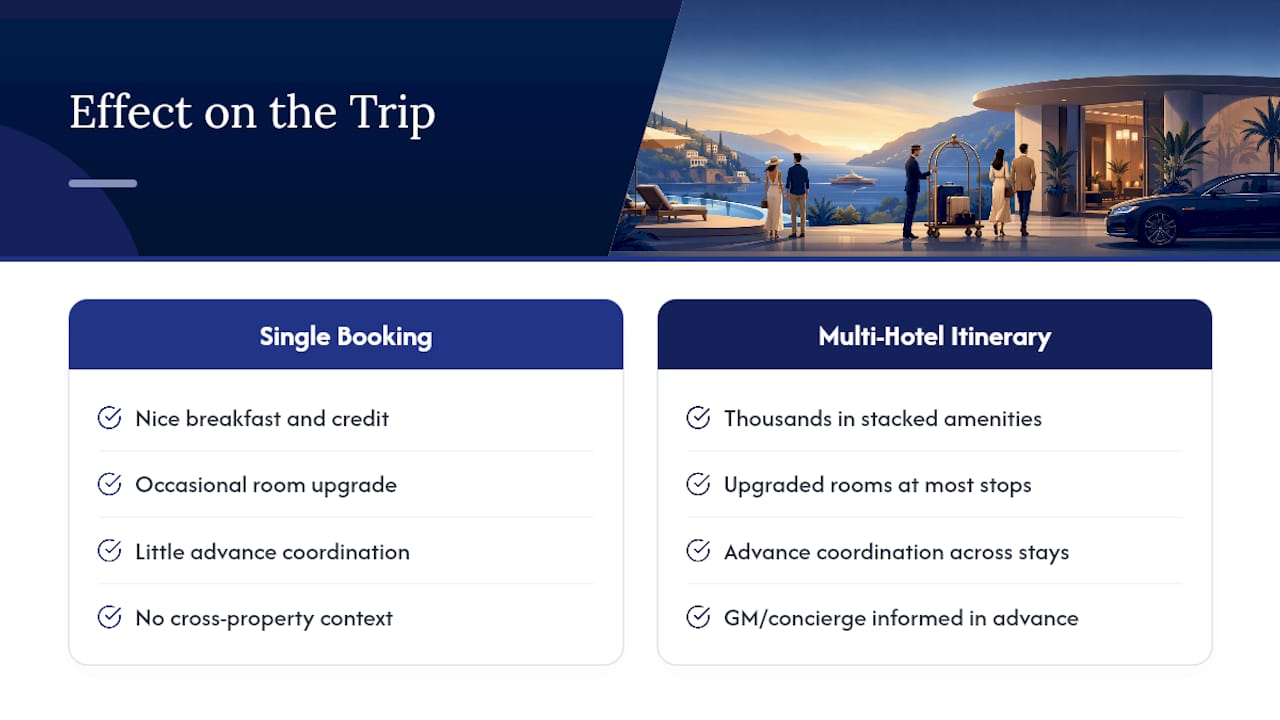
The compounding effect matters more than any single perk. A traveler booking one hotel through a preferred program gets a nice breakfast and a credit. A traveler booking an entire multi-country itinerary this way, four or five hotels across a trip, accumulates thousands of dollars in stacked amenities, upgraded rooms at nearly every stop, and a level of advance coordination that a single hotel booking never triggers on its own.
That coordination shows up in ways guests notice without knowing why. A GM’s office confirming your anniversary before you arrive. A concierge who already knows you prefer a quiet table for dinner. A late flight that gets accommodated without a fight over the checkout time, because the hotel already had context that you were delayed. None of that is automatic. It’s the product of an advisor pre-loading each property with information a generic booking never carries.
For itineraries built around a single trip theme, a honeymoon moving through three countries, a milestone celebration with a villa stay bookended by city hotels, or a multi-generational family trip, the amenity stacking becomes part of the trip’s design, not an afterthought layered on at booking. Advisors who plan bespoke itineraries around these relationships tend to sequence hotels deliberately, front-loading the strongest preferred relationships at the properties where the client will spend the most time or mark the most significant occasion.
What Do Real Advisor Bookings Look Like in Practice?
Consider a fairly common scenario: a couple books a 10 night trip across two countries for a milestone anniversary, arranged entirely through preferred hotel relationships. At the first property, the advisor’s advance notes prompt a category upgrade and a private dinner setup arranged before arrival. At the second, a portal booking flags the stay for the GM’s attention, resulting in a suite assignment and a spa credit beyond the standard package.
Neither of those outcomes was guaranteed by the amenity list alone. They happened because the booking carried context, and because the advisor had a working relationship with each property’s sales team from prior client stays. That’s the pattern that shows up across the advisor community: the properties an advisor visits or sends repeat business to consistently deliver more than the baseline package, while first-time or one-off bookings tend to land closer to the standard perks.
The lesson generalizes. A single request, even a well-written one, competes with hundreds of others hitting a hotel’s reservations desk. A request backed by production history and a named advisor contact gets read differently. That’s the entire logic behind why the consortia model exists in the first place: it turns individual advisor relationships into leverage that no single traveler could build alone, no matter how many times they’ve stayed at a brand.
What Restrictions Come With Preferred Hotel Benefits?
The amenity package isn’t unconditional, and understanding the limits prevents disappointment at check-in. Room upgrades are subject to availability, which means a fully booked property during a festival or conference week may not have upgrade inventory regardless of the reservation’s status. Peak season and holiday periods see the highest incidence of upgrade shortfalls.
Property credits often carry restrictions: some can’t be applied to alcohol, some expire if unused during the stay rather than rolling into a future visit, and some exclude specific outlets like a hotel’s flagship restaurant. Read the fine print on the confirmation rather than assuming the credit works everywhere on property.
Non-commissionable rate codes are the most common way perks disappear entirely. Corporate rates, some third-party discount codes, and certain loyalty program redemptions typically fall outside the preferred structure, even when booked through the same advisor. A rate booked using points, for instance, generally won’t carry the amenity package at all.
Finally, program benefits are usually tied to a minimum stay in many cases, one or two nights, and some hotels cap the number of preferred bookings they honor with full amenities during their busiest weeks. None of this means the programs are unreliable. It means the value depends on an advisor who knows which restrictions apply to which property, and who books accordingly.
Agency perspective: layering preferred access into full-service planning
After 35 years arranging luxury travel, we’ve found the amenity package is the easy part. The harder, more valuable work is layering preferred access with vetted on-the-ground partners and 24/7 support so nothing falls through at 2 a.m. in another time zone. We also believe in showing clients the numbers, itemizing the upgrade, credit, and amenity value on every confirmation, because value you can’t see is value that’s easy to underappreciate.
— tammylevent@gmail.com
Let Elite Travel Attach These Benefits to Your Next Stay
Our agency has built supplier relationships that make preferred programs work as intended, not just theoretically available. Clients can be enrolled in strong consortia and hotel-side portals for various destinations, with on-the-ground partners helping to confirm amenities in writing before check-in.
There is no service fee for this work, and a price match guarantee helps clients book with confidence without paying more. Support is available 24/7 to assist with adjustments mid-trip if needed. If you’re planning a European itinerary or a milestone trip anywhere else in the world, request a consultation and we’ll walk you through exactly which preferred programs apply to your properties and what they’ll deliver before you book a single night.
Sources
- Hospitality
- TIQUE — How travel advisors use preferred hotel partnerships
- Forbes Travel Guide — How to get VIP perks at 5-star hotels
FAQ
Do I Pay More Booking Through a Preferred Program?
No. Rate parity means you pay the same flexible rate as booking direct, while the hotel pays your advisor’s commission.
Do I Still Earn Hotel Loyalty Points?
Yes, in most cases. Preferred bookings typically earn full points and elite-night credit, though a small number of boutique brands occasionally exclude point-earning.
Can an Advisor Add Perks After I’ve Already Booked Direct?
Rarely, and never retroactively on a completed stay. Amenities need to attach at the time of booking through the correct preferred channel, so it’s best to involve your advisor before you reserve.
Which Preferred Hotel Programs Are Most Common?
Virtuoso, Signature Travel Network, and Ensemble are the largest consortia, while Hyatt Privé, Marriott STARS, and Preferred Hotels & Resorts represent the major hotel-side portals advisors use directly.
What’s the Typical Value of the Standard Amenity Package?
Virtuoso reports average amenity value exceeding $550 per stay across its network, covering the upgrade, breakfast, credit, and welcome amenity combined.
