

A realistic incentive travel budget starts with total cost per traveler, not the hotel rate. In North America, buyers averaged about $6,000 per person in 2025, and that figure covers air, management fees and taxes. Top-tier programs run well above it. This guide shows how to turn those benchmarks into a budget you can defend to your CFO: what to count, how to split it, where to save and what to hold in reserve.
TL;DR
- Budget by total cost per traveler (qualifiers and guests, air, fees, taxes, gifting), not by room rate.
- Benchmarks: $5,100 global average and $6,000 North American average per person in 2025. Your tier matters more than the average.
- Hotels and air take about 48% of a typical plan. Protect the experience design and trim seasonality, duration and food-and-beverage format first.
- Hold a 10–15% contingency, and re-quote close to the program date rather than trusting an old per-person number.
- Present good, better and best scenarios tied to business goals, not one stripped-down proposal.
Table of Contents
- What the benchmarks say about incentive travel spend
- How to split the budget across categories
- Count every traveler, then add the lines people forget
- Where to save, and where not to
- Build good, better and best scenarios
- Tie each dollar to a business purpose
- Keep the budget alive after you approve it
- Our perspective: budgets fail at the edges
- Let us build your scenarios
- FAQ
- Sources
What the benchmarks say about incentive travel spend
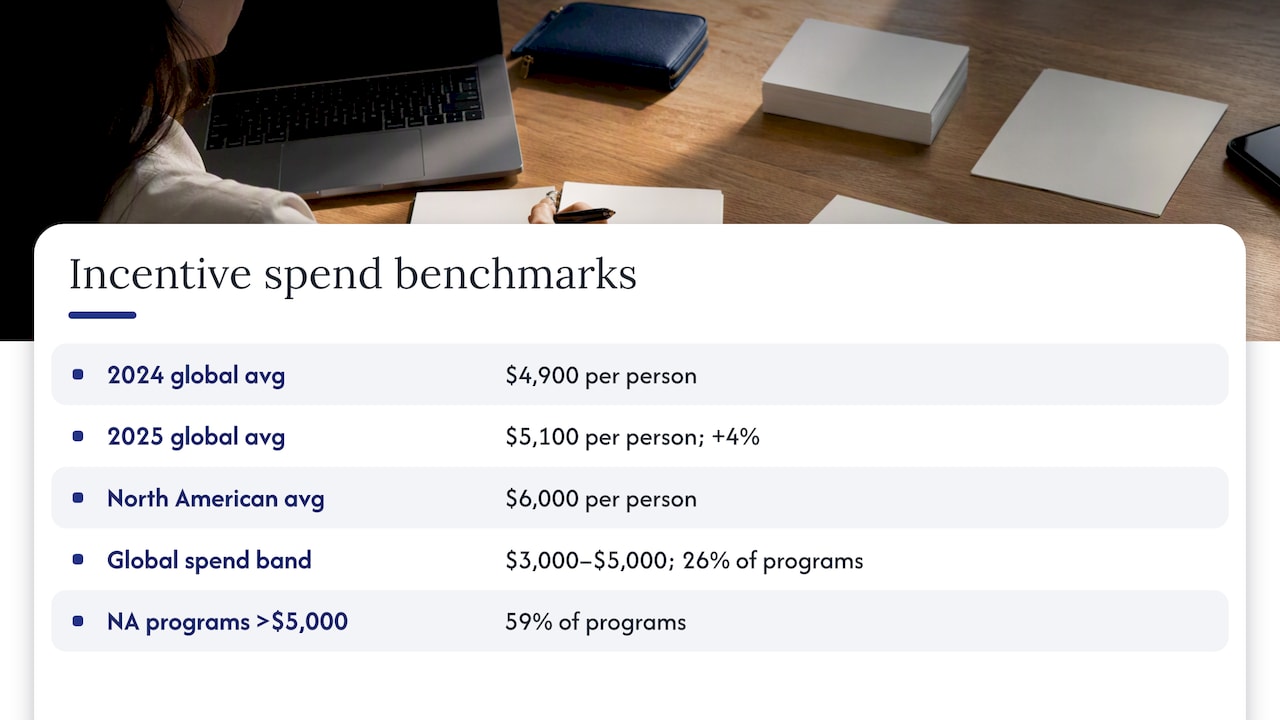
The most cited yardstick is the 2025 Incentive Travel Index. It puts global average spend at $5,100 per person, up 4% from $4,900 in 2024. North American buyers averaged $6,000. The most frequently reported global band was $3,000 to $5,000 per person (26% of programs), while 59% of North American programs exceeded $5,000.
Two cautions before you copy a number into a spreadsheet.
First, these are averages across very different programs. A regional sales meeting and a president’s club for your top 1% are not the same product.
Second, the index defines per-person spend as total program cost divided by qualifiers and guests, including airfare, management fees, taxes and other fees. If a quote leaves out transfers, taxes, gifting or destination management, it is not comparable to the benchmark, and it will grow later.
How program tier changes the number
The same index shows how much tier moves the budget: highest-tier programs averaged $9,000 per person in 2025, against $4,300 for broad-participation programs and $4,100 for typical channel programs. The survey also reports that 47% of buyers expect to use tiers more in future planning.
| Program type | 2025 average per person |
|---|---|
| Highest-tier (top performers) | $9,000 |
| Broad participation | $4,300 |
| Typical channel program | $4,100 |
| North America, all programs | $6,000 |
| Global, all programs | $5,100 |
The practical takeaway: decide who is traveling and what the trip must signal before you pick a figure. A budget that is right for 300 qualifiers can be far too thin for the 20 who anchor your top tier.
How to split the budget across categories
The 2025 Index also offers a planning model for 2026. It projects this allocation:
| Category | Share of budget |
|---|---|
| Hotels | 28% |
| Airfare | 20% |
| Food and beverage | 18% |
| Destination experiences and activities | 13% |
| Third-party agency fees | 7% |
| Ground transportation | 6% |
| Gifting | 4% |
| Other (AV and similar) | 4% |
Hotel and air together are 48%. That is why a flat budget can feel like a cut: those lines are already large and keep rising. The Incentive Research Foundation’s international incentives research notes that labor and supplier costs are climbing too, and frames the better question as which features most strongly drive qualification, attendance and appreciation.
A worked example
Say your all-in ceiling is $6,000 per person for 100 travelers, so $600,000. Using the model above:
- Hotels: $168,000
- Airfare: $120,000
- Food and beverage: $108,000
- Experiences and activities: $78,000
- Agency fees: $42,000
- Ground transportation: $36,000
- Gifting: $24,000
- Other: $24,000
This is an illustration of the percentages, not a quote. Your split will shift with destination and group: a remote resort pushes air and F&B up, a city program pushes experiences and venues up. Use the model as a starting grid, then replace each line with supplier quotes.
Count every traveler, then add the lines people forget
Most overruns come from items that were never in the first number. Build your sheet to include:
- Guests. If partners travel, the per-person figure applies to them too.
- Air and air-on-call. Airfare is the single biggest budget concern among IRF’s international-incentive respondents. Schedule changes can mean overnight hotel nights and replacement tickets.
- Taxes, resort fees and service charges. They are easy to leave out of a room-rate comparison.
- Transfers and ground transportation, including synchronized arrivals for large groups.
- Destination management, permits, security and staffing for any venue not built for private corporate events.
- Gifting, communications and the launch of the program itself.
- Contingency.
On the last point, we recommend a ceiling per person with a built-in reserve. Our guide to setting group trip per-person ceilings with 10–15% contingency walks through the mechanics.
Where to save, and where not to
The IRF research is direct on this: experience design is the wrong area to cut. The experience is what makes people qualify. Savings are better found in:
- Seasonality. Shoulder-season dates can lower hotel and air costs without changing the product.
- Duration. Cutting one night often saves more than downgrading every night.
- Food-and-beverage format. One signature dinner with simpler meals around it keeps the memory and trims the line.
- Gifting. Scale it down before you scale down the destination.
- Venue and agenda utilization. Paying for space you do not use is pure waste.
- Airlift. Choose destinations partly for nonstop connectivity.
If you are early in the decision, our comparison of domestic versus international incentive trips shows how destination choice shifts air, transfer and time costs. Teams with a tighter ceiling can start with our page on cheap incentive trips.
Build good, better and best scenarios
MPI’s reading of the 2025 Index describes a market of cautious optimism: some buyers trim duration, gifting or destination cost, while others invest in better lodging and richer experiences. Both are rational. Put them in front of your leadership as options.
| Scenario | What changes | Best for |
|---|---|---|
| Good | Shoulder season, shorter stay, one signature event | Broad participation, channel partners |
| Better | Peak-adjacent dates, upgraded lodging, optional excursions | Mid-tier qualifiers |
| Best | Premier property, private access, personalized itineraries | Top performers, executives |
The lodging line is where scenarios usually diverge. Adventure-led programs are a good example: a custom adventure lodge package bundles accommodations, dining and guided activities into one price, which can make the trade-off between room quality and activity spend easier to compare.
If you present only the lowest option, you invite the question of why the trip is not better. If you present only the highest, you invite a no. Three options let the decision-maker choose a level of investment rather than reject a proposal.
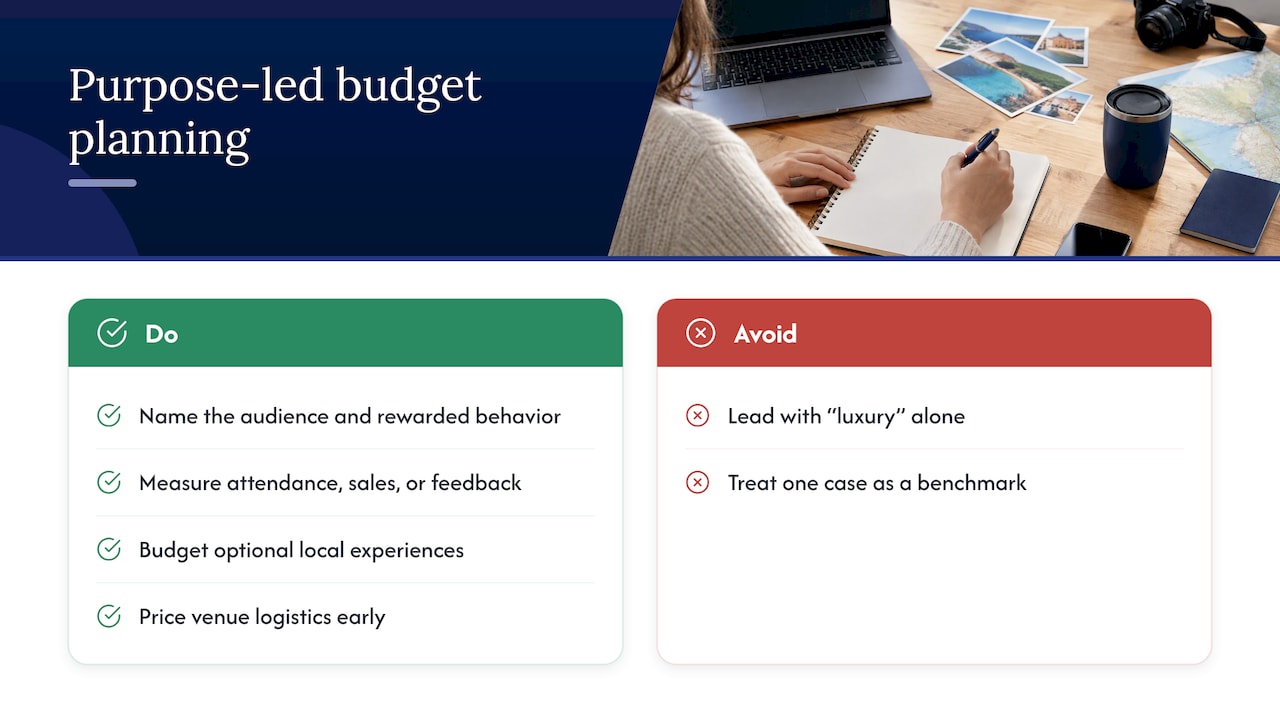
Tie each dollar to a business purpose
GBTA’s CEO said in August 2026 that companies have not stepped away from travel but are more selective and productivity-focused. A budget request that says “luxury” will meet more resistance than one that says what each category buys.
For every major line, write one sentence: who it motivates, what behavior it rewards, and how you will measure it (qualification rates, attendance, post-trip sales, participant feedback).
The evidence for personalization is encouraging, with limits. In a 2025 SITE Crystal case study of a Banff program, 97.7% of participants said they felt appreciated and valued, and the client reported 853% ROI. That is one case, not a benchmark. But it shows why optional experiences, local authenticity and a measurement plan belong in the budget conversation.
Local access can also beat pricier inventory. SITE’s VAOVA Travel case study describes exclusive cultural venues, coordination with destination boards and immersive local programming. The lesson for your budget: when a venue is not designed for a private event, price permits, kitchens, security, transport, staffing and backup plans early.
Keep the budget alive after you approve it
A per-person number set a year ago is a hypothesis. In GBTA’s January 2026 poll, 84% of business-travel buyers expected 2026 spending to rise or hold at 2025 levels, and those expecting an increase averaged 12%. U.S. buyers also flagged cost control as a concern more often than non-U.S. buyers (74% versus 62%).
A simple rhythm helps:
- Set the ceiling and reserve at the planning stage.
- Request firm quotes for hotel, air and ground once dates are fixed.
- Re-forecast at each milestone (contracting, launch, final headcount).
- Release the reserve only after final air and rooming lists are confirmed.
For the planning timeline around those checkpoints, see our guide on how to plan corporate incentive travel that motivates.
Our perspective: budgets fail at the edges
In 35 years of designing high-end travel, we have seen that incentive budgets rarely fail on the big lines. Hotels and flights get quoted carefully. The trouble sits at the edges: the guest who was not counted, the transfer that was not priced, the dinner venue that needed a temporary kitchen.
We plan from total cost per traveler and show clients where every dollar goes. We do not charge service fees, because we are paid by suppliers for booked travel, so the budget you see is not padded by a planning fee on our side. We also offer a price match guarantee, and we are available 24/7, which matters when a flight is cancelled at midnight and the group is mid-itinerary.
Our advice is to protect the moments that make winners feel recognized, and to be disciplined about everything around them. A concierge-level approach means knowing which on-the-ground partners can deliver a private experience at a sensible price, and which “exclusive” add-ons are just markup.
— tammylevent@gmail.com
Let us build your scenarios
If you want a per-person budget with good, better and best options, our team can build it around your qualifier count, tiers and goals. Start with our incentive travel planning page, see how a company incentive program works, or reach us through elitetravelgroup.net.
FAQ
How much should I budget per person for incentive travel?
The 2025 Incentive Travel Index shows a North American average of $6,000 per person and a global average of $5,100, including air, fees and taxes. Broad-participation programs averaged $4,300 and highest-tier programs $9,000. Pick the tier first, then test the number against real quotes.
What is included in an incentive travel budget?
Hotels, airfare, food and beverage, destination experiences, ground transportation, agency fees, gifting and other costs such as AV. The 2025 Index model weights these at 28%, 20%, 18%, 13%, 7%, 6%, 4% and 4%. Add taxes, guests and a contingency reserve.
How much contingency should I hold?
We recommend 10–15% of the per-person ceiling for group trips. Airfare disruption, headcount changes and venue requirements are the usual causes of overruns, so release the reserve only after final air and rooming lists are set.
Where can I cut costs without ruining the trip?
Start with travel dates, program length, food-and-beverage format and gifting. IRF research warns against cutting experience design, since that is what motivates qualifiers.
Sources
- Incentive Travel Index 2025 Survey Highlights
- Incentive Travel Index 2025 Survey Highlights (tier data)
- IRF: The State of International Incentives
- MPI: What the Incentive Travel Index 2025 tells us
- GBTA: 2026 forecast
- GBTA: January 2026 poll
- SITE Crystal: 360insights Banff case study
- SITE Crystal: VAOVA Travel case study
- Altai Mountains Resort adventure packages
