



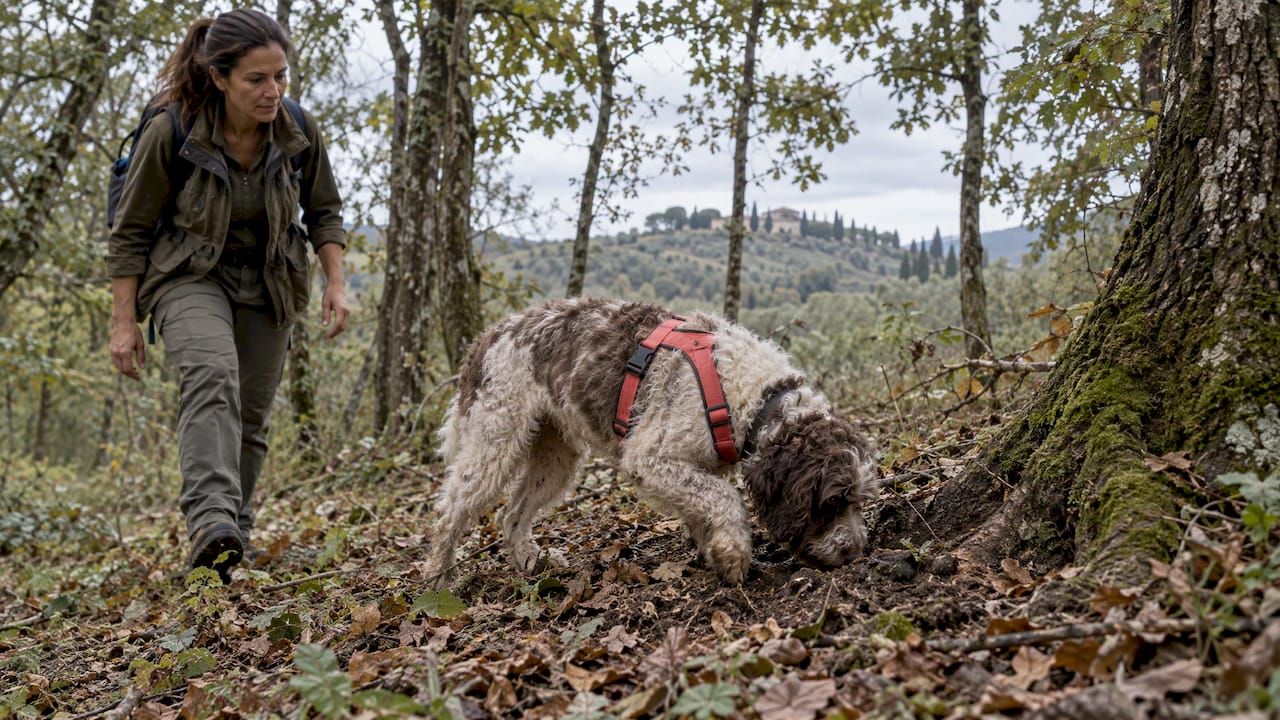
The best time for truffle hunting in Tuscany is October through mid-January for white truffles, with a second strong window from mid-November to mid-March for prized black truffles. Summer and spring hunts exist too, but only two months a year, May and September, are closed to everyone. A good hunt takes about an hour in the woods behind a trained dog, then a long lunch built around the finds. It works best when it is placed deliberately inside a wider Tuscan itinerary, so the timing, the transfer and the table all suit the rest of your trip.
This guide is for travelers planning a refined Tuscan stay, not for anyone hoping to dig up truffles on their own. You will see how the season works, which area suits which truffle, what a hunt costs, what to wear and how to carry truffles through U.S. customs.
TL;DR
- White truffle season runs 1 October to 15 January under Tuscan law. Prized black truffles run 15 November to 15 March. All truffle collecting is banned in May and September.
- San Miniato and the Siena area are the best-known white truffle territories. Guided hunts there are the classic choice for a fall trip.
- Expect about an hour of actual hunting with a licensed hunter and a Lagotto Romagnolo dog. Guided hunts are listed at roughly €100 to €480 per person depending on the lunch and setting.
- Truffles are generally admissible into the U.S. without an import permit, but you must declare them to CBP and keep receipts and packaging.
- A hunt is best folded into a custom Tuscany itinerary, so the date, driver and lunch fit your trip rather than the reverse.
Table of Contents
- When is truffle hunting season in Tuscany?
- Where to hunt: the Tuscan truffle territories
- What actually happens on a guided hunt
- Building a hunt into a luxury Tuscany trip
- A sample plan for a white truffle week
- Bringing truffles home to the United States
- Our perspective
- Plan your Tuscan truffle trip with us
- FAQ
- Sources
When is truffle hunting season in Tuscany?
Tuscany does not have one truffle season. It has several overlapping ones, set by regional law. The Tuscan statute, law 36/2023, Article 8 sets the collecting periods for each species:
| Truffle | Legal collecting period |
|---|---|
| White truffle (Tuber magnatum) | 1 October to 15 January |
| Prized black truffle (Tuber melanosporum) | 15 November to 15 March |
| Summer black, scorzone | 1 June to 31 August, and 1 October to 30 November |
| Autumn black, uncinatum | 1 October to 15 January |
| Winter black and bianchetto (marzuolo) | 15 January to 15 April |
| Macrosporum and mesentericum | 1 October to 31 December |
The same law prohibits searching for and collecting every truffle species across the region in May and September. This closed period, called the fermo ecologico, protects the truffle grounds. If your dates fall in May or September, no legitimate guided hunt can take place, so choose another month or pair Tuscany with a different part of Italy that month.
Which month suits which traveler
The table gives the legal limits. Your choice of month depends on what you want from the trip.
- October and November: the white truffle at its most celebrated. This is also when Tuscan menus fill with shaved truffle over eggs, tagliolini and risotto, and when the fall landscape is at its most photogenic. November is the busiest month for truffle-themed events in San Miniato, so book hotels and guides early.
- December to February: prized black truffle and the tail of the white season. Fewer visitors, cozy fireplace lunches, and a good fit for a winter escape or a holiday-week trip.
- March and April: the winter black and bianchetto, a milder, garlicky truffle. A quiet shoulder-season option.
- June to August: scorzone, the summer black truffle. The flavor is gentler than white or winter black, but the hunt happens in warm, green woods, ideally late in the afternoon when it is cooler.
One caution from the Tuscan food writers who track harvests: yields change year to year with rainfall, temperature and soil conditions, so a great truffle year is never guaranteed. That is a reason to schedule your hunt in the middle of a season rather than on its first or last day, and to keep a day or two of flexibility in your plan.
Where to hunt: the Tuscan truffle territories
Truffles grow where particular trees, soils and moisture meet. According to Visit Tuscany’s official truffle guide, white truffles are gathered mainly in the San Miniato hills and the Siena area, plus the Valtiberina, Mugello and Casentino woods. They favor hilly ground, riverbanks, shady valleys and north-facing slopes. The bianchetto is widespread in those areas and also appears along the coasts of Pisa, Livorno and the Maremma. The scorzone prefers calcareous soils under oak and pine.
For most visitors that translates into two practical bases:
- San Miniato, between Florence and Pisa. The most famous white truffle town in Tuscany and the natural choice for an October or November hunt. It sits roughly midway between the two cities, so it combines easily with a Florence stay.
- The Siena area and Crete Senesi. Rolling clay hills, villas and wineries, with hunts a short drive from Montalcino, Pienza and Chianti. This is the better choice if your trip is built around wine estates and countryside rather than cities.
A hunt from Florence usually means a drive of about 30 to 45 minutes. A hunt from a villa in Chianti or the Val d’Orcia can be much closer. Where you sleep decides how much of your day goes to the road, which is one reason to choose your base and your hunt together. Our guide to Tuscany villas matched to your trip goal shows how different bases change the rhythm of a stay, and Tuscany versus Umbria helps if you are weighing the neighboring truffle region.
What actually happens on a guided hunt
Here is the first thing to understand: you will not find the truffles. The dog will.
A typical Tuscan hunt follows a simple pattern:
- Meeting and briefing. You meet the hunter, who explains the species, the season and how the dogs are trained.
- The walk. You follow the hunter and a Lagotto Romagnolo, the Italian water-dog breed prized for its nose, through oak, poplar or willow woods. When the dog marks a spot, the hunter digs carefully with a small tool so the ground stays healthy. Guests are often invited to lift the truffle out themselves.
- The lunch. The hunt ends at a farmhouse or estate table, with a fixed menu that features truffles, often with wine.
The Tuscany Guide reports that guided hunts in Tuscany cost between €100 and €480, and that the hunt itself lasts about an hour in every case it lists (prices as published on 30 September 2026). The spread comes mostly from the lunch: a simple farmhouse meal sits at the low end, while a private reserve, a longer menu and wine pairings sit toward the top. Check cancellation terms before you book, because they differ widely and the cheapest listing was the only one with free cancellation.
Why you do not need a license
Finding truffles in Tuscany is regulated. The Tuscany Guide notes that a collector needs a regional license, which requires a training course of at least 30 hours and an exam, a minimum age of 16, and a yearly fee of €92.96. Those rules apply to people who collect, not to guests. As a visitor you walk with a licensed hunter, which is exactly why the experience is both legal and worth having. Hunters may work with a maximum of two dogs, and fines for violations run from €500 to €5,000.
What to wear and what to expect
- Closed shoes with grip, such as trainers or light hiking shoes, and long trousers. Woodland ground can be damp and muddy even on a clear day.
- Layers. Autumn mornings in the hills are cool, and woods hold the chill.
- A little patience with language. Hunters are craftspeople first, and not every one speaks fluent English. A guide or concierge who has arranged the day can smooth that over.
- Time for the table. Plan the afternoon around lunch rather than squeezing in a museum visit right after.
The real pleasure of the morning is watching an old craft work. Good hunters read vegetation, soil texture and microclimate, and the dog’s behavior, to find where the truffles are. You leave understanding why a few grams of white truffle can cost so much, and the lunch tastes better for it.
Building a hunt into a luxury Tuscany trip
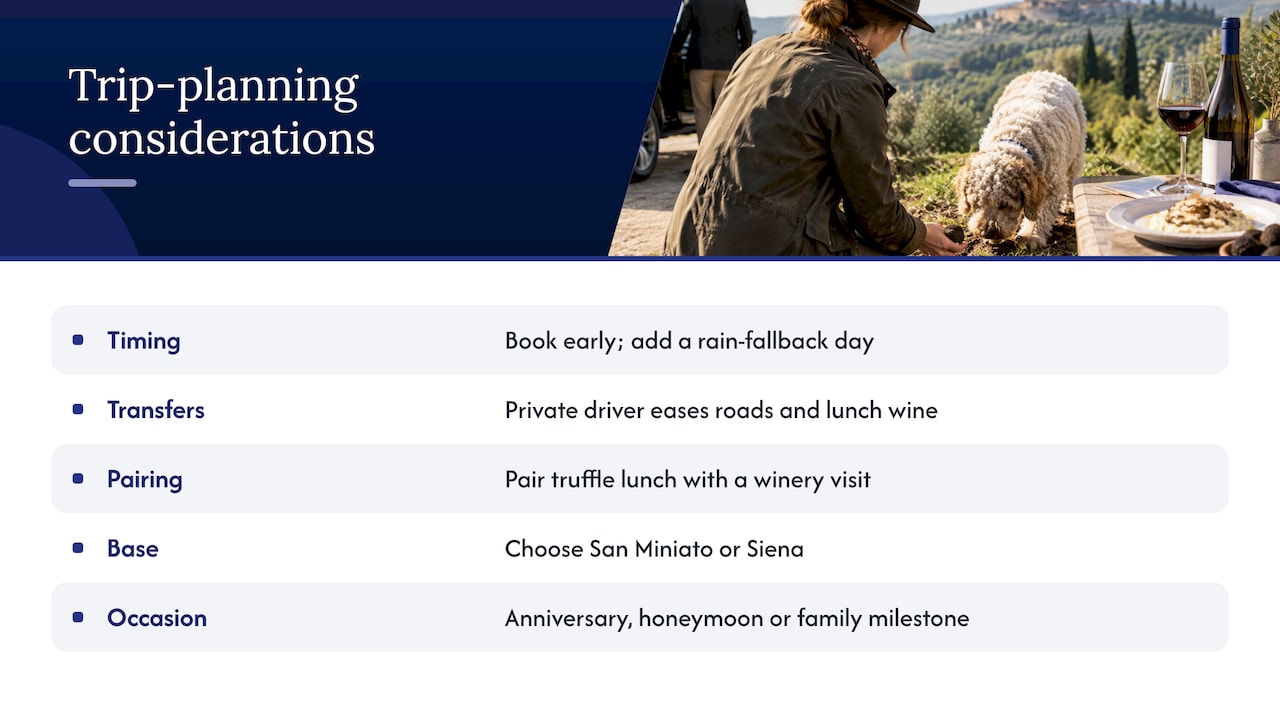
The difference between a pleasant tourist excursion and a memorable day is rarely the hunt itself. It is everything around it.
Timing. In peak white truffle weeks, the best private hunts and the best restaurant tables fill early. A fixed hunt date also needs a fallback in case of heavy rain. Build one spare day into a stay of a week or more.
Transfers. A private driver removes the stress of narrow country roads and means you can enjoy the wine at lunch. It also lets you move on to a winery or a hilltop village afterward without watching the clock.
Pairing. The truffle lunch pairs naturally with a winery visit. Our write-up of a day at Torciano Winery shows how a Tuscan estate day can be arranged around food and wine.
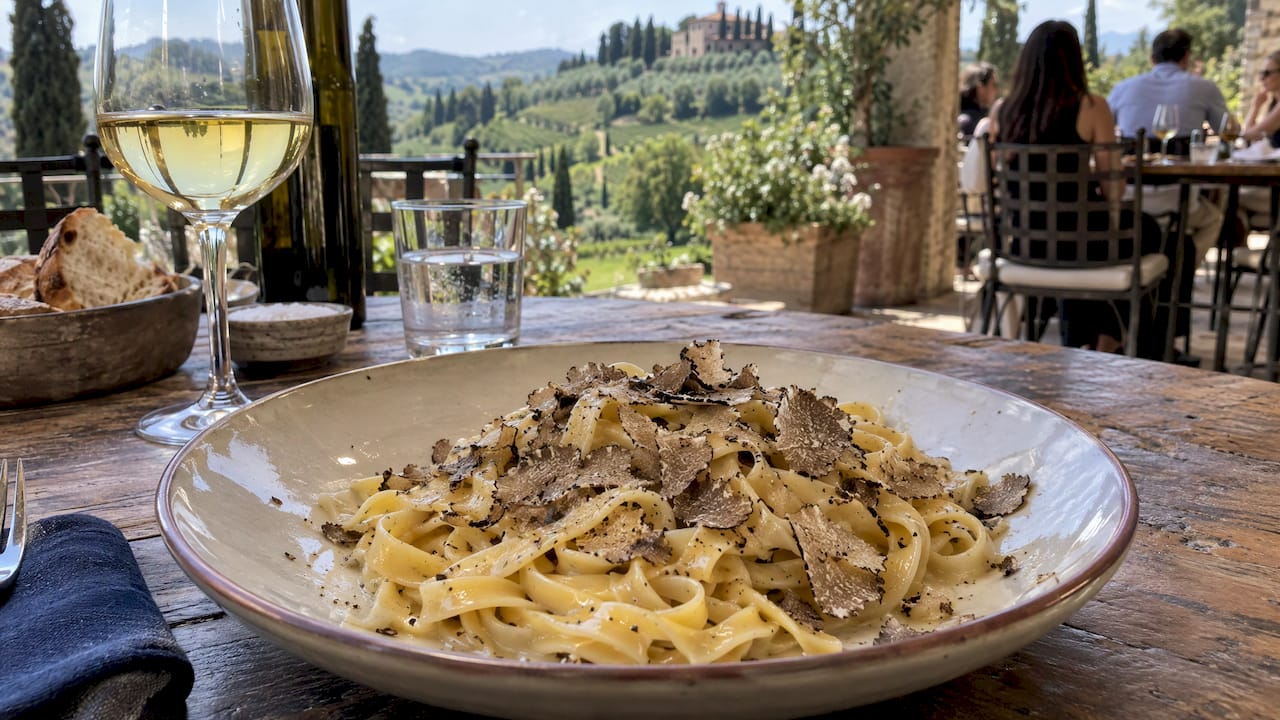
Where you stay. If truffles are the point of the trip, choose a base near San Miniato or Siena. If they are one highlight among many, an itinerary such as our 7-day Tuscany tour or 8-day Siena and Chianti vacation gives you a framework to adjust. For a shorter city stay, the 4-day Florence package leaves room for a half-day country excursion.
Occasions. A truffle hunt makes a strong anniversary, honeymoon or family milestone moment. It is memorable, outdoors, a little unusual and ends with a long meal. If you are planning a celebration, our honeymoon packages and milestone travel ideas show how a single experience can anchor a wider trip.
A sample plan for a white truffle week
This outline shows how the pieces fit together in late October or early November. It is a shape, not a fixed program.
- Days 1 to 2, Florence. Arrive, settle in and see the city on foot. Keep the second evening unhurried.
- Day 3, San Miniato. Morning hunt with a licensed hunter and dog, then a truffle lunch. Return to your hotel or continue to the countryside.
- Days 4 to 6, Siena and Chianti. Estate stays, wine tastings and village walks. Leave one afternoon free.
- Day 7, flexibility. If rain cancels the hunt on day 3, this is the buffer.
Winter and summer versions follow the same rhythm. In winter, swap the white truffle for black and expect a heartier table. In summer, schedule the hunt for late afternoon and finish with an evening meal outdoors.
Bringing truffles home to the United States
Most travelers want to carry at least a small jar or a fresh truffle home. You can, if you handle the paperwork honestly.
USDA APHIS lists fresh truffles among plant products that are generally admissible from all countries without an import permit, subject to inspection by U.S. Customs and Border Protection (CBP). The practical rules:
- Declare them. APHIS states that travelers must declare all agricultural products to CBP officers. As long as a product is declared, you face no penalty even if an inspector decides it cannot enter.
- Keep proof. Hold on to receipts and original packaging, which show where the product came from.
- Buy sealed and clean. Choose truffles that are cleaned of soil. Contaminated soil is the main reason agricultural products are refused.
- Plan for freshness. A fresh truffle loses its aroma fast. Eat it within a few days, and keep it cool and wrapped in paper during travel.
The list of admissible products can change, so check the APHIS page above before you fly. Processed items such as truffle oils, pastes and salts follow the general rules for food products, and the same advice applies: declare them and keep the packaging.
Our perspective
A truffle hunt can be a very ordinary excursion or the most talked-about day of a trip. What separates them is planning. After 35 years of designing luxury travel, we believe the best journeys are built around a handful of moments, with everything else arranged so those moments are effortless.
For Tuscany, that means starting with the season, not the hotel. We look at which truffle suits your dates, which area fits your route, and how far you will travel on the day. Then we shape the rest: where you sleep, how you get there, what you eat afterward and what you do on the day the weather turns.
Our itineraries are customized one at a time, and we work with on-the-ground partners who know the destinations. We charge no service fees and back our bookings with a price match guarantee, and our team is available 24/7, which matters when a plan needs to change in the middle of a trip.
For a honeymoon, a family milestone or a small group of friends, a Tuscan truffle morning followed by a long lunch is one of the great simple pleasures of Italy. We would rather you spend it relaxed than coordinating logistics.
tammylevent@gmail.com
Plan your Tuscan truffle trip with us
If you would like a truffle hunt built into a Tuscany itinerary, our team designs journeys around the experiences you care most about, from a single week in Florence and Chianti to a longer Italian tour. Tell us your dates, who is traveling and what you want from the trip, and we will shape the route, stays and days around it. Explore our luxury vacation packages to see how we work.

We also arrange group travel and incentive trips when a truffle lunch is meant to host a larger party.
FAQ
What time of year is truffle hunting in Tuscany?
The main season is autumn into winter. White truffles can be collected from 1 October to 15 January and prized black truffles from 15 November to 15 March. Summer scorzone is allowed from June to August, and again in October and November. All collecting is banned in May and September.
Can Americans go truffle hunting in Italy?
Yes. Visitors join a guided hunt with a licensed hunter and a trained dog. The collector’s license and training requirements apply to the hunters, not to guests, so you only need to book a guided experience and follow the guide’s instructions.
Can I bring truffles from Italy back to the US?
Generally yes. USDA APHIS lists truffles among plant products admissible without an import permit, subject to CBP inspection. Declare them on arrival, keep your receipts and original packaging, and bring truffles that are free of soil.
How long does a truffle hunt in Tuscany take?
The walk itself is about an hour. With the lunch that follows and a transfer from Florence or Siena, plan on a half day, roughly four to five hours door to door.
How much does a guided truffle hunt cost?
Listings in Tuscany run from about €100 to €480 per person, according to prices published on 30 September 2026. The difference comes largely from the lunch, the private setting and any wine pairing. Prices move with the season, so confirm the current figure when you book.
Sources
- Tuscan regional law 36/2023, Article 8, truffle collecting periods
- Truffles in Tuscany: quick guide, Visit Tuscany
- Tuscan truffles: seasons, regions and varieties
- Truffle hunting in Tuscany: the season is set by law
- Generally authorized non-propagative plant products, USDA APHIS
- International traveler guidance, USDA APHIS
