



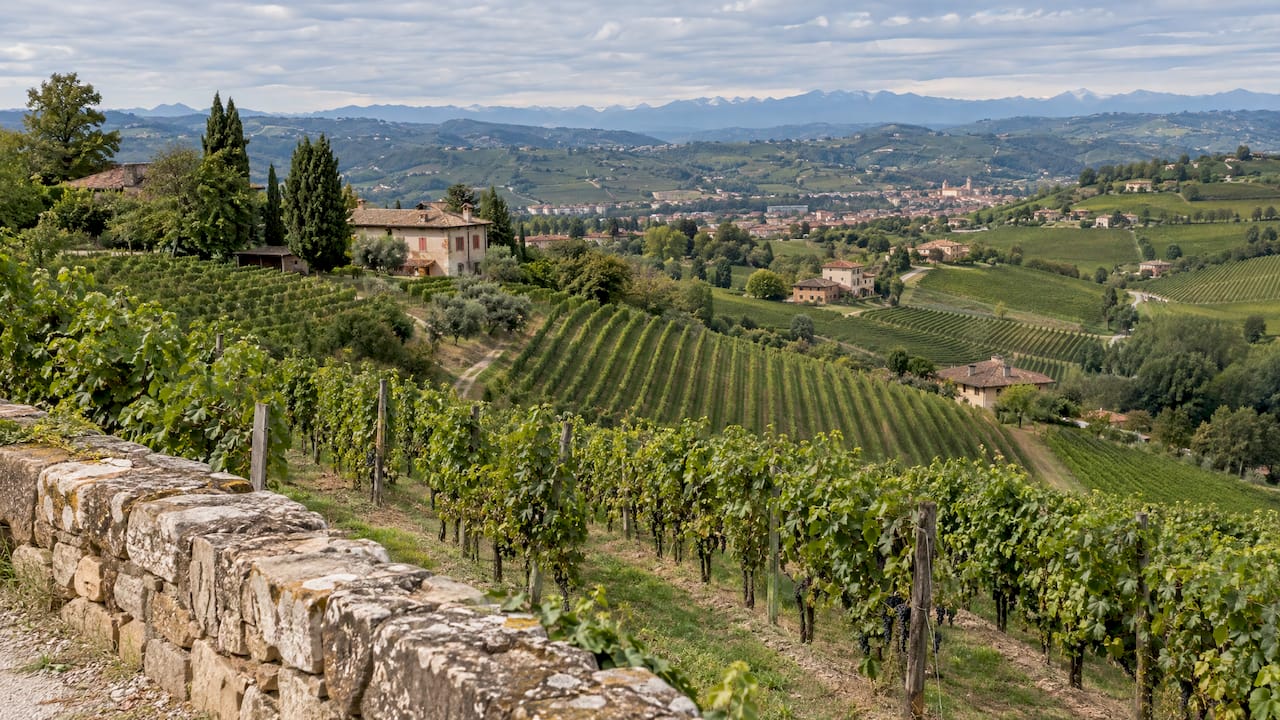
Every one of Italy’s 20 regions makes wine, but you will not visit all of them, and you should not try. The useful way to read the map is in four blocks (northwest, northeast, central, and the south and islands), then to choose the two or three regions whose wines, scenery and pace match the trip you want. This guide gives you that map, the signature wines of each area, and the practical logic of pairing regions so the drives, tastings and lunches fit together. If you want a trip built around those choices, our Italy specialists design it from the first conversation to your return home.
TL;DR
- Italy has 20 wine regions, matching its 20 administrative regions, and Food & Wine notes that most Italian wines are labeled by place rather than by grape.
- Think in four blocks: northwest (Piedmont, Lombardy), northeast (Veneto, Friuli, Alto Adige), central (Tuscany, Umbria) and the south and islands (Campania, Puglia, Sicily, Sardinia).
- For visitors, Tuscany and Piedmont are the two flagships: Sangiovese and Chianti in one, Nebbiolo and Barolo in the other.
- Pick two or three regions per trip, give each at least three or four days, and build in private transfers and cellar appointments rather than driving yourself between them.
Table of Contents
- How Italy’s wine map is organized
- The northwest: Piedmont and Lombardy
- The northeast: Veneto, Friuli and Alto Adige
- Central Italy: Tuscany, Umbria and beyond
- The south and islands
- Which regions are known for what
- How to choose and combine regions
- Planning a Tuscany wine trip first
- Your Italy wine trip, designed for you
- Our perspective
- FAQ
- Sources
How Italy’s wine map is organized
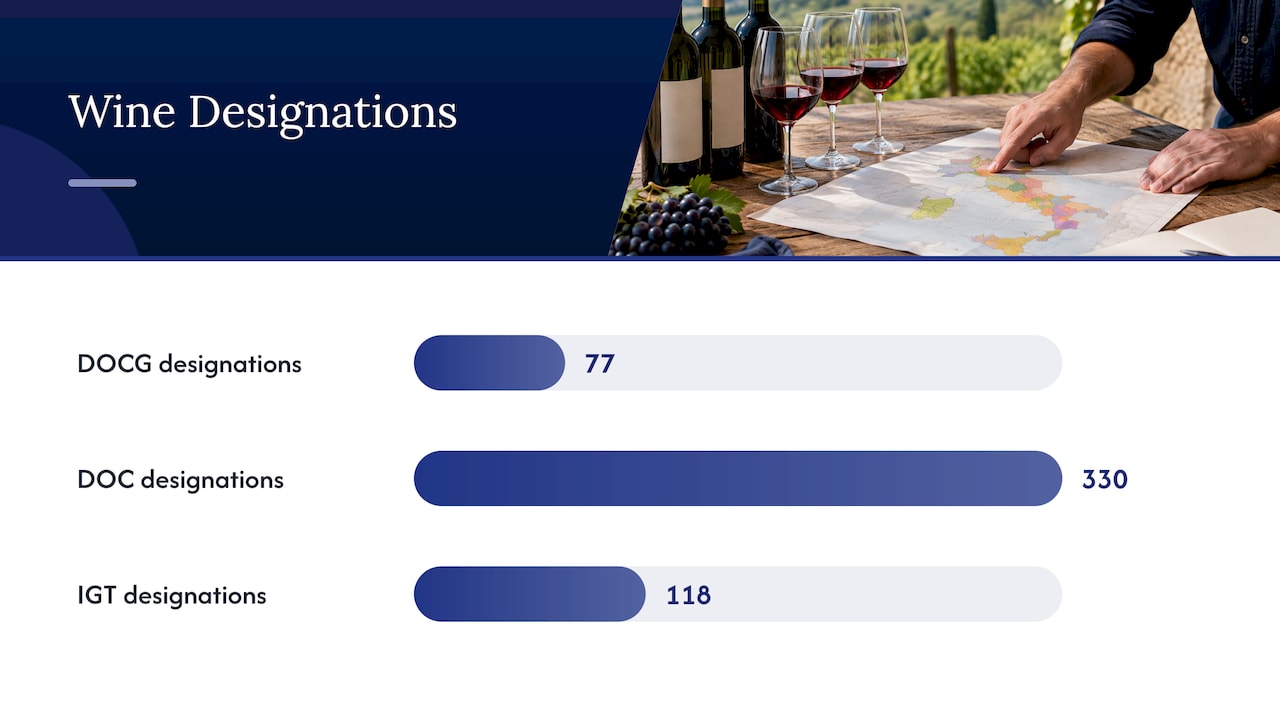
Italy’s regions are political units drawn for government, not for viticulture. The wine zones inside them are defined by a quality system you will see on every label. At the top is DOCG, then DOC, then IGT, a broader category for wines with a looser geographic identity. According to Federdoc’s Vinitaly 2024 brochure, the national totals stand at 77 DOCG, 330 DOC and 118 IGT designations, with figures that update as new zones are approved.
That is why you will see different region counts online. Some writers group zones by grape or by terroir, but the 20 administrative regions are the simplest frame for planning travel, because they match the airports, roads and hotel bases you will actually use. Federdoc also publishes production-area maps of the designations across the regions if you want to see the zones drawn out.
The number of designations tells you something about where to spend time. Piedmont lists 19 DOCG and 41 DOC zones, Tuscany 11 and 41, and Veneto 14 and 29, according to the same Federdoc brochure. Sicily has just 1 DOCG but 23 DOC zones, which reflects a region whose reputation is being rebuilt around a few distinctive places such as Etna.
The four-block shortcut
The simplest map for a traveler splits the country like this:
| Block | Regions | Wines to know | Typical feel |
|---|---|---|---|
| Northwest | Piedmont, Valle d’Aosta, Lombardy, Liguria | Barolo, Barbaresco, Barbera, Franciacorta | Misty hills, truffles, serious reds |
| Northeast | Veneto, Friuli-Venezia Giulia, Trentino-Alto Adige | Prosecco, Amarone, Soave, Pinot Grigio | Mountains, lakes, big range of whites |
| Central | Tuscany, Umbria, Marche, Abruzzo, Lazio | Chianti Classico, Brunello, Sagrantino | Rolling hills, hilltop towns |
| South and islands | Campania, Puglia, Basilicata, Calabria, Sicily, Sardinia | Aglianico, Primitivo, Nero d’Avola, Cannonau | Sun, coastline, volcanic soils |
The Wine Society’s regional guide describes the northwest as the part of Italy that has most consistently made high-quality wine, with Nebbiolo as its key red, and the northeast as the part that exports more wine than the rest of the country put together. Climate moves in the same direction as the map: Italy stretches across roughly eleven degrees of latitude, so wines generally get riper and warmer in style as you travel south.
The northwest: Piedmont and Lombardy
Piedmont sits beneath the Alps, and its best-known wines come from the Langhe hills around the town of Alba. Barolo and Barbaresco are both made from Nebbiolo, a pale, tannic red with aromas the Wine Society’s Sarah Knowles MW describes as rose and tar, and with the structure to age for decades. Nearby you will find Barbera, Dolcetto, Moscato d’Asti and Gavi.
This is a quieter, more intimate region than Tuscany. Visits tend to be by appointment at family cellars, lunches are long, and the season that matters most to many travelers runs from the Nebbiolo harvest into the white truffle weeks in autumn. Plan around Turin’s airport for the Langhe, and use Alba as your base.
Lombardy adds two distinct experiences. Franciacorta is the country’s prestige sparkling wine, made in the traditional method near Lake Iseo. Valtellina, in the Alps above Lake Como, grows Nebbiolo on steep terraces. Both combine easily with a lake stay, which is why they suit couples and milestone trips that want a change of scenery alongside the tasting.
The northeast: Veneto, Friuli and Alto Adige
Veneto is where volume and prestige meet. Prosecco comes from the hills north of Venice, Soave from the Garganega grape, and Valpolicella and Amarone from the hills near Verona. Verona is an easy base: opera, a walkable old town and cellars within a short drive. For a trip with a city component, this is the most convenient wine region in the country.
Friuli-Venezia Giulia, on the Slovenian border, is the place for textured white wines from the Collio and Colli Orientali areas. Trentino-Alto Adige is the most Alpine of the three, with German-speaking villages, Pinot Nero, Gewürztraminer and vineyards climbing toward the Dolomites. The Wine Society notes the contrast between Veneto’s commercial export drive and the more niche, French- and German-influenced styles of Trentino and Alto Adige. For a family or multigenerational group, the Dolomites give non-drinkers hiking, cable cars and spa time while the wine lovers visit cellars.
Central Italy: Tuscany, Umbria and beyond
Tuscany is the region most visitors picture first. The American Wine Society’s Central Italy program divides it into two macro-zones. The central hills hold Chianti, Montalcino and Montepulciano, where Sangiovese is grown on limestone, clay and volcanic soils at elevations up to 600 meters. The Tyrrhenian coast, including Bolgheri and Maremma, has sandy, gravelly soils and is the birthplace of the Super Tuscan style.
The key appellations to recognize are Chianti Classico DOCG, Brunello di Montalcino DOCG (100% Sangiovese), Vino Nobile di Montepulciano DOCG and Bolgheri DOC. Chianti sits between Florence and Siena, which makes it the easiest wine landscape to combine with art, architecture and a luxury villa stay.
Umbria, just south and east, is smaller and quieter. Its signature is Sagrantino. The same American Wine Society guide notes that Montefalco Sagrantino DOCG must be 100% Sagrantino and aged at least 37 months, including 12 in wood, producing one of Italy’s most tannic and age-worthy reds. Orvieto offers a lighter white alternative. If you are deciding between the two regions, our guide to Tuscany vs. Umbria sets out which suits which kind of trip.
Further along the Adriatic, Abruzzo’s Montepulciano d’Abruzzo and Marche’s Verdicchio are excellent for travelers who have already done the classics and want something less visited.
The south and islands
Southern Italy rewards travelers who want wine mixed with coastline and history. Campania, around Naples and the Amalfi Coast, is home to Aglianico (including Taurasi) and the white Greco. Puglia, the heel of the boot, is known for Primitivo and Negroamaro, and for whitewashed towns and baroque Lecce. Basilicata’s Aglianico del Vulture grows around an extinct volcano, as Italian Wine Central’s regional roundup explains, in a region that makes only a tiny share of national output.
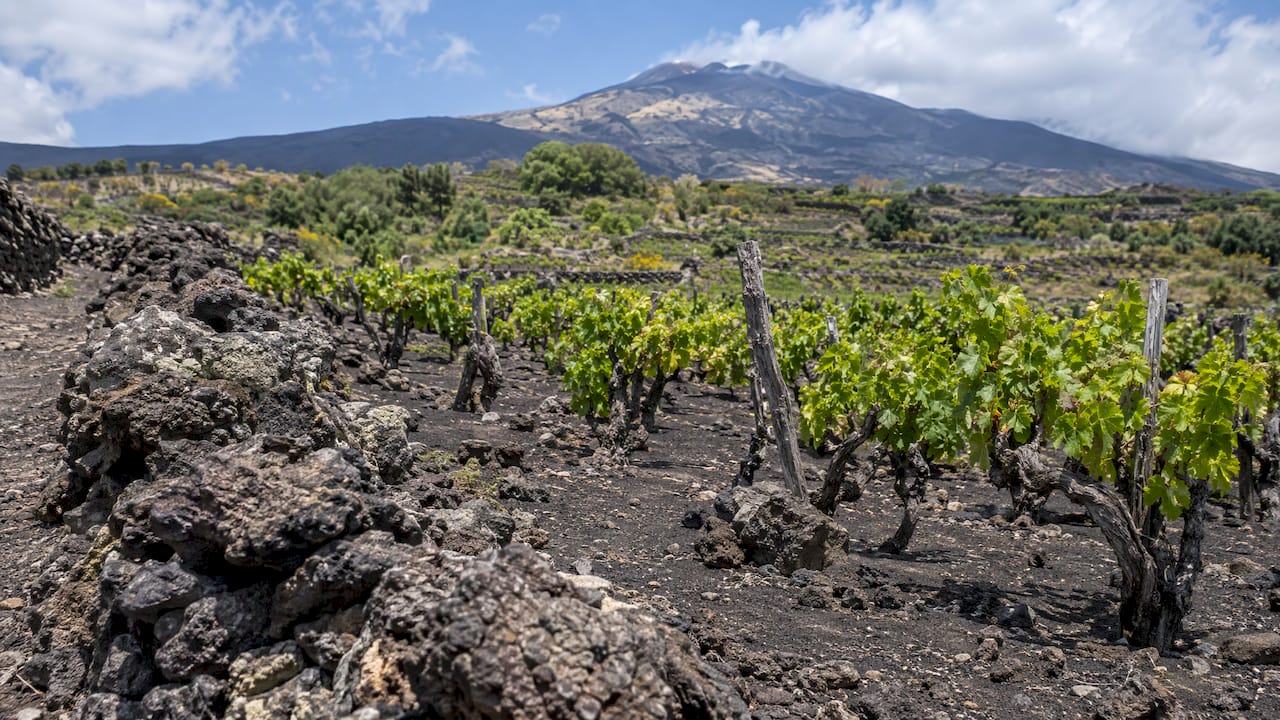
Sicily is the standout for adventurous wine travelers. Mount Etna rises to 3,357 meters, and its reds from Nerello Mascalese grow on old lava flows above 700 meters. Catania or Taormina makes a natural base for estate visits. Sardinia adds Cannonau and Vermentino and suits a beach-and-wine trip. If your itinerary includes the Amalfi Coast, our piece on Capri and what to do there shows how an island day can sit alongside a mainland wine stop.
Which regions are known for what
Use this as a quick reference when choosing where to go:
| Region | Signature wines | Best for |
|---|---|---|
| Tuscany | Chianti Classico, Brunello, Super Tuscans | First-time visitors, villas, art and wine |
| Piedmont | Barolo, Barbaresco, Barbera | Collectors, truffle season, quiet cellars |
| Veneto | Prosecco, Amarone, Soave | City plus wine, Verona and Venice |
| Alto Adige | Pinot Nero, Gewürztraminer | Mountains and active families |
| Lombardy | Franciacorta, Valtellina | Lake stays, sparkling wine |
| Umbria | Sagrantino, Orvieto | Slower pace, hill towns |
| Campania | Aglianico, Greco | Coast, Pompeii, Amalfi |
| Puglia | Primitivo, Negroamaro | Beaches, baroque towns |
| Sicily | Etna reds, Nero d’Avola | Volcano, culture, adventure |
| Sardinia | Cannonau, Vermentino | Beach and island travel |
For the food side of any of these, a regional food culture guide is a good way to understand why local dishes and local wines belong together at the table. Italian wines are built for the cuisine of their own region, so the best pairings are usually the local ones.
How to choose and combine regions
The mistake most travelers make is trying to see too much. A workable rule is four days for a single region such as Chianti or the Langhe, and seven to ten days for two or three. The classic pairings are Tuscany with Umbria, which share a landscape and sit close together, and Tuscany with Piedmont, which makes for a much bigger contrast but a longer transfer. Both flagship regions sit roughly four hours apart by autostrada, so the move between them should be planned as part of the day, not squeezed in after a tasting.
Three questions decide the shortlist:
- What do you want to drink? If you love big structured reds, start in Piedmont and Tuscany. If you prefer sparkling and white wines, look at Veneto, Lombardy and Friuli. If you want something new, go to Etna.
- What else belongs on the trip? Florence and Siena, Verona and Venice, the Amalfi Coast, or a lake. The best wine itinerary is one where the in-between days are as good as the cellar days.
- When can you travel? Harvest in September and October is atmospheric but busy, and many family estates close for a week or two around mid-August. Late spring and early autumn are comfortable for both weather and availability. Our best time to visit Italy guide breaks the year down month by month.
Practical points that shape the trip
Hilltop towns in Tuscany have restricted traffic zones, and the winding roads between wine towns are slower than a map suggests. Many of the best estates take visitors by appointment only, and the most sought-after tastings, such as a private cellar session with the winemaker, need to be arranged well ahead. Those details are exactly what a specialist smooths over: transfers, driver-guides, reservations at the right estates and restaurants, and timing that keeps long lunches from clashing with the next appointment.
Planning a Tuscany wine trip first
If this is your first Italian wine trip, Tuscany is the most forgiving place to start: the villages are beautiful, the infrastructure is excellent, and Florence is a major international gateway. We have written a full guide to planning a private Tuscany wine tour, and you can see what a day at a working estate looks like in A Day at Torciano Winery.
For itineraries already built around the region, look at our Tuscany, Siena and Chianti 8-day vacation package, the 7-day, 6-night Tuscany tour or the shorter 4-day Florence package. Couples combining wine with a longer route will find ideas in our 12-night Italy honeymoon itinerary.
Your Italy wine trip, designed for you
Elite Travel Management Group is a luxury travel agency with 35 years of experience designing customized journeys across Europe and beyond. For Italy, we build one-on-one, concierge-level itineraries around the regions and wines you care about, drawing on on-the-ground partners we know. We charge no service fees, offer a price match guarantee, and are available 24/7 from the first conversation until you are home.
See our Italy vacation packages or explore all of our luxury vacation packages to start planning.
Our perspective
Italian wine rewards the traveler who chooses fewer places and sees them well. The map has more than 500 official appellations, but a memorable trip rarely needs more than two regions, one rhythm of days, and a handful of cellars where someone is expecting you.
After 35 years designing high-end travel, we think the difference between a pleasant wine holiday and an exceptional one is in the sequencing: the right hotel in the right village, a private tasting at the hour the light is best, a lunch that is booked rather than hoped for, and a transfer that is simply handled. That is what a concierge-level approach is for, and it is why we design each Italy itinerary around the person traveling rather than around a template.
We also believe that wine travel should not carry hidden costs. We charge no service fees and stand behind a price match guarantee, so you can plan Piedmont, Tuscany or Etna with confidence and focus on the part that matters: what is in the glass in front of you.
tammylevent@gmail.com
FAQ
How many wine regions does Italy have?
Italy has 20 wine regions, one for each of its administrative regions, stretching from Lombardy and Valle d’Aosta in the north to Sicily in the south, as Food & Wine describes. Within them sit hundreds of smaller zones: 77 DOCG, 330 DOC and 118 IGT, according to Federdoc. Counts that differ online usually group zones in other ways.
Which Italian wine region is best to visit first?
Tuscany is the most natural first choice. It has Chianti between Florence and Siena, Montalcino and Montepulciano, and the Bolgheri coast, all in one compact area with excellent hotels and a major airport. Travelers who want fewer crowds and more structured reds often choose Piedmont for a second trip.
What is the difference between DOC and DOCG?
Both are official quality designations that tie a wine to a place and a set of production rules. DOCG is the higher tier, applied to historic zones such as Chianti and Barolo. Where Food & Wine’s guide explains the system, it notes that most Italian wines are labeled by region rather than grape. IGT is a broader, more flexible category.
How many days do I need for an Italian wine trip?
Plan about four days for a single region such as Chianti or the Langhe, and seven to ten days for two or three regions. That leaves room for cellar visits, scenic drives and long lunches without rushing. Moving between distant regions, such as Tuscany and Piedmont, adds a half day of travel.
Can I visit Italian wineries without a car?
Yes. Many estates are in rural hills where public transport is limited and hilltop towns restrict traffic, so private drivers and guided transfers are the practical choice. We arrange these as part of an Italy itinerary so tastings and meals run to plan.
Sources
- Italian Wine Regions & Italian Wine, Food & Wine
- Italian wines with designation of origin, Federdoc Vinitaly 2024 brochure
- Production areas, Federdoc
- Get To Know Italian Wine: Key Regions And Wine Styles, The Wine Society
- Maps and Regions, American Wine Society National Tasting Project
- Regional Roundup: Basilicata and Calabria, Italian Wine Central
