




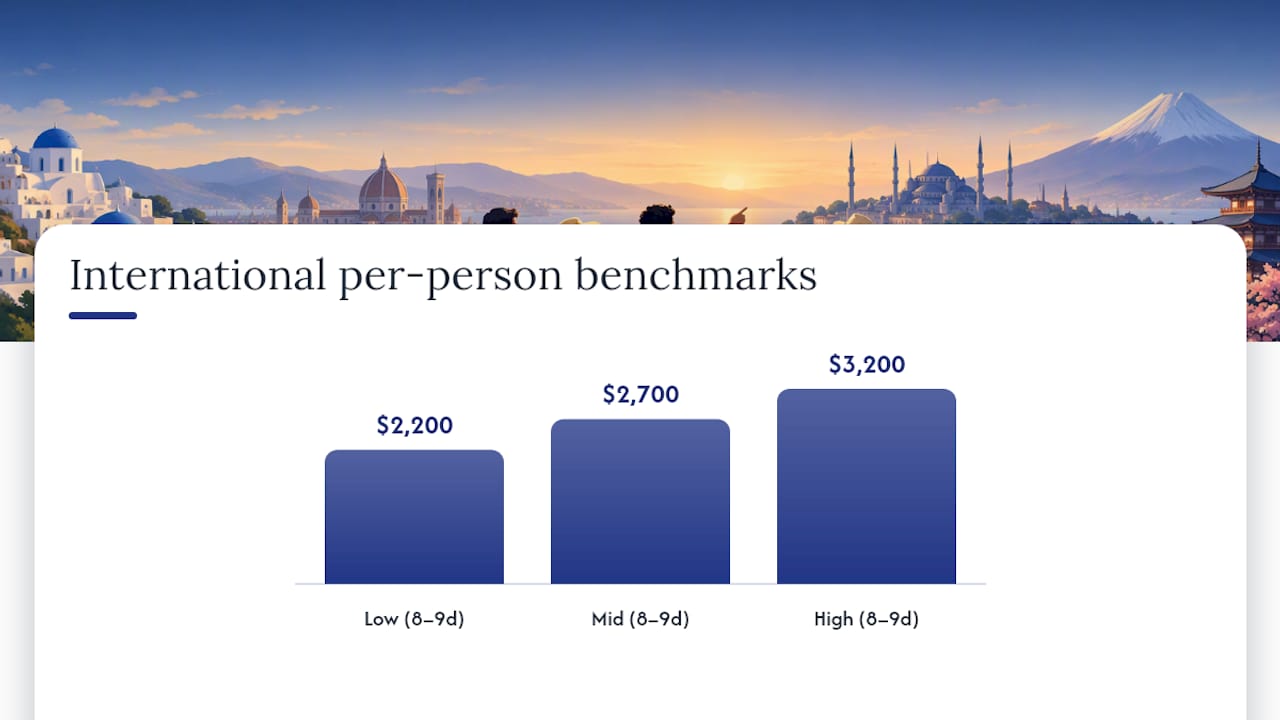
A short domestic weekend trip for a group typically runs $150 to $300 per person per day, while a typical 7 to 9 day international group trip lands between $2,200 and $3,200 per person. The single best first move is to set a per-person spending ceiling with a 10 to a 15% contingency built in, then build a shared tracking template before anyone books a flight. The sections below break down the line items, the levers that move your total, and the splitting and charter details that trip up most groups.
TL;DR:
- Group size and booking early can significantly reduce costs, especially through shared accommodations and discounted transport or activity packages.
- Establishing fixed and flexible cost categories before booking ensures clarity and prevents disputes over expenses like meals, lodging, and optional activities.
- Charter flights are cost-effective only if the group size fills most of the plane and plans are unlikely to change, with strict contract and protection protocols.
- Using a clear, pre-set budget ceiling helps avoid overspending and ensures all travelers agree on spending limits before making arrangements.
- Outsourcing complex logistics and contract review to a professional travel planner can save money and reduce risks, especially for large or intricate group trips.
Table of Contents
- Typical cost breakdown and per-person benchmarks
- How group size, room setup, and trip type change your total
- Building your budget step by step with a copy-ready template
- How to split, track, and settle shared costs fairly
- Charter flights, ticket pricing, and passenger protections
- When a professional planner earns its cost
- Payment methods and timing for group travel expenses
- Negotiating group rates with vendors and service providers
- Budget conversations first
- Let Elite Travel manage the budget and the contracts
- Sources
- FAQ
Typical cost breakdown and per-person benchmarks
Group trip costs come down to a handful of predictable categories, and knowing the ranges before you start planning keeps the conversation grounded instead of guesswork. For international group trips averaging 8 to 9 days, common budgeting benchmarks include a low range of $2,200, a mid-range of $2,700, and a high end of $3,200 per person, with lodging running $150 to $250 per night and meals averaging about $100 per person per day. Shorter domestic trips of 4 to 5 days tend to fall between $150 and $300 per person per day all-in, while international trips more commonly run $200 to $400 per day, according to budget breakdowns from travel writers, with accommodation usually the biggest swing factor.
Most group budgets encompass categories such as lodging, transportation, meals, activities, taxes and fees, and gratuities, each contributing to the overall cost.
One traveler’s per-day meal budget averaging around $100 adds up fast: over an 8-day trip, that alone is $800 per person before a single dinner reservation is booked.
Here is a simple worked example. Say a group of eight books a mid-tier 8-day trip at the Princeton benchmark of $2,700 per person, for a group total of $21,600. That gap between the headline number and the number you should actually budget is exactly why the next step matters more than the first estimate.
How group size, room setup, and trip type change your total
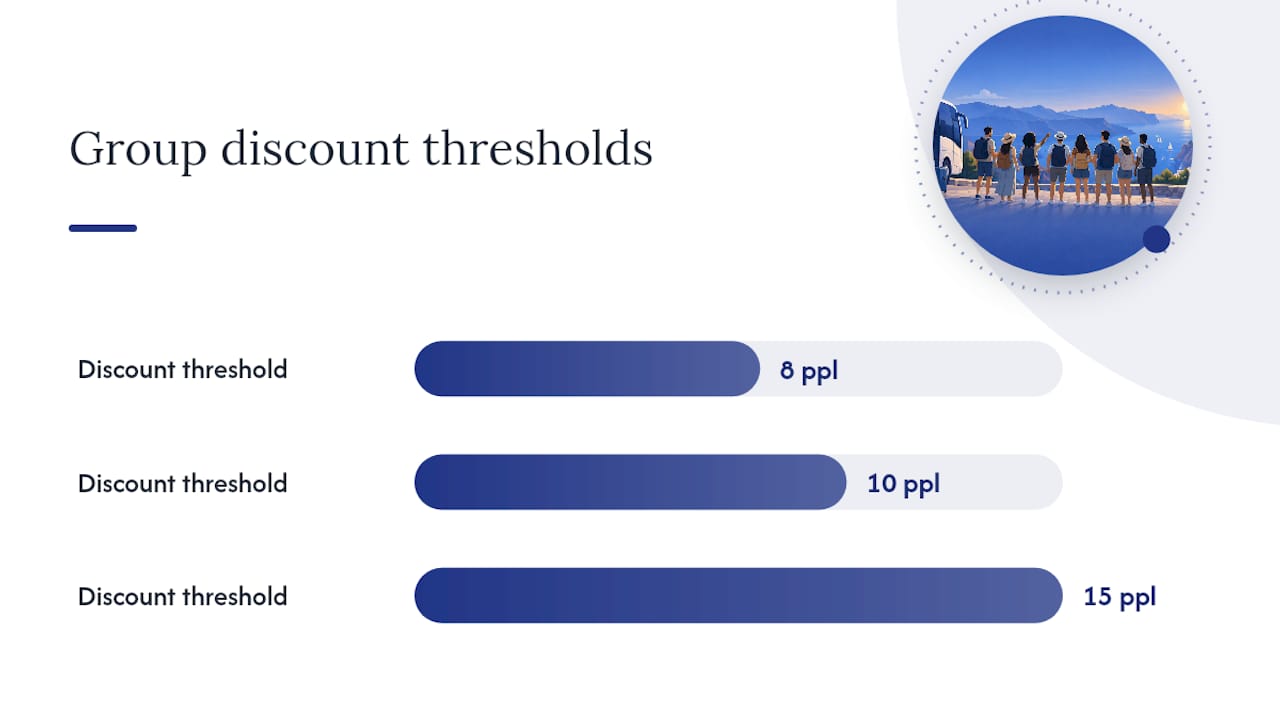
Group size is the biggest cost lever most planners underuse. A shared 4-bedroom rental split six ways can cost far less per person than six separate hotel rooms, but only if everyone agrees on room configuration before the deposit goes down, since uneven splits (a couple in a king room versus two singles sharing twins) are the most common source of post-trip arguments. Booking minimums also change the math: many tour operators, restaurants, and activity providers offer discounted group rates once a booking hits 8, 10, or 15 people, and missing that threshold by one or two travelers can push the whole group into a higher price tier.
Trip type matters just as much as headcount. A comparison of luxury group travel companies shows how filled seats and negotiated blocks affect per-person pricing differently than a loosely organized trip where everyone books separately. A few patterns worth knowing:
- Larger groups often unlock lower per-person lodging costs when booking full villas, vacation rentals, or hotel room blocks rather than individual rooms.
- Group discounts are most common on transport, group dining, and ticketed activities, less so on flights unless chartering.
- Flexibility drops as costs lock in: airfare and hotel blocks are often the first things to become non-refundable, sometimes 60 to 90 days before departure.
- Smaller sub-groups within a larger trip (a “budget tier” and a “splurge tier”) can preserve inclusion without forcing everyone to the same spending level.
The trade-off is straightforward: the earlier you lock in group rates, the more you save, but the less room you have to change plans if someone drops out or the group grows.
Building your budget step by step with a copy-ready template
A repeatable process prevents the scramble that happens when half the group wants a beach resort and the other half wants a city apartment. Budgeting guides recommend starting the money conversation before choosing a destination, not after.
- Collect four numbers from every traveler: their total trip ceiling, their flight budget cap, their daily spending limit, and one non-negotiable splurge they want included.
- Lock major bookings early and mark each one as fixed (flights, lodging deposits) or flexible (activities, some meals) so the group knows what can still change.
- Build category budgets from those fixed and flexible items, then divide the group total to get an honest per-person number, including your contingency.
- Set decision deadlines for each fixed booking so the group does not lose group rates or availability while waiting on stragglers.
Once you have those numbers, a simple shared template does the rest of the work. A usable structure includes:
- Trip total ceiling and per-person ceiling (with contingency included).
- Fixed costs list: flights, lodging deposit, charter or transport contracts.
- Flexible costs list: meals, activities, incidentals, with a daily cap per person.
- Running total column that updates as bookings confirm.
- A separate contingency line, never blended into the daily budget.
Pro Tip: Ask every traveler to submit their four numbers before you share any destination ideas. It keeps the budget conversation honest instead of anchored to whoever suggests the first resort.
For readers who want more detail on trimming costs without cutting quality, practical guidance on optimizing travel budgets covers where to spend and where to cut.
How to split, track, and settle shared costs fairly
The clearest source of group trip friction is not the total cost, it is confusion over who owes what. Before the trip starts, define exactly what counts as a shared expense (lodging, group transport, communal dinners) versus an individual one (souvenirs, solo excursions, room service), and agree on a rule for optional activities: only people who join pay in, and the group total never absorbs someone else’s choice to skip an excursion.
For tracking, groups generally choose between two approaches:
- A shared spreadsheet, low-friction and free, works well for smaller groups who trust each other to log expenses honestly.
- An expense-splitting app automates the math and reduces disputes for larger groups, though it requires everyone to actually use it and to be comfortable sharing spending data with the group.
Comprehensive group expense guides recommend logging costs immediately rather than trying to reconstruct receipts at the end of the trip, plus a midpoint reconciliation check so nobody is surprised by a final tally.
Pro Tip: Run one reconciliation checkpoint at the trip’s midpoint, not just at the end. It catches math errors while receipts are still fresh and gives the group a chance to adjust spending before the last few days.
Common edge cases have straightforward fixes: a couple sharing a room pays the two-person room rate split between them rather than the group’s average per-person lodging cost, and non-drinkers at a shared dinner either order separately or the group agrees in advance to split food only, with drinks itemized. Settling up at the end works best as one net transfer per person rather than a dozen small reimbursements crossing each other.
Charter flights, ticket pricing, and passenger protections
Charter flights can save a group money when the group is large enough to fill most of a plane and the destination lacks convenient scheduled service, but they come with less flexibility if plans change. DOT guidance describes three charter types: public charters, sold to individual passengers often as part of a package; affinity charters, limited to members of a specific organization; and single-entity charters, where one buyer (often a tour operator or the group itself) purchases the entire flight.
Before paying any deposit on a charter, confirm these points:
- Ask whether the flight is a Public Charter or an Affinity Charter, since consumer protections and resale rules differ between the two.
- Request the operator/participant contract in writing, since DOT identifies this contract, which must state price per passenger, itinerary, and conditions, as the essential protection for charter purchasers.
- Compare the charter fare to scheduled airfare for the same dates before committing, since charters are not automatically cheaper.
For scheduled flights, DOT requires airlines and ticket agents that display prices to advertise the total price the consumer must actually pay, which makes it easier to compare group airfare quotes without hidden add-ons appearing later.
When a professional planner earns its cost
Complex logistics are where a managed planner pays for itself: multi-family destination weddings, incentive trips with contracted room blocks, or any trip involving a charter contract. A planner reviews vendor and charter contracts line by line, negotiates deposit schedules so the group is not exposed to full prepayment months out, and builds the contingency buffer into the plan from day one instead of discovering the gap after final payment.
A luxury travel management group with extensive experience offers contract review and concierge-level itinerary design, charges no service fees, and backs bookings with a price match guarantee, providing support available 24/7 for groups juggling multiple time zones and travelers. Before hiring any planner, ask what is included in their fee structure, whether they review supplier contracts directly, and how they handle deposit timing if the group’s headcount changes.
Payment methods and timing for group travel expenses
Most group trips work best with a staged payment structure rather than one lump sum: an initial deposit to hold lodging and transport, a second payment 60 to 90 days out when final headcounts are confirmed, and the balance due closer to departure. Paying by credit card for deposits and fixed bookings gives travelers dispute protections that a bank transfer does not, which matters if a vendor cancels or changes terms.
For shared group expenses during the trip itself, decide in advance whether one person fronts costs and gets reimbursed or whether each traveler pays their own share on the spot. Fronting works for smaller purchases like a group dinner, but larger costs, such as a charter deposit or a villa rental, are better split directly between travelers’ own payment methods so no single person carries the financial or dispute risk. Set a clear deadline for final payments tied to the vendor’s own cancellation policy, not just an arbitrary internal date, so nobody in the group misses a non-refundable window.
Negotiating group rates with vendors and service providers
Group rates are rarely fixed. Hotels, restaurants, and tour operators often have flexibility once your group hits their minimum headcount, and asking directly, rather than accepting the first quote, frequently gets better terms.
A few approaches that consistently work:
- Ask about off-peak or shoulder-season group rates, which are often discounted further than the vendor’s standard group pricing.
- Negotiate deposit terms, not just price, since a smaller upfront deposit protects your group if headcount shifts.
- Request a written rate confirmation before paying anything, so verbal promises do not disappear when a different staff member handles your booking.
- Bundle bookings with one vendor (lodging plus meals, or transport plus activities) to strengthen your negotiating position for a package discount.
Vendors that regularly work with groups, from tour operators to venues, generally have more room to negotiate than a single restaurant handling its first large reservation, so it helps to ask directly what their group threshold is before assuming the quoted price is final.
Budget conversations first
The number that matters most is not the trip average, it is the ceiling your group agrees on before anyone books anything. In practice, mismatched budgets surface fastest when one traveler suggests a splurge activity nobody else priced in, so raise it early and let the group vote with real numbers, not vague enthusiasm. Use the template above, and if the logistics get complex, a planning call is worth the hour.
— tammylevent@gmail.com
Let Elite Travel manage the budget and the contracts
Building a group budget by spreadsheet works until the group grows past eight people, a charter enters the picture, or a destination wedding needs three vendor contracts reviewed at once. That is where Elite Travel’s group travel service takes over the contract review, deposit negotiation, and per-person cost tracking so your group gets one clear number instead of a dozen spreadsheet arguments.

Some luxury travel services charge no service fees, back bookings with a price match guarantee, and offer 24/7 availability for groups coordinating across time zones. Visit the luxury vacation packages page to see how a concierge-managed group trip comes together, or reach out directly to start a conversation about your group’s dates and budget.
Sources
- Group travel budgeting — Princeton University Travel
- Charter flights | U.S. Department of Transportation
- Buying a ticket | U.S. Department of Transportation
- Group trip budget template: Set expectations before booking | Stamp’d (Adventure-Seeker)
- The complete guide to managing group trip expenses | Dayze
FAQ
What is the average cost of a group travel package?
For an 8 to 9 day international group trip, benchmarks range from $2,200 on the low end to $3,200 on the high end per person, with a mid-range around $2,700. Shorter domestic trips typically run $150 to $300 per person per day, while international trips run $200 to $400 per day according to travel budget breakdowns.
Is $10,000 too much for a vacation?
Whether $10,000 is too much depends entirely on trip length, destination, and group size rather than any fixed ceiling. Using the Princeton per-person benchmarks as a reference, a mid-range 8 to 9 day international trip costs about $2,700 per person. Groups can multiply this by their number of travelers to estimate a total budget, with more luxurious itineraries costing more.
Are group trips worth it?
Group trips often lower per-person costs on lodging and activities through shared rentals and group discounts, but the savings depend on everyone agreeing on a budget ceiling before booking. The value comes from splitting fixed costs like a villa or charter across more people, not from any guaranteed universal discount.
Is it cheaper to travel solo or in a group?
Solo travel avoids the coordination costs of group budgeting, but groups can lower per-person lodging and transport costs by splitting shared rentals, hotel blocks, or charter seats across more travelers. Which is cheaper depends on whether the group can fill enough seats or rooms to unlock those group rates, a trade-off covered in more detail in group versus individual travel comparisons.
