




For most group trips, an agency-managed group fund or a staged per-person installment plan puts cash in hand and keeps tracking clear. Buy now, pay later (BNPL) pay-in-four exists and can help some travelers, but it carries trade-offs for them and for you. Below, we show how to set timelines, decide who pays fees, and automate tracking.
TL;DR:
- BNPL pay in four commonly starts with 25% down, followed by three biweekly installments; late fees, autopay, merchant fees, and weaker dispute protections can complicate refunds.
- Get supplier deposit and final payment dates in writing, then set earlier collection deadlines and size the deposit to cover the supplier’s first payment.
- Say who pays fees and document cancellation, refund, and dropout rules before collecting, including who receives any unused balance from the group fund.
- Choose a collection tool with individual payment links, live fund totals, saved card charges, automatic reminders, and exportable reports; tie deadlines to supplier cutoffs.
Table of Contents
- Which group trip payment options can you choose from?
- How do you set up a payment plan step by step?
- What tools automate collection and tracking?
- How do you get travelers to pay on time?
- Why does experienced agency management change the outcome?
- Want us to handle your group’s payments?
- FAQ
- Sources
Which group trip payment options can you choose from?
Three models cover almost every group. Each one changes who holds the money, who carries the risk, and how much chasing you do.
- Agency-managed group fund: Travelers pay real money into a shared pool, and payments are released to suppliers when the booking requires them. You get cash certainty and one place to see who has paid.
- Staged per-person installments: Each traveler pays a deposit, a mid-payment and a final balance. This works through supplier authorizations, saved-card charges or agency invoices.
- BNPL pay-in-four: The Consumer Financial Protection Bureau (CFPB) describes these as interest-free installment loans that can include mandatory autopay and late fees. A common structure is a 25% down payment followed by three installments every two weeks.
On the organizer side, a group fund gives you the clearest cash position, while staged installments depend on each traveler’s card or bank holding up. With BNPL, the provider usually takes on the collection risk, but merchants typically pay a fee, and refunds and disputes can get more complicated. CFPB consumer guidance notes that BNPL offers fewer dispute protections than credit cards. If you pick BNPL, decide up front whether travelers cover that fee.
How do you set up a payment plan step by step?
Work backward from the date your supplier needs final money. Everything else hangs off that date.
- Find the supplier cutoff. Ask for the deposit and final payment deadlines in writing, then set your own deadlines ahead of the supplier cutoff.
- Calculate a per-person total. Add every shared cost, then build in a contingency buffer. Planners commonly hold a contingency buffer, and our group trip budgeting guide shows how to set per-person ceilings.
- Size the deposit. A deposit that covers the supplier’s first payment is the safest target. For long-lead bookings, spread the middle payments evenly so nobody faces a lump sum.
- Pick a timeline. A small group booking a few months out can run a deposit, one midpoint and a final payment. A larger or long-lead trip works better with a deposit followed by monthly installments.
- State your fee policy. Say plainly whether processing or BNPL fees are built into the price, passed to travelers or absorbed by you. Pass-through is the most common choice because it protects your margin.
- Write the refund and dropout rules. Spell out what happens if someone cancels, who gets refunded from the fund, and whether an empty spot can be resold.
- Close out. Pay the supplier, record the payment, then refund or reallocate any leftover balance.
Pro Tip: Put every rule in one short document that travelers acknowledge before they pay. Disputes almost always trace back to a policy nobody wrote down.
What tools automate collection and tracking?
The right tool replaces spreadsheets and text-message nudges. Look for these features:
- Per-person payment links so each traveler pays their own amount
- Live fund totals that update as money arrives
- Saved-card charges for later installments
- Invoice integration for supplier payments
- Automatic reminders before each due date
- Exportable reports you can hand to a supplier or accountant
JourneyFuse, for example, documents a group-fund workflow where per-person payments land in the organizer’s Stripe balance, fund totals update in real time, and the money pays suppliers once the target is reached. Collection pages like PayIt2’s trip collection share a single link, show a cost breakdown with tiers, and typically transfer funds in 2–3 business days.
A simple workflow looks like this: create the fund, add travelers and amounts, share the links, watch the dashboard, record the supplier payment, then refund or close the fund.
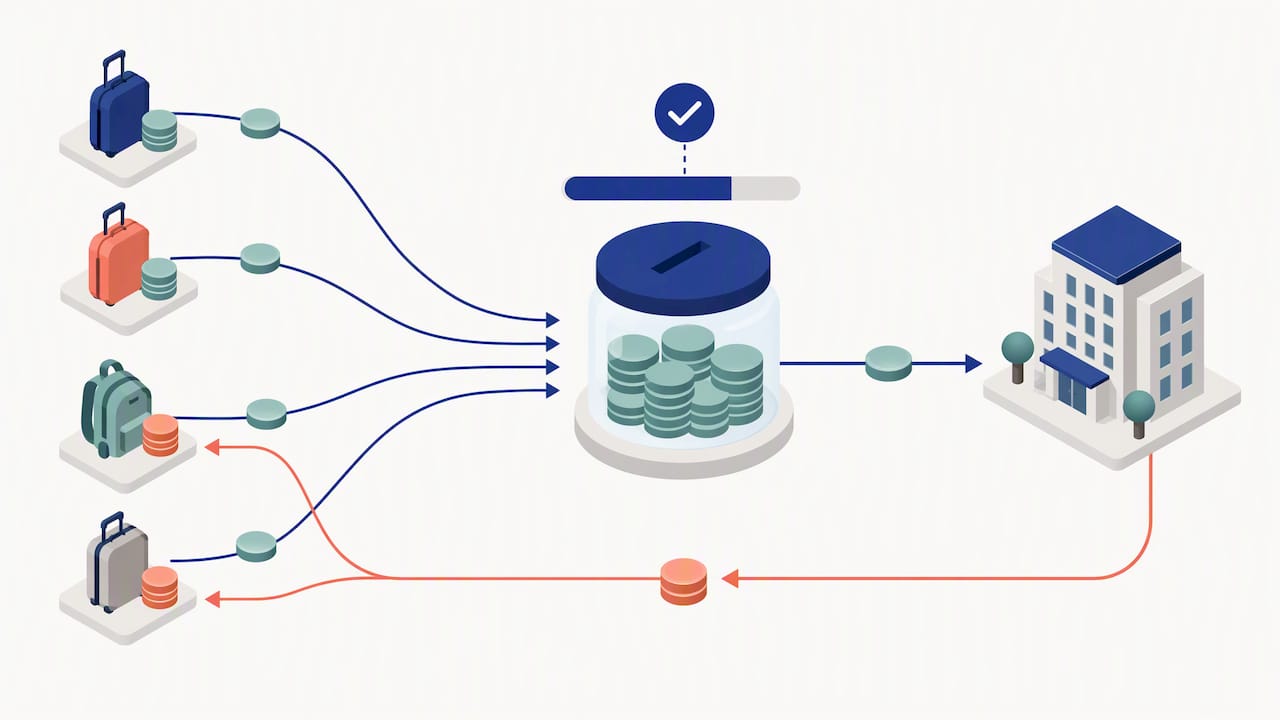
Automation removes the manual follow-up that eats organizer time: every reminder the system sends is one message you do not write yourself.
The common pitfalls are unclear fee rules, no record of who owes what, and releasing money to suppliers before the target is met.
How do you get travelers to pay on time?
Clear messages beat frequent messages. Every payment page and invite should include:
- The per-person total and each due date
- What the money pays for
- Your processing or BNPL fee policy
- Refund and dropout rules
- How to reach you with questions
Then set a cadence. Send the initial invite with the payment link. Follow with a reminder around the midpoint of each payment window. Send a final reminder shortly before the deadline, and give notice before any saved-card charge runs.
If rooms or add-ons differ, use tiered payment links so a traveler in a single room and a traveler sharing see only their own amount. Tie each deadline to a real supplier date and say so: “Final payment is due March 1 because the hotel releases unconfirmed rooms on March 8” gets far more response than a bare due date. If collections run short, our guide on optimizing travel budgets can help you present trimmed options. For itemizing shared costs, this regional budgeting page from Grand Canyon Journeys shows a useful cost breakdown.
Why does experienced agency management change the outcome?
Through our group work at Elite Travel Management Group, we have come to a firm view: the payment plan is not an admin chore, it is the trip’s financial spine. Most group trips that go sideways do so because money moved without a clear rule, not because the itinerary was weak. A concierge agency earns its place on destination weddings, incentive travel and any trip with large deposits, where supplier rules are strict and one missed payment can cost a block of rooms. Picture an organizer who used to spend evenings reconciling transfers against a spreadsheet. With one managed fund, they see a single balance, fewer arguments, and a clean handoff to the supplier. Our guide to why expert group planning makes the difference goes deeper.
— tammylevent@gmail.com
Want us to handle your group’s payments?

We design and manage group travel for clients who want the details handled. For organizers, that means:
- Group travel planning built around your guest list and budget
- Group travel planning tailored to your travelers
- Coordination with suppliers to help keep your trip arrangements on track
- Concierge support
Reach out when supplier rules are complex, deposits are large, or the group is high-value and you want expert support with the travel arrangements. We charge no service fees. Start on our group travel page and tell us about your trip.
This article is general information, not a substitute for advice from a qualified financial advisor. Consult a qualified financial professional about your own circumstances before acting on anything here.
FAQ
Is there a way to pay for a trip in installments?
Yes. Most group trips can be paid through a deposit, a mid-payment and a final balance, either through an agency or a collection platform. Check each supplier’s cutoff dates first so your installment schedule finishes before the final payment is due.
What is a good app for group travel payments?
Look for per-person payment links, live fund totals, saved-card charges and automatic reminders. Platforms such as JourneyFuse document these features, and an agency-managed fund removes the tool-picking entirely.
Is BNPL a good way to split trip costs?
It can work for individual travelers, but it has trade-offs. The CFPB warns that BNPL loans can carry late fees and autopay requirements, so make sure travelers understand the terms before choosing it.
How do you plan a trip for a large group?
Start with the supplier’s payment deadlines, set a per-person price with a contingency buffer, and collect through one tracked system. Our guide to organizing luxury group travel covers supplier coordination in more detail.
Sources
- Consumerfinance
- Buy Now, Pay Later: Market trends and consumer impacts
- Collecting Group Payments (Group Funds) | JourneyFuse
- Group Trip Payment Collection | Split Costs with PayIt2
