




TL;DR:
- Seamless travel offers a frictionless journey by integrating technology and proactive human support at every stage. It relies on biometric systems, AI orchestration, and 24/7 assistance to eliminate disruptions and improve traveler experience. Preparation and lifecycle management further ensure a connected, stress-free journey from booking to return.
A seamless travel experience is defined as the frictionless, integrated progression through every stage of a trip, from booking to return, where technology and coordinated human support eliminate the disruptions that typically derail journeys. The industry term for this is frictionless travel or travel orchestration, and it goes far beyond convenience. It means biometric corridors like the one at Jakarta’s Soekarno-Hatta Airport, where AI-powered biometrics bypass document checks entirely. It means 24/7 human support centers like Hickory Solutions365 that rebook flights before you even reach the gate. When every touchpoint connects, travel stops being stressful and starts being what it was always supposed to be.
What is a seamless travel experience, really?
The phrase gets used loosely, but the definition is precise. Seamless travel is defined by continuity and synchronization across all communication and service touchpoints, not just by convenience or comfort. Booking on one platform means nothing if your hotel, airline, and ground transport are operating in separate silos with no shared data.
Think of it this way: a traveler lands in a new city after a delayed flight. In a traditional setup, they re-explain their itinerary to a hotel front desk, wait in a taxi queue, and scramble to find a confirmation email. In a truly orchestrated experience, the hotel already knows about the delay, the car is waiting, and the room is ready. That gap between those two scenarios is exactly what seamless travel solves.
The shift toward this model is being driven by three forces: biometric infrastructure, AI-powered journey orchestration, and proactive human support. Each one addresses a different layer of friction. Together, they create what Amadeus describes as a personalized, queue-free travel corridor where the traveler’s identity and preferences follow them automatically across every provider.

What technologies power a frictionless travel experience?
Biometric systems and identity continuity
Biometric infrastructure is the backbone of modern travel orchestration. When airports, airlines, and hotels recognize traveler identity across all journey stages, services become automated and personalized without requiring repeated document checks. Jakarta’s Soekarno-Hatta Airport is the clearest live example: its seamless corridor uses facial recognition and AI to move passengers through check-in, security, and boarding without a single manual document verification.
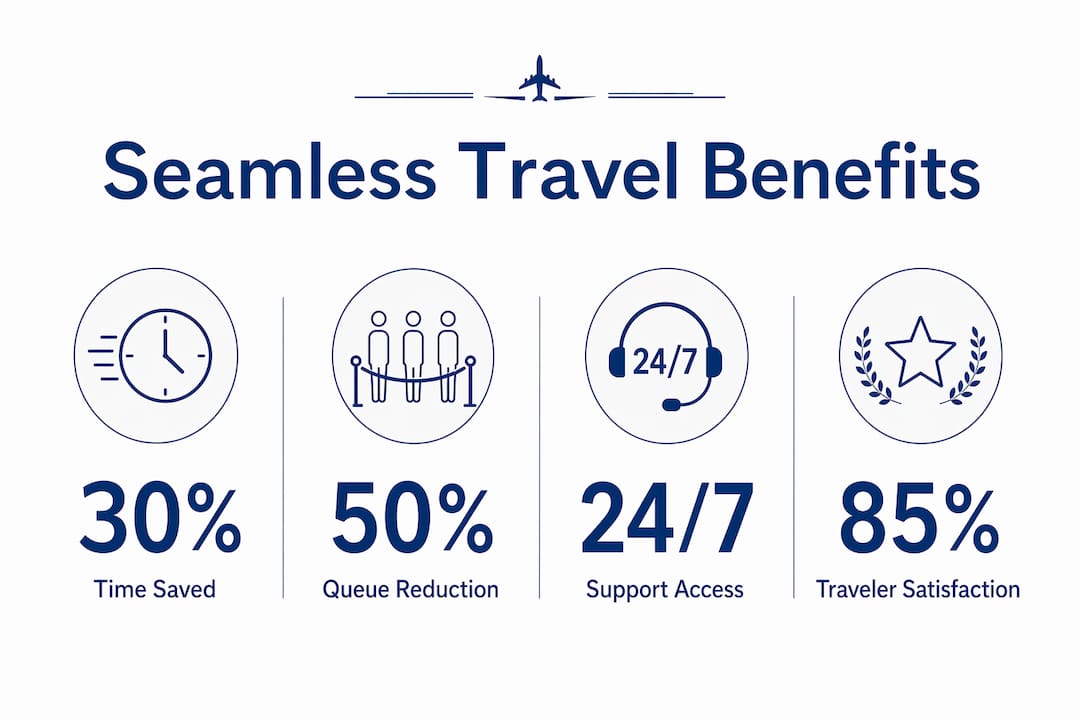
The practical impact is significant. Biometric touchpoints reduce queue times, cut manual processing errors, and create a data trail that allows every downstream provider to anticipate traveler needs. A hotel that receives a biometric-linked profile knows your room preferences before you arrive.
AI orchestration and connected data
AI does the coordination work that no human team could manage at scale. It monitors flight statuses, weather disruptions, hotel availability, and ground transport in real time, then triggers automatic adjustments before the traveler notices a problem. This is what separates reactive travel management from proactive orchestration.
The critical enabler is data synchronization. Booking on one platform is insufficient without synchronized communication across desktop, mobile, email, and agents. A disruption that triggers a rebooking must also update the hotel, the car service, and the traveler’s phone simultaneously. When that chain breaks, the experience fractures.
Pro Tip: If you are working with a travel management company, ask specifically whether their systems push real-time updates to all providers simultaneously or whether updates require manual intervention. That single question reveals the difference between a connected platform and a glorified booking engine.
24/7 human support as the safety net
Technology handles the predictable. Humans handle the exceptions. Hickory Solutions365 offers round-the-clock assistance, airport monitoring, and rebooking to keep travelers on track when automated systems hit their limits. The distinction matters: a scripted call center reads from a screen; a staffed support center has authority to rebook, escalate, and solve.
For luxury travelers and corporate clients, 24/7 travel support is not a premium add-on. It is the difference between a disruption that costs two hours and one that costs two days.
How do you prepare to ensure a seamless travel experience?
Preparation is where most travelers lose the advantage that technology offers. A perfectly orchestrated system still fails if the traveler arrives with expired documents, a blocked credit card, or no offline backup of their itinerary. Here is the preparation sequence that professionals use:
Notify your bank before departure. Notifying banks of travel dates takes under 2 minutes via most banking apps and prevents declined transactions at the worst possible moments. Skipping this step is the single most avoidable disruption in international travel.
Schedule a pre-trip health consultation. Pre-trip health consultations reduce risk and increase traveler confidence, especially for complex or high-risk destinations. Specialists advise on vaccinations, medications, and destination-specific health risks weeks before departure. Waiting until the week before a trip often means missed vaccination windows.
Store documents offline. Saving screenshots of documents offline prevents reliance on unstable cloud connections or airport Wi-Fi. Digital clutter at security causes delays. An offline backup on your phone’s camera roll, organized by document type, removes that risk entirely.
Purchase travel insurance early. Timing matters more than most travelers realize. Cancel For Any Reason (CFAR) policies must typically be purchased within 14–21 days of the initial trip deposit to remain valid. The role of travel insurance in a frictionless trip is not just financial protection. It is the confidence to move forward without hesitation.
Confirm all provider connections. Call or message your hotel, transfer service, and tour operators 48 hours before arrival. Confirm they have your updated flight details. This single step catches the majority of coordination failures before they become problems.
Pro Tip: Create a single offline document that contains your flight confirmation numbers, hotel addresses, emergency contacts, and insurance policy number. Save it as a PDF on your phone and email it to yourself. This takes 10 minutes and eliminates the most common friction points at airports and borders.
What are the real benefits of seamless travel?
The benefits of a frictionless travel experience fall into two categories: what travelers feel and what providers gain.
For travelers, the most immediate benefit is time. Biometric corridors eliminate queue time at check-in and security. AI-driven rebooking resolves disruptions before they compound. Personalized service means fewer explanations and more enjoyment. The cumulative effect is a trip that feels effortless rather than managed.
For travel professionals and service providers, the benefits are operational. The shift to Travel 3.0 reframes travel as a lifecycle partnership involving pre-trip risk assessment, live disruption management, and post-trip analysis. This model improves traveler satisfaction above traditional transaction-based booking. It also reduces the manual workload on support teams by resolving issues at the system level rather than the human level.
Loyalty is the long-term payoff. Travelers who experience a genuinely coordinated trip do not shop around for the next booking. They return to the provider who made it work. For luxury agencies and corporate travel managers, that retention is the clearest measure of whether the experience was truly frictionless or just well-marketed.
How do seamless travel solutions compare?
Different solutions address different layers of the travel experience. Understanding how they compare helps travelers and professionals choose the right combination.
| Solution Type | What It Solves | Best For | Key Limitation |
|---|---|---|---|
| Biometric corridors (e.g., Soekarno-Hatta) | Identity verification and queue elimination | High-volume airport transit | Requires airport-level infrastructure investment |
| AI orchestration platforms (e.g., Amadeus) | Real-time disruption detection and rebooking | Corporate and managed travel | Dependent on connected provider data feeds |
| 24/7 human support centers (e.g., Hickory Solutions365) | Complex exception handling and escalation | Luxury and high-stakes travel | Requires staffing and expertise at scale |
| Omnichannel communication systems | Cross-platform information continuity | All traveler types | Fails without consistent data input from all providers |
| Lifecycle travel management (Travel 3.0) | End-to-end journey visibility and post-trip analysis | Corporate travel programs | Requires long-term provider partnership |
The most effective approach combines all five. Biometrics handle identity. AI handles logistics. Human support handles exceptions. Omnichannel systems keep communication consistent. Lifecycle management ties the whole experience together across pre-trip, in-trip, and post-trip phases. No single solution covers all layers on its own.
For group travel, coordination complexity multiplies. Services like Batam Ferry group booking show how transportation providers are building group-specific tools that reduce the coordination burden for travel managers handling 15 or more passengers simultaneously.
Key takeaways
A frictionless travel experience requires synchronized technology, proactive human support, and disciplined pre-trip preparation working together across every journey stage.
| Point | Details |
|---|---|
| Define it precisely | Seamless travel means synchronized continuity across all providers, not just comfort or convenience. |
| Technology is the foundation | Biometrics, AI orchestration, and connected data systems remove friction at the system level. |
| Preparation prevents failure | Bank notifications, offline documents, and early insurance purchase eliminate the most common disruptions. |
| Human support is non-negotiable | Automated systems handle the predictable; staffed 24/7 centers resolve the exceptions that technology cannot. |
| Lifecycle thinking beats transactional booking | Travel 3.0 partnerships covering pre-trip through post-trip deliver measurably better traveler outcomes. |
Why the human layer still defines the best travel experiences
I have spent years watching the travel industry chase the promise of full automation, and I will tell you what the data and the client feedback consistently show: technology sets the floor, but humans set the ceiling.
The most sophisticated biometric corridor in the world cannot negotiate a last-minute suite upgrade at a sold-out hotel in Florence. An AI platform cannot read the subtext in a client’s message that says “we’re celebrating something important” and translate that into a private dinner reservation with a view of the Colosseum. That requires judgment, relationships, and the kind of contextual intelligence that only comes from years of working with specific destinations and specific partners.
What I find most underappreciated in the conversation about frictionless travel is the concept of proactive disruption management. True seamless travel means services contact the traveler before they must initiate action after a delay or change. Most travelers have never experienced this. They are used to discovering problems themselves and then fighting to resolve them. When a provider reaches out first, with a solution already in hand, the psychological effect is profound. It is the difference between feeling managed and feeling cared for.
My advice for travelers in 2026: stop evaluating providers on price and start evaluating them on their disruption response protocol. Ask what happens when your flight is canceled at 11 p.m. in a foreign city. The answer tells you everything about whether the experience will actually be frictionless or just frictionless until something goes wrong.
For professionals building seamless travel planning programs for clients, the shift to lifecycle thinking is not optional anymore. Clients who have experienced it will not go back to transactional booking. The agencies that build those end-to-end relationships now will own the loyalty that follows.
How Elitetravelgroup delivers this for every client
Elitetravelgroup has spent 35 years building exactly the kind of end-to-end travel experience this article describes, not as a concept, but as a daily practice.

Every itinerary Elitetravelgroup designs connects the right hotels, the right on-the-ground partners, and the right timing so that nothing falls through the gaps. The team is available 24/7 because disruptions do not wait for business hours. From luxury adventure travel packages built around your specific interests to bespoke itineraries crafted for milestone celebrations, every detail is coordinated before you leave home. Elitetravelgroup charges no service fees and offers a price match guarantee, so the only thing you carry on your trip is anticipation.
FAQ
What is a seamless travel experience?
A seamless travel experience is the frictionless, integrated progression through every stage of a trip, enabled by synchronized technology, biometric systems, and proactive human support that eliminates disruptions before travelers encounter them.
What makes travel truly frictionless?
Frictionless travel requires continuous data synchronization across all providers, including airlines, hotels, and ground transport, combined with 24/7 human support that resolves exceptions automated systems cannot handle.
How do i prepare for a hassle-free international trip?
Notify your bank of travel dates, store document copies offline, purchase travel insurance within 14–21 days of your deposit, and confirm all provider connections 48 hours before departure to prevent the most common coordination failures.
What is seamless travel support?
Seamless travel support is round-the-clock, expert-staffed assistance that monitors your journey in real time, handles rebooking during disruptions, and contacts you proactively with solutions rather than waiting for you to report a problem.
How does travel 3.0 differ from traditional booking?
Travel 3.0 treats travel as a lifecycle partnership covering pre-trip risk assessment, live disruption management, and post-trip analysis, rather than a single transaction. This model delivers measurably better traveler satisfaction than conventional booking approaches.
