




A bespoke itinerary is a fully customized travel plan built around your specific preferences, pace, and goals rather than a generic package someone else designed. Unlike a standard tour, it reflects who you are as a traveler: where you want to linger, what you refuse to miss, and how much breathing room you need between experiences. Custom itineraries yield 40% higher traveler satisfaction than standard package tours, and that gap is widening as travelers demand plans that actually fit their lives.
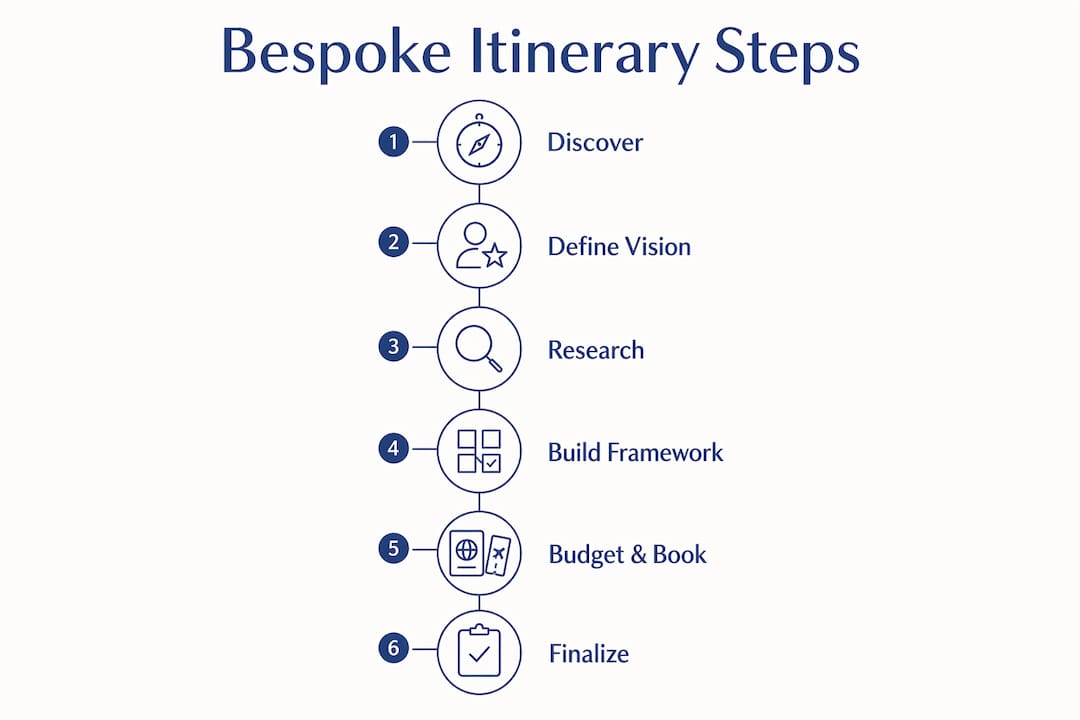
Building one well requires a clear sequence. Skip steps and you end up with a plan that looks polished on paper but collapses by day two. The six major planning phases are:
- Vision and goal setting: Define your travel style, pace, and non-negotiables
- Destination research: Build and evaluate a long list of options
- Day-by-day framework: Anchor fixed bookings, cluster activities geographically
- Budgeting and booking: Set realistic totals, book anchors first
- Final review: Verify logistics, add contingency plans
- Document and share: Create one offline-capable source of truth
Each phase builds on the last. Rushing through discovery to get to booking is the single most common mistake, and it almost always produces a trip full of popular activities you never actually wanted.
How do you define your travel vision as the first planning step?
The most frequent planning error is failing to define non-negotiable goals during the discovery phase, which leads travelers straight to generic tourist spots that look impressive on Instagram but feel hollow in person. Before you research a single destination, get clear on what this trip is actually for.
Start by writing down your travel style honestly. Are you someone who wants to be moving constantly, or do you need slow mornings and long lunches? Do you travel for culture, food, adventure, or pure relaxation? The answers shape every decision that follows, from which destinations make the shortlist to how many activities you schedule per day.

Consider everyone traveling with you. Companions with mobility limitations, dietary restrictions, or young children change the logistics significantly. A couple celebrating an anniversary has different priorities than a family with teenagers. Getting these needs on paper early prevents the awkward mid-trip realizations that derail plans.
Key questions to answer before you research anything:
- What is the primary purpose of this trip? (celebration, exploration, rest, adventure)
- What is your preferred daily pace? (two activities, five activities, or somewhere between)
- What are your absolute non-negotiables, the experiences you would cancel the trip without?
- What do you actively want to avoid? (crowds, long drives, early mornings)
- Are there accessibility, dietary, or health considerations that affect logistics?
- Who else is traveling, and what do they need from this trip?
If you are traveling with others, use a shared Google Doc to collect everyone’s answers before you start planning. Disagreements about pace and priorities are much easier to resolve at this stage than after you have booked non-refundable reservations.
Pro Tip: Write your non-negotiables at the top of your planning document and keep them visible throughout the process. When you hit a decision point later, those anchors prevent you from drifting toward popular but misaligned choices.
How do you research and select destinations that match your vision?
With your goals documented, destination research becomes a filtering exercise rather than an open-ended scroll through travel content. You are not looking for the most beautiful place in the world. You are looking for the place that fits your specific vision, travel dates, budget, and accessibility requirements.
Build a long list first. Use travel blogs, Reddit communities like r/travel and destination-specific subreddits, Google Maps’ Explore feature, and local travel forums to surface options you would not find in a standard guidebook. The goal at this stage is quantity, not commitment. Write everything down without judging feasibility yet.
Then apply filters systematically:
- Seasonality: Does your travel window align with good weather and open attractions?
- Accessibility: Can you get there without a connection that adds a full day of transit?
- Exclusivity and booking lead time: Do the experiences you want require reservations months in advance?
- Geographic logic: Can this destination connect naturally with others on your list, or does it require backtracking?
- Personal resonance: Does this place connect to something you genuinely care about, or is it just popular?
That last filter matters more than most travelers realize. A destination that connects to your actual interests, whether that is architecture, wine, marine life, or culinary history, produces a richer experience than one you chose because it appeared on a “best of” list.
Once you have narrowed to two or three strong candidates, look at how experiences cluster within each destination. A city where your top five interests are all within a walkable radius is a better fit than one where they are scattered across different regions requiring daily long drives. Geographic clustering at the destination-selection stage saves hours of frustration during the day-by-day build. For inspiration on how different travelers approach this, bespoke itinerary examples across travel styles can show you how the filtering process plays out in practice.
Build in at least one buffer day per week of travel. These are not wasted days. They absorb delays, extend experiences that turn out to be better than expected, and give you the flexibility that separates a bespoke plan from a rigid tour schedule.
How do you build a detailed day-by-day itinerary framework?
This is where the planning gets concrete. The framework below works for any destination and any trip length. Follow the sequence and the structure holds; skip steps and the days start to feel either frantic or shapeless.

Start with your anchors. Identify fixed, non-moveable elements first: flight arrival and departure times, hotel check-in and check-out windows, hard-to-get restaurant reservations, timed entry tickets, and any permits or specialized bookings. These are the skeleton. Everything else fills in around them.
Cluster by geography, not excitement level. Organizing days by geographic clusters rather than interest priority reduces transit time by 30–50% and eliminates the exhausting zigzag pattern that kills trip momentum. Assign each day to a neighborhood, district, or zone. Then place your activities, meals, and flexible time within that zone.
Apply the 60/40 rule. Plan 60% of each day and leave 40% open. Over-scheduling is the most common reason itineraries collapse early in a trip. Fatigue, delays, and the simple desire to sit at a café longer than planned are all real. The 40% open block is not empty time; it is where the best travel memories tend to happen.
Sequence activities logically. Morning energy suits physically demanding or cognitively rich experiences. Afternoons work well for wandering, shopping, or slower cultural visits. Evenings anchor around dining. Avoid scheduling your most demanding experience after a long transit day.
Layer in logistics. Add transit times between activities, not just activity durations. Google Maps walking estimates are optimistic for tired travelers. Add some buffer time on any transit time, more for intercity moves.
Pro Tip: Build your day-by-day plan in a spreadsheet with columns for time, activity, location, duration, booking status, and notes. Seeing the full day in one row immediately reveals whether you have over-packed it.
| Day | Morning anchor | Afternoon zone | Evening anchor | Buffer block |
|---|---|---|---|---|
| — | Arrival, hotel check-in | Neighborhood walk | Dinner reservation | — |
| — | Museum (timed entry) | Adjacent district | Local market | 3 hrs open |
| Day 3 | Day trip departure | Regional site | Return, rest | Full afternoon |
| — | Buffer day | Flexible | Flexible | Full day open |
| — | Morning activity | Packing, checkout | Departure transfer | — |
The buffer day in this sample is not a placeholder. It is a deliberate structural choice that keeps the rest of the plan from feeling brittle. For families building this kind of framework, a luxury family travel workflow adds useful guidance on pacing for mixed-age groups.
What do you need to know about budgeting and booking your bespoke trip?
Effective budgeting starts with a realistic total figure set before you commit to anything non-refundable. Without that ceiling, it is easy to spend heavily on accommodation and flights and then discover you have nothing left for the experiences that actually motivated the trip.
Break the total into categories and assign rough percentages based on your priorities:
- Accommodation: Often the largest single line item for luxury travel; book early for the best properties
- Flights and transfers: Include airport transfers, intercity trains, and any private transport
- Experiences and activities: Prioritize based on your non-negotiables list from step one
- Food and dining: Separate fine dining reservations from daily meal estimates
- Emergency reserve: Keep 10–15% of the total unallocated for unexpected costs
Book in a specific sequence. Flights and accommodation come first because they are the hardest to replace and often the most price-sensitive. Then book your anchor experiences, the sold-out tours, timed entries, and restaurant reservations that require advance planning. Everything else fills in closer to departure.
Pay close attention to refundability. For a bespoke trip, flexibility has real value. A slightly higher rate for a refundable hotel room is often worth it, particularly for the first and last nights of a trip when flight delays are most likely to affect check-in timing. For a detailed look at the booking sequence for luxury travel, booking luxury travel step by step covers the full decision framework.
Watch for costs that rarely appear in initial estimates: resort fees, destination charges, gratuities for guides and drivers, luggage storage between check-outs, and travel insurance. These ancillary costs can significantly increase a trip’s total cost if not accounted for upfront.
How do you finalize and fine-tune your itinerary before you leave?
A draft itinerary is a wish list. Verification is what turns it into a reliable plan. Run through the following checks before you consider the itinerary final.
Logistics sanity check: Walk through each day mentally. Does the geographic sequence make sense? Are you crossing the same area twice when you could have combined those visits? Does the transit time between your morning and afternoon activities actually work, or did you underestimate it?
Booking confirmation audit: Verify every reservation. Check that names match your passport, that confirmation numbers are correct, and that check-in times align with your arrival logistics. A hotel that checks in at 3 PM when your flight lands at 8 AM needs a luggage storage plan.
Seasonal and operational verification: Check that attractions are open on the specific days you plan to visit. Many museums close on Mondays. Some seasonal experiences, boat tours, outdoor markets, and viewpoints, operate on limited schedules. Verify within two weeks of departure, not just at the planning stage.
Community feedback: Post your rough itinerary in a destination-specific travel forum or Facebook group. Recent visitors flag issues that no guidebook captures: the restaurant that changed ownership, the trail that is currently closed for maintenance, the neighborhood that is better visited in the morning than the afternoon.
Contingency planning: For every anchor activity, know what you will do if it falls through. Weather cancellations, unexpected closures, and illness happen. A backup plan does not need to be elaborate; it just needs to exist so you are not making decisions under stress.
Document accessibility: Create a single source of truth document containing flight numbers, hotel addresses, confirmation codes, and check-in times. Make it accessible offline. International data can be unreliable, and the moment you need your hotel address most is usually the moment you have no signal.
What do experienced luxury travel planners do differently?
The difference between a competent itinerary and an exceptional one usually comes down to workflow discipline, not creativity. Experienced planners follow a consistent sequence and resist the temptation to skip phases when a destination feels familiar.
Professional planning typically breaks into timed phases: 10–15 minutes for preference setting, 30–60 minutes for destination research, and 30–45 minutes for the day-by-day build. That structure keeps planning focused and prevents the sprawl that turns a two-hour session into an unfinished project.
The most consistent best practices from experienced planners:
- One source of truth: Every logistics detail lives in a single shared document, not scattered across email threads, notes apps, and booking confirmations
- Anchors first, always: Non-refundable flights, exclusive reservations, and permits get locked before anything else is planned around them
- Geographic clustering as a non-negotiable: Days organized by zone, not by excitement level, consistently produce better trip flow
- Buffer days built in from the start: One per travel week, treated as a structural element rather than an afterthought
- The 60/40 rule applied consistently: Sixty percent planned, forty percent open, every day without exception
Statistic callout: Custom itineraries yield 40% higher traveler satisfaction than standard package tours. That gap reflects what happens when a plan is built around a specific person rather than the average traveler.
Planners who work at the luxury level also know when to hand off. Certain bookings, private villa access, exclusive dining experiences, and curated local guides, require relationships that take years to build. That is where an agency like Elitetravelgroup adds value that no spreadsheet can replicate. With 35 years of experience and a no-service-fee model, Elitetravelgroup brings both the methodology above and the on-the-ground connections that turn a well-planned trip into something genuinely exceptional. Whether you are designing a luxury Europe vacation or a curated Asia itinerary, the planning framework is the same. The difference is who is executing it.
Ready to move from framework to finished itinerary? Elitetravelgroup’s team is available 24/7, charges no service fees, and offers a price match guarantee. Start with your vision and let the experts handle the rest.
Key Takeaways
A bespoke itinerary built on the six-phase process above consistently outperforms generic packages because every decision traces back to a specific traveler’s goals, not a standardized template.
| Point | Details |
|---|---|
| Start with vision, not destinations | Define non-negotiables and travel style before researching any location. |
| Anchor first, fill second | Lock flights, exclusive reservations, and permits before building daily plans around them. |
| Cluster geographically | Organizing days by zone reduces transit time by 30–50% and improves trip flow. |
| Apply the 60/40 rule | Plan 60% of each day and leave 40% open to prevent burnout and allow spontaneity. |
| One source of truth | Keep all logistics in a single offline-accessible document before and during travel. |
