




A marriage you solemnize abroad is governed by the host country’s laws, not U.S. law, so recognition back home depends on following those local rules exactly and authenticating your paperwork afterward. Confirm residency and document requirements through the U.S. Department of State and the destination’s civil registry now, then start gathering certified vital records and scheduling apostille or authentication steps before you lock in travel dates.
TL;DR:
- Most registries require each partner’s valid U.S. passport, certified long form birth certificate, and proof that any previous marriage legally ended.
- Residency rules, witnesses, translations, and medical tests vary by country or municipality; some Mexican locations still require a clinic visit shortly before the ceremony.
- Hague Convention destinations require an apostille, while others require authentication; mailed processing can take several weeks, compared with same day service in Washington.
- Embassies cannot perform most civil marriages or certify freedom to marry, but they can witness an eligibility affidavit; appointments require in person attendance.
- Start researching registry rules and ordering certified records six to nine months before travel; schedule consular appointments and local translations three to four months out.
Table of Contents
- What destination countries commonly require
- How to ensure U.S. recognition: apostille vs. authentication
- Consular and embassy roles: affidavits, notarial services, and limits
- Which route is right for you: married abroad, married at home, or symbolic ceremony
- Practical timeline and checklist for your legal paperwork
- How a concierge planner handles the legal steps for you
- Our honest take on which path to choose
- Let us handle the logistics of your destination wedding
- FAQ
- Sources
What destination countries commonly require
Every country sets its own marriage rules, and the differences can catch couples off guard if they assume one set of documents works everywhere. The State Department notes that requirements swing widely: some countries have no residency rule at all, while others require weeks of stay before a civil official will issue a license, and a few still mandate blood tests.
Most countries ask for a core set of documents regardless of location:
- A valid U.S. passport for each partner.
- A certified long-form birth certificate, not the short-form abstract many states issue by default.
- Proof that any prior marriage has ended, such as a final divorce decree or a death certificate for a deceased former spouse.
Beyond those basics, local formalities vary by jurisdiction. Some countries impose a minimum-stay or residency period before a couple can apply for a marriage license, ranging from a short stay to a longer period. Many require two independent witnesses present at the civil ceremony, and most set a minimum marriage age with parental consent required below that threshold, often 18 without consent and 16 or 17 with it. Medical or blood tests, once common across Latin America, have been phased out in most jurisdictions but still apply in parts of Mexico, where a local clinic visit is sometimes required within days of the ceremony.
Translation adds another layer. Any document not issued in the destination’s official language typically needs a certified translation, and some registry offices insist the translation happen locally, using a translator on their approved list, rather than one prepared and apostilled in the United States beforehand. Confirming this detail early avoids a scramble once you have landed, since a translation done in the wrong order can mean redoing it under time pressure. Because rules shift by municipality as often as by country, the safest planning assumption is to prepare for the strictest plausible version of the local requirements, then relax if the civil registry turns out to be more flexible in practice.
How to ensure U.S. recognition: apostille vs. authentication
Getting married abroad is only half the job. The certificate the local registry hands you has to be certified for use in the United States, and which certification applies depends entirely on whether the destination belongs to the 1961 Hague Convention. If it does, you need an apostille. If it does not, you need an authentication certificate instead, and the two processes run through different offices, as explained in Usa.
For documents issued at the state level, such as a birth certificate, the apostille or authentication typically comes from that state’s Secretary of State. For federal documents, the Office of Authentications at the U.S. Department of State handles the request, using forms such as DS-4194 and offering drop-off, mail-in, and expedited pickup options.
A practical sequence to follow:
- Order certified long-form copies of birth certificates and any divorce or death decrees well ahead of travel.
- Determine whether the destination is a Hague member and request the matching apostille or authentication from the correct issuing authority.
- Arrange certified translations if the destination’s civil registry requires them, confirming whether they must be done locally.
- Keep several certified copies of every document, since registry offices and embassies may each retain one.
One key figure to plan around: Office of Authentications processing windows can vary widely, from same-day service at the Washington office to several weeks for mailed requests, so building in a buffer before finalizing travel dates matters more than most couples expect.
Consular and embassy roles: affidavits, notarial services, and limits
U.S. embassies and consulates play a narrower role than many couples assume. They do not perform civil marriages for U.S. citizens abroad in most countries, and they cannot issue a document certifying that you are free to marry, often mislabeled a “certificate of celibacy.” What they can do is witness your signature on an affidavit of eligibility to marry, a document many foreign registries require before issuing a license.
A few practical points to know before you book an appointment:
- Notarial appointments at embassies and consulates are in-person only; there is no remote option.
- A consular seal fee typically applies, often around $50 per seal, according to State Department guidance on notarial services.
- Do not sign or notarize the original document you intend to have apostilled before the appointment. Sign it in front of the consular officer or notary as instructed, since a premature signature can invalidate the document for authentication.
Pro Tip: Schedule your consular appointment weeks in advance, since availability for notarial services at busy embassies fills quickly during peak wedding season.
For the actual civil marriage ceremony, you will still need a local official or registry office, since embassies hand that function to the host country’s civil or religious authorities in nearly every case.
Which route is right for you: married abroad, married at home, or symbolic ceremony
Couples generally choose from three paths, and the right one depends on how much paperwork you are willing to manage.
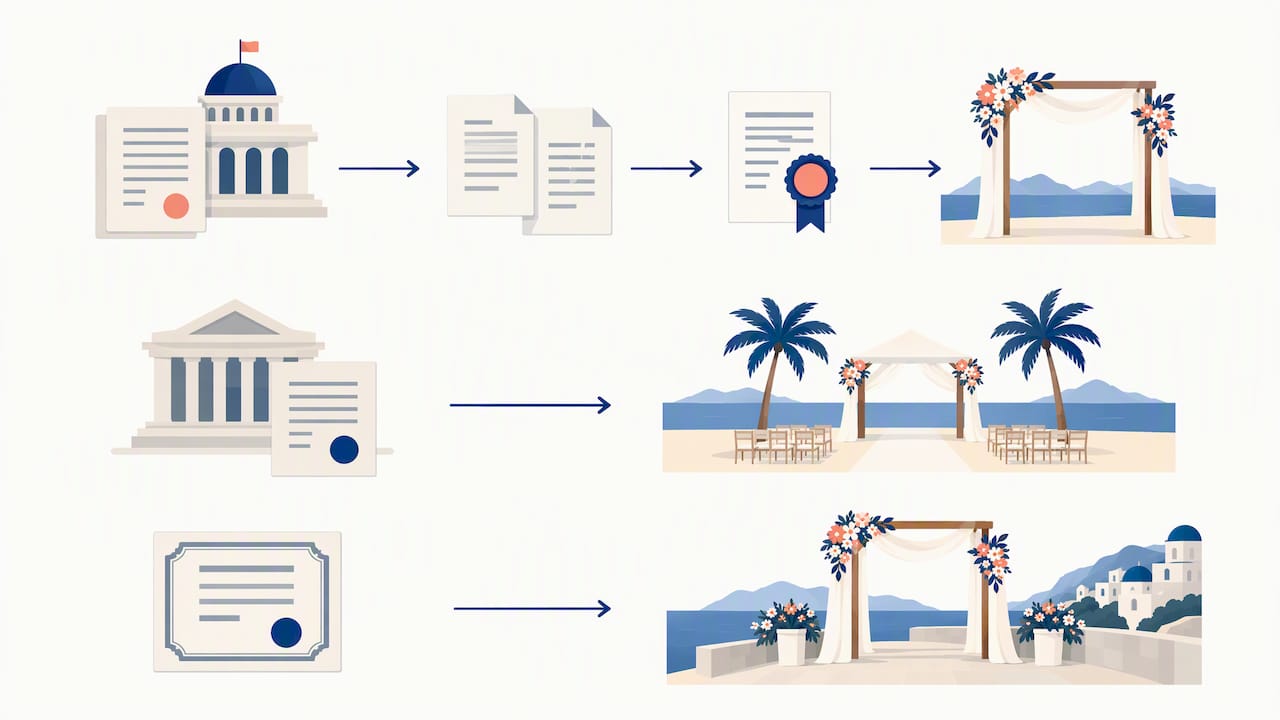
Marrying legally abroad works well when the destination’s rules are simple, such as no residency period and no blood test, or when you are comfortable meeting those requirements on a tight timeline. The tradeoff is extra cost and coordination: translations, apostilles or authentications, and sometimes a second in-country appointment.
Marrying legally at home, before or after the trip, sidesteps most of that complexity. Many planning resources point out that a courthouse or civil ceremony in your home state avoids foreign residency rules, translation requirements, and the authentication chain entirely, since the legal marriage never touches foreign paperwork. This route tends to suit couples who want a specific overseas setting for photos and celebration without the administrative load.
A symbolic-only ceremony abroad is the third option: couples complete the legal marriage at home and treat the destination event purely as a celebration, with no legal paperwork required by the venue country at all.
A short checklist helps decide:
- How flexible is your timeline? Residency periods and processing delays eat into tight schedules.
- How do your guests expect the ceremony to work, legally binding or purely symbolic?
- Are you willing to comply with local requirements like blood tests or in-person registry visits?
Practical timeline and checklist for your legal paperwork
Legal readiness runs on its own clock, separate from venue bookings and guest invitations, and missing a step can delay the wedding itself.
- Six to nine months out: research the destination civil registry’s exact rules, order certified long-form birth certificates, and start the apostille or authentication process if your destination requires it.
- Three to four months out: schedule your embassy or consulate notarial appointment for the affidavit of eligibility, arrange certified local translations if needed, and complete any required in-country medical tests.
- Two weeks to the day of the ceremony: obtain certified copies of your foreign marriage certificate immediately after the registry issues it, and request the apostille or authentication right away if you have not already secured one.
Statistic to anchor your planning: Office of Authentications processing can take anywhere from same-day to several weeks, so the final authentication step belongs on your calendar the moment the foreign certificate is in hand, not after you are already home. Our destination wedding checklist for 2026 walks through this same sequence with dates attached.
How a concierge planner handles the legal steps for you
Coordinating certified translators, local registry offices, and embassy notarial appointments across time zones is the part of destination wedding planning that trips up even organized couples, and it is exactly where a dedicated planner earns their keep.
- We coordinate certified translation and registry-office timing through partners who know each destination’s current rules.
- We track document deadlines against travel dates, so apostille or authentication requests go in with enough lead time.
- We draw on experience arranging destination weddings and stay reachable when a document question comes up outside normal business hours.
If you want a professional hand on the logistics, our destination wedding workflow outlines exactly how we sequence these steps, and our planning guide covers the broader vendor and venue coordination that runs alongside the legal work.
Our honest take on which path to choose
For most couples, marrying legally at home and treating the overseas event as the celebration is the lower-friction choice: it sidesteps residency rules, translation requirements, and the apostille or authentication chain entirely. Marrying abroad still makes sense when the destination’s rules are straightforward or the legal ceremony itself matters to you, and in either case, document authentication is manageable with enough lead time and the right help coordinating it. Our checklist and planning team are available if you want that coordination handled for you.
— tammylevent@gmail.com
Let us handle the logistics of your destination wedding
Planning the legal side of a wedding abroad takes as much attention as picking the venue, and we build that coordination into every destination wedding we plan. Our concierge approach covers local partner coordination, document and translation timelines, and the scheduling that keeps your authentication paperwork from colliding with your travel dates.

Here is what that looks like in practice:
- We match you with local officiants, registries, and translators at the destination you choose.
- We build your document timeline around apostille or authentication processing windows.
- We stay reachable so a document question never waits for office hours, and we charge no service fees for the planning itself.
If ceremony music is on your list, our partner Dustin Callahan builds custom piano sets for destination celebrations across a range of styles. To get started on the legal and logistical side, visit our destination wedding packages page and request a consultation.
FAQ
What is the new marriage law in 2026?
There is no single new international marriage law for 2026. Requirements still vary by destination country, so the governing rules are whatever the host country’s civil registry currently requires, which is why checking State Department guidance for your specific destination before booking matters more than any general headline.
What is the 50/20/30 rule for weddings?
This is a budgeting guideline some wedding planners use to split costs, typically allocating roughly half to venue and catering, a portion to attire and photography, and the remainder to smaller details, though exact splits vary by source. It is a financial planning tool, not a legal requirement for marriage abroad.
What are the rules for a destination wedding?
Rules depend entirely on the country where you marry: expect requirements around residency, witnesses, minimum age, and sometimes medical tests, plus certified document translations in some jurisdictions. After the ceremony, you generally need an apostille or authentication certificate, per USA.gov, to have the marriage recognized in the United States.
How far away is considered a destination wedding?
There is no official distance threshold. A destination wedding is generally understood as a ceremony held somewhere other than the couple’s or most guests’ home area, often involving travel and an overnight stay, rather than a specific mileage cutoff.
