




TL;DR:
- Hiring an independent local coordinator and mapping every decision to a Critical Path Method timeline ensures a reliable luxury destination wedding.
- Proper sequencing of venue, vendors, and legalities, along with clear contracts and communication protocols, minimizes risks and hidden costs.
Hire an independent, on-the-ground local coordinator first, then map every decision to a Critical Path Method timeline. That single combination converts a high-risk destination wedding into a reliably executed luxury event. Here is what to act on immediately:
- Hire an independent local coordinator before any other vendor (not the resort coordinator, who works for the venue).
- Lock a provisional venue window at 14–18 months out for peak Mediterranean or top-villa destinations.
- Establish your budget currency and VAT strategy in writing before signing any vendor contract.
- Set a CPM critical-path milestone for core vendor booking (photographer, caterer, officiant) no later than 9 months out.
- Open a central project-management board (Asana, Trello, or a shared Google Workspace) and invite all key vendors on day one.
Elite Travel Management Group, Inc. operates as the executive producer across all of these steps, so nothing falls between the cracks.
Table of Contents
- What does a phased destination wedding workflow look like?
- Who is accountable for each deliverable on your team?
- How should you communicate with destination vendors?
- How do you build a budget that protects you from hidden costs?
- Which contract clauses and permits must you lock before final payment?
- How do you manage guest travel, room blocks, and VIP arrivals?
- What does a day-of critical path and contingency plan look like?
- What templates and checklists should your team deploy immediately?
- How does Elitetravelgroup execute this workflow as your concierge partner?
- Key Takeaways
- The mistake most affluent couples make — and how the workflow prevents it
- Ready to hand this workflow to a team that has done it 35 years running?
- Useful sources
What does a phased destination wedding workflow look like?
A destination wedding planning timeline runs in five distinct phases. The CPM logic is simple: venue first, then save-the-dates, then core vendors. Miss any of those in sequence, and every downstream task slips.
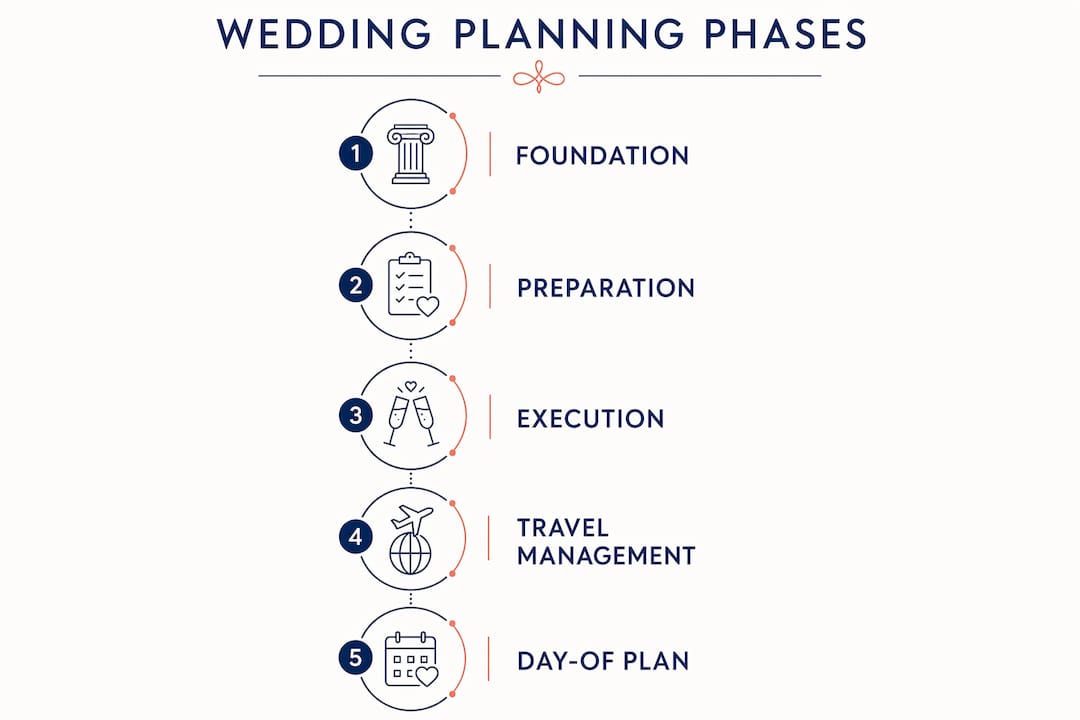
| Phase | Months Out | Primary Goals |
|---|---|---|
| Foundation | 14–18 | Hire coordinator, secure venue provisional hold, set budget and currency |
| Core Vendor Booking | 9–12 | Photographer, caterer, officiant, florist, music; send save-the-dates |
| Legal and Logistics | 6–9 | Apostilles, translations, consulate appointments, room blocks |
| Guest and Detail | 3–6 | Formal invitations, VIP transfers, run-sheet draft, vendor contract review |
| Final Execution | — | Final payments, day-of run sheet, contingency confirmation, vendor call times |
Legal paperwork alone can consume 3–4 months for apostilles, certified translations, and consulate appointments. Build that buffer into the Foundation phase, not the Legal and Logistics phase. Top-tier Mediterranean villas book 14–18 months out; starting at 12 months means accepting second-choice venues in Halkidiki destinations.
Who is accountable for each deliverable on your team?
Every luxury destination wedding needs five defined roles. Overlap between them is where expensive mistakes happen.
- Independent local coordinator: Advocates for the couple, negotiates vendor pricing, verifies permits, and manages day-of execution. Unlike a resort coordinator, this person works for you, not the venue.
- Luxury travel planner/concierge: Manages guest travel logistics, room blocks, VIP arrivals, and honeymoon sequencing. Elitetravelgroup fills this role.
- On-site day-of manager: Runs the run sheet minute-by-minute; distinct from the coordinator who has been managing the build-up for months.
- Legal/documentation advisor: Handles marriage license requirements, apostilles, and any residency-period rules in the destination country.
- Vendor leads: Photographer, caterer, florist, and music each own their own deliverable timeline and report to the coordinator.
Local planners act as eyes and ears on the ground, leveraging vetted vendor networks that no amount of social media research can replicate. For affluent clients, that network access is the differentiator between a good event and an exceptional one.
Pro Tip: When contracting an independent coordinator, require a Certificate of Insurance (COI) naming you as additionally insured, a written substitution clause specifying that any replacement coordinator must be pre-approved by you, and a clause defining what constitutes a breach with a pre-negotiated remedy.

How should you communicate with destination vendors?
Vendor-management fatigue is the quiet killer of destination weddings planned remotely. The fix is a formal protocol, not more emails.
- One dedicated wedding mailbox: Create a wedding-specific email address that all vendors use. No personal inboxes, no text threads for anything contractual.
- Triage rules in every contract: Non-urgent communications should be acknowledged within a few business days; urgent matters (day-of changes, permit issues) require prompt responses within one to two days. Put this in writing as a contract clause, not a verbal agreement.
- PM board structure: One board per vendor category. Fields: task name, owner, due date, status (Not Started / In Progress / Blocked / Complete), and a critical-path flag for zero-float items.
- Scheduled check-ins: Brief video calls every 4–6 weeks in the Foundation and Core Vendor phases; weekly in the final 60 days.
- Communication triage categories: Urgent (venue, legal, weather backup decisions), Non-Urgent (décor details, menu iterations), Informational (confirmations, receipts). Vendors who miss triage windows get a formal written notice, which creates a paper trail if a dispute arises.
Reframing vendor requests as “project requirements on the critical path” turns hopeful asks into deadline-driven priorities. That shift in language alone changes how vendors respond.
How do you build a budget that protects you from hidden costs?
The costs that blindside affluent clients are never the obvious ones. Catering and photography quotes are easy to compare. The invisible line items are what erode a carefully planned budget.
- VAT on European services: Many destination countries charge value-added tax on vendor services. Confirm in writing whether quoted prices are VAT-inclusive or exclusive before signing.
- Currency conversion risk: If a vendor quotes in euros or another local currency, lock the exchange rate or build a 5–8% currency buffer into that line item.
- Vendor travel costs: Bringing a domestic photographer or stylist abroad adds flights, hotels, and per diems. Weigh that against a local vendor’s familiarity gap.
- Permit and access fees: Noise curfew extensions, vendor access permits for private venues, and generator rentals for outdoor receptions are frequently omitted from standard quotes.
- Weather backup costs: A tent, an indoor alternative, or a rescheduling fee all carry price tags. Budget for the backup before you need it.
A standard luxury payment schedule runs: 25–30% deposit at contract signing, a milestone payment at 6 months out, and the final balance 30 days before the event. Never release the final balance without a signed deliverables acceptance form. Negotiate itemized invoices from every vendor so you can audit line by line, and always confirm the invoice currency in the contract itself.
Which contract clauses and permits must you lock before final payment?
Contracts for destination weddings need three clauses that most standard templates omit.
- Liquidated Damages: A pre-negotiated penalty the vendor pays if they fail to perform. This converts a vague “we’ll make it right” promise into an enforceable remedy without requiring you to prove actual damages in a foreign court.
- Substitution Clause: Any replacement vendor must be pre-approved by you and meet the same or higher standard. Without this, a vendor can send an unqualified substitute on the day.
- Governing Law and Jurisdiction: Where feasible, specify your home jurisdiction. At minimum, specify a neutral arbitration process so disputes do not require litigation abroad.
Permit checklist (verified by your independent coordinator):
- Venue operating permit and event license
- Noise curfew confirmation and any extension permit
- Vendor access permits for caterers, photographers, and entertainment
- COIs from every vendor naming you as additionally insured
- Local officiant licensing and marriage certificate filing requirements
How do you manage guest travel, room blocks, and VIP arrivals?
Save-the-dates go out 10–12 months before the wedding for international guests. Destination weddings typically see 40–60% of invited guests actually attend, so size your initial room block conservatively and negotiate an expansion option with the hotel.
- Room-block negotiation: Request a rate guarantee through the wedding date, an attrition clause capped at 80% (not 100%), and complimentary early check-in for VIP guests.
- Guest travel portal: A dedicated wedding website with a travel tab, direct booking link to the room block, and a clear RSVP deadline removes most guest confusion.
- VIP arrival services: Airport greeters, private transfers, luggage handling, and a welcome amenity in the room. Price these as a package and negotiate with the hotel concierge at the room-block stage, not afterward.
- RSVP deadline: Set it 10–12 weeks before the event to finalize catering counts, seating, and transport manifests.
Elitetravelgroup manages guest travel coordination end-to-end, from room-block negotiation to private transfer scheduling, so the couple never has to field individual guest travel questions.
What does a day-of critical path and contingency plan look like?
- Vendor call times: All vendors on-site 2–3 hours before guest arrival. Confirm in writing 72 hours prior.
- Transport windows: Guest shuttles depart 30 minutes before ceremony; VIP cars 45 minutes before.
- Ceremony timeline: Processional, vows, ring exchange, recessional — each segment timed to the minute with a 10-minute buffer built in.
- Reception flow: Cocktail hour, dinner service, speeches, first dance, cake, open dancing — each with a hard end time the coordinator enforces.
- Weather backup trigger: Decision made no later than 6 AM on the wedding day. Backup venue or tent must be confirmed and staffed by 8 AM.
- Vendor no-show protocol: Coordinator activates the pre-approved backup vendor list immediately. No improvising on the day.
- Power and tech contingency: Generator on standby for outdoor receptions; backup audio system confirmed with the band or DJ.
- Event insurance: Carry event cancellation and liability coverage. A 10% budget buffer remains necessary even with insurance, because policy exclusions are common for weather and force-majeure scenarios.
What templates and checklists should your team deploy immediately?
The workflow above only works if it lives in a shared system. These are the four assets your team needs before any vendor conversation begins.
| Template | Use Case |
|---|---|
| Master CPM Timeline | Maps every task to a phase, flags zero-float items, and assigns an owner |
| Vendor RFP | Scope, deliverables, cancellation terms, liability, and substitution language in one document |
| PM Board Template | Pre-built columns (task, owner, due date, status, critical-path flag) ready to import into Asana or Trello |
| Response-Time Clause | Plug-and-play contract language for 24-hour urgent / 72-hour non-urgent triage |
- RFP essentials: Scope of work, delivery deadlines, cancellation and refund terms, liability cap, substitution approval requirement, and invoice currency.
- CPM sync: Every template milestone maps to a CPM node. When a task slips, the board auto-flags all dependent tasks so the coordinator can triage immediately.
- Destination wedding checklist: Use as the master reference alongside the CPM board to catch any task the timeline does not explicitly name.
How does Elitetravelgroup execute this workflow as your concierge partner?
Elitetravelgroup steps in as the executive producer across every phase, so couples make decisions rather than manage logistics.
- Venue sourcing and provisional holds: Elitetravelgroup’s 35-year network means access to top-tier properties before they hit public availability.
- Independent coordinator procurement: Elitetravelgroup vets and contracts the on-the-ground coordinator, including COI verification and substitution clause review.
- Vendor negotiation: Transparent, itemized pricing with VAT and currency confirmed in writing before any contract is signed.
- Guest travel management: Room blocks, VIP transfers, and arrival services handled entirely by Elitetravelgroup’s team.
- 24/7 support: No service fees, a price-match guarantee, and round-the-clock availability because destination wedding emergencies do not observe business hours.
Engagement follows the workflow phases: discovery call, destination scoping, proposal and contract, on-site coordination, and post-event debrief. Every step maps to a CPM milestone so nothing is left to assumption. Learn more about why couples hire a professional for destination weddings.
Key Takeaways
A destination wedding succeeds when the independent coordinator is hired first and every subsequent decision is sequenced on a CPM critical path with contract protections in place.
| Point | Details |
|---|---|
| Hire the coordinator first | An independent local coordinator advocates for you, not the venue, and prevents foreigner markups. |
| CPM sequencing is non-negotiable | Venue, then save-the-dates, then core vendors — miss the sequence and every downstream task slips. |
| Budget for invisible costs such as VAT, currency risk, permits, and weather backups as essential line items rather than afterthoughts. | |
| Contracts need three key clauses | Liquidated Damages, Substitution Clause, and Governing Law reduce reliance on foreign courts. |
| Elitetravelgroup as executive producer | Elitetravelgroup manages coordinator procurement, vendor negotiation, and guest travel with no service fees. |
The mistake most affluent couples make — and how the workflow prevents it
The conventional wisdom says the biggest destination wedding risk is choosing the wrong venue. It is not. The real failure point is vendor accountability at 4,000 miles. Couples who plan remotely without a formal communication protocol end up managing a dozen WhatsApp threads, chasing confirmations, and discovering on the day that a vendor interpreted “floral arch” very differently than the mood board suggested.
The workflow in this guide exists precisely because those failures follow a predictable pattern: no CPM board, no response-time clause, no substitution protection. A VAT surprise on a final invoice is not bad luck; it is a missing line in a contract. A vendor no-show is not an anomaly; it is what happens when there is no Liquidated Damages clause and no backup vendor pre-approved.
Elitetravelgroup’s 35 years of experience means the team has seen every version of these failures and built the protocol to prevent them. The couples who arrive at their wedding weekend genuinely relaxed are the ones who delegated the logistics to a team with the network, the contracts, and the 24/7 availability to handle whatever comes.
Ready to hand this workflow to a team that has done it 35 years running?
Elitetravelgroup takes the entire destination wedding workflow off your plate, from the first discovery call to the final guest transfer home. No service fees. A price-match guarantee. And a team available around the clock because the week before a destination wedding is not the time to wait for a callback.

Here is how onboarding works: a 30-minute discovery call to scope your destination and guest count, a destination and vendor proposal within 5 business days, contract and coordinator procurement, and full on-site support through the event. Couples planning intimate celebrations can also explore luxury micro destination wedding packages, while those planning larger events can review the full destination wedding services page. Contact Elitetravelgroup today to start your discovery call.
Useful sources
- How to Hire Your Destination Wedding Team — CPM sequencing, Liquidated Damages and Substitution Clause language, and vendor communication protocol.
- How to Communicate with Wedding Vendors — Response-time triage rules and PM-board best practices.
- Destination Wedding Planning Guide — Beyond Baggage — Realistic timing for legal paperwork, save-the-date windows, and attendance rate guidance.
- Wedding Coordinator vs. Travel Agent — Romance Travel Group — Independent coordinator rationale and foreigner markup avoidance.
- How to Book Vendors from a Distance — Destination I Do — Local planner network advantages and virtual walkthrough guidance.
- Bringing Your Own Vendor vs. Local Vendors — Destination I Do — Trade-off analysis for domestic vs. local vendor sourcing.
- How the Economy Impacts Wedding Costs — The Knot — Hidden cost drivers including VAT, currency risk, and permit fees.
Recommended
- Concierge Travel Planning Workflow: A Pro’s Guide
- Why Hire for Destination Weddings: A Couples’ Guide
- How to Plan a Destination Wedding: Your 2026 Guide
- Your Destination Wedding Checklist for 2026
