




Travel insurance is worth the money when you’d take a real financial hit from losing prepaid, nonrefundable costs, or when you’re heading somewhere your health coverage won’t follow you. The NAIC, Travel, and firms like Elitetravelgroup all point to the same rule: expect to pay 3% to 8% of your trip cost for that protection. Skip it for a cheap, refundable weekend trip. Buy it for anything expensive, international, or complicated.
TL;DR:
- Travel insurance is generally worth it for trips with high nonrefundable deposits, international destinations, multiple segments, or higher health risks, especially involving family or chronic conditions.
- Coverage should focus on medical emergency evacuation limits exceeding $100,000, and policies should clearly specify covered reasons for cancellation, with documentation required.
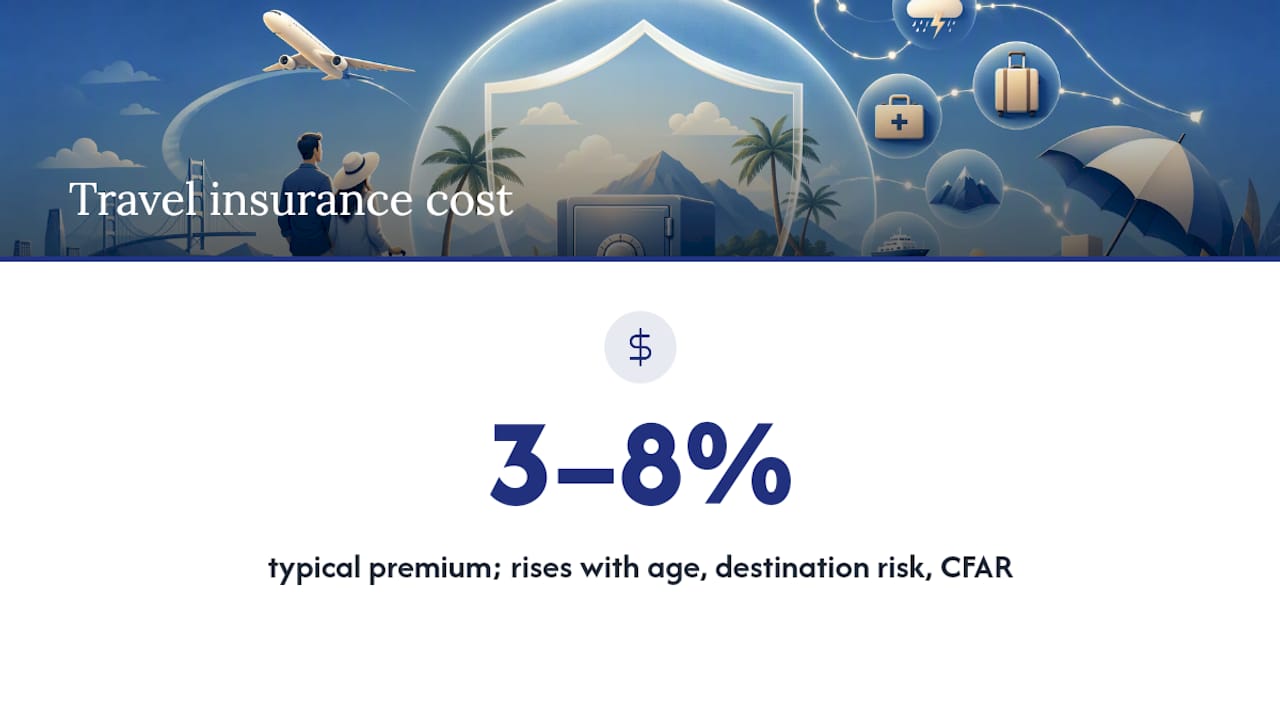
- Premium costs typically range from 3% to 8% of the trip price, increasing with age, destination risk, additional coverage, or trip complexity.
- Optional CFAR coverage can add significant benefits but must be bought within three weeks of booking since it costs more and has strict purchase deadlines.
- Skipping insurance makes sense mainly for fully refundable domestic trips, trips covered by credit cards, or self-insured travelers who can absorb potential losses.
Table of Contents
- When Is Travel Insurance Worth It? A Scenario Checklist
- What Travel Insurance Covers (and What It Doesn’t)
- What Does Travel Insurance Cost?
- How to Decide: Your Trip Risk Checklist
- When You Can Skip Travel Insurance
- How a Luxury Travel Advisor Handles Travel Insurance
- A Publisher’s Take on Buying Travel Insurance
- How Elite Travel Helps You Choose the Right Coverage
- Sources
When Is Travel Insurance Worth It? A Scenario Checklist
The math changes depending on what you’re booking, not just how much you’re spending. Run your trip against these scenarios before you decide.
- Big nonrefundable deposits. Destination weddings, group cruises, and multi-night resort packages often carry cancellation penalties that scale with how close you are to departure. Losing $8,000 on a wedding trip stings a lot more than losing $150 on a one-night hotel stay.
- International or remote travel. Domestic health insurance, including Medicare, generally stops covering you the moment you leave the country. If you get sick in a rural part of Peru or need a hospital in Southeast Asia, you’re often paying cash upfront and fighting for reimbursement later.
- Multi-segment itineraries. Three flights, two tour operators, and a rental car all have to connect on schedule. Every added supplier is another point where a delay or cancellation can cascade into missed connections.
- Travelers with health concerns or dependents. Older travelers, anyone managing a chronic condition, or parents traveling with kids face higher odds of a trip getting derailed by illness, and higher stakes if it does.
- Seasonal and regional risk. Caribbean trips during hurricane season, Pacific Northwest trips during wildfire season, and travel to regions with active political unrest all carry disruption odds well above baseline.
- Cancel For Any Reason (CFAR) situations. If you want the flexibility to back out for a reason your policy doesn’t automatically cover, like anxiety about a destination or a work conflict, CFAR is the only way to get partial reimbursement. It costs more and has to be bought early.
If your trip checks two or more of these boxes, the premium is doing real work. If it checks none of them, you’re likely paying for coverage you’ll never use.
What Travel Insurance Covers (and What It Doesn’t)
Most standalone policies bundle five coverage types, and each one solves a different problem.
Trip cancellation and interruption reimburses prepaid costs if you have to cancel or cut a trip short for a covered reason: illness, a death in the family, jury duty, or a natural disaster at your destination. The catch is that phrase, “covered reason.” The NAIC specifically advises reading that list before you buy, because insurers vary widely on what qualifies, and you’ll need documentation (a doctor’s note, a death certificate, an official notice) to file a claim.
Travel medical and emergency evacuation covers care abroad and the cost of getting you to a hospital that can actually treat you. This is the coverage that matters most and gets underestimated the most. Emergency evacuation from a remote area can run past $100,000 for a complex rescue, which is why low evacuation limits on a cheap policy are a real problem, not a minor detail.
Baggage loss, delay, and trip delay benefits reimburse essentials when your bag or your flight doesn’t show up on time. The Department of Transportation tracks baggage mishandling rates, and this coverage is what pays for a toothbrush and a change of clothes when your suitcase lands a day after you do.

CFAR add-ons typically reimburse 50% to 75% of your nonrefundable costs for canceling any reason, but you generally have to purchase it within 14 to 21 days of your first trip payment, and it adds roughly 40% to your base premium.
Common exclusions to check before you buy: pre-existing medical conditions (unless you buy a waiver early), high-risk activities like heli-skiing, and “known events” like a storm that’s already been named before you purchased the policy.
What Does Travel Insurance Cost?
Premiums scale with trip cost, traveler age, destination risk, and how much CFAR or medical coverage you add. The 3% to 8% rule of thumb holds across most standalone policies, but the range within that band depends heavily on who’s traveling and where.
Older travelers pay more because medical claims are statistically more likely, and international trips with remote destinations push premiums toward the higher end of the range because evacuation risk climbs. Adding higher medical or evacuation limits, common for travelers heading to countries with expensive private healthcare, also raises the price, but usually by less than CFAR does.
For a single flight or hotel stay, the point-of-booking add-on you see at checkout might be fine. For anything with multiple suppliers, a standalone policy from a comparison site tends to offer higher coverage limits for a comparable price, because it isn’t subsidizing a booking platform’s margin.
How to Decide: Your Trip Risk Checklist
Work through this in order. By the end, you’ll know whether to buy, skip, or call an advisor.
- Add up your nonrefundable exposure. Total every deposit and payment you’d lose if the trip fell through tomorrow. If that number would strain your budget, insurance is worth pricing out.
- Check your existing coverage first. Look at your health insurance policy for foreign coverage clauses, and check the benefits guide for the credit card you used to book. Some cards already include trip cancellation or baggage delay coverage.
- Rate your health risk honestly. Any chronic condition, recent diagnosis, or pregnancy changes the math. A pre-existing condition waiver only works if you buy it in that early window, so this step needs to happen before you shop around.
- Count your moving parts. More flights, more tour operators, and more countries all mean more chances for one delay to wreck the rest of the schedule.
- Call the insurer with specific questions, not general ones. Ask for the exact list of covered cancellation reasons, the pre-existing condition waiver terms and deadline, the medical evacuation limit in dollars, and whether emergency care requires pre-approval from the assistance line.
- Buy within the window. Most CFAR add-ons and pre-existing condition waivers require purchase within 14 to 21 days of your first trip deposit. Miss it, and those options disappear for that trip.
- Keep a claims folder from day one. Save your itinerary confirmations, medical records if illness triggers a cancellation, receipts for anything you buy because of a delay, and any written communication from airlines or tour operators.
Pro Tip: Photograph your luggage contents before you check a bag on an international flight. If it’s lost, that photo does more to speed up a baggage claim than any receipt you can dig up later.
Watch for red flags while you shop: a policy that lists “covered reasons” in vague language instead of a specific enumerated list, an evacuation limit under $100,000 for remote or international travel, and assistance-line reviews that mention long hold times or refused pre-approvals. Those are the details that surface only when you actually need to file a claim, which is the worst time to discover them.
When You Can Skip Travel Insurance
Skipping coverage is a defensible call in a few specific situations, not a universal risk.
- Short domestic trips booked with fully refundable rates carry little downside if plans change.
- If your credit card includes trip protections, confirm you booked the trip on that exact card and check the coverage caps, since many card benefits max out well below what a standalone policy would pay.
- Employer-sponsored health plans that already cover international care remove one of the biggest reasons to buy travel medical coverage separately.
- Self-insuring, meaning setting aside cash equal to your nonrefundable exposure instead of paying a premium, works for travelers who book infrequently and can absorb an occasional loss.
The trade-off is convenience versus protection. Point-of-booking add-ons are fast to buy but usually cap benefits lower than a standalone policy built for your specific trip.
How a Luxury Travel Advisor Handles Travel Insurance
Complex, high-value itineraries change the calculus. When a trip involves a private villa deposit, a chartered yacht segment, and a multi-country flight sequence, a single missed connection can trigger cancellation penalties across several unrelated suppliers at once. A luxury travel agency routinely recommends standalone policies over point-of-booking add-ons for group travel, destination weddings, and multi-supplier luxury trips, because the coverage limits actually match the stakes.
Part of that work means matching policy wording to the itinerary itself: making sure evacuation limits are adequate for remote destinations, and helping clients secure CFAR within the purchase window when a trip’s timeline is still uncertain. You can see how this fits into broader trip planning on our travel insurance overview, and clients traveling to multiple countries can review why insurance matters for every trip we book.
A Publisher’s Take on Buying Travel Insurance
Most of the “worth it or not” debate skips the actual question, which is how much financial stress you can absorb if a trip goes wrong. It’s a starting price for peace of mind, and whether that price is worth paying depends entirely on your own tolerance for risk, not some universal formula.
Run the checklist above against your actual trip. If you’re booking anything with real complexity, layered suppliers, international medical exposure, high nonrefundable deposits, talk to a travel advisor before you buy blind.
— tammylevent@gmail.com
How Elite Travel Helps You Choose the Right Coverage
A luxury travel agency provides services including reviewing the actual policy wording against your itinerary before purchase, sourcing policies that match your trip’s risk, reviewing fine print on covered reasons and evacuation limits, and coordinating claims support, often with 24/7 assistance because travel emergencies don’t wait for business hours.

This matters most on trips with real complexity: a European itinerary crossing four countries, a remote adventure trip, or a destination wedding with dozens of guests and nonrefundable deposits scattered across multiple vendors. If you’re planning something in that category, explore our Europe vacation packages or adventure travel itineraries and ask us to build the insurance conversation into your itinerary from the start, not as an afterthought once you’ve already put down deposits.
Sources
- Should you get travel insurance? What you should know about protecting your trips — NAIC
- Is travel insurance worth it? — Money
- Medicare
- Lost, delayed, or damaged baggage — U.S. DOT
