




Most travel agents now charge something, whether it’s a flat planning fee of $100 to $500, an air-only booking fee of $25 to $275, or a retainer for complex trips that can run over $2,000. Fees show up most often on air-only bookings, award-ticket research, and custom luxury or group itineraries. Before paying anything, ask exactly what the fee covers, whether it’s refundable, and who is the merchant of record on your booking.
TL;DR:
- Most travel agents charge fees for air-only bookings, award research, and complex or group itineraries, with flat fees up to $2,000 depending on complexity.
- Agents also earn commissions, which influence how much they charge directly, especially on cruises and packages with high supplier commissions.
- Fees are usually waived or credited for repeat, high-spend clients or when the fee is applied to the final trip cost.
- It is essential to clarify what a fee covers, if it’s refundable, and who is responsible for refunds before paying.
- For simple trips, booking directly is often cheaper, but agents can save money on multi-destination, group, or error-prone bookings through perks and preferred programs.
Table of Contents
- Travel Agent Fees: The Main Types and What They Cost
- How Travel Agents Get Paid Behind the Scenes
- When Do Travel Agents Charge Fees, and When Do They Waive Them?
- What Does a Travel Agent Fee Actually Pay For?
- What Should You Ask Before Paying a Travel Agent Fee?
- What Consumer Protections Apply to Travel Agent Bookings?
- Does a Travel Agent Actually Save You Money?
- Publisher Perspective: How No-Fee Luxury Planning Changes the Math
- Request a Clear Fee Breakdown From Elite Travel
- Sources
- FAQ
Travel Agent Fees: The Main Types and What They Cost
The days of every trip booking for free through an agent are mostly gone. More than half of US travel advisors now charge some kind of fee, and the amount depends heavily on what you’re asking them to do. Here’s how the major fee structures break down:
- Flat per-trip fees: Usually $100 to $500 for standard vacation planning, but complex multi-country or luxury itineraries can push past $2,000.
- Hourly rates: Some advisors bill $50 to $150 per hour for research-heavy trips, typically used for custom itineraries that don’t fit a standard package.
- Air-only or per-segment fees: Booking flights alone, especially award-ticket searches, commonly costs $25 to $275 per passenger, reflecting the time it takes to hunt down award availability across airline programs.
- Percentage or per-person fees: Group and wedding planners often charge a percentage of total trip value or a flat per-person rate, since coordinating a dozen travelers costs more time than booking one couple.
- Retainers: High-touch luxury advisors sometimes ask for a retainer upfront, applied later toward planning work or credited against the final booking.
A honeymoon to one destination with no add-ons might carry a $150 flat fee. A ten-day, four-country anniversary trip with private transfers and dinner reservations at booked-out restaurants can easily justify $800 or more, simply because of the hours involved.
How Travel Agents Get Paid Behind the Scenes
Fees are only half the picture. Advisors also earn supplier commissions, and understanding that split explains why pricing varies so much between agents and trip types.
Cruise lines and tour operators often pay more, sometimes double that. Airlines, by contrast, pay little or nothing on most tickets, which is exactly why air-only bookings tend to carry the highest client-facing fees.
Cruise pricing complicates this further. Non-commissionable fares (NCFs) can shrink an advisor’s commissionable base by roughly 20% to 25%, meaning the advisor earns less than the sticker price suggests even on a “commission-rich” booking. Add in overrides (bonus commissions host agencies negotiate for volume) and payment timing that can lag weeks after your trip, and it’s clear why compensation structures shape how much an agent needs to charge you directly. Ask how your agent gets paid. It’s a fair question, and a good advisor answers it without hesitation.
When Do Travel Agents Charge Fees, and When Do They Waive Them?
Fees cluster around bookings that take the most labor relative to the commission they generate. Others rarely carry a fee at all.
- Usually carries a fee: Air-only tickets, award-ticket bookings requiring mileage research, bespoke luxury itineraries, and group or destination wedding planning.
- Often fee-free: Cruises and packaged tours, where supplier commissions are high enough that many advisors skip a separate fee.
- Sometimes waived or credited: High-spend clients, repeat travelers, or bookings where the planning fee gets applied toward the final trip cost once you book.
The logic is straightforward: a $6,000 all-inclusive resort package with a single booking form takes far less time than untangling connecting flights across three award programs, highlighting why convenience is the top priority in business travel. Agents price accordingly, and many will credit a planning fee back once you commit to a booked itinerary.
What Does a Travel Agent Fee Actually Pay For?
A fee buys labor you don’t see: hours of research, direct lines to hotel and airline contacts, and someone accountable when something goes wrong mid-trip.
Concretely, that means routing research for award tickets across multiple airline alliances, upgrade requests through preferred-partner hotel programs that aren’t available to the public, and untangling visa or entry paperwork for multi-country itineraries. It also covers advocacy: when a flight cancels or a hotel loses your reservation, an advisor with existing supplier relationships can often resolve it faster than you can on hold with a call center.
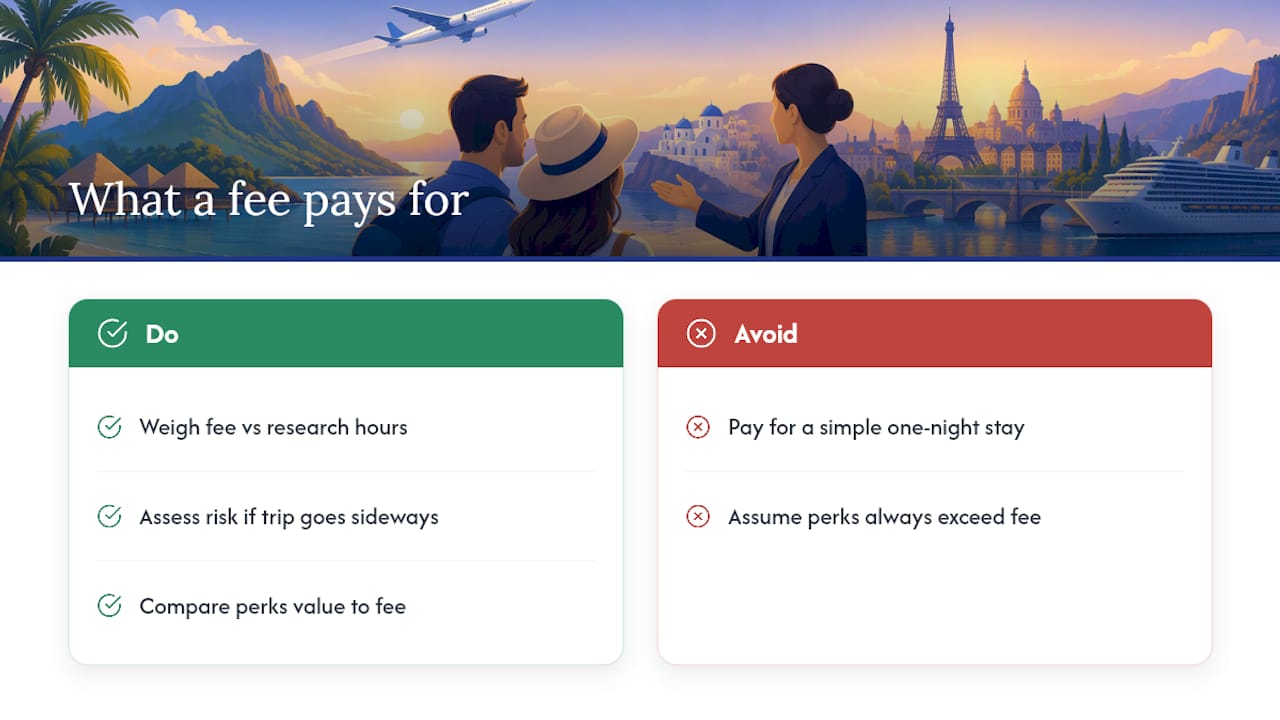
Weigh the fee against three things: how many hours the research would cost you, how much risk you’re carrying if something goes sideways, and whether the perks (room upgrades, resort credits, early check-in) exceed what you’d get booking direct. On a $500 fee tied to $1,200 in upgrades and credits, the math favors the advisor. On a simple one-night stay, it usually doesn’t.
What Should You Ask Before Paying a Travel Agent Fee?
Get clarity before money changes hands. A good advisor answers these without flinching.
- What exactly does this fee cover, in writing?
- Is the fee refundable, and under what conditions?
- Will it be credited toward my final booking cost?
- Are there separate change or cancellation fees on top of this one?
- Who is the merchant of record on this booking, meaning who’s responsible if a refund is owed?
Request a short written scope of work and cancellation policy before you pay anything. Watch for red flags: vague labels like “service fee” or “processing fee” with no explanation, refusal to disclose how the advisor earns supplier compensation, or nonrefundable fees attached to no defined deliverable.
Pro Tip: Ask specifically whether the fee is waived or reduced for repeat clients or larger bookings. Many advisors quietly offer this but won’t volunteer it unless you ask directly.
What Consumer Protections Apply to Travel Agent Bookings?
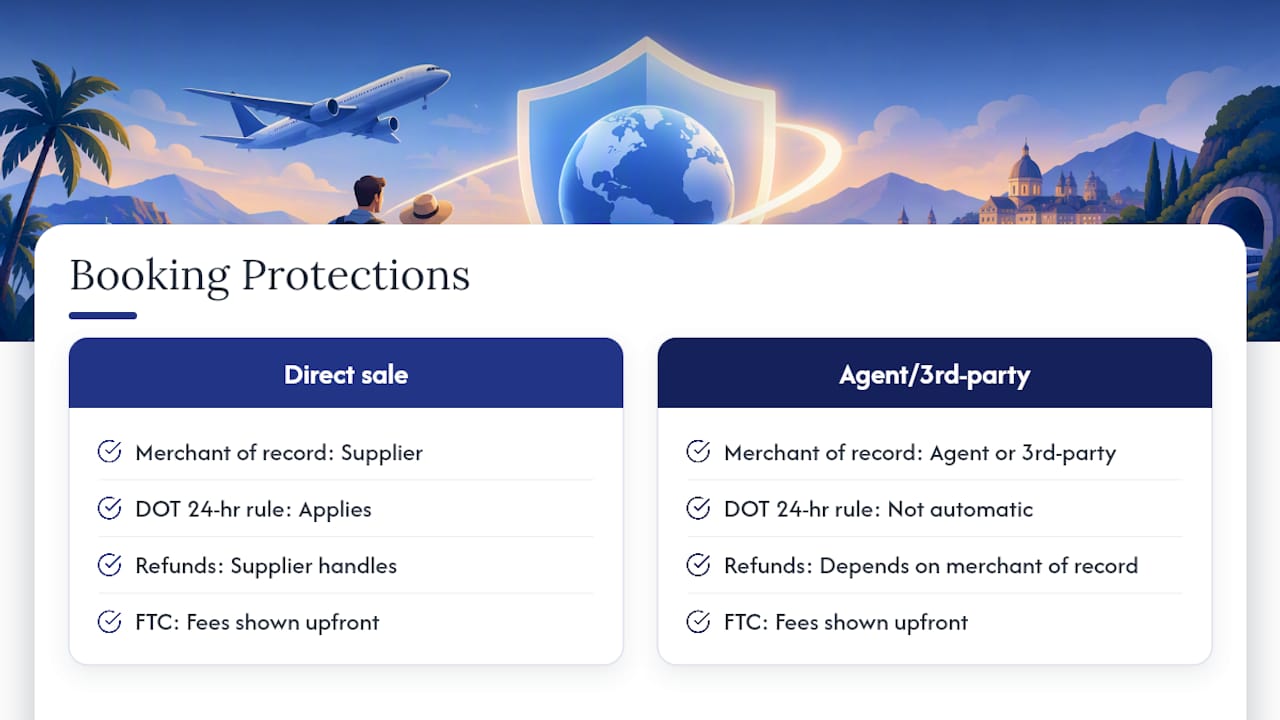
Two federal rules matter more than most travelers realize. The Department of Transportation clarifies that its 24-hour airline refund and hold rule doesn’t automatically extend to tickets bought through a travel agent or third-party site. Refund responsibility depends on who is the merchant of record, the entity that actually processed your payment.
Separately, the FTC’s total-price rule now requires businesses to disclose mandatory lodging and event fees upfront rather than tacking them on at checkout. Before booking, confirm who is merchant of record, get refund and change policies in writing, and compare the full price, meaning the supplier’s total plus any advisor fee, not just the headline rate.
Does a Travel Agent Actually Save You Money?
It depends entirely on the trip. Agents tend to save money on complex multi-destination itineraries, group and wedding bookings where coordinating a dozen travelers invites costly mistakes, and situations where a supplier makes an error only an advisor’s direct contact can fix quickly. Access to packaged rates or room upgrades through preferred programs can also offset the fee.
DIY is usually cheaper for a simple round-trip domestic flight or a single-hotel stay with no special requests. Run the real comparison by adding any mandatory supplier fees plus the advisor’s fee into one total, then compare that number against what you’d pay booking direct.
Publisher Perspective: How No-Fee Luxury Planning Changes the Math
Elitetravelgroup charges no service fees and backs bookings with a price match guarantee and 24/7 support. This model removes the fee-versus-value calculation entirely for luxury travelers. That structure works because commission-rich luxury bookings can fund the planning labor without passing a separate charge to you. Whatever agency you choose, ask for the fee policy and deliverables in writing before booking.
— tammylevent@gmail.com
Request a Clear Fee Breakdown From Elite Travel
Clients can receive concierge-level itinerary design, direct access to preferred hotel and cruise partners, and extensive destination expertise without a separate service charge.

That applies whether you’re planning a destination wedding, a milestone luxury cruise, or a custom luxury vacation package built around your dates and budget. Because compensation comes from supplier partnerships rather than client fees, the price-match guarantee and 24/7 support apply regardless of how complicated your itinerary gets, including group travel coordination across a dozen travelers or more. Reach out to request a no-obligation consultation and ask directly for a written breakdown of what’s included. Start by browsing Elite Travel’s luxury vacation options and requesting a quote for your trip dates.
Sources
- Buying a ticket | US Department of Transportation
- More than half of US advisors now charge fees (Travel Weekly)
- Do travel agents save you money? (NerdWallet)
FAQ
Is it cheaper to go through a travel agent or do it yourself?
It depends on trip complexity. Simple, single-hotel or direct round-trip flight bookings are usually cheaper booked yourself, while multi-destination trips, group travel, and award-ticket bookings often come out even or ahead with an advisor once you factor in avoided errors and preferred-partner perks.
How much does a travel agent make on a $10,000 trip?
On top of supplier commission, some advisors also charge a separate client fee depending on the complexity of the booking.
How much is a typical travel agent service fee?
Flat planning fees commonly range from a few hundred dollars up to over $2,000 for complex trips, while air-only bookings often run $25 to $275 per passenger. Elitetravelgroup charges no service fees on its luxury travel planning, relying instead on supplier compensation.
Do you actually save money using a travel agent?
Sometimes, particularly on complex itineraries, group bookings, or trips where an advisor’s preferred-partner access unlocks upgrades or credits you couldn’t get booking direct. On simple, single-component trips, the savings are usually smaller or nonexistent, so it’s worth comparing the total price, fee included, against booking it yourself.
