



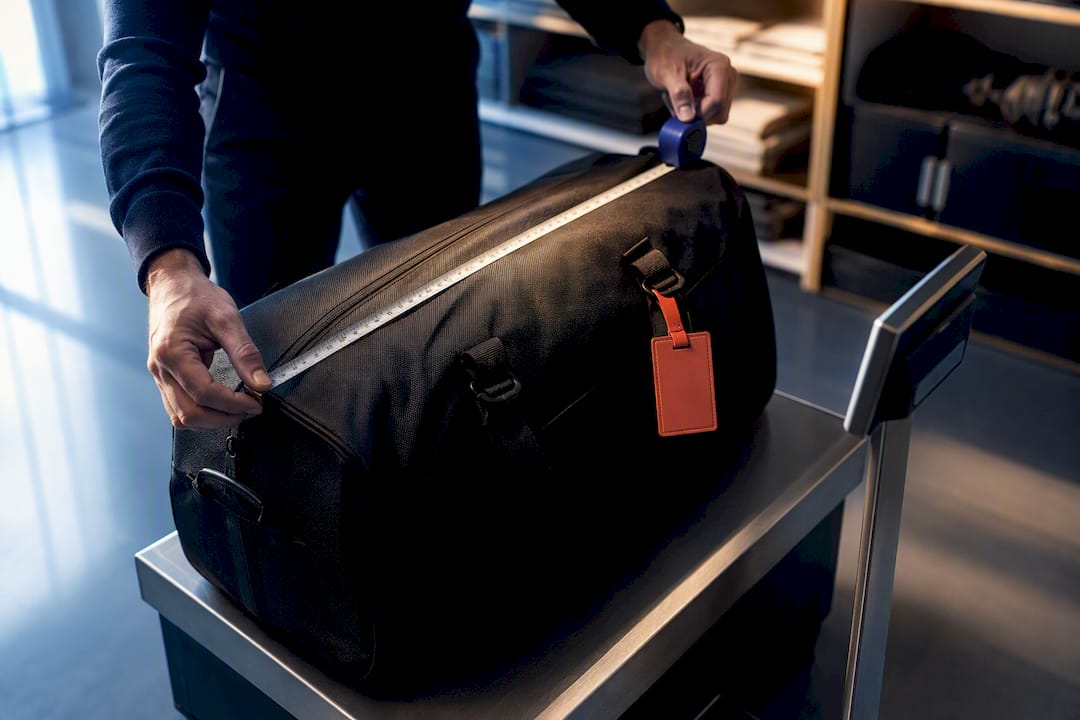
Expect $25 to $150 for a single domestic bag, $99 to $235 or more for door-to-door international shipping, and higher totals if your bag trips a dimensional-weight or oversize surcharge. Three factors set the final number: billed weight (which is often higher than what your bathroom scale shows), how far and how fast you need the bag to travel, and which accessorial fees your carrier tacks on. Measure your bag’s actual dimensions before you request a quote. That single step often decides whether you land at the low end of the range or the high end.
TL;DR:
- Dimensional weight calculations can significantly increase costs, especially for large, lightly packed bags that exceed surcharge thresholds due to rounded measurements.
- Changes in 2026 mean carriers round dimensions up more aggressively, often pushing bags into higher billing weight categories without visible rate increases.
- Shipping a 50 lb domestic bag typically costs between $25 and $150, but international or expedited services can easily surpass $300 in total costs.
- Avoid unexpected surcharges by measuring your luggage precisely, choosing pickup locations like hotels, and requesting firm quotes that include all fees.
- Forwarding is cost-effective for multiple or oversized bags, but small, lightweight bags on direct flights are usually cheaper to check with airlines.
Table of Contents
- What Drives Luggage Forwarding Cost
- Sample Luggage Forwarding Prices, Including a 50 lb Bag
- Hidden Surcharges That Push the Final Bill Higher
- How Dimensional Weight Is Calculated (and Why 2026 Rules Changed the Math)
- Is Luggage Forwarding Worth the Cost?
- Scheduling Pickup: Transit Times and Lead Times
- A Concierge’s Checklist for Worry-Free Luggage Forwarding
- Why the 2026 Rule Changes Matter More Than the Headline Rate Hikes
- Sources
- FAQ
What Drives Luggage Forwarding Cost
Luggage forwarding pricing breaks into two models: itemized freight rates, where you pay a base charge plus separate fees for pickup, fuel, and handling, and all-inclusive door-to-door pricing, where a specialty shipper bundles everything into one number. Luggage Forward’s published pricing folds pickup, delivery, and value protection into a flat rate, which makes comparison shopping easier but usually starts higher than a bare carrier quote.
Every carrier bills you for the greater of your bag’s actual weight or its dimensional weight, a figure calculated from its size rather than what it weighs on a scale. A large, lightly packed duffel can cost more to ship than a small, dense one because of this rule alone.
Speed changes the math fast. Ground service is the cheapest way to move a bag, but express or overnight options can run several times the ground rate for the same box, according to pricing breakdowns from Betachon. Distance matters too. Carriers price by zone, so a bag traveling 300 miles costs less than the same bag crossing the country or an ocean.
Watch for the gap between a “starting at” advertised rate and what you actually owe:
- Base freight charges cover the miles and the pound, nothing else.
- Pickup and residential delivery fees often apply on top of the base rate.
- Fuel surcharges shift monthly and rarely appear in headline pricing.
- All-inclusive quotes trade a higher sticker price for fewer surprises at checkout.
Sample Luggage Forwarding Prices, Including a 50 lb Bag
These are illustrative ranges, not quotes. Actual pricing on your bag will depend on its exact weight, dimensions, origin, destination, and the carrier’s current rate table, so treat this table as a planning tool and confirm the number with a live quote before you book.
| Shipment type | Weight/size | Typical cost range |
|---|---|---|
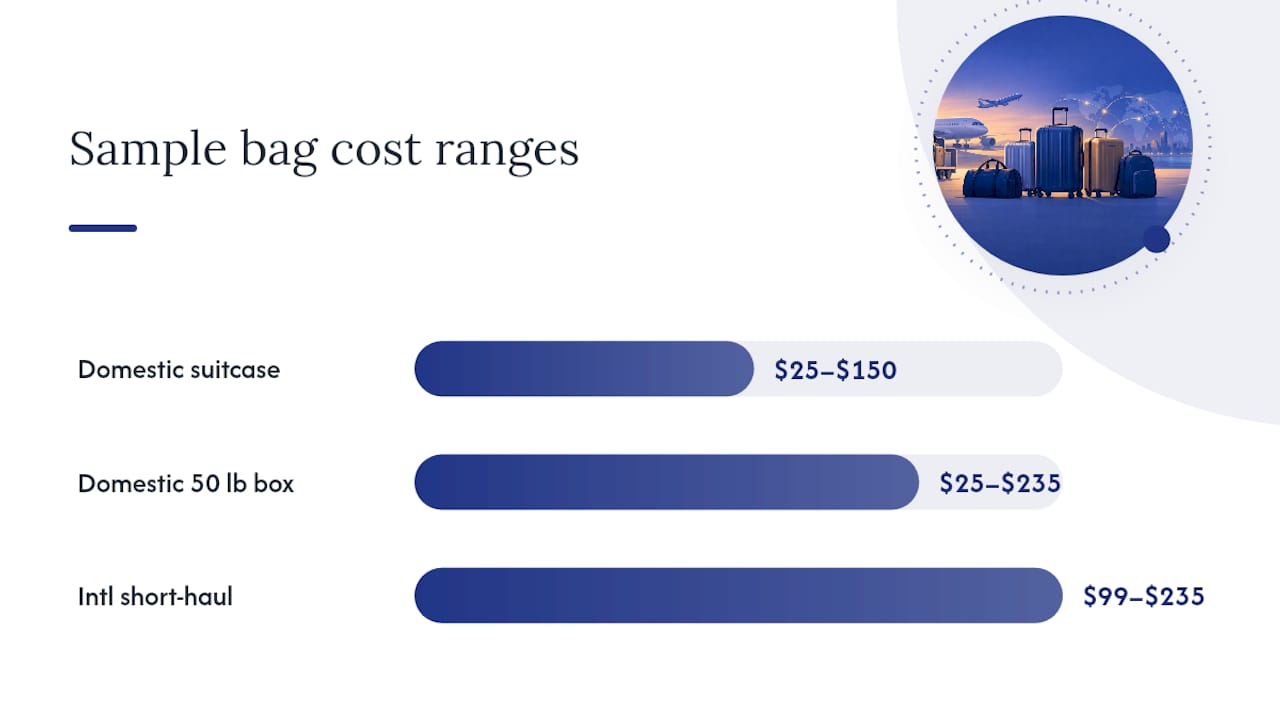
| Domestic, single suitcase | Standard checked bag (~50 lb) | $25–$150 |
| Domestic, 50 lb box | 50 lb, boxed | $25–$235 depending on zone and speed |
| International, short-haul | Standard suitcase | $99–$235 |
| International, long-haul or express | Standard suitcase | Typically more expensive, increasing with distance and speed |
| Door-to-door white-glove service | Standard suitcase | Starting at a higher all-inclusive price |
A 50 lb box shipped domestically can land anywhere from roughly $25 on ground service between nearby zones to $235 when you pay for expedited delivery across the country. That spread alone explains why two travelers shipping what feels like the same suitcase can end up with wildly different bills. International shipping compresses that spread upward. Even a short-haul international route rarely dips below $99 once you add customs handling, and long-haul or express service can push a single bag past $300.
One-off consolidators and specialty luggage shippers sometimes undercut standard parcel carriers on bulky, light items, since they aggregate volume and negotiate freight-like rates that avoid retail oversized-parcel pricing entirely.
Hidden Surcharges That Push the Final Bill Higher
The quoted base rate is rarely the number you pay.
- Residential surcharge: applies when pickup or delivery happens at a home address instead of a business location.
- Fuel surcharge: a variable percentage added to nearly every shipment, adjusted monthly.
- Additional handling fee: triggered when a package exceeds certain cubic-volume or weight thresholds.
- Oversize or large-package fee: kicks in above roughly 10,368 cubic inches for additional handling and 17,280 cubic inches for large-package classification, per DimMath’s surcharge thresholds.
- Signature and address-correction fees: small individually, but they compound when a delivery address is incomplete or a signature gets missed on the first attempt.
The most common trigger customers might overlook is dimensional rounding. Carriers round every side of your bag up to the next whole inch before calculating volume, which can push a bag over a surcharge threshold that precise measurements would have missed.
Pro Tip: Shave one inch off any side you can before you box or bag your luggage for shipping. Because carriers round every dimension up, a bag that measures just over a threshold gets billed as if it cleared it by a full inch, and that difference alone can add a $100+ additional handling fee.
Choosing a business pickup location, such as a hotel front desk instead of a home address, is one of the simplest ways to strip a fee out of your total.
How Dimensional Weight Is Calculated (and Why 2026 Rules Changed the Math)
Dimensional weight, or DIM weight, is the number carriers use when your bag is bulky but light. If DIM weight comes out higher than your bag’s actual weight, you pay for the DIM figure instead.
The calculation runs in three steps, following the standard DIM formula:
- Round each dimension (length, width, height) up to the next whole inch.
- Multiply the three dimensions together to get cubic inches, then divide by the carrier’s DIM divisor.
- Round the result up to the next whole pound. That number is your billable weight if it exceeds actual weight.
The divisor itself changed the outcome for a lot of shippers recently. UPS and FedEx began rounding fractional dimensions up more aggressively starting August 18, 2025, and USPS aligned its own divisor and rounding rules on July 12, 2026. A bag that measured 28 by 20 by 12 inches and would have rounded down under the old rules now rounds up on every side, which can add a full pound or more of billable weight and shift the bag into a higher price bracket entirely.
Is Luggage Forwarding Worth the Cost?
Airlines typically charge $30 to $75 per checked bag domestically and considerably more internationally, especially for a second or third bag or anything overweight. Compare that to a forwarding quote in the $25 to $150 domestic range, or $99 and up internationally, and the math tips in different directions depending on how many bags you’re moving and where you’re headed.
Forwarding tends to win when:
- You’re checking three or more bags, since airline per-bag fees stack fast.
- You’re on a multi-city or cruise itinerary and don’t want to drag luggage through connections.
- Your bags are oversized or overweight for standard airline limits, where airline penalty fees get steep.
- You’d rather arrive at your destination hotel with bags already waiting than manage curbside check-in.
A single, standard-weight bag on a direct flight is usually cheaper to check with the airline. If you’re on top of the travel budget and only carrying one suitcase, forwarding’s convenience premium probably isn’t worth paying for.
Scheduling Pickup: Transit Times and Lead Times
Ground shipments typically take three to seven business days domestically; express service cuts that to one or two days for a higher fee. International door-to-door shipping commonly runs five to twelve days depending on customs processing.
Book pickup at least five to seven days ahead for domestic trips and two to three weeks ahead for international ones, especially during peak travel seasons when carrier capacity tightens.
Before handoff, confirm:
- The delivery address and a working phone number for the receiving contact.
- Insurance or declared value coverage on the shipment.
- Labels are attached to every piece, not just the outermost box.
A Concierge’s Checklist for Worry-Free Luggage Forwarding
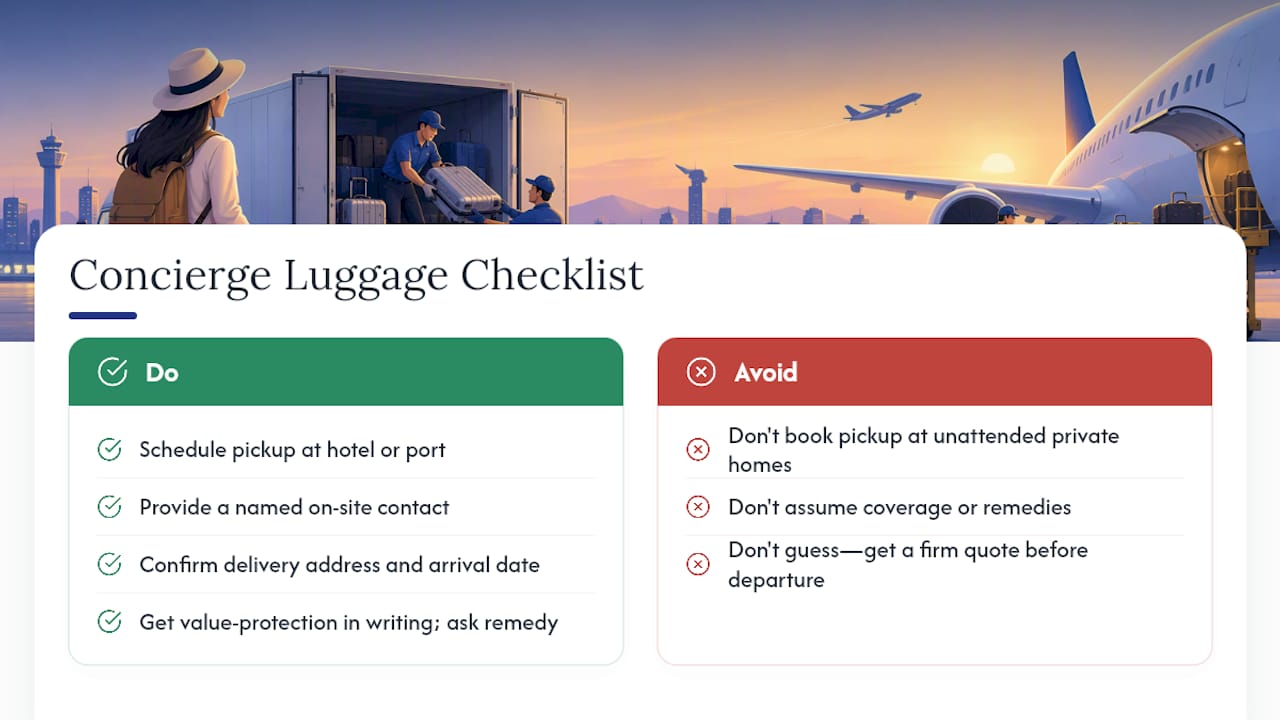
Coordinating a forwarded bag is logistics work, and it’s exactly the kind of detail a concierge handles as a matter of course rather than an afterthought. Scheduling a pickup window at a hotel or port-side address with a reliable on-site contact avoids the residential surcharges and missed-handoff fees that trip up travelers booking pickup at a private home with no one available during a two-hour delivery window.
A solid pre-shipment checklist includes confirming the delivery address and arrival date with the receiving property, verifying pickup windows against your own travel schedule, and getting value-protection coverage in writing rather than assuming it. Ask specifically whether the carrier’s remedy for loss or damage is a cash settlement or a repair-and-replace policy. Those two terms are not interchangeable, and the difference matters if a bag full of formalwear for a destination wedding goes missing.
Pro Tip: Build a 2 to 4 hour pickup window into your schedule and give the carrier a named on-site contact at your hotel. That one step, borrowed from how private airport transfers get coordinated, eliminates most missed-handoff fees before they happen.
Travelers moving golf clubs, ski gear, or multiple oversized bags for a group trip run into these same DIM and surcharge rules, just at a larger scale, which is one more reason to get a firm quote before departure rather than guessing at the number.
Why the 2026 Rule Changes Matter More Than the Headline Rate Hikes
Most travelers still shop luggage forwarding the way they did five years ago: they compare a couple of quoted totals and pick the lower number. That approach missed something important in 2026. The dimensional-rounding changes that landed alongside them did more damage to actual bills than the published rate hikes ever will.
Here’s what that means in practice: a bag that would have shipped as a normal-weight parcel two years ago can now round into a higher billable weight simply because carriers stopped giving fractional inches the benefit of the doubt. Nobody advertises that shift on a rate card. You only find it when you measure your own bag and run the numbers yourself.
My advice, unglamorous as it sounds, is to measure before you quote. Every other decision, ground versus express, domestic versus all-inclusive, matters less than getting an accurate cubic-inch figure before a carrier rounds it for you. Treat the concierge-style checklist, not the sticker price, as the real cost control.
— tammylevent@gmail.com
Sources
- 2026 parcel pricing: the changes beyond the rate rise — Ship24
- Oversize & Additional Handling Surcharge Calculator (UPS, FedEx, USPS) — 2026 — DimMath
- How much does it cost to ship a 50 pound box? — Betachon
- How Much Does It Cost to Ship Luggage? — Luggage Forward
FAQ
Is Luggage Forwarding Worth It?
For a single standard bag on a direct domestic flight, checking it with the airline is usually cheaper. Forwarding earns its cost back when you’re moving multiple bags, oversized gear, or navigating a multi-city or cruise itinerary where handling your own luggage adds real hassle.
How Much Does It Cost to Ship a 50 Lb Suitcase?
Domestically, a 50 lb box typically runs $25 to $235 depending on distance and how fast you need it delivered. International shipping for the same bag generally starts around $99 and can exceed $300 for express service.
Is Luggage Forwarding Safe?
Reputable forwarders offer tracking and value-protection coverage, but ask in writing whether that coverage pays a cash settlement or repairs and replaces damaged items. Confirming this before you ship, not after something goes wrong, is the only way to know what you’re actually covered for.
Is Luggage Forward a Good Company?
Luggage Forward is a specialty door-to-door shipper that bundles pickup, delivery, and value protection into one all-inclusive price, which simplifies comparison shopping even though the headline rate often starts higher than piecemeal carrier pricing. Whether it’s the right fit depends on how much you value that bundled convenience versus assembling the cheapest itemized quote yourself.
