




Yes, travel agents and booking sites get used in scams, and the single biggest safeguard is payment method: never wire money, load gift cards, or send crypto to secure a trip. Insist on a supplier-confirmed booking number before you pay anything, and put the charge on a credit card. If it’s already too late, report it fast. Your dispute window closes quicker than you think.
TL;DR:
- Using a credit card for payment offers better protection through dispute and chargeback options compared to wire transfers, gift cards, or cryptocurrencies.
- Verifying booking confirmation numbers directly with airlines or hotels helps prevent falling for fake or stolen reservations.
- Cross-checking contact details, licensing, membership, and online reviews before booking can help identify legitimate agencies and avoid scams.
- Quick action by disputing fraud charges and reporting to authorities within days increases chances of recovering stolen funds after a scam.
- Paying only after receiving verifiable, supplier-issued confirmation reduces exposure to look-alike agencies and fraudulent booking sites.
Table of Contents
- Common Travel Agent and Booking Scams to Watch For
- How to Verify a Travel Agent, Agency, or Booking Site Before You Commit
- Payment and Booking Red Flags: What Not to Pay With and Why
- If You Think You’ve Been Scammed: Step by Step
- How to Protect Yourself Before Booking: A Pre-Purchase Checklist
- Why a Vetted Travel Advisor Reduces Risk
- Legal Rights and Consumer Protections Specific to Travel Agent Scams
- Recent Cases That Show How These Scams Actually Play Out
- How to Identify and Avoid Phishing Attempts Related to Travel Bookings
- A Travel Advisor’s View on Spotting Trouble Early
- If You Want a Trusted Agent: How a Vetted Luxury Travel Agency Can Help
- Sources
Common Travel Agent and Booking Scams to Watch For
Most travel agent scams follow a handful of tested scripts, and once you’ve seen the pattern, they get much easier to spot on sight.
Fake or look-alike agencies are the most common version. Scammers clone a legitimate agency’s name, logo, and website copy, then run ads that route calls to a fraudulent call center. IATA documents confirm that impersonation of airlines and booking platforms through fake sites is a widespread tactic, not a rare edge case.
- Hijacked rental listings: a real vacation-home photo set gets copied onto a fake booking page, and the “owner” insists on a direct deposit.
- Prize and free-vacation offers: you “won” a trip, but claiming it requires paying taxes or a processing fee upfront. The FTC is blunt about this one: a legitimate prize never requires payment to claim it.
- Bogus charter flights and timeshare resale schemes that vanish once funds clear.
- Fake visa, passport, or International Driving Permit services that charge inflated fees for documents you could get directly from the government.
The State Department warns specifically about impostor sites selling passport and visa services, and the guidance is simple: use only official government channels for travel documents.
How to Verify a Travel Agent, Agency, or Booking Site Before You Commit
Verification takes maybe ten minutes, and it’s the ten minutes that saves your trip.
- Cross-check the phone number and email against the supplier’s own website. Don’t call back a number from the agent’s email signature. Search for it independently.
- Ask for the supplier-issued confirmation number and call the airline, hotel, or cruise line directly to confirm it’s real, before you send final payment.
- Look up the agency’s state licensing status where applicable, and check for American Society of Travel Advisors (ASTA) membership or a Better Business Bureau profile.
- Search the agency’s name plus the word “complaint” or “scam” and see what surfaces from the past 12 months.
- Verify the business has a real, checkable physical address and, for larger transactions, a tax ID they’re willing to provide.
Pro Tip: Ask the agent to email your confirmation directly from the supplier’s own domain, or forward you the supplier’s confirmation email unedited. A legitimate booking always has a paper trail you can independently verify.
Payment and Booking Red Flags: What Not to Pay With and Why
The payment method is the single clearest signal you’ll get before money leaves your account. Wire transfers, gift cards, payment apps, and cryptocurrency share one trait that scammers love: once the funds move, they’re gone. The FTC specifically recommends avoiding all four because none of them come with built-in recovery options.
Credit cards work differently. They give you a formal dispute and chargeback process if a trip never materializes, and card issuers are required to investigate.
- Wire transfers: no recall option once the receiving bank processes it.
- Gift cards: functionally cash the moment the codes are read aloud.
- Payment apps (Zelle, Venmo, Cash App): built for friends and family, not commerce, with minimal fraud protection.
- Cryptocurrency: irreversible by design.
If an agent pressures you to pay through only one of these channels, or demands full payment immediately with no room to verify anything first, that’s the tell. Legitimate agencies confirm bookings and give you time to review before final payment clears.
If You Think You’ve Been Scammed: Step by Step
Move fast. The sooner you act, the better your odds of recovering money and helping investigators build a case.
- Call your card issuer immediately and ask about disputing the charge or starting a chargeback. Do this within days, not weeks.
- Save every email, text, receipt, and screenshot in one folder. Include the agent’s name, phone number, and any website URLs used.
- File a report at Reportfraud, which routes complaints to law enforcement nationally.
- If the scam involved a fraudulent website or online communication, also file with the FBI’s Internet Crime Complaint Center (IC3).
- Report to your state attorney general’s consumer protection office, since some states pursue travel fraud cases directly.
- Contact the airline, hotel, or cruise line named in your “confirmation” to find out whether any booking under your name actually exists.
A real case out of New York shows why speed matters: a Long Island travel agent was accused of defrauding clients out of more than $50,000 after collecting payments for trips that were never booked. Clients who acted quickly with their card issuers had a better shot at recovering funds than those who waited.
How to Protect Yourself Before Booking: A Pre-Purchase Checklist
Build these habits now, and most scams simply won’t get a foothold.
- Skip the sponsored ad at the top of your search results and type the supplier’s known URL directly. IATA’s fraud guidance flags SEO-poisoned search ads as a common entry point for fake travel sites.
- Require a supplier confirmation number before final payment, and verify it independently.
- Get a written contract that spells out refund and cancellation terms, and read it before you sign anything.
- Pay by credit card whenever the option exists.
- Keep copies of every receipt, voucher, and itinerary in one place, digital and printed.
Pro Tip: If an agent can’t produce a supplier confirmation number within 24 hours of taking your deposit, ask for a refund. A real booking exists the moment money changes hands, not “sometime next week.”
Why a Vetted Travel Advisor Reduces Risk
A reputable advisor removes most of the guesswork because they book directly through verified supplier relationships and hand you written confirmations you can check independently. They also handle disputes on your behalf and stay reachable when something goes sideways at 11 p.m. the night before your flight.
- Ask any advisor for proof of the booking: a confirmation number you can verify with the airline or hotel directly.
- Request their refund and cancellation policy in writing before you pay a deposit.
- Confirm they’ll remain your point of contact if a supplier changes or cancels your itinerary.
Elite Travel’s consumer guidance on travel scams walks through exactly what documentation a legitimate advisor should provide.
Legal Rights and Consumer Protections Specific to Travel Agent Scams
Consumer protection here comes from several overlapping layers, and knowing which one applies to your situation matters.
At the federal level, the FTC enforces against deceptive and unfair practices under the FTC Act, which covers false prize promises and misrepresented travel packages. The agency doesn’t typically resolve individual disputes dollar for dollar, but complaints filed through reportfraud.ftc.gov feed directly into investigations that can shut operations down.
State attorneys general offer a more direct path for individual consumers. Many states have their own travel-seller registration laws, particularly California, Florida, Hawaii, and Washington, which require sellers of travel to register and, in some cases, bond themselves financially. A bonded agency gives you a fallback claim against that bond if the agency collapses or defrauds clients.
Your credit card issuer is arguably your strongest practical protection. Under the Fair Credit Billing Act, you can dispute charges for services never rendered, and issuers are required to investigate within specific timeframes. This is separate from state or federal action and moves far faster.
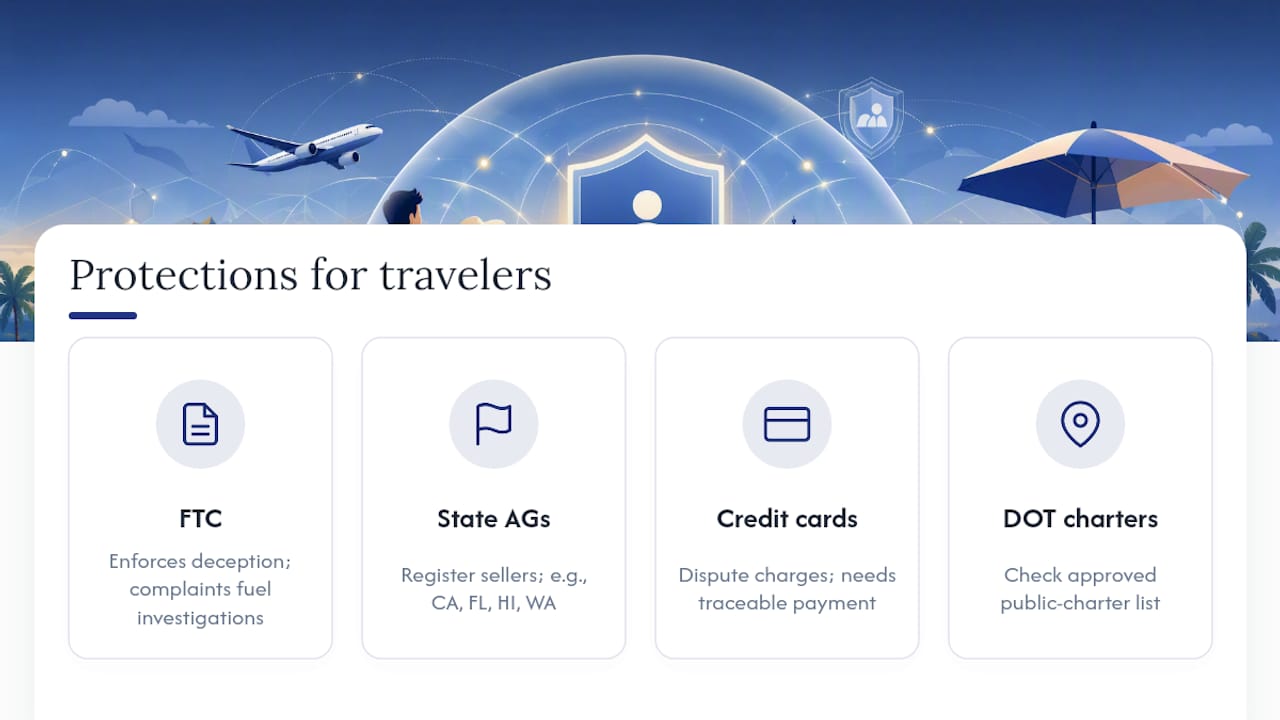
For chartered flights specifically, the Department of Transportation maintains an approved public charter list. A charter package that isn’t on that list, or can’t point you to DOT approval, is operating outside a framework meant to protect you if the flight never happens.
None of these protections work retroactively if you paid by wire transfer or gift card. They depend on a traceable, disputable payment trail existing in the first place.
Recent Cases That Show How These Scams Actually Play Out
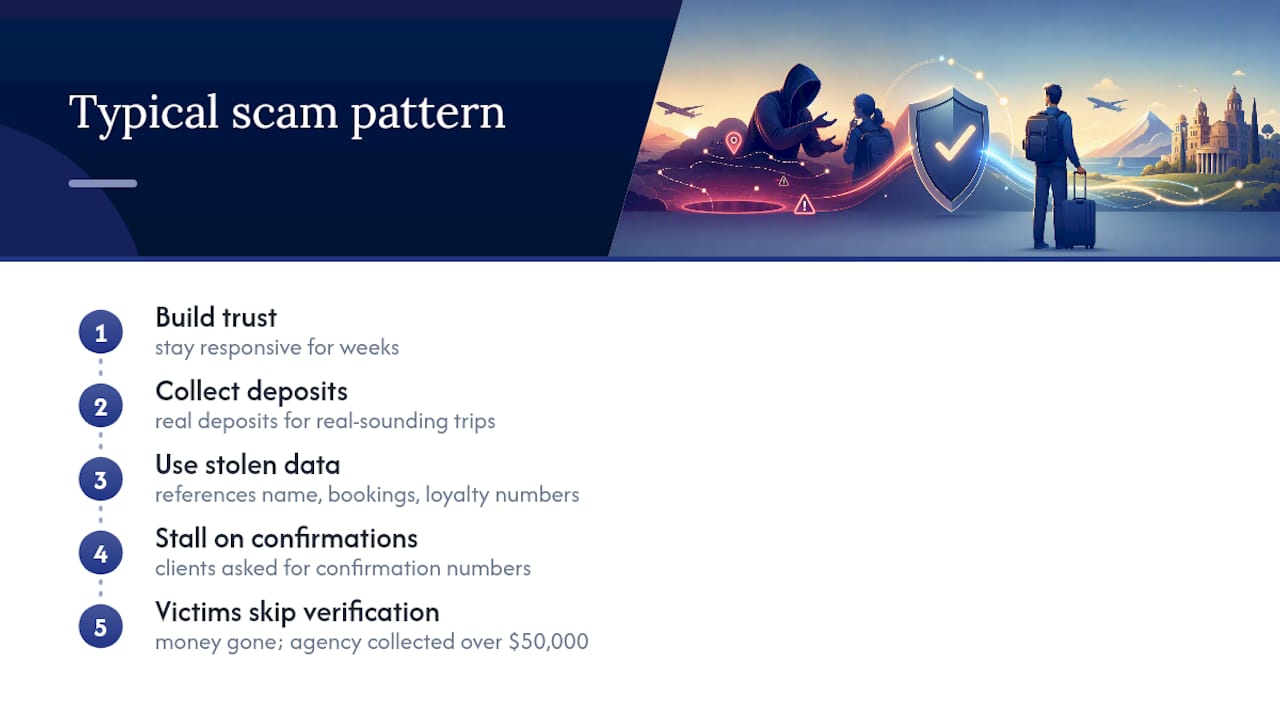
The Long Island case mentioned earlier is a useful template because it shows the pattern almost every fraudulent agent follows: build trust over time, collect real deposits for real-sounding trips, and stall when clients ask for confirmation numbers. By the time clients realized nothing had been booked, the money was gone and the agency had allegedly collected over $50,000 from multiple families.
Malwarebytes’ security research adds a modern wrinkle to that same pattern: today’s scams increasingly use data stolen in earlier breaches to make fraudulent communications look convincing. A scammer who already has your name, past booking history, or loyalty number can reference real details in a fake confirmation email, which makes the old advice, “look for typos,” far less reliable than it used to be.
The common thread across these cases isn’t sophistication. It’s patience. Scammers who take small deposits and stay responsive for weeks build exactly the kind of trust that makes victims skip the verification step. The agency in the CBS New York case reportedly operated for a stretch before clients compared notes and realized none of their trips actually existed with the airlines or resorts named on their itineraries.
How to Identify and Avoid Phishing Attempts Related to Travel Bookings
Phishing tied to travel bookings usually arrives disguised as something you’re already expecting: a booking confirmation, a payment receipt, or an urgent notice about a flight change. That’s what makes it effective. You’re primed to open it.
Look at the sender’s actual email address, not just the display name. A message claiming to be from a major hotel chain but sent from a generic address, or a domain with extra characters swapped in, is the clearest tell. Hover over links before clicking; the destination URL rarely matches the supplier’s real domain in a phishing attempt.
Be suspicious of any email demanding immediate payment or account verification through a link rather than by logging into the supplier’s app or site directly. Legitimate airlines and hotels don’t typically ask you to “confirm payment details” through an embedded link in an unsolicited email.
If you booked recently and get a message about a “problem with your reservation,” go around the email entirely. Open a browser, navigate to the supplier’s site directly, or call the number on your original confirmation, not the number in the suspicious message. This single habit defeats the majority of travel phishing attempts, because the scam depends on you clicking through rather than verifying independently.
Two-factor authentication on your email and loyalty accounts adds another layer, since a compromised loyalty account is often the first domino in a broader booking scam. If a message ever asks you to disable two-factor authentication “to fix a booking issue,” treat that as an automatic red flag.
A Travel Advisor’s View on Spotting Trouble Early
Most clients who avoid scams do one thing consistently: they ask for the confirmation number before they ask for anything else. Transparency about supplier contacts and a documented paper trail aren’t extra steps. They’re the whole game.
— tammylevent@gmail.com
If You Want a Trusted Agent: How a Vetted Luxury Travel Agency Can Help
You could spend hours cross-checking licenses, calling suppliers directly, and building your own paper trail for every leg of a trip, or you could hand that verification work to someone who already does it for a living. That’s the real difference a vetted advisor offers: not just booking convenience, but someone who’s already confirmed the supplier relationship before your money ever moves.
Some luxury travel agencies spend years building direct relationships with hotels, resorts, and tour operators worldwide, which means the confirmation you get isn’t a forwarded email. It’s a documented booking you can verify with the supplier yourself. There are no service fees added on top, and a price match guarantee means you’re not sacrificing value for peace of mind. Support is available outside regular office hours, so if something changes with a supplier late at night before a flight, assistance is available.
If you’re planning a trip and want a written supplier confirmation before you commit a dollar, start with Elite Travel’s adventure travel packages or explore Europe vacation planning and request verification documentation up front. It’s a five-minute conversation that tells you everything you need to know about who you’re actually booking with. For organizers coordinating group logistics, vendor verification practices from event planning offer a useful parallel on why confirming suppliers directly matters just as much outside the travel industry as within it.
