




Travel supplier failure happens when an airline, hotel, cruise line, or tour operator that a business or traveler relied on becomes insolvent or collapses, leaving bookings unfulfilled. The two main financial backstops are Supplier Failure Insurance (SFI) for tour operators and agents, and Scheduled Airline Failure Insurance (SAFI) for airline-specific collapses. Travelers rely on travel disruption cover, refund rights, and repatriation assistance built into consumer protection schemes.
TL;DR:
- Insurance coverage for supplier failure protects travelers’ refunds and alternative arrangements but depends on clear policy wording and timely claims filing.
- Virtual card payments offer a chargeback option that helps recover funds faster than waiting on insolvency proceedings, especially for airlines.
- Acting quickly by contacting the seller, reviewing policies, and documenting the situation can significantly improve recovery chances for travelers and businesses.
- Diversifying suppliers and establishing backup relationships can reduce the impact of a collapse, especially when prepaid exposure is concentrated among few partners.
- Curated supplier networks and ongoing financial monitoring by travel advisors can enable early rebooking and minimize disruption during supplier insolvencies.
Table of Contents
- What Counts as Supplier or End-Supplier Failure?
- Who Gets Hurt When a Supplier Fails, and How Much?
- SFI, SAFI, and Payment Strategy: How Coverage Actually Works
- What to Do the Moment a Supplier Fails
- How Travel Businesses Can Reduce Supplier Risk
- Why Vetted Suppliers Change the Recovery Timeline
- A Different Way to Reduce Your Exposure
- Sources
What Counts as Supplier or End-Supplier Failure?
End-supplier failure means the company that actually delivers the service, not the agency that sold it, goes under financially. That could be an airline halting operations, a hotel operator filing for insolvency mid-season, or a local ground handler in Southeast Asia disappearing overnight with prepaid deposits. The travel agency or tour operator that booked the trip is still on the hook to the customer in most cases, even though the failure happened somewhere else in the chain.
The sequence after a failure usually runs the same way regardless of which supplier collapsed:
- Immediate disruption: bookings are cancelled, hotel rooms are unconfirmed, or a flight simply doesn’t operate.
- Relocation or repatriation: travelers already on the ground need alternative flights, hotels, or transport home.
- Claim and insolvency process: the seller (and its insurer, if one exists) files claims to recover funds already paid to the failed supplier.
That third stage can drag on for months, especially when the failed supplier is based overseas and its assets are tied up in foreign insolvency courts.
Who Gets Hurt When a Supplier Fails, and How Much?
A supplier collapse hits travelers and travel businesses differently, and the fixes look different too. Travelers care about getting home and getting their money back. Businesses care about both of those things plus their prepaid exposure and their reputation with every customer who booked through them.
For travelers, protection usually comes from three places: a package travel consumer scheme, a standalone travel insurance policy with disruption or supplier-failure add-ons, and the payment method used to book (credit cards often carry stronger dispute rights than debit).
- Travelers should check whether their policy explicitly names “end supplier failure” or only covers cancellation for illness and weather.
- Travel businesses face prepaid funds locked in supplier accounts, potential chargebacks from angry customers, and regulatory reporting obligations depending on where they’re licensed.
- Refund timelines for travelers often run 4 to 12 weeks; business insolvency claims can take considerably longer to resolve.
Reputational damage often lands on the seller, not the failed supplier, even when the seller did nothing wrong.
SFI, SAFI, and Payment Strategy: How Coverage Actually Works
Supplier Failure Insurance protects tour operators and travel agents when a contracted supplier, a hotel chain, a DMC, a cruise line, becomes insolvent. It typically covers refunds owed to customers, the cost of arranging alternative accommodations or activities, and repatriation expenses if travelers are stranded. SFI is purchased by the business, not the traveler, though its existence is what makes a seller’s refund promise credible.
Scheduled Airline Failure Insurance covers a narrower but common scenario: the collapse of an airline whose seats were sold as part of a package. Because air-inclusive packages carry the largest prepaid exposure, insurers frequently pair SFI and SAFI so a single failure, whether it starts with the airline or the ground supplier, doesn’t fall into a coverage gap.
Travelers buying independently should look for travel disruption or inconvenience cover that names supplier insolvency specifically, not just weather delays or personal illness. Policy wording varies significantly between insurers, so the fine print matters more here than in almost any other travel insurance category.
Common exclusions to watch for:
- Suppliers already known to be in financial distress before the policy was purchased
- Claims filed after a strict notification window, often 30 to 60 days
- Repatriation costs above a stated per-person limit
Payment method changes the math too. Virtual card (VCN) payments have helped travel intermediaries recover close to $60 million through chargebacks across multiple airline failures, often faster than waiting on formal insolvency proceedings.
Pro Tip: If you run a travel business, ask suppliers whether they’ll accept payment via virtual card instead of wire transfer. It costs you nothing extra and gives you a chargeback path if the supplier folds before delivering the service.
What to Do the Moment a Supplier Fails
Acting fast preserves both your money and your options. Here’s the order that actually works.
- Contact the seller first. If you booked through an agency or tour operator, they are your primary point of contact, not the failed supplier.
- Pull up your policy documents. Check whether your coverage explicitly names supplier or end-supplier failure, and note the claims deadline.
- Document everything. Save booking confirmations, payment receipts, correspondence, and photos of any stranded situation.
- Contact your card issuer if payment recovery looks likely. Chargebacks often have their own filing windows, sometimes as short as 60 to 120 days from the transaction date.
- Reach out to consular services if stranded abroad. Embassies can’t pay your bills, but they can help with emergency documentation and connections to local resources.
For travel businesses, the checklist runs parallel but adds two steps: notify affected customers immediately with a clear timeline, and open a formal claim with your SFI or SAFI insurer the same day you learn of the failure. Insurers generally want proof of payment to the failed supplier, the original booking contract, and evidence of the supplier’s insolvency filing or public collapse announcement. The businesses that recover fastest are the ones with this documentation already organized before disaster strikes, not scrambling to find it afterward.
How Travel Businesses Can Reduce Supplier Risk
Supplier failure isn’t fully preventable, but its impact is manageable with the right controls in place before a crisis hits.
Start by mapping which suppliers carry the most exposure. A hotel partner handling 40% of your peak-season bookings represents a very different risk than one handling 5%. Diversifying critical suppliers and maintaining backup relationships means one collapse doesn’t take down an entire season’s bookings.
Payment strategy matters as much as insurance. Businesses using virtual cards or on-scheme card payments instead of bank transfers retain a chargeback option that wire transfers simply don’t offer.
Contract terms deserve equal attention:
- Require suppliers to show evidence of insurance or financial standing before signing
- Build in clear refund terms and escalation contacts for operational failures
- Set rapid-notice requirements so you learn about supplier distress before customers do
Pro Tip: Keep a written continuity plan naming at least one backup supplier for every category, hotels, ground transport, local guides, in each major destination you sell. Reviewing expert partnership practices for travel planning is a useful starting point for building that network.
Why Vetted Suppliers Change the Recovery Timeline
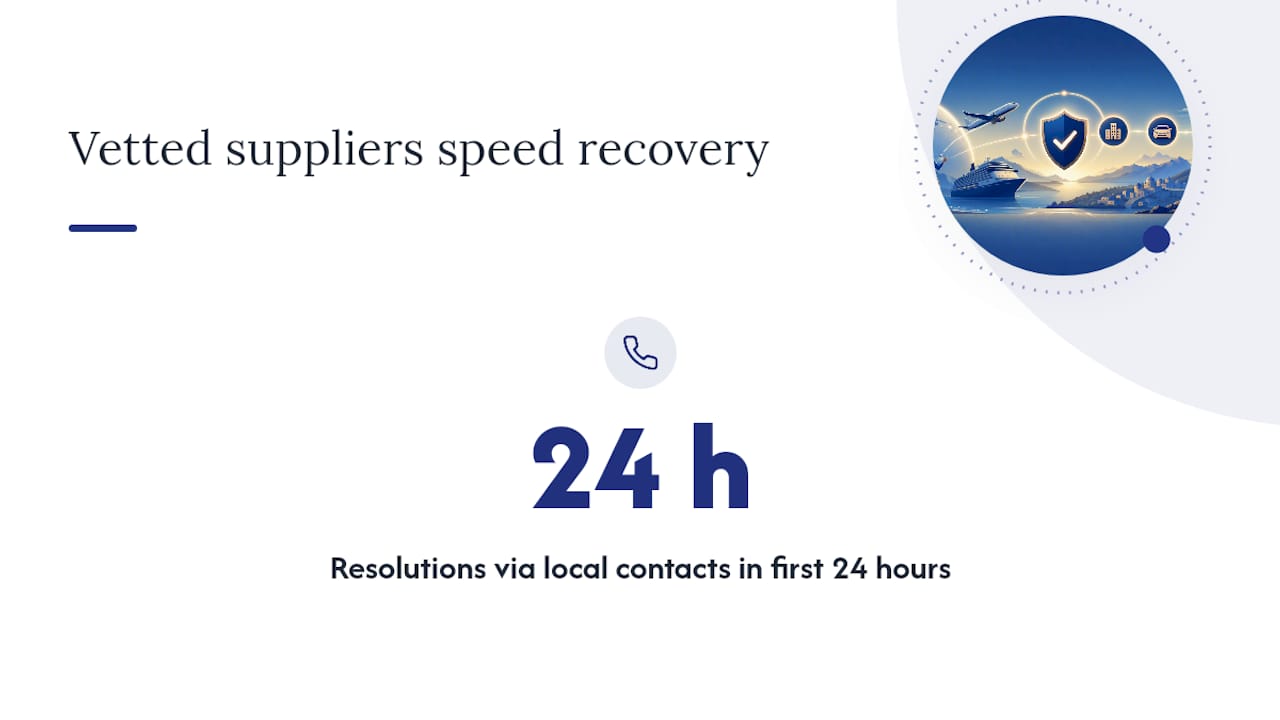
Booking through an advisor who already monitors supplier financial health changes what happens when something goes wrong. Advisors who maintain long-standing relationships with hotels, ground operators, and airlines tend to hear about instability before it becomes a public collapse, and that early warning often means rebooking happens before a traveler even notices a problem.
Curated supplier networks matter most in the first 24 hours of a disruption, when a phone call to the right person on the ground can resolve what would otherwise take a customer service queue days to sort out.
— tammylevent@gmail.com
A Different Way to Reduce Your Exposure
Insurance products like SFI and SAFI matter, but they’re a financial backstop for a failure that already happened. Some luxury travel agencies take a different approach: reducing the odds you ever end up filing that claim in the first place by building itineraries through long-standing supplier relationships and monitoring their financial stability and service quality directly.

That matters most on complex trips, adventure travel in remote regions, multi-country European itineraries, or destination weddings with dozens of moving pieces, where a single unreliable supplier can unravel an entire schedule. Because some agencies work with vetted, on-the-ground partners and offer around-the-clock support, disruptions can get caught and rerouted early. Some agencies also do not charge service fees and offer booking guarantees.
If you’re planning a trip where supplier reliability actually matters, an adventure travel itinerary built by an advisor who already knows the ground partners is worth a conversation before you book anything yourself.
Sources
- Supplier Failure Insurance (SFI) — TMU Management
- What is end supplier failure? — Total Travel Protection
- End supplier failure cover — Globelink
