




The most effective honeymoon itinerary follows a simple rhythm: one big experience per day, intentional buffer days built in, and every booking locked in the right order. Whether you have three days or ten, the structure below gives you a ready-to-use plan you can copy right now, plus a five-minute starter checklist to get moving before you close this tab.
Your five-minute starter checklist:
- Decide your travel window (how many days you realistically have after the wedding)
- Choose your honeymoon style: minimoon, one-base, or split-stay
- Identify your single must-have experience or destination anchor
- Open a dedicated savings account or honeymoon registry fund
- Write one sentence describing your ideal trip (you’ll use it to guide every booking)
Three ready-to-use templates are covered below: a 3-day minimoon, a 7-day one-base, and a 10-day split-stay. Jump to the sample itineraries section if you want the day-by-day layouts now, or read through the full planning guide to build your own from scratch.
Key Takeaways
A well-structured honeymoon itinerary limits big activities to one per day, builds in buffer days, and locks premium inventory 6–12 months before departure.
| Point | Details |
|---|---|
| Book premium inventory first | Overwater villas and safari camps often sell out many months in advance; book these early. |
| Add about one-sixth contingency | Budget about one-sixth buffer above your planned total to cover upgrades, surprises, and unexpected costs. |
| One big activity per day | Cap each day at one major experience to avoid fatigue and keep the trip feeling romantic rather than rushed. |
| Use the three-act arc | Structure your trip to decompress initially, enjoy key anchor moments mid-trip, and wind down toward the end. |
| Elitetravelgroup for complex trips | For multi-stop or ultra-luxury honeymoons, engage Elitetravelgroup well before departure to access premium inventory and bespoke itinerary design. |
Table of Contents
- How do you create a step-by-step honeymoon itinerary?
- How should you set a honeymoon budget?
- How do you choose the right destination and travel dates?
- What is the right booking timeline for a honeymoon?
- How do you pace a honeymoon itinerary day by day?
- Three copyable day-by-day honeymoon templates
- What travel documents and health prep do you need?
- What should you pack and do the week before you leave?
- When does hiring a honeymoon planner actually make sense?
- A planner’s honest take on what most couples get wrong
- Elitetravelgroup’s bespoke honeymoon planning: how to get started
- Sources
How do you create a step-by-step honeymoon itinerary?
Start with your vision, not your destination. Most couples make the mistake of picking a place first and then trying to fit their preferences around it. Flip that order. Answer four questions together before you open a single booking site:
- How much time do you have? Be honest. If you’re exhausted from wedding planning, five days of beach is better than ten days of island-hopping.
- What’s your energy level? Adventure-first or rest-first? One of you may want to hike at sunrise; the other may want coffee on a terrace until noon.
- How far are you willing to fly? A 14-hour flight eats two days of a seven-day trip.
- What’s the one thing you’d regret missing? That answer becomes your anchor experience.
Honeymoon types and which one fits you
Zola’s honeymoon planning guide recommends deciding your honeymoon type early because every other decision, budget, timing, and destination, follows from it.
- Minimoon (2–4 nights): A short, nearby trip taken right after the wedding, often followed by a longer trip later. Perfect for couples who are tired, budget-conscious, or planning a bigger trip for an anniversary.
- Maximoon (10–14+ nights): The full, once-in-a-lifetime trip. Requires more planning lead time and a larger budget, but delivers the depth most couples dream about.
- One-base: You stay in one place the entire trip. Lower logistics stress, more time to actually relax, and easier to go deep on a single destination.
- Split-stay: Two locations, sometimes two countries. Adds variety but also adds transit days. Best for trips of nine nights or more.
- Voluntourism: Combines travel with a meaningful project. Niche but growing, and works well for couples who find purpose-driven travel more fulfilling than pure leisure.
Once you’ve chosen your type, write a single sentence: “We want a [type] honeymoon in [region], focused on [anchor experience], for [number] nights.” That sentence will guide every booking decision you make.
Pro Tip: Bespoke honeymoon advisors often ask “what does a perfect morning look like for each of you?” before they suggest a single destination. Try answering that question together — the gap between your two answers tells you exactly how much structure your itinerary needs.
How should you set a honeymoon budget?
Budget before you book. Couples who skip this step consistently overspend on flights and accommodation, then run short on the experiences that actually make the trip memorable.
A practical allocation framework for a two-person honeymoon:
That buffer covers flight upgrades, a spontaneous dinner reservation, or a last-minute activity you didn’t anticipate, and it’s a standard recommendation from honeymoon planning resources for exactly this reason.
Funding options worth knowing
- Dedicated savings account: Open one the moment you get engaged. Automate a monthly transfer so the fund grows without effort.
- Honeymoon registry or cash fund: Platforms like Zola and The Knot let guests contribute directly to specific experiences (a sunset cruise, a spa day, a private dinner) rather than giving physical gifts. Itemized asks tend to get more participation than a generic cash pool.
- Credit card points: If you’re not already using a travel rewards card, start now. Points accumulated during wedding vendor payments can cover flights or hotel nights. Transfer partners vary by card issuer, so check which airline and hotel programs your card connects to.
Pro Tip: When building your registry, list specific experiences with photos and descriptions, not just dollar amounts. “Sunset catamaran sail for two” gets funded faster than “Honeymoon fund contribution.”
How do you choose the right destination and travel dates?
Seasonality is the most underestimated variable in honeymoon planning. A destination that looks perfect in photos can be underwater, overpriced, or overrun with crowds depending on when you go.
Key rules for matching your wedding date to a destination:
- Hurricane season (June–November): The Caribbean and parts of Mexico carry real storm risk during this window. Rates drop significantly, but travel insurance becomes non-negotiable.
- Monsoon season: Southeast Asia (Thailand, Bali, Vietnam) sees heavy rain from roughly May through October depending on the region. The shoulder months on either side often offer the best value with manageable weather.
- European high season (June–August): Popular destinations like the Amalfi Coast, Santorini, and Paris see peak crowds and peak prices. April–May and September–October offer better availability and cooler temperatures.
- Southern Hemisphere timing: If you’re marrying in December or January and want summer weather, consider New Zealand, South Africa, or Australia, where it’s midsummer.
Check current honeymoon travel trends for destination-specific timing advice before you commit.
Flight time and the one-base vs. split-stay decision
Flight time directly eats into your trip. A 14-hour flight to the Maldives on a seven-day honeymoon leaves you five days on the ground after accounting for jet lag and travel days. For trips under seven nights, keep your destination within a six-to-eight hour flight from home.

For multi-destination trips, planning guidance recommends limiting to two locations for trips of 7–12 nights. More than two locations increases transit time and erodes the relaxation you’re paying for.
Passport and visa quick check: Most countries require your passport to be valid for at least six months beyond your travel dates. If you’re changing your name after the wedding, book flights under your current legal name and update documents before your next trip. Visa processing times vary widely; check the U.S. Department of State’s travel site for your specific destination well in advance.
For a shorter domestic option, the Destin, Florida area is a strong minimoon candidate for couples in the Southeast, with white-sand beaches, calm Gulf waters, and no passport required.
What is the right booking timeline for a honeymoon?
The Knot’s honeymoon planning timeline and My Honeymoon Hotel’s complete guide both recommend starting 9–12 months out for popular destinations and premium inventory. Here’s the month-by-month breakdown:
12–9 months before departure
- Decide your honeymoon type and write your vision sentence.
- Set your total budget and open a dedicated savings or registry fund.
- Research destination seasonality and narrow to two or three options.
- Check passport validity and start any name-change process if needed.
- Book flights. The sweet spot for international airfare is typically 60–110 days before departure, but for peak-season travel, locking in earlier protects availability.
- Book your primary accommodation. Overwater villas, safari camps, and boutique hotels with limited rooms sell out 6–12 months in advance.
6 months before departure
- Confirm visa requirements and apply if needed.
- Book any must-do experiences with limited capacity: private tours, cooking classes, hot-air balloon rides, or exclusive restaurant reservations.
- Purchase travel insurance. Do this as soon as you book your first non-refundable item so pre-existing condition waivers apply.
- Start your honeymoon planning guide research for day-by-day activity ideas.
3 months before departure
- Book remaining activities and restaurant reservations (30–90 days is the standard window for most dining and excursion bookings).
- Arrange airport transfers and any inter-island or inter-city transport.
- Schedule a travel clinic appointment if vaccines are required (some require a series over several weeks).
- Finalize your packing list and identify any gear you need to buy.
1 month before departure
- Reconfirm all reservations: flights, hotels, transfers, and activities.
- Notify your bank and credit card companies of your travel dates and destinations.
- Order any foreign currency you’ll need for cash-only markets or tipping.
- Set up an international phone plan or purchase an eSIM for your destination.
1–2 weeks before departure
- Send pre-arrival emails to your hotel noting any special occasions (honeymoon, dietary needs, room preferences).
- Print or screenshot all confirmations and save them offline.
- Arrange pet care, house-sitting, or mail hold.
- Pack and weigh luggage to avoid airline fees.
Day before departure
- Charge all devices and pack adapters for your destination’s outlet type.
- Confirm your airport transfer pickup time.
- Pack a carry-on with all travel documents, medications, a change of clothes, and valuables.
- Hand off any wedding-related responsibilities (gifts, keys, vendor follow-ups) to a trusted person.
Booking priority callout: Overwater villas in the Maldives and French Polynesia, private safari camps in Kenya and Tanzania, and small-ship cruise cabins tend to be the earliest to sell out. If any of these are on your list, treat them as your first booking, not your last.
How do you pace a honeymoon itinerary day by day?
The single most effective pacing rule: one big activity per day, maximum. That means one snorkeling excursion, one city tour, one cooking class, or one long hike per day, not all four. The rest of the day fills itself.
Core pacing principles:
- Arrival day: Keep it light. A short walk, a good dinner, and early sleep. You are almost certainly tired.
- Buffer days: Plan at least one full unscheduled day per five days of travel. These are not wasted days. They are the days you remember most.
- Anchor placement: Put your highest-effort or most symbolic experience in the middle of the trip, not on day one or the final day. Mid-trip placement lets you recover before and after without the pressure of a rushed ending.
- Rest-day frequency: For trips of seven nights or more, plan two rest or light days for every three active days.
Personalization research supports building in simple mood check-ins so you can swap a high-effort activity for a quieter option in real time. The best itineraries have a Plan B for every anchor day.
A sample daily rhythm
| Time | Active Day | Restful Day |
|---|---|---|
| Morning | Guided excursion or hike (3–4 hrs) | Slow breakfast, coffee, no alarm |
| Midday | Lunch at a local spot | Pool or beach time |
| Afternoon | Return, shower, rest | Light walk or spa |
| Evening | Dinner reservation (pre-booked) | Casual dinner, early night |
Pro Tip: Design your itinerary as a three-act arc: the first two days decompress, the middle days explore and hit your anchor moments, and the final day or two reflect and wind down. Couples who front-load every big experience often feel flat by the end of the trip.
Three copyable day-by-day honeymoon templates
These templates are starting points. Swap destinations, activities, and timing to fit your own trip. For curated itinerary ideas across different styles, Elitetravelgroup’s planning resources offer additional inspiration.
3-day minimoon template
Day 1 (Arrival): Check in by early afternoon. Short coastal walk or explore the neighborhood. Pre-booked dinner at a restaurant you’ve been wanting to try. Early night.
Day 2 (Anchor day): Your one big experience: a sunset sail, a spa day, a private cooking class, or a day trip to a nearby attraction. Pre-booked lunch. Relaxed evening with a bottle of wine and room service or a casual dinner.
Day 3 (Easy morning + departure): Sleep in. Leisurely breakfast. A short morning activity if energy allows (a beach walk, a local market). Check out by noon. Departure.
Transfer note: For a domestic minimoon, keep your destination within a two-hour drive or a short direct flight. Every hour of transit on a three-day trip is a meaningful percentage of your total time.
For a coastal minimoon, the Destin, Florida area offers a practical day-by-day framework for couples planning a Gulf Coast getaway.
7-day one-base template
Day 1 (Arrival): Light arrival. Check in, unpack, short walk. Dinner at the hotel or a nearby restaurant.
Day 2 (Active): First anchor excursion. Half-day guided tour, snorkeling trip, or cultural experience. Afternoon rest. Pre-booked dinner.
Day 3 (Rest/light): Pool or beach morning. Afternoon spa or local market browse. Casual dinner.
Day 4 (Active): Second major excursion or day trip. Full-day activity with a packed lunch or a stop at a local restaurant.
Day 5 (Romantic milestone): Sleep in. Couples’ spa treatment. Pre-booked private dinner or sunset experience. This is your emotional peak day.
Day 6 (Buffer): No plans. Wander, read, swim, nap. Follow your mood. This is the day you’ll talk about for years.
Day 7 (Easy morning + departure): Breakfast. Final short activity or souvenir shopping. Checkout and transfer.
Pacing note: Two active days, two rest or light days, one big excursion, one romantic milestone evening, and one buffer day. That’s the rhythm.
10-day split-stay template
This template uses two destinations. Allocate one full day to each transfer so you’re not arriving exhausted.
Days 1–2 (Destination A, arrival and settle): Arrive, check in, light first day. Day 2: orientation walk, first local meal, early night.
Days 3–4 (Destination A, active): Day 3: anchor excursion. Day 4: rest or light activity, afternoon at leisure.
Day 5 (Transfer day): Morning checkout. Travel to Destination B (flight, ferry, or train). Arrive by late afternoon. Check in, short walk, early dinner.
Days 6–7 (Destination B, settle and explore): Day 6: orientation and light activity. Day 7: second anchor excursion or full-day experience.
Day 8 (Romantic milestone): Pre-booked private dinner or signature experience. This is your emotional midpoint for Destination B.
Day 9 (Buffer): Unscheduled. Sleep in, explore at your own pace, or revisit a favorite spot.
Day 10 (Departure): Easy morning. Final breakfast. Transfer to airport.
A 10-day French Polynesia itinerary covering Tahiti, Mo’orea, and Bora Bora illustrates exactly how ferry and inter-island flight timing works in a split-stay format, with realistic transfer windows between islands.
Substitution ideas: If weather disrupts your anchor day, move the buffer day up and reschedule the excursion. If energy is low on a planned active day, swap it for a rest day and push the activity to the buffer slot.
What travel documents and health prep do you need?
Get the administrative items done early. They take longer than you expect and can’t be rushed.
Documents checklist:
- Passports valid for at least six months beyond your return date
- Visas applied for and received (check processing times; some take 4–6 weeks)
- Travel insurance policy printed and saved offline
- Copies of all reservations (flights, hotels, transfers, activities)
- Emergency contact list: embassy phone numbers, travel insurance claims line, hotel front desk
Health and immunizations:
Check CDC travel health pages for general guidance and the CDC destination list for country-specific vaccine recommendations. Some vaccines require a series administered over several weeks, so schedule your travel clinic appointment at least 6–8 weeks before departure. Yellow fever, typhoid, and hepatitis A are common requirements for tropical destinations.
Travel insurance:
Buy it the day you make your first non-refundable booking. Cancel For Any Reason (CFAR) coverage costs more but gives you maximum flexibility if wedding-related stress, illness, or a family emergency forces a change. Standard policies cover trip interruption, medical emergencies, and lost luggage. Check whether your credit card already includes some travel protections before purchasing a separate policy, but note that most cards don’t cover medical evacuation, which can cost tens of thousands of dollars abroad.
Pro Tip: Keep a photo of every document on your phone AND in a cloud folder your partner can also access. If a bag is lost, you’ll still have everything you need to move forward.
Money tips:
- Notify your bank and all credit card companies before you leave.
- Carry a small amount of local currency for markets, tips, and cash-only vendors.
- Use a no-foreign-transaction-fee credit card as your primary payment method.
- Keep one backup card in a separate bag from your wallet.
What should you pack and do the week before you leave?
Final week timeline
- Seven days out: Reconfirm every reservation by email or phone. Send your hotel a pre-arrival note mentioning your honeymoon and any preferences (high floor, quiet room, dietary needs).
- Five days out: Order local currency if you haven’t. Activate your international phone plan or set up an eSIM. Notify your bank.
- Three days out: Start packing. Weigh your bags. Identify anything you still need to buy.
- One day out: Pack your carry-on with all essentials. Confirm your airport transfer. Hand off house keys, pet care, and any remaining wedding logistics.
Packing essentials checklist
Documents and money:
- Passports, visas, travel insurance card
- Printed and digital copies of all confirmations
- Credit cards (two minimum), small amount of local cash
Health and comfort:
- Prescription medications (carry-on only, in original bottles)
- Over-the-counter basics: pain reliever, antidiarrheal, antihistamine, motion sickness tablets
- Sunscreen (reef-safe if you’re visiting coral reef destinations)
- Insect repellent with DEET for tropical destinations
Tech:
- Universal power adapter
- Portable charger
- eSIM or international SIM card activated
- Offline maps downloaded for your destination
Clothing:
- Versatile pieces that work for both beach and dinner
- One outfit per day plus two extras for delays or spills
- Comfortable walking shoes and one pair of dressier shoes
Destination-specific:
- Snorkel gear (if you prefer your own)
- Light rain jacket for tropical or mountain destinations
- Formal outfit for any pre-booked fine dining reservations
When does hiring a honeymoon planner actually make sense?
Not every couple needs a travel planner. But for certain trips, professional help pays for itself in time saved, access to inventory, and the confidence that nothing has been missed.
You’ll benefit most from a planner if:
- Your trip is 10+ nights or involves more than one destination
- You’re targeting premium inventory: overwater villas, private safari camps, or boutique properties with limited rooms
- Your booking window is tight (under six months before a peak-season trip)
- You want experiences that aren’t bookable online: private island access, chef’s table reservations, or custom cultural experiences
- You simply don’t have the bandwidth after wedding planning to research and coordinate everything yourself
What Elitetravelgroup offers:
Elite Travel Management Group, Inc. brings 35 years of luxury travel experience to honeymoon planning. The agency works on a concierge model: one-on-one itinerary design, on-the-ground partner relationships, and 24/7 support from the first call through your return home. There are no service fees, and a price-match guarantee means you’re not paying more than you would booking direct.
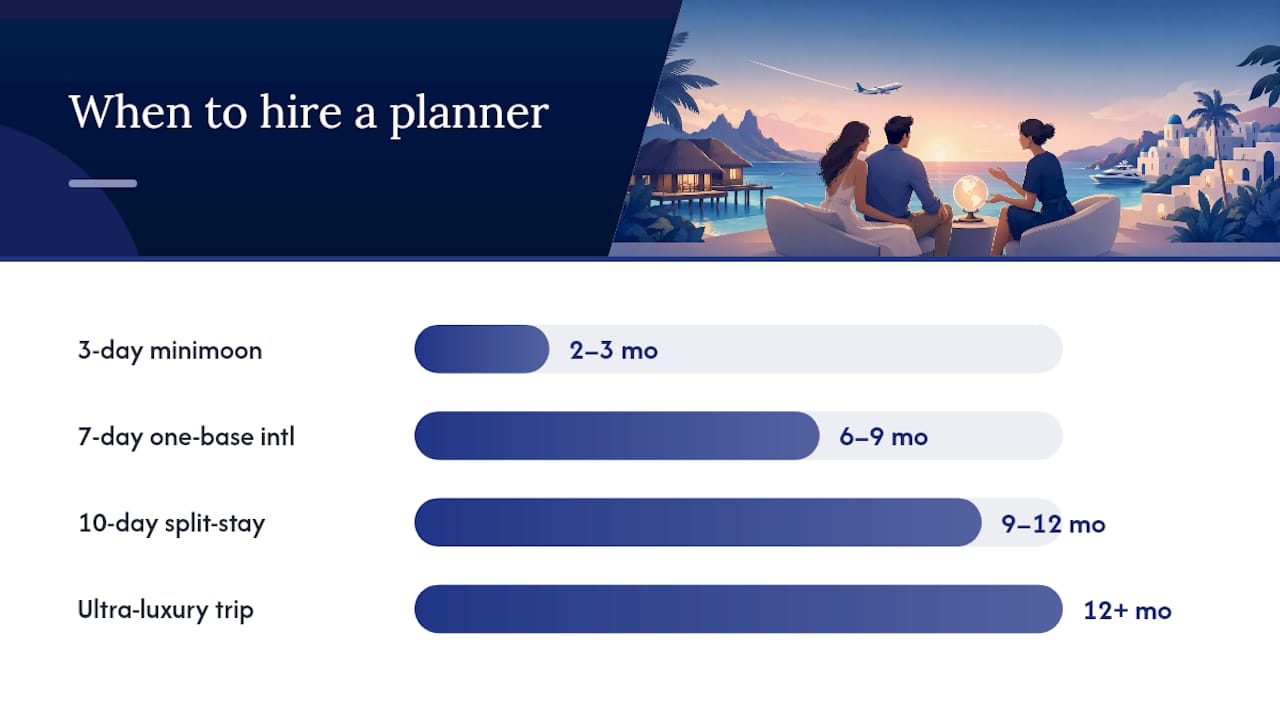
For ultra-luxury inventory, overwater villas, and bespoke itineraries across Europe, Asia, and beyond, engaging Elitetravelgroup at the 6–9 month mark gives you the best access to premium rooms and signature experiences before they sell out.
| Trip type | DIY or planner? | When to engage |
|---|---|---|
| 3-day domestic minimoon | DIY works well | Book 2–3 months out |
| 7-day one-base international | Either; planner adds value for premium rooms | 6–9 months out |
| 10-day split-stay or multi-stop | Planner strongly recommended | 9–12 months out |
| Ultra-luxury (safari, Maldives, private villa) | Planner essential | 12+ months out |
A planner’s honest take on what most couples get wrong
Most couples spend the most energy on the destination and the least energy on the pacing. They pick Bora Bora or the Amalfi Coast, book a beautiful hotel, and then fill every day with activities because they feel like they should make the most of it. By day four, they’re exhausted and quietly resentful of the itinerary they built.
The habit I’d suggest: always schedule your highest-effort experience in the middle of the trip, not on day one or two. You need a day or two to decompress from the wedding before you’re actually present enough to enjoy a once-in-a-lifetime experience. And you need a buffer day after it so the memory isn’t immediately crowded out by another big event.
One thing most articles won’t tell you: do a quick mood check with your partner every morning. Not a formal conversation, just a simple “how are you feeling today?” That one question lets you swap a planned hike for a beach day without either person feeling like they’re ruining the plan. The couples who do this consistently report that their trip felt more like theirs.
Before you leave, hand off one specific person the responsibility for wedding-day loose ends: who has the gift envelopes, who holds the house key, who follows up with the caterer on the final invoice. One person, one handoff. Don’t let that list follow you onto the plane.
Elitetravelgroup’s bespoke honeymoon planning: how to get started
Planning a honeymoon from scratch is genuinely time-consuming, and after months of wedding logistics, most couples are ready to hand the details to someone who does this every day. Elitetravelgroup’s luxury honeymoon packages are built around a concierge model that removes the friction entirely.

Here’s how it works: you start with a brief intake call where the team learns your dates, budget, and two or three destination preferences. From there, they draft a custom itinerary, walk you through it, and refine it until it’s exactly right. Every booking, from European routes to Asia itineraries, is handled by the agency, with on-the-ground partners managing the details at your destination. No service fees. No guessing whether the overwater villa you found online is actually as good as the photos suggest.
To get started, gather your travel dates, a rough budget range, and two or three destination ideas. Then request a consultation at Elitetravelgroup. The team is available 24/7, so you can reach out whenever the planning urge hits, even at midnight after a rehearsal dinner.
Sources
- Wwwnc
- How to Plan a Honeymoon: The Complete 2026 Guide (Timeline, Budget, Destinations) | My Honeymoon Hotel
- Honeymoon Planning 101: What You Need to Know – Zola
- A honeymoon planning timeline | The Knot
- Honeymoon Itinerary Planning: Your Stress-Free Guide | The Aurora Wedding
