




Cancel for Any Reason coverage is an add-on to a comprehensive travel insurance policy that reimburses 50% to 75% of your prepaid, nonrefundable trip costs if you cancel for a reason your base plan won’t cover. The catch: you almost always have to buy it within a short eligibility window after your first trip deposit, insure the full nonrefundable cost of your trip, and cancel at least 48 hours before departure. Miss any of those windows and CFAR isn’t available to you at any price.
TL;DR:
- CFAR must be purchased within 10 to 21 days of your initial trip deposit, and the full nonrefundable costs need to be insured for coverage to apply.
- Cancellation must occur at least 48 to 72 hours before departure, or CFAR eligibility may be lost entirely.
- It generally reimburses 50% to 75% of prepaid costs, with premium plans sometimes reaching up to 80% reimbursement.
- CFAR does not cover refunds already received, vouchers, award travel, or partial trip cancellations, making timing and full coverage critical.
- Booking CFAR early, matching insured amounts to actual expenses, and working with a travel advisor for complex trips significantly increase its value.
Table of Contents
- How Does CFAR Insurance Work?
- When Can You Buy CFAR, and When Must You Cancel?
- What Does CFAR Actually Pay Out, and What Does It Cost?
- Which CFAR-Capable Providers Should U.S. Travelers Compare?
- Is CFAR Worth It for Your Trip?
- Why Work With a Travel Advisor for High-Value, CFAR-Heavy Trips
- The Real Gap in Most CFAR Advice
- Elite Travel: A Concierge Alternative to Shopping CFAR Solo
- Where to Verify CFAR Terms Before You Buy
- Sources
How Does CFAR Insurance Work?
CFAR isn’t a standalone policy. It’s an upgrade you attach to a comprehensive travel insurance plan, and no major U.S. insurer sells it by itself. That distinction trips people up constantly. You’re not shopping for “CFAR insurance” the way you’d shop for rental car coverage. You’re shopping for a trip protection plan, and then asking whether that specific insurer lets you tack CFAR onto it.
The mechanical difference between CFAR and standard trip cancellation comes down to why you’re canceling. Standard trip cancellation only pays out for a list of named, covered reasons: a documented illness, a death in the family, a natural disaster at your destination, jury duty, and similar events the insurer has agreed to underwrite in advance. When your reason matches the list, standard trip cancellation can reimburse 100% of your prepaid costs.
CFAR removes the list. You can cancel because your babysitter fell through, because a work project got complicated, because you got cold feet about flying, or honestly because you just changed your mind. The insurer doesn’t ask why. What you give up in exchange is the full payout. Instead of 100%, you’re typically looking at 50% to 75% of your nonrefundable trip costs, with a handful of premium plans advertising reimbursement closer to 80%.
CFAR has firm boundaries most travelers don’t discover until they try to file a claim:
- It reimburses prepaid, nonrefundable costs only, not refunds you’ve already received or vouchers a supplier issued you.
- It typically excludes award travel booked with points or miles, since there’s no cash cost to reimburse.
- You generally have to insure the entire trip and cancel the entire trip, not just cancel one hotel night or one excursion.
- Any refund or credit you accept from an airline, cruise line, or tour operator reduces what CFAR will pay, since NerdWallet’s coverage explains that CFAR fills the gap between what a supplier gives back and what you actually lost.
So CFAR works best as a pressure valve for uncertainty, not as a guaranteed refund. If you’re fairly sure you’ll take the trip, standard trip cancellation with its named perils is usually the cheaper, sufficient choice.
When Can You Buy CFAR, and When Must You Cancel?
The eligibility rules for CFAR are stricter and less forgiving than almost any other travel insurance add-on, which is exactly why so many travelers miss the window without realizing it.
- Buy within the eligibility window. Most insurers require you to add CFAR within 10 to 21 days of your first trip payment, often phrased as 14 to 21 days from the date of your initial deposit, according to Insurance.com’s breakdown of CFAR mechanics. The clock starts the moment you put down any nonrefundable money, not when you finish booking the whole trip.
- Insure 100% of your nonrefundable costs. If your total prepaid, nonrefundable trip cost is $8,000 and you only insure $5,000 of it, most insurers will deny or prorate a CFAR claim. The policy has to match your actual financial exposure.
- Cancel the whole trip, not part of it. CFAR generally doesn’t let you cancel one leg of a multi-stop itinerary and keep the rest insured.
- Cancel at least 48 to 72 hours before departure. NerdWallet notes that this cutoff varies by policy, but same-day or next-day cancellations typically fall outside CFAR eligibility entirely.
- Check your state. New York and Washington have historically restricted or disallowed CFAR as a standard add-on under state insurance regulations, so residents there sometimes see different products or none at all.
Pro Tip: Cruise travelers face a variation on the purchase window: some insurers require CFAR to be added before your cruise line’s final payment date, not the general 14-to-21-day rule. Set that reminder the same day you book, because final payment deadlines sneak up fast on group and cruise bookings.
What Does CFAR Actually Pay Out, and What Does It Cost?
The math on CFAR is where most travelers decide whether it’s worth the money, and the numbers are more concrete than the marketing copy suggests.
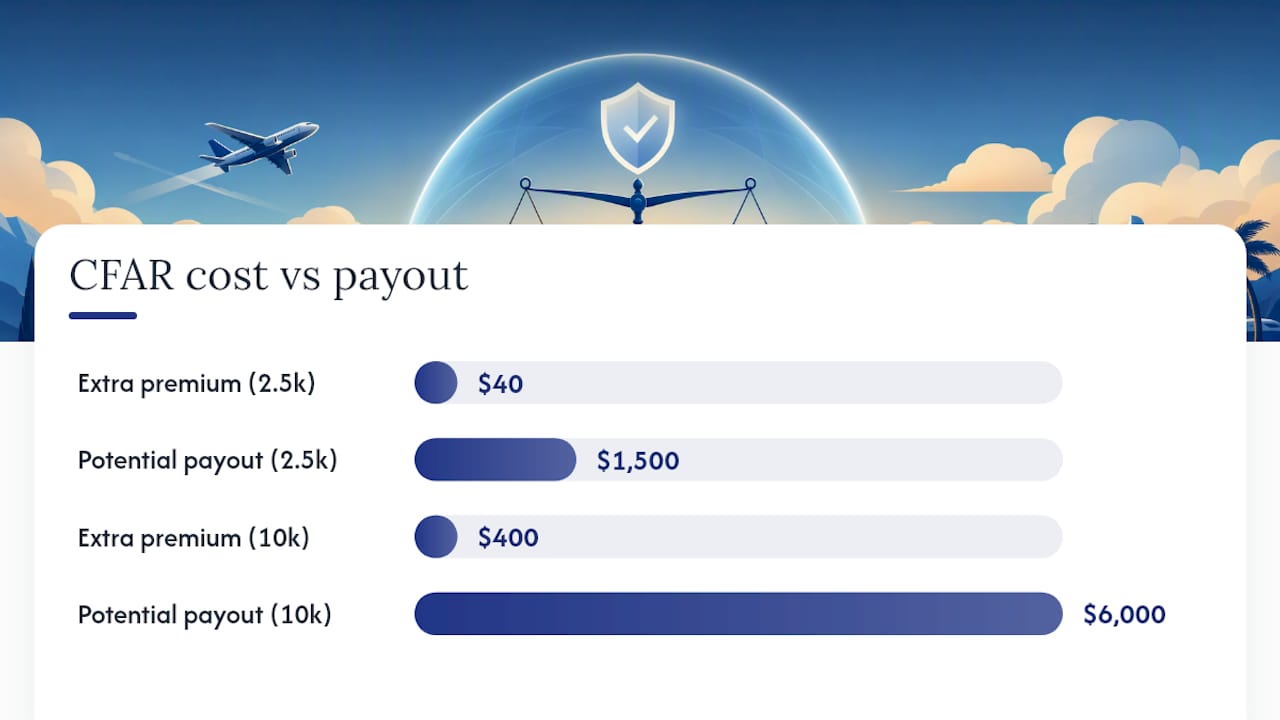
Reimbursement typically runs 50% to 75% of your insured nonrefundable costs, with some premium upgrades from insurers like Allianz citing reimbursement levels closer to 80% for buyers who qualify. On the cost side, adding CFAR to a comprehensive plan raises your premium by roughly 40% to 60% compared to the base policy, which marketplaces sometimes simplify into an estimate of an extra 3% of total trip cost.
Here’s how that plays out on two trip sizes:
| Trip cost | Base policy (approx.) | CFAR premium impact | Potential CFAR payout at 60% |
|---|---|---|---|
| $2,500 | $100 | +40%–60% (~$40 more) | ~$1,500 |
| $10,000 | $600 | +40%–60% (~$400 more) | ~$6,000 |
The pattern holds regardless of trip size: you’re paying a few hundred dollars more to protect thousands. On a $10,000 honeymoon or destination wedding trip, spending an extra $300 to $400 for the right to walk away with $6,000 instead of losing the full amount is a straightforward trade for most risk-averse travelers.
One number that catches people off guard: CFAR payouts shrink if a supplier already refunded you anything. If your airline gives you a $400 voucher after you cancel, that $400 typically comes off your CFAR claim, since the policy exists to cover what you actually lost, not to double-pay you on top of a refund you already received.
Which CFAR-Capable Providers Should U.S. Travelers Compare?
The shortlist below focuses on insurers that are actively sold in the U.S. market, publish clear CFAR terms, and show up consistently in independent roundups of CFAR providers. Availability, exact reimbursement tiers, and state restrictions vary by policy and by state, so treat every figure below as a starting point for your own quote request, not a final number.
A few notes worth reading before you request quotes:
- Allianz’s premium tiers are worth a look if you want reimbursement above the standard range. Confirm the exact percentage on the specific plan you’re quoted, since not every Allianz plan includes the higher tier.
- Tin Leg’s cruise-specific tier matters if you’re locked into a cruise line’s final payment schedule rather than a hotel or tour deposit.
- Faye has built a reputation around a faster, more modern quoting and claims experience, which matters if you’ve been burned by slow paperwork on a past claim.
- Travelex Insurance Services and other marketplace-distributed plans make it easy to pull several quotes at once, but read each insurer’s own CFAR terms rather than trusting a marketplace summary alone.
- IMG Travel Insurance and HTH Travel Insurance both lean toward longer international stays and study-abroad programs, which is a different buyer profile than a one-week leisure trip.
Is CFAR Worth It for Your Trip?
The decision usually comes down to two questions: how much money is nonrefundable, and how uncertain are your plans right now.
- Run the break-even math first. If your trip costs $6,000 and CFAR adds $250 to your premium, you need roughly a 5% chance of canceling for a reason your base plan wouldn’t cover to make the math favor CFAR. Most travelers underestimate that probability when a wedding, a job change, or a family emergency is even remotely plausible in the next few months.
- Skip CFAR on refundable or low-cost trips. If your hotel offers free cancellation and your flights are on a flexible fare, you’re already covered without paying extra.
- Ask every insurer the same five questions: What’s the exact purchase window from my deposit date? What percentage do you reimburse? What’s the cancellation cutoff? What’s specifically excluded? What documentation do you need for a claim?
- Buy CFAR the same day you make your first deposit. Waiting even a week can cost you the option entirely, and buying early can also help lock in pre-existing condition waivers on your base policy.
- Save every receipt. Nonrefundable deposits, final payment confirmations, and any refund or voucher documentation all matter if you eventually file a claim.
Pro Tip: Put your CFAR deadline and your cancellation cutoff on your calendar the day you buy the policy, not the week before your trip. The purchase window is unforgiving, and the cancellation cutoff has a way of arriving faster than travelers expect once a trip is already underway.
Why Work With a Travel Advisor for High-Value, CFAR-Heavy Trips
CFAR shopping gets genuinely complicated once you’re booking a multi-vendor itinerary: a cruise with a separate final payment date, a destination wedding with a dozen nonrefundable vendor deposits, or a group trip where six travelers each need coverage timed to their own deposit dates. A travel advisor who handles this daily catches the purchase-window and documentation details a first-time buyer often misses.

Elite Travel has spent 35 years building concierge-level itineraries across Europe and beyond, and that includes knowing which insurers handle CFAR cleanly for cruises, weddings, and multi-stop group trips. DIY shopping works fine for a simple weekend trip with one hotel deposit. It gets riskier fast once you’re juggling several suppliers, each with its own refund policy and payment schedule.
The Real Gap in Most CFAR Advice
Most CFAR guides treat the purchase window as a footnote. It shouldn’t be. The single biggest reason travelers lose access to CFAR isn’t cost, it’s timing: they book a trip, get busy, and don’t add the upgrade until they’re past day 21. By then, no amount of research fixes the problem.
The conventional wisdom also oversells CFAR as insurance against regret. It isn’t. It’s a partial hedge, usually 50% to 75%, against a specific kind of uncertainty: the trip you’re genuinely unsure you’ll take. If you’re confident you’re going, standard trip cancellation with named perils is cheaper and often sufficient.
What actually matters, based on how these policies are underwritten, is matching the insured amount to your real nonrefundable exposure and buying on day one of your deposit, not day twenty. Readers who get those two things right capture most of CFAR’s value. Everyone else is paying for a safety net they can’t actually use when they need it.
— tammylevent@gmail.com
Elite Travel: A Concierge Alternative to Shopping CFAR Solo
Elite Travel exists for travelers who’d rather hand off the insurance research entirely and know it’s being handled correctly the first time. When you’re booking a destination wedding with a dozen nonrefundable vendor deposits or a cruise with its own final payment deadline, matching the right CFAR policy to the right purchase window isn’t a task most people want to manage alone.

Elite Travel’s concierge approach means a real person tracks your deposit dates, matches your trip to insurers with clean CFAR terms, and stays available if a claim needs documentation support later. There’s no service fee for that guidance, and Elite Travel backs every booking with a price match guarantee, so protecting a high-value trip doesn’t mean overpaying to arrange it. If you’re planning a destination wedding, a multi-stop European itinerary, or an adventure trip with several nonrefundable deposits on the line, reach out to Elite Travel before you book your first payment. Getting the insurance conversation started early is what preserves your CFAR eligibility in the first place.
Where to Verify CFAR Terms Before You Buy
Every insurer writes its own CFAR rules, so cross-check the shortlist above against primary sources before committing to a policy.
- Read the exact CFAR terms on each insurer’s own policy page, since purchase windows and reimbursement percentages differ by plan tier.
- Use a marketplace like Squaremouth to pull side-by-side quotes, but confirm cancellation cutoffs directly with the insurer rather than relying on a summary.
- Check your state’s insurance regulator resources if you live in New York, Washington, or another state with CFAR restrictions.
- For booking timing and supplier refund policies more broadly, this guide on securing the best weekend rates covers related deposit and cancellation considerations worth knowing before you travel.
This article is general information, not a substitute for advice from a qualified financial advisor. Consult a qualified financial professional about your own circumstances before acting on anything here.
Sources
- Cancel for Any Reason (CFAR) Trip Insurance — Progressive
- Insurance
- The Guide to Cancel For Any Reason (CFAR) Travel Insurance — NerdWallet
- Cancel For Any Reason (CFAR) Travel Insurance — Squaremouth
