



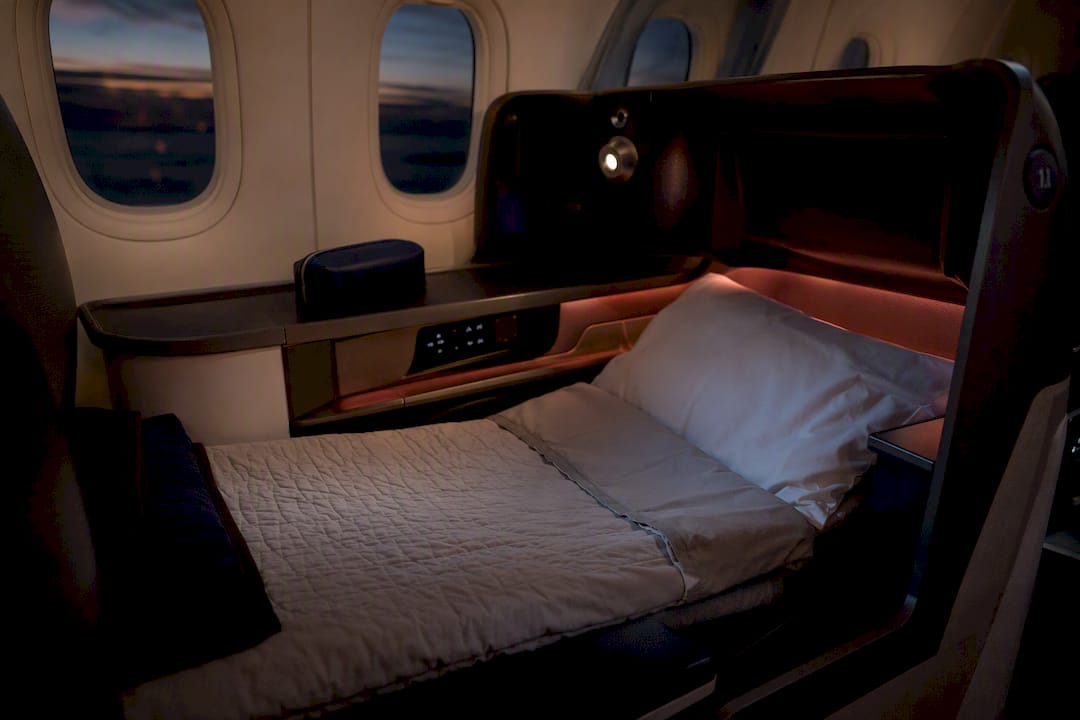
Business class is worth it when your flight crosses at least one overnight stretch of roughly 7 to 8 hours or more and you need to function the day you land. Below that threshold, or when the price gap runs past four or five times the economy fare, you’re usually better off pocketing the difference. That’s the whole rule, but four variables decide how it applies to your actual trip: flight length, what you’re doing after you land, the specific cabin product on your aircraft, and how wide the price gap really is once you account for fees.
Run through two quick examples and the pattern gets obvious. A 10-hour overnight flight from New York to Milan, where you have a wedding rehearsal the next afternoon, is a strong yes. A 4-hour daytime hop from Chicago to Denver is almost always a no, no matter how nice the seat looks in the airline’s marketing photos.
The evidence backs this up in a way that surprises people who assume business class is just a status purchase. A 2023 sleep study found that passengers in lie-flat seats got 47% more slow-wave sleep than those in standard recliners, and reported 34% lower jet-lag scores a full day after landing. That’s not comfort. That’s recovered time you can spend working, sightseeing, or simply not feeling like garbage at your daughter’s wedding.
- Flight length: Under 5 hours, business class rarely earns its keep. Over 7 to 8 hours overnight, it often does.
- Arrival plans: A meeting, a ceremony, or a hike the next morning changes the math entirely.
- Cabin product: Not all “business class” is equal. Confirm the actual seat, not just the fare class.
- Price gap: A 2x premium is an easy yes. A 6x premium demands a harder look.
Key Takeaways
Business class delivers its clearest return on overnight flights past 7 to 8 hours when arrival productivity matters, and consolidator pricing is what makes that return affordable.
| Point | Details |
|---|---|
| Apply the flight-length rule | Business class earns its price mainly on overnight routes of roughly 7 to 8 hours or more. |
| Check the actual seat | Confirm the aircraft’s real cabin configuration, not just the fare class letter, before booking. |
| Add back hidden economy costs | Bag fees, seat selection, and airport food can add a modest fee to a “cheap” economy fare. |
| Shop consolidators first | Consolidator pricing can bring the business-class multiple down from 4 to 6 times economy to roughly 2 to 3.5 times. |
| Use premium economy for daytime long-haul | It’s the better value on 6 to 9 hour flights where sleep isn’t the priority. |
Table of Contents
- Is Business Class Worth the Cost? What You Actually Get
- Premium Economy vs Business Class: When the Middle Tier Wins
- How Do You Decide Between Business and Economy?
- What Does Business Class Really Cost Once You Add It All Up?
- How Do You Get Business Class Value Without Paying Retail?
- What Elite Travel Advisors Actually Recommend
- What Else Could That Money Buy Instead?
- An Editorial Take on the Real Math Behind This Decision
- Sources
Is Business Class Worth the Cost? What You Actually Get
The honest answer depends on which “business class” you’re buying, because the product varies wildly by airline and route. But the core benefits are consistent enough to break down one at a time, and once you see them laid out, it’s easier to figure out which ones matter for your trip and which ones you’d happily skip.
Sleep is the biggest one, and it’s measurable
The lie-flat bed is the single feature that changes a long-haul flight from an endurance test into something closer to a decent night’s sleep. Frequent flyers and travel advisors consistently point to the bed itself as the highest-return reason to pay the premium, ahead of the champagne, the amenity kit, or the wider seat.
Seat layout determines whether you actually get that sleep
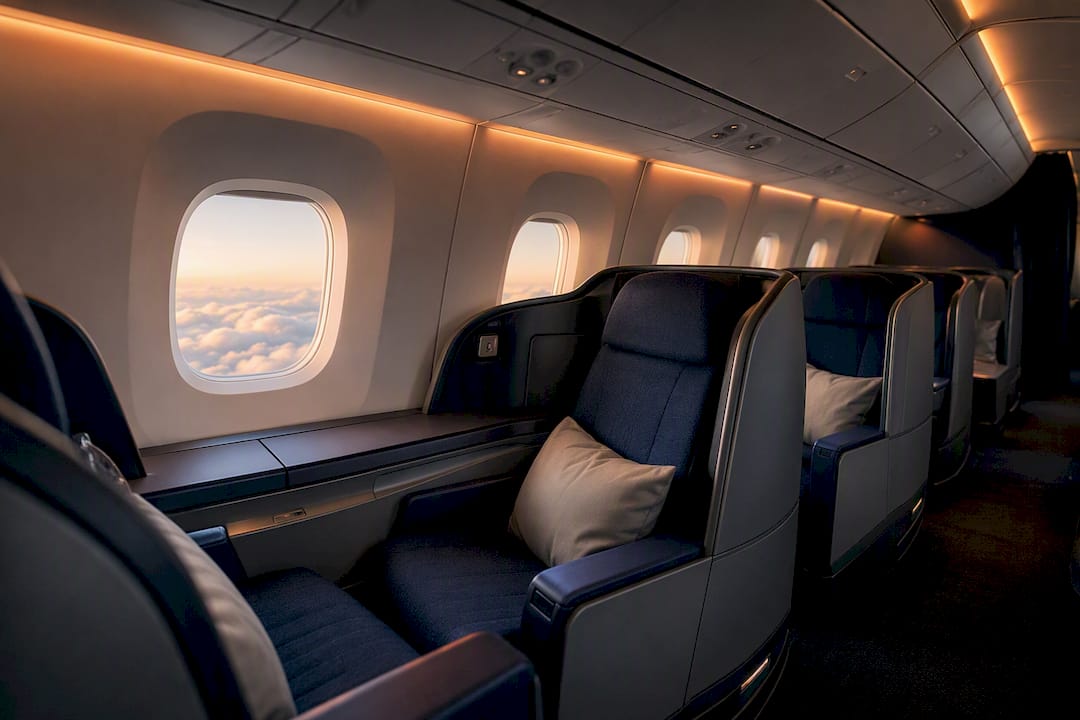
Not every business-class seat gives you privacy or unrestricted access to the aisle. Older 2-2-2 configurations mean a middle-seat passenger has to climb over a neighbor to get up, which defeats half the point of paying for space. Newer 1-2-1 layouts give every passenger direct aisle access and a partially or fully enclosed pod. If you’re booking based on price alone without checking the seat map, you can end up paying business-class money for what’s functionally a slightly bigger economy seat with a footrest.
Ground perks add up faster than people expect
Airport lounges aren’t just a quiet room with bad coffee anymore. Top-tier lounges now include showers, full hot buffets, and dedicated workspace, with a handful (Qatar’s Al Mourjan among them) treated as destinations in their own right by aviation reviewers. Add priority boarding, fast-track security, and one or two checked bags included in the fare, and you’ve offset a meaningful chunk of the price difference before you even board.
- Lounge access with food, showers, and quiet space to work or rest.
- Priority check-in, security, and boarding that can save 30 to 60 minutes at busy airports.
- One or two checked bags typically included, versus paying per bag in economy.
- Wider tray tables and often a proper desk-height surface for a laptop.
- Faster, more reliable Wi-Fi on many long-haul business cabins.
Service and catering matter more on longer flights
A multi-course meal service, real cutlery, and a flight attendant who has eight passengers to look after instead of forty makes a longer flight feel shorter. It’s not the reason to buy the ticket on its own, but it compounds with everything else.
Premium Economy vs Business Class: When the Middle Tier Wins
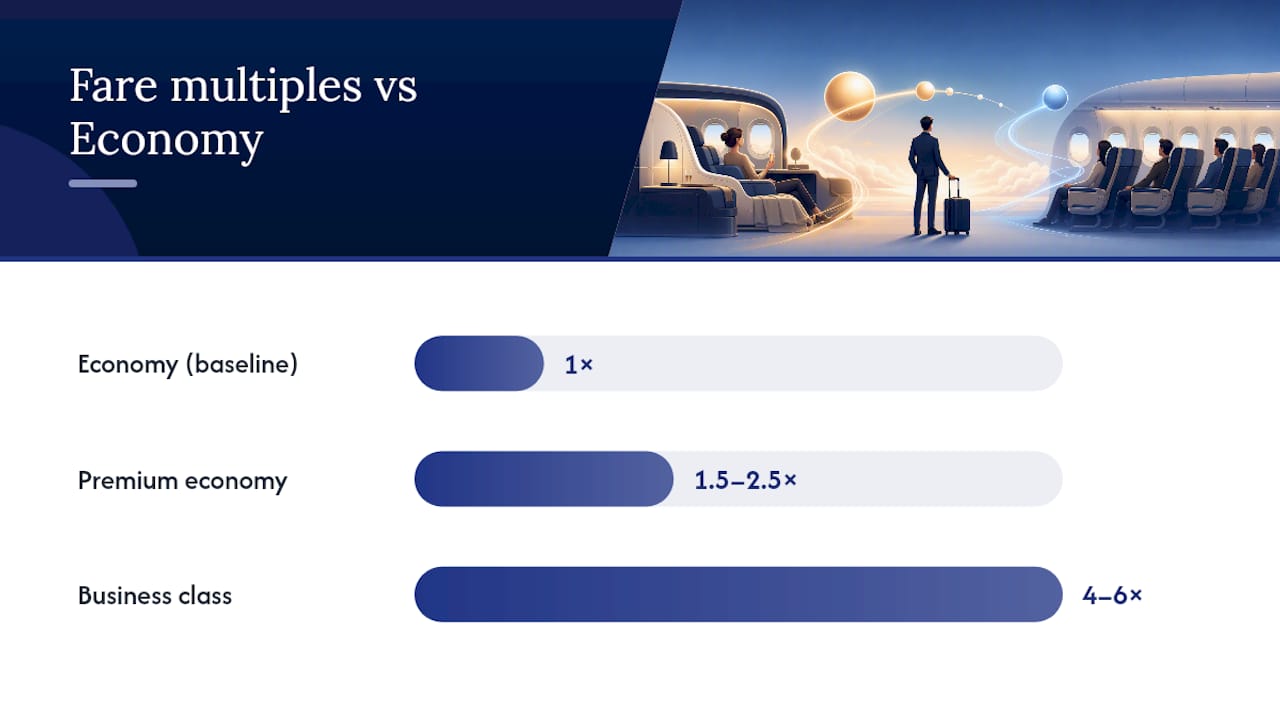
Premium economy exists precisely for the trips where business class is overkill but standard economy feels punishing. It typically runs 1.5 to 2.5 times the economy fare and gives you 38 to 42 inches of pitch, a wider seat, and better recline, but it stops short of a lie-flat bed. That single gap, no fully horizontal sleep, is what separates it from business class on any flight where sleep quality is the actual goal.
Where premium economy makes the smartest financial sense is the daytime long-haul sector: a 6 to 9 hour flight where you’re not trying to sleep anyway, just trying to be comfortable while you watch movies or work. Think a midday flight from Los Angeles to Honolulu, or a daytime London to Cairo route. You’re awake for the whole thing regardless of cabin, so the lie-flat bed’s biggest advantage never comes into play.
- Best fit: Daytime flights of 6 to 9 hours where sleep isn’t the priority.
- Best fit: Budget-conscious travelers who still want more legroom and better food than economy.
- Weak fit: Overnight flights where you genuinely need to sleep and function the next day.
- Weak fit: Routes where the premium economy cabin is old and barely differs from economy plus.
On price, the rough bands hold up across most major carriers: economy as the baseline, premium economy usually costs moderately more than economy, and full-fare business class often landing at 4 to 6 times economy on published prices, though that multiple compresses considerably once you shop consolidator fares (more on that below). If you’re torn between the two and the flight lands during your normal waking hours, premium economy is usually the better use of the extra money. Save business class for the flights where the sun sets somewhere over the ocean and you actually need those lie-flat hours.
How Do You Decide Between Business and Economy?
The four-variable test from the opening isn’t just a mental checklist, it’s a scoring exercise you can actually run before you book. Give each variable real weight instead of treating them equally, because they aren’t.
Flight length carries the most weight. Under 5 hours, business class almost never justifies its price regardless of the other three variables. Between 5 and 7 hours, it becomes a toss-up that depends heavily on timing. Past 7 to 8 hours overnight, the case strengthens fast, and this is the range where the sleep data actually applies.
Arrival plans carry the second-most weight. Ask yourself plainly: do you have a meeting, a ceremony, a hike, or a full day of activity within 12 hours of landing? If the answer is yes and the flight is overnight, business class stops being a luxury and starts being a productivity tool. If you’re landing and heading straight to a hotel to sleep off jet lag anyway, some of that value disappears.
Cabin product needs a direct check, not an assumption. Fare class letters (like “J” or “C”) tell you almost nothing about the physical seat. Two flights on the same route, same airline, different aircraft, can have completely different business cabins, one with a modern 1-2-1 lie-flat suite, the other with an aging 2-3-2 recliner from a decade-old retrofit. Look up the actual aircraft type and seat map before you commit.
Price gap is the final filter. A jump from $800 to $1,600 is an easy yes if the other three variables line up. A jump from $800 to $4,800 demands a harder look at whether a mileage redemption, a consolidator fare, or premium economy solves the problem better.
Here’s a short checklist to run through at booking:
- Confirm total flight time, including any overnight segment.
- List what you need to do in the first 12 hours after landing.
- Look up the specific seat map for your aircraft, not just the fare class.
- Compare the published business fare against a consolidator or award price.
- Calculate the real price multiple versus economy on that same flight.
- Decide if premium economy covers your actual need instead.
Pro Tip: Before you assume a route needs full business class, check whether the airline flies more than one aircraft type on it. Switching your travel date by even a day can put you on a newer plane with a dramatically better cabin for the same price.
What Does Business Class Really Cost Once You Add It All Up?
Economy tickets look cheaper until you start adding back everything that used to be included. Two checked bags round-trip typically add a modest fee, paid seat selection adds additional fees per leg, and airport food can add further costs for a family or even a solo traveler on a long layover. None of that shows up in the sticker price, but all of it shows up on your card statement.
There’s also a less obvious cost: your time and output after landing. If you bill your work at $75 an hour and a bad flight costs you half a productive day, that’s roughly $300 to $400 in lost value, before you even factor in how a wrecked first day can affect a honeymoon or a milestone trip you paid thousands of dollars to plan.
Here’s how the math plays out on two representative routes:
Consolidator pricing routinely brings that published business multiple of 4 to 6 times economy down to roughly 2 to 3.5 times, which changes the entire calculation on the long-haul route. At full published fare, business class costs nearly four and a half times the padded economy total. Through a consolidator, that gap shrinks to under three times, and once you weigh in a full night of usable sleep before an important arrival, the math starts favoring business class rather than fighting it. On the short domestic route, though, no amount of consolidator discounting closes a gap that never should have opened in the first place. Three hours doesn’t need a lie-flat bed.
How Do You Get Business Class Value Without Paying Retail?
Nobody who flies business class regularly pays the number listed on the airline’s own website. Retail business fares are essentially list price, and the entire secondary market of consolidators, award programs, and flash sales exists because airlines routinely sell excess business inventory below it.
Consolidators, wholesalers who buy blocks of premium seats and resell them, typically bring that 4 to 6 times economy multiple down to 2 to 3.5 times. A good travel advisor with the right supplier relationships can access these fares directly, which is a large part of what you’re paying for when you use an agency instead of booking blind online.
Miles make the most sense when you have a large balance sitting idle or when a specific route has notoriously bad award availability that a points strategy happens to unlock. Paid consolidator fares tend to make more sense when your dates are fixed and you need certainty. Flash sales and last-minute upgrade bids favor flexible travelers who can pounce within a day or two of an airline releasing discounted premium inventory.
- Check consolidator fares before accepting a published business price.
- Compare a miles redemption against the cash consolidator rate before committing points.
- Set fare alerts for flash sales on your specific route.
- Try nearby departure or arrival airports, since flexibility on origin or date can save several hundred dollars on the same cabin.
- Bid on an upgrade at check-in if you already hold an economy or premium economy ticket.
Pro Tip: If a business-class fare looks too good to be true, it might be an error fare. Book it, but don’t make non-refundable hotel or activity plans around it until the airline confirms the ticket. Some error fares get honored, plenty get canceled within 24 hours.
What Elite Travel Advisors Actually Recommend
After 35 years of booking premium travel, Elite Travel’s approach comes down to one principle: the fare class letter tells you almost nothing, and the aircraft tells you everything. Advisors verify the actual seat configuration on the specific tail number and route before ever recommending a client pay for business class, because two flights with the same fare code can have completely different products.
The recurring lesson from decades of booking premium seats is that clients who ask “what fare class is this” are asking the wrong question. The right question is “what does the actual seat look like, and will I get real sleep in it.” An advisor who checks the aircraft type, the seat map, and the current consolidator pricing before quoting anything is doing the real work that separates a good recommendation from a guess.
- Verify the actual cabin and seat type before quoting a client, not just the booking class.
- Source consolidator fares through supplier relationships to compress the price gap.
- Recommend premium economy or a strategic economy booking with lounge access add-ons when the flight, timing, or budget doesn’t justify full business fare.
- Flag routes and dates where flash sales or upgrade bids are realistic options.
Honesty matters here too. When a client’s flight is a 4-hour daytime hop, or the only available business cabin is an outdated recliner barely different from economy plus, a knowledgeable advisor will say so rather than upselling a product that won’t deliver the value the client expects. That honesty is part of what makes working with a luxury travel agency worth more than a fare aggregator that has no idea what seat you’re actually buying.
What Else Could That Money Buy Instead?
Every dollar spent upgrading a flight is a dollar not spent somewhere else on the trip, and that trade-off deserves real thought before you default to business class out of habit. On a two-week European itinerary, the difference between an economy and business fare could instead fund a private guide through the Alhambra, an extra three nights at a better property, or a cooking class with a local chef that becomes the story you tell for years.
The comparison isn’t always business class versus nothing. It’s business class versus a meaningfully upgraded experience once you land. For a short flight, that trade almost always favors spending the money on the ground. For a 10-hour overnight flight before a milestone event, the equation flips, because no amount of hotel upgrade fixes a body that never slept.
The smartest version of this thinking treats travel budget as one pool split across flights, lodging, and experiences, rather than a series of separate decisions made in isolation. Business travelers who fly six or more premium long-haul trips a year weigh this math differently than a couple planning a once-a-decade honeymoon, and both groups are right to reach different conclusions from the same four-variable test.
An Editorial Take on the Real Math Behind This Decision
The research here supports a narrower conclusion than most travel advice admits: business class earns its price almost entirely through sleep, not status. Strip away the champagne and the wide seat, and the case collapses to one variable, whether you’re crossing a night’s worth of hours and need to function afterward.
Conventional advice treats business class as a single yes-or-no purchase tied to budget alone. That’s backwards. The better question is always what the flight costs you in recovered time, not just dollars. A consultant charging $150 an hour loses more sleeping upright for nine hours than they’d ever save skipping the upgrade.
Prioritize the aircraft and seat map first, price second. A cheap business fare on a bad recliner is worse value than a well-priced premium economy seat on a modern plane.
— tammylevent@gmail.com
Sources
- Difference between business class and premium economy on ultra-long flights | SimpleFlying
- Economy vs Business Class: Real Cost Analysis | BusinessClassSignal
- Is business class worth the splurge? | CNN
