




U.S. travelers do not need ETIAS yet: the system is not operational, and no passport holder can apply today. If you’re booking Europe travel for late 2026 or beyond, your one move right now is checking your passport’s expiration date and bookmarking the official ETIAS site so you catch the launch announcement instead of a scam site.
TL;DR:
- ETIAS is not yet operational, and U.S. travelers should only focus on checking passport validity and bookmarking official sources for future updates.
- Once launched, ETIAS will allow visa-exempt Americans to travel across most European countries for up to 90 days within a 180-day period, with a validity of three years or until passport expiration.
- The application process will be straightforward, requiring personal and travel information, a fee of EUR 20, and application only through official EU portals to avoid scams.
- A valid ETIAS does not guarantee entry, and travelers must carry the exact passport used in their application, with renewals requiring reapplication before trips.
- Early planning by travel agencies can incorporate ETIAS checks into itinerary scheduling, helping travelers avoid last-minute application delays or denials.
Table of Contents
- What Is ETIAS for U.S. Travelers in 2026, and How Is It Different From a Visa?
- Who Needs ETIAS, and What Are the Validity Rules?
- How Do You Apply for ETIAS Once It Opens?
- What Does ETIAS Cost, and When Will It Actually Launch?
- What Should You Check on Travel Day Once ETIAS Is Active?
- How Elite Travel Handles ETIAS Inside Bespoke Trip Planning
- Does ETIAS Cover Multiple Entries or Just One Trip?
- How Will ETIAS Change Your Trip Planning, Including Layovers?
- How Secure Is Your ETIAS Data, and Who Can Access It?
- What Happens if Your ETIAS Application Gets Denied?
- Why Early ETIAS Prep Beats Last-Minute Scrambling
- Let Elite Travel Handle Your Pre-Trip Compliance Checks
- Sources
What Is ETIAS for U.S. Travelers in 2026, and How Is It Different From a Visa?
ETIAS is not a visa. It’s a pre-travel screening tool, similar in spirit to the U.S. ESTA program that European visitors use to enter America. Once active, it will let visa-exempt travelers, including Americans, get pre-approved before they ever board a plane. The authorization ties directly to your passport number and stays valid for up to three years or until that passport expires, whichever comes first.
People also confuse ETIAS with the Entry/Exit System, or EES, but they do different jobs entirely. The U.S. State Department draws the line clearly: EES collects biometric data, fingerprints and a facial photo, at the actual border when you enter or exit. ETIAS is the paperwork check that happens before you ever get to that border.
A few practical points to keep straight:
- ETIAS approval does not guarantee entry. A border officer can still deny you at the airport based on your documents or answers.
- EES logs your physical arrival and departure; ETIAS screens your eligibility to travel in the first place.
- Both systems will eventually work together, but they’re administered and checked at different points in your trip.
Who Needs ETIAS, and What Are the Validity Rules?
Any American with a valid U.S. passport traveling visa-free counts as in-scope once the system launches. That covers multiple European countries in the ETIAS zone, mostly Schengen members plus a handful of associated states like Iceland and Norway. If you currently enter France, Italy, Greece, or Spain without a visa, ETIAS will eventually apply to that same trip.
The stay math doesn’t change from what U.S. travelers already know from Schengen rules: 90 days within any rolling 180-day period, across the whole zone combined, not per country. Once approved, your authorization rides with your passport for up to three years or until that passport’s expiration date, whichever hits first.
A few things to flag before you plan a trip around it:
- Diplomats, certain military personnel, and holders of specific residence permits may fall outside ETIAS entirely.
- Family members of EU nationals sometimes qualify for different treatment, so don’t assume the standard rule applies if that’s your situation.
- Coverage details shift as countries update their status, so check the official country list close to your travel date rather than relying on older articles, including this one.
How Do You Apply for ETIAS Once It Opens?
When the portal activates, the process should mirror ESTA closely enough that most Americans find it familiar. Here’s the sequence to expect, based on the application requirements the EU has already published:
- Gather your documents first. You’ll need your passport, a payment card for the fee, your current address and contact details, and background information covering education and occupation.
- Access the application only through the official channels. That means the eventual government portal or its official mobile app, never a third-party site that shows up in search results promising expedited processing.
- Complete the form. Expect fields on personal details, travel document data, planned destinations, and a handful of security-related background questions.
- Pay the fee and submit. The application fee runs EUR 20, payable by card at the time of submission.
- Wait for confirmation. Most approvals arrive fast, but build in buffer time in case your file gets flagged for additional review.
The mistakes that trip people up are almost always avoidable. A passport that doesn’t match your travel booking, a passport nearing expiration, waiting until the week before departure to apply, or handing your passport details to a “visa assistance” website that has nothing to do with the EU government. That last one is the costliest error: travel journalists have already flagged fraudulent sites charging fees for a system that isn’t even accepting applications yet.
Pro Tip: Once ETIAS does open, apply the same week you book your flights rather than waiting until closer to departure. Early submission gives you a cushion if your file needs manual review, and it means one less task competing for your attention during final packing.
What Does ETIAS Cost, and When Will It Actually Launch?
The fee is set at EUR 20, a flat cost regardless of how many countries you’re visiting during that authorization’s validity window. Several groups skip the fee entirely.
- Travelers under 18 at the time of application.
- Travelers over 70 at the time of application.
- Qualifying family members of EU nationals, depending on their specific status.
On timing, the official EU position is blunt: “ETIAS is currently not in operation.” No launch date is posted, and the EU has committed to giving several months of public notice before it flips the switch. That notice window matters for your planning. If you’re booking a 2026 trip now, treat ETIAS as something to watch, not something to act on. When the announcement drops, you’ll have time to apply well before departure.
What Should You Check on Travel Day Once ETIAS Is Active?
Once the system launches and you’re approved, a few habits will keep your trip friction-free. The single most important one: carry the exact passport you used on your application. ETIAS ties to a specific passport number, not to you as a person, so a mismatch causes real problems at the gate.
- Confirm your passport has at least three months of validity remaining beyond your planned exit from the ETIAS zone.
- Expect airlines to verify your ETIAS status against your passport before you board, the same way they already check ESTA for flights to the U.S.
- Keep a return ticket, proof of accommodation, and evidence of sufficient funds accessible, since border officers can still ask for these even with a valid ETIAS.
- Travel insurance documentation is worth having on hand, particularly for longer stays or if you’re visiting multiple countries in one trip.
If you renew or replace your passport after getting approved, your existing ETIAS becomes void. You’ll need to reapply under the new passport number before your next trip, so build that step into your pre-departure routine rather than discovering it at check-in.
How Elite Travel Handles ETIAS Inside Bespoke Trip Planning
Clients booking custom Europe itineraries through Elite Travel don’t have to track ETIAS developments themselves. Our planning process folds those checks into the same timeline we already use for passport validity and visa requirements on international trips.
- We monitor official EU launch notices so your application window lines up with your booking dates, not the other way around.
- We verify passport expiration against your travel dates well ahead of departure, catching renewal issues before they become a scramble.
- We build reminders into your itinerary timeline for both the ETIAS application step and pre-boarding document checks.
That’s the same discipline we bring to every international trip we plan, regardless of whether a new authorization system is involved.
Does ETIAS Cover Multiple Entries or Just One Trip?
ETIAS is built for repeat use, not a single crossing. Once approved, your authorization covers multiple entries into the zone for the full length of its validity, up to three years or until your passport expires. That’s a meaningful difference from a single-entry visa, where one trip uses up the entire authorization and you’d need to reapply for the next one.

For someone planning a European honeymoon this year and a milestone anniversary trip two years later, a single ETIAS approval could plausibly cover both, provided your passport is still valid and the authorization hasn’t expired. That’s a real advantage over the visa process some travelers know from other regions, where every trip means starting the paperwork over.
The multiple-entry structure does come with one catch worth remembering: it doesn’t reset your allowed stay each time you enter. The 90-day-in-180-day limit applies across all your entries combined, not per visit. Someone splitting a long summer between Italy, Portugal, and France under one ETIAS still can’t exceed 90 total days in the zone within that six-month window, no matter how many separate entries they make.
For frequent travelers, business visitors doing repeat European trips, or families splitting a longer vacation across multiple visits home to see relatives abroad, that multi-entry flexibility is the whole point of the system. It’s designed to reduce paperwork for people who cross European borders often, while still enforcing the same overall time limit regulators care about.
How Will ETIAS Change Your Trip Planning, Including Layovers?
Once ETIAS is live, it changes your pre-trip checklist more than it changes the trip itself. The authorization needs to be in place before you board your flight, not before you land, which means the planning shifts earlier in your timeline compared to how Americans currently handle Schengen entry.
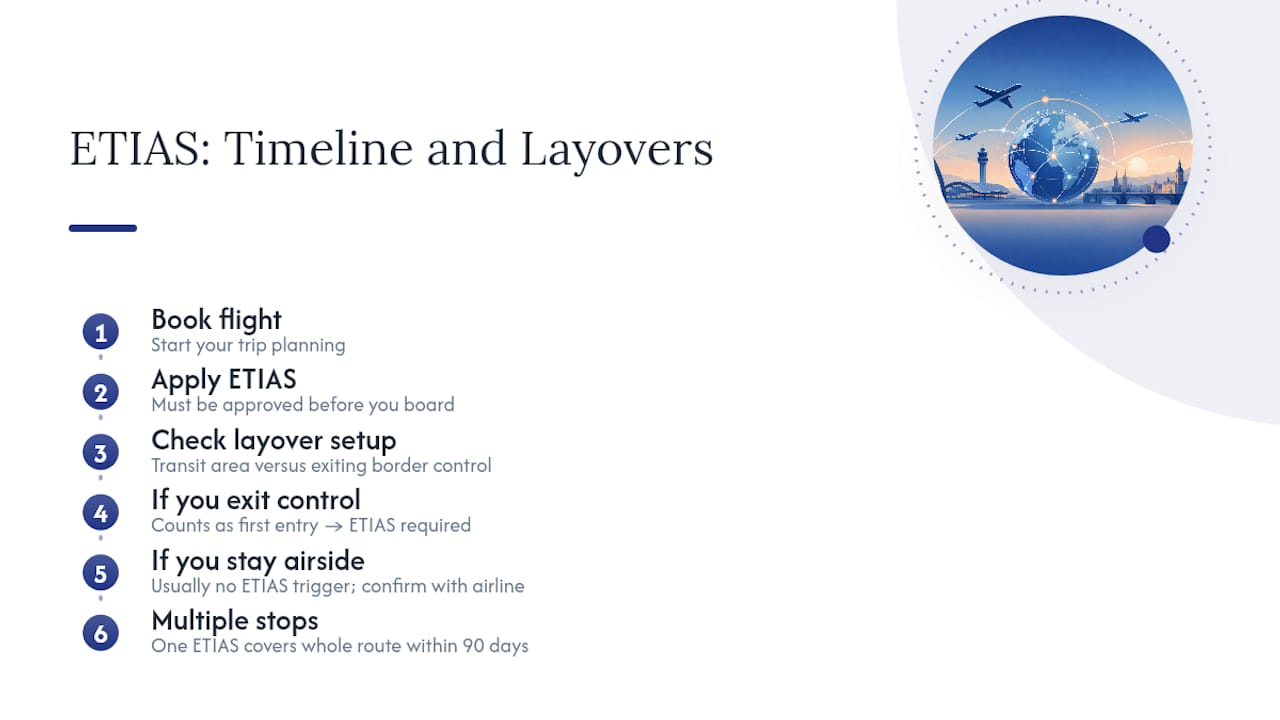
Transit is where the real nuance sits. If you’re flying from the U.S. to, say, Athens with a layover in Frankfurt, and you never leave the international transit area in Frankfurt, you typically won’t trigger the same entry requirements as someone clearing border control there. But the moment you exit security to change terminals, collect checked bags, or clear passport control for any reason, that layover counts as an actual entry into the ETIAS zone. Airlines and airports vary on how transit areas are configured, so this is worth confirming for your specific connection rather than assuming.
The safest approach: assume any layover where you’ll pass through border control requires the same ETIAS approval as your final destination. Build your application timeline around your first point of entry into the zone, not your ultimate arrival city. If your itinerary includes multiple countries, whether you’re island hopping in Greece or combining a few days in Paris with a week in Tuscany, one ETIAS covers the whole route as long as you stay within your 90 day allowance and your listed travel plans roughly match what you actually do.
How Secure Is Your ETIAS Data, and Who Can Access It?
Your ETIAS application will include a fair amount of personal information: passport details, contact information, education and occupation background, and answers to security-related questions. That data doesn’t sit in a single unprotected database open to anyone with a login.
The system is designed to connect with existing EU security databases, including systems that already flag security, migration, and health risks tied to other EU border and visa infrastructure documented by the European Commission’s Home Affairs office. That’s part of why some applications take longer than others: the automated check runs your information against those databases, and a possible match triggers manual review by a human caseworker rather than an automatic rejection.
For American travelers used to submitting personal data for ESTA, the practical mechanics feel similar. You’re providing information once for a set validity period, and that data is reused, not resubmitted, for every entry during those three years. The bigger risk isn’t the official system, it’s the fake ones. Fraudulent sites that mimic government portals ahead of the real launch have already drawn warnings from travel journalists, and handing your passport number and personal details to one of those is a genuinely bad outcome. Apply only through the official portal or its official app, and treat any site asking for ETIAS fees before the system has launched as an immediate red flag.
What Happens if Your ETIAS Application Gets Denied?
Most ETIAS applications should clear automatically within minutes, but not all of them will. A denial usually traces back to a handful of causes: a security or migration database flag, inconsistent information between your application and your passport, or an unresolved question from a previous immigration record somewhere in the EU.
If you’re denied, the EU is expected to provide a specific reason for the refusal, not a vague rejection. That detail matters, because it tells you whether the issue is fixable, like a data entry error you can correct and resubmit, or something more substantive that requires an actual appeal.
Applicants who believe a denial was made in error will have the right to appeal through the member state that issued the decision, following that country’s specific administrative appeal process. Since EU member states each run their own appeal procedures rather than one centralized EU appeals body, the exact steps will depend on which country’s system flagged your application. That’s worth knowing now: if a denial ever happens, your first move is identifying which country issued the decision, since that’s where your appeal gets filed.
Reapplying with corrected information is usually faster than appealing, when the fix is something straightforward like a passport number typo. Save the formal appeal route for cases where you genuinely believe the underlying decision was wrong, not just where a form got filled out incorrectly.
Why Early ETIAS Prep Beats Last-Minute Scrambling
The travelers who handle ETIAS smoothly are the ones who treat it as a scheduling task, not a scramble. Check your passport’s expiration date nine to twelve months before any planned Europe trip, especially if it’s already showing wear or getting close to that ten-year mark, as part of a comprehensive family travel planning guide to ensure stress-free trips. Elite Travel has spent 35 years building itineraries around exactly this kind of regulatory timing, and the pattern holds: clients who build document checks into their planning calendar early never end up dealing with a denied boarding or a border delay.
— tammylevent@gmail.com
Let Elite Travel Handle Your Pre-Trip Compliance Checks
You could track ETIAS launch announcements yourself, cross-reference passport rules, and manage the application timing against your own booking calendar. Plenty of independent travelers do exactly that. But if you’d rather hand that administrative layer to someone who’s already tracking it for every client’s Europe itinerary, that’s where Elite Travel fits in.
When you book a custom Europe vacation through Elite Travel, ETIAS timing gets woven into your itinerary planning from the start, alongside passport validity checks, visa research, and pre-departure document review. You get one point of contact tracking the regulatory details while you focus on the parts of the trip that are actually fun. Elite Travel charges no service fees, backs every quote with a price match guarantee, and stays reachable 24/7 for the inevitable last-minute question. If you’re planning a European honeymoon, milestone celebration, or multi-country itinerary for 2026, reach out to start your custom itinerary and let us fold ETIAS prep into the plan before you ever have to think about it.
Sources
- European Travel Information and Authorisation System (ETIAS) – ETIAS
- U.S. Department of State — Europe travel guidance
- Traveling to Europe This Year? You Won’t Need ETIAS—Yet | Condé Nast Traveler
Bookmark these directly and avoid third-party sites promising early applications. Only official government domains handle real ETIAS submissions.
