




The best luxury yoga retreats share four non-negotiable features: private accommodation, small groups of a moderate number of guests, lead teachers with E-RYT 500 credentials, and clearly itemized inclusions covering meals, spa access, and transfers. Anything missing one of those isn’t luxury — it’s expensive.
Quick picks for 2026:
- Sensei Lanai, Four Seasons Resort Lanai — Best for longevity-focused wellness with medical-grade diagnostics; Hawaii
- Miraval Resorts (Arizona) — Best for deep rest and mindfulness immersion; adults-only, all-inclusive
- Canyon Ranch Lenox — Best luxury spa + yoga combination; Massachusetts Berkshires
- Kripalu Center for Yoga & Health — Best for serious practice depth with world-class teachers; Stockbridge, MA
- Aro Hā, New Zealand — Best international option for transformative, nature-immersive practice
- Ananda in the Himalayas — Best for Ayurvedic integration and private wellness consultations; India
Planning a high-end yoga retreat involves more logistics than most travelers expect. Elitetravelgroup specializes in exactly this: concierge-level vetting, room and teacher confirmation, and 24/7 support from deposit to return flight. Contact the team at Elitetravelgroup to start planning.
Key Takeaways
The most important thing to know: a genuine luxury yoga retreat is defined by small group sizes (8–16 guests), E-RYT 500 lead teachers confirmed for your full dates, private accommodation, and itemized inclusions, not by price alone.
| Point | Details |
|---|---|
| Group size is the clearest quality signal | Cap of 8–16 guests allows real teacher adjustments and a genuinely intimate experience. |
| Verify E-RYT 500 credentials directly | Check the Yoga Alliance registry before paying any deposit; 2,000+ teaching hours is the floor for senior instructors. |
| Book 4–6 months out for top properties | Peak-season weeks at Miraval, Aro Hā, and Sensei Lanai sell out well in advance; shoulder season offers 10–20% savings. |
| Budget 30–40% above the base rate | Flights, transfers, and additional spa treatments routinely add $1,500–$2,500 to an international retreat’s total cost. |
| Elitetravelgroup handles the full booking | Concierge-level vetting, teacher and room confirmation, no service fees, and 24/7 support for wellness retreats worldwide. |
Table of Contents
- What are the best luxury yoga retreats right now?
- What actually makes a yoga retreat genuinely luxury?
- What does a typical day at a luxury retreat look like?
- How do you vet a luxury yoga retreat before paying a deposit?
- What do luxury yoga retreats cost, and what’s included?
- When should you book a luxury yoga retreat?
- Why does hiring a luxury travel planner improve the retreat outcome?
- Elitetravelgroup can plan your luxury wellness retreat
- Sources
What are the best luxury yoga retreats right now?
The Condé Nast Traveler editorial list and the Global Wellness Institute both confirm what experienced wellness travelers already know: the gap between a good retreat and a genuinely transformative one comes down to a handful of specific, verifiable details. Here are the properties that consistently clear that bar.
U.S. options
Sensei Lanai, Four Seasons Resort Lanai — Lanai, Hawaii
Best for: longevity and science-backed wellness
Sensei is the most medically sophisticated yoga and wellness property in the U.S. right now. Developed in partnership with Dr. David Agus, the program pairs daily yoga and movement sessions with biometric assessments, sleep coaching, and personalized nutrition. Groups are kept small by design. Typical weekly rates start around $5,000 per person for a standard room and climb significantly for private residences. Transfers from Lanai Airport are included; flights from Honolulu are short but extra. Book 4–6 months out for peak winter weeks.
Miraval Arizona Resort & Spa — Tucson, Arizona
Best for: deep rest and mindfulness immersion
Miraval is adults-only and all-inclusive, which removes the friction that undermines most retreat experiences. Yoga, meditation, equine therapy, and spa treatments are all folded into a single daily rate. The Sonoran Desert setting does real work here: no traffic noise, no distractions, and a schedule that builds in genuine downtime. Rates typically run $700–$1,200 per person per night, all-inclusive. Book 3–5 months ahead for spring and fall.
Canyon Ranch Lenox — Lenox, Massachusetts
Best for: luxury spa + yoga in a classic New England setting
Canyon Ranch Lenox sits in a restored Gilded Age mansion in the Berkshires. The yoga program is strong, but the real draw is the depth of the spa and wellness menu: over 40 services, fitness classes, and health consultations available daily. It’s a particularly good choice for couples who want different wellness priorities under one roof. Rates start around $900 per person per night, with most meals and classes included. The Berkshires shoulder season (late October through November) offers better availability and slightly lower rates.
Kripalu Center for Yoga & Health — Stockbridge, Massachusetts
Best for: serious practice depth and teacher-training-level instruction
Kripalu is the largest yoga retreat center in North America, and its faculty roster reads like a who’s who of senior American yoga teachers. Programs run from weekend intensives to week-long immersions, with options in Ayurveda, trauma-sensitive yoga, and restorative practice. Accommodations range from shared dormitory-style rooms to private suites; for a genuine luxury experience, request a private room with a lake view. Rates for private accommodations with meals run roughly $350–$600 per night. Lead times of 2–3 months are usually sufficient except for summer programs, which sell out faster.
Miraval Life in Balance Spa at Monarch Beach Resort — Dana Point, California
Best for: coastal California luxury with flexible scheduling
This Miraval-branded property on the Southern California coast offers a lighter version of the Arizona flagship: yoga, meditation, and spa services layered onto a full-service luxury resort. It suits travelers who want retreat-quality programming without fully unplugging from resort amenities. Rates vary by room category; spa and yoga programming is available à la carte or as packages.
Rancho La Puerta — Tecate, Baja California, Mexico (near San Diego)
Best for: week-long immersion with organic farm-to-table dining
Technically just across the U.S. border, Rancho La Puerta is a 90-minute drive from San Diego and operates on a Saturday-to-Saturday schedule that creates genuine community among guests. The organic farm supplies most of the kitchen, and the yoga program covers multiple styles daily. It’s one of the best values in the luxury wellness category, with weekly rates typically in the $4,500–$6,500 range including all meals, classes, and most activities. Transfers from San Diego are available.
International options for U.S. travelers
Aro Hā — Glenorchy, New Zealand
Best for: transformative nature immersion and physical challenge
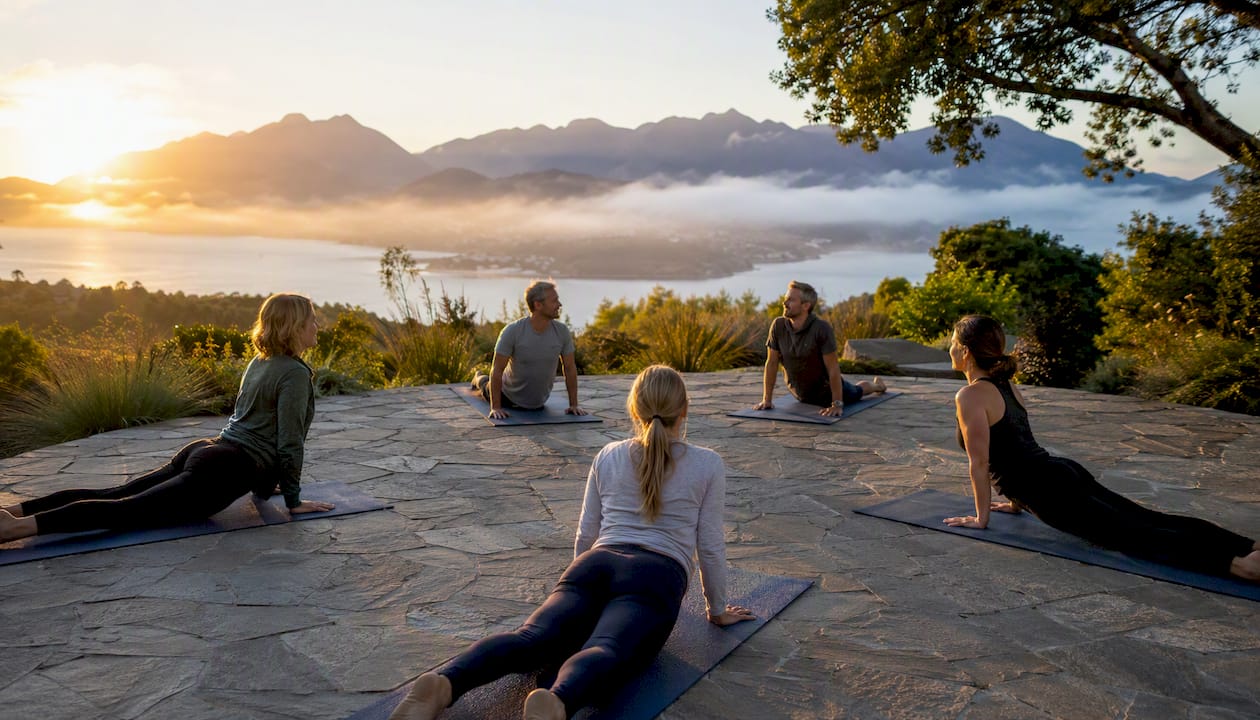
Aro Hā sits above Lake Wakatipu near Queenstown and runs programs that combine yoga, hiking, and plant-based nutrition in a setting that is genuinely remote. Groups are capped at 16 guests, and the program is structured but not over-scheduled. Weekly rates run approximately $5,500–$7,500 per person, including all meals, accommodation, and guided activities. Flights from the U.S. West Coast to Queenstown connect through Auckland or Sydney; plan for a full travel day each way.
Ananda in the Himalayas — Narendra Nagar, Uttarakhand, India
Best for: Ayurvedic integration and private wellness consultations
Ananda is set in a maharaja’s estate above the Ganges Valley and remains one of the most respected wellness properties in Asia. The yoga program draws on classical Hatha and Vedic traditions, and every guest receives a private Ayurvedic consultation on arrival. Spa treatments, meals, and daily yoga classes are included. Weekly rates start around $3,500 per person in standard rooms; suites and private villas push that considerably higher. Flights from the U.S. East Coast to Delhi take roughly 14–16 hours; Ananda arranges transfers from Rishikesh or Delhi.
Six Senses Ibiza — Ibiza, Spain
Best for: European luxury spa + yoga with a design-forward aesthetic
Six Senses Ibiza opened its RoseBar longevity clinic alongside its yoga and wellness programming, making it one of the most complete high-end yoga and wellness properties in Europe. The property is small by resort standards, which keeps the feel intimate. Rates vary significantly by season; summer weeks can exceed $1,500 per night. Fly into Ibiza Airport directly from major European hubs, or connect through Madrid or Barcelona from the U.S.
Kamalaya Koh Samui — Koh Samui, Thailand
Best for: holistic detox and yoga in a tropical setting
Kamalaya is built around a monk’s cave on the southern coast of Koh Samui and has won multiple World Spa Awards. Yoga, detox programs, and Ayurvedic treatments are all available, with a strong emphasis on personalized wellness plans. Weekly rates start around $3,000 per person including meals and some treatments. Fly into Koh Samui Airport via Bangkok; Elitetravelgroup’s Phuket and Thailand packages can be extended to include a Kamalaya stay.
What actually makes a yoga retreat genuinely luxury?
The word “luxury” is doing a lot of work in retreat marketing, and not all of it is honest. Yoga, the markers that actually predict a premium experience are specific and verifiable before you pay a deposit.
The real checklist:
- Private accommodation. Shared dormitories or “glamping” tents with shared bathrooms are not luxury, regardless of the price tag. Look for en-suite private rooms or villas.
- Small group size: 8–16 guests. Above 20, teachers cannot give meaningful individual adjustments. Above 30, you’re at a workshop, not a retreat.
- Lead teacher with E-RYT 500 credentials. The Yoga Alliance’s standards for Registered Yoga Schools require lead trainers to hold the E-RYT 500 designation, which means at least 2,000 hours of teaching experience. That’s the floor for a senior teacher, not a ceiling.
- Low guest-to-staff ratio. One staff member per two or three guests is a reasonable expectation at the high end. It shows up in how quickly dietary requests are handled, how attentive spa staff are, and whether someone meets you at the airport.
- Itemized inclusions. A genuine luxury property lists exactly what’s covered: meals, spa treatments (number and type), airport transfers, yoga sessions, and private consultations. “All-inclusive” with no itemization is a red flag.
- Clear cancellation terms. Reputable properties publish their deposit and refund policies before you ask. A 30-day full-refund window is reasonable; anything shorter deserves scrutiny.
- Independent guest reviews with dates. Look for reviews on third-party platforms (TripAdvisor, Google) that are recent and specific. A property with only testimonials on its own website is showing you a curated highlight reel.
- On-site wellness staff or clinical partnerships. At the high end, this means a resident Ayurvedic doctor, a licensed massage therapist on staff (not contracted in), or a formal partnership with a medical wellness provider.
The Global Wellness Institute’s 2026 report documents a clear premiumization trend: the best properties are moving toward personalized diagnostics and medical-grade wellness services as standard inclusions, not add-ons. That’s the direction the category is heading.
Pro Tip: Watch for “celebrity teacher” marketing that lists a well-known instructor as a retreat leader when they’re actually appearing for a single session or a keynote. Ask specifically: “Will [teacher name] be present and teaching for the full program?” The answer tells you everything.
What does a typical day at a luxury retreat look like?
Two principles define a well-designed luxury yoga retreat schedule: structured practice and generous unstructured time. A retreat that runs from 6 AM to 9 PM with back-to-back sessions is not restorative — it’s exhausting. The best properties build in two to three hours of free time mid-day as a non-negotiable.
A sample day at a mid-to-high-end retreat:
- 6:30–7:30 AM: Sunrise pranayama or gentle movement (optional but encouraged)
- 7:30–9:00 AM: Slow breakfast, usually buffet-style with dietary accommodations
- 9:00–11:00 AM: Main morning yoga session (the primary practice of the day)
- 11:00 AM–1:00 PM: Free time: spa treatment, pool, nature walk, or rest
- 1:00–2:00 PM: Lunch
- 2:00–4:00 PM: Workshop, excursion, or elective session (meditation, journaling, cooking class)
- 4:00–6:00 PM: Free time or private 1:1 session (if booked)
- 6:00–7:30 PM: Restorative or Yin yoga, followed by group dinner
- 8:30 PM onward: Optional evening talk or early rest
Variants by retreat type:
- Deep-practice intensives (like advanced Ashtanga or teacher-training-adjacent programs) replace the afternoon free block with a second full practice session. These suit experienced practitioners who want to accelerate their development, not decompress.
- Restorative “reconnect” stays (Miraval, Canyon Ranch) keep the morning practice gentle and weight the afternoon toward spa, nature, and unstructured time. The yoga is a tool for nervous-system regulation, not the centerpiece.
- Luxury spa-focused retreats (Six Senses, Sensei) treat yoga as one element in a broader wellness menu. You might practice three times in a week and spend the rest of your time in hydrotherapy, receiving bodywork, or in a wellness consultation.
At genuine luxury properties, attendance at sessions is almost always optional. You paid to be there; no one is taking roll. That said, the best retreats design their schedules so you actually want to show up.
How do you vet a luxury yoga retreat before paying a deposit?
Use these 10 questions on every discovery call or booking inquiry. A property that can’t answer them clearly is telling you something important.
- Who is the lead teacher on my exact dates? Get the name, not a category.
- Will that teacher be present and teaching for the full program? Confirm they’re not just opening the retreat and leaving.
- What are the exact inclusions? Ask for an itemized list: meals, spa treatments (number and type), transfers, yoga sessions, private consultations.
- What is the student-to-teacher ratio? Anything above 16:1 for a yoga-focused retreat deserves a follow-up question.
- How many total guests will be on the property during my stay? A 12-person yoga retreat sharing a resort with 200 other guests is a different experience than an exclusive-use property.
- What is the cancellation and refund policy? Get this in writing before you pay any deposit.
- Are airport transfers included? If not, what are the logistics and approximate cost?
- Is there a health intake or screening process? Reputable retreats ask about injuries, medications, and health conditions before arrival.
- Are private sessions available, and what do they cost? Know this upfront so you can budget accurately.
- Can you share recent, date-specific guest reviews? Ask for links to third-party reviews, not testimonials from the property’s own site.
Red flags to watch for:
- Schedules packed from early morning to late evening with no free blocks
- “All-inclusive” language with no itemized breakdown
- Large mixed events (weddings, corporate groups) sharing the property during your dates
- Teacher bios that list training but no verifiable teaching hours or Yoga Alliance registration
- Deposit policies requiring full payment months in advance with no refund window
Verifying credentials takes five minutes. Go to the Yoga Alliance registry at yogaalliance.org, search the teacher’s name, and confirm their designation (RYT 500 or E-RYT 500) and registration status. An E-RYT 500 means the teacher has logged at least 2,000 teaching hours post-certification. That’s the credential to look for at a premium retreat.
Small group sizes matter for a specific reason: adjustments. A teacher working with 8 students can watch every body in the room and offer hands-on corrections or verbal cues tailored to each person. At 30 students, that’s physically impossible. The intimacy of a small group is where the transformative potential actually lives.
What do luxury yoga retreats cost, and what’s included?
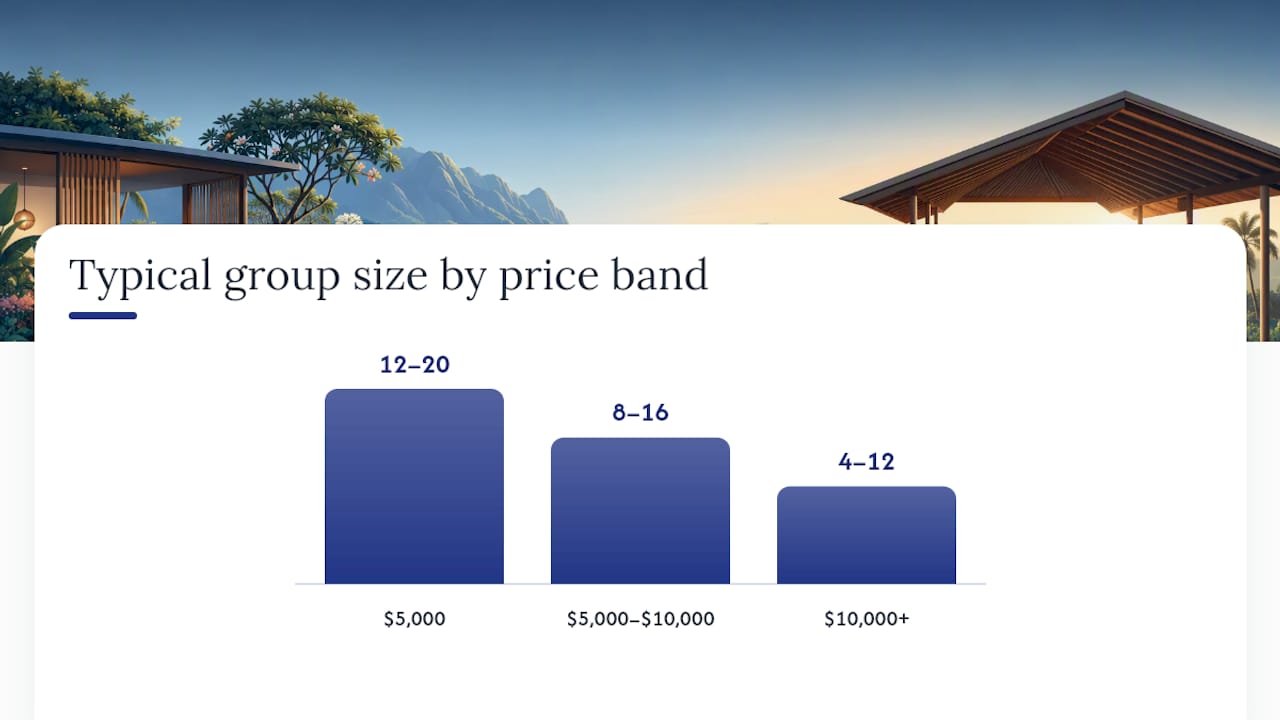
Price bands vary significantly by region, property type, and what’s folded into the rate. Here’s how the tiers break down.
| Price band (per person, per week) | Lodging standard | Typical group size | Spa treatments | Meals | Transfers | Private sessions | Common extras |
|---|---|---|---|---|---|---|---|
| $5,000 | Private room, en-suite | 12–20 | 1–2 included | All meals included | Often extra | Available at added cost | Flights, alcohol, excursions |
| $5,000–$10,000 | Private suite or villa room | 8–16 | 3–5 included | All meals, chef-prepared | Usually included | 1–2 included | Flights, premium alcohol, advanced diagnostics |
| $10,000+ | Private villa or exclusive-use property | 4–12 (or full buyout) | Unlimited or daily | Private chef, personalized menus | Included (private transfers) | Daily privates included | Flights, international visas, bespoke excursions |
A worked example: 7-day international luxury retreat
Consider a week at Ananda in the Himalayas in a standard room:
- Base rate (7 nights, meals, daily yoga, Ayurvedic consultation): approximately $3,500 per person
- Round-trip flights, New York to Delhi: approximately $1,200–$1,800 per person
- Transfer, Delhi to Ananda (4 hours by car, arranged by property): approximately $150 per person
- Two additional spa treatments beyond inclusions: approximately $200–$300
- Estimated total per person: $5,050–$5,750
That’s a useful benchmark. The base rate is rarely the full cost.
Wellness tourism’s growth is pushing luxury properties to add medical-grade services, longevity diagnostics, and personalized health programming as standard inclusions at the higher price bands. At Sensei Lanai and Six Senses RoseBar, biometric assessments and physician consultations are now part of the base program, not add-ons. That’s a meaningful shift in what $10,000+ per week actually buys.
The role of food at these properties is worth noting separately. Chef-driven menus built around the retreat’s wellness philosophy, with full dietary customization, are a hallmark of the top tier. How lodging and gastronomy combine to shape the overall guest experience is something the best retreat operators think about carefully, and it shows in the quality of what’s on the plate.
When should you book a luxury yoga retreat?
The short answer: earlier than you think. Popular programs at Miraval, Kripalu, and Aro Hā sell out 4–6 months in advance for peak-season dates. Holiday weeks (Thanksgiving, Christmas, New Year’s) at U.S. properties often fill within days of opening.
Practical booking guidance:
- Standard lead time: 3–4 months for most mid-tier luxury retreats; 5–6 months for top-tier properties and peak dates
- Shoulder season advantage: Late September through November and late January through March offer 10–20% lower rates at many properties, better room availability, and smaller groups
- Early-bird pricing: Some properties (Kripalu, Rancho La Puerta) offer discounts of 10–15% for bookings made 6+ months out; ask specifically about early-bird windows
- Room holds: Ask whether a property will hold a room for 48–72 hours while you confirm travel logistics before requiring a deposit
Teacher substitution policy: Always ask what happens if your lead teacher cancels. A reputable property will offer a named substitute of equivalent credential, a partial refund, or the option to rebook. If the answer is vague, that’s a risk worth pricing in.
Travel logistics that affect timing:
- India (Ananda): U.S. citizens need a tourist visa or e-Visa (available online, typically processed in 3–5 business days, but apply at least 2 weeks out to be safe)
- New Zealand (Aro Hā): No visa required for U.S. citizens for stays under 90 days; flights from the U.S. West Coast to Queenstown take 12–14 hours with a connection
- Thailand (Kamalaya): No visa required for U.S. citizens for stays under 30 days; best weather on Koh Samui runs December through April
- Spain (Six Senses Ibiza): No visa required for U.S. citizens for Schengen stays under 90 days; peak season is June through August, with shoulder season (May, September) offering better value
Why does hiring a luxury travel planner improve the retreat outcome?
A planner does four things a DIY booking cannot: confirms teacher presence for your exact dates, negotiates room categories and upgrades before they’re gone, itemizes every inclusion so there are no surprises on checkout, and manages contingency plans when something changes.
Wellness tourism is now a structural driver of luxury travel, and the properties that attract high-net-worth travelers are increasingly complex to book correctly. A room at Sensei Lanai is not just a hotel reservation; it involves a pre-arrival health intake, a wellness program selection, and coordination between the spa, the kitchen, and the movement team. Getting all of that right on a first call with a property you’ve never dealt with is harder than it looks.
Specific ways a concierge planner improves outcomes:
- Verifies the lead teacher is confirmed for your dates before any money changes hands
- Confirms group size caps and whether other events share the property
- Negotiates room upgrades and early check-in/late checkout based on existing supplier relationships
- Coordinates dietary requirements, health conditions, and injury notes with the retreat team in advance
- Arranges private sessions and spa bookings before you arrive, so nothing sells out
- Manages flight and transfer logistics as a single itinerary, not separate bookings
- Provides 24/7 support if a teacher cancels, a flight is delayed, or a program changes
A planner’s value is most visible when something goes wrong. A client traveling to an international retreat discovered two weeks before departure that the lead teacher had withdrawn from the program. Because the booking was managed through a concierge agency, the planner had the retreat’s operations contact on file, negotiated a partial credit and a rescheduled date with a confirmed substitute teacher, and rebooked the client’s flights without a change fee through an existing airline relationship. That outcome is not available to someone who booked directly through a retreat’s website.
Two patterns come up repeatedly in how concierge-planned wellness trips differ from self-booked ones. First, the room: planners who work regularly with a property know which specific rooms have the best light, the quietest position, or the closest access to the spa, and they request them by name. Second, the private sessions: at properties like Kripalu or Ananda, the best teachers for private instruction are booked weeks in advance by guests who know to ask. A planner asks on day one.
Elitetravelgroup has 35 years of experience building bespoke wellness itineraries for clients who want the retreat experience done right. No service fees, a price match guarantee, and 24/7 availability mean you’re not navigating this alone. See 2026 luxury travel trends for context on how personalized wellness travel is evolving.
Pro Tip: Always ask your planner to request the property’s current group manifest for your dates — meaning the confirmed number of guests already booked. A retreat marketed as “intimate” that’s already at 14 of 16 spots has a very different feel than one with 6 confirmed guests. That number shapes everything from teacher attention to dinner conversation.
One thing most travelers don’t check before booking
Before finalizing any retreat, ask the property to send a photo of the actual yoga shala or practice space you’ll be using, and confirm whether any other events will share communal facilities during your stay. This sounds minor. It isn’t.
A beautifully photographed property can have a practice space that’s a converted conference room with low ceilings and fluorescent lighting. More commonly, a retreat marketed as exclusive-use will have a corporate group using the pool and dining room on the same dates. Neither detail appears in the listing. Both materially affect the experience. One direct question, asked before the deposit, prevents both problems.
Elitetravelgroup can plan your luxury wellness retreat
Elitetravelgroup takes the vetting, logistics, and negotiation off your plate entirely. Rather than spending hours cross-referencing teacher credentials, room categories, and inclusion lists across a dozen properties, you get a single expert who has done this before and knows which properties actually deliver what they advertise.

The agency’s wellness travel services cover the full scope: property selection matched to your goals, teacher and room confirmation before deposit, dietary and health coordination with the retreat team, private session scheduling, and seamless transfer arrangements. For group retreats, executive wellness buyouts, or private villa programs, Elitetravelgroup handles the complexity that makes those bookings genuinely difficult to execute well.
No service fees. A price match guarantee. Available 24/7. Contact Elitetravelgroup at Elitetravelgroup to brief a planner on your dates, goals, and preferred destinations, and get a curated shortlist within 48 hours.
Sources
- Yoga
- Standards for RYS Credentials (Yoga Alliance)
- What are the Lead Trainer requirements for an RYS 200, RYS 300 and RYS 500?
- 2026 GWI country rankings (Global Wellness Institute)
- US Leads Global Wellness Tourism Boom as Luxury Resorts, Spa Hotels and Healing Retreats Redefine Travel in 2026 – Travel And Tour World
- The Best Yoga Retreats in the US and Canada – Condé Nast Traveler
