




Most luxury travel advisors do not charge a separate service fee for a standard cruise booking, because the cruise line already pays them a commission on the fare. That commission typically runs 10% to 16%, and for advisors who specialize in luxury lines, it can climb to 15% to 20%. Elite Travel Management Group, Inc. does not charge service fees on any booking, luxury cruises included.
Fees enter the picture when a booking demands work the commission doesn’t cover: private shore charters, multi-ship itineraries, or a destination wedding spread across a fleet of cabins. In those cases, a planning fee compensates the advisor for hours of custom research and vendor coordination that a standard fare doesn’t fund. Before you book, ask your advisor two things:
- “Do you charge a planning or service fee, and if so, is it credited toward my booking?”
- “Is your commission built into the cruise line’s published price, or would I pay less booking direct?”
Key Takeaways
Travel advisors earn commissions from cruise lines rather than client fees for most bookings, and Elite Travel charges no service fees on any cruise itinerary.
| Point | Details |
|---|---|
| Commission covers most bookings | Advisors typically earn 10% to 16% of the fare, rising to 15%–20% for luxury specialists. |
| Fees appear with complexity | Simple bookings rarely carry fees; bespoke multi-stop itineraries often run $100 to $500 or more. |
| Ask two questions upfront | Confirm whether a fee applies and whether it’s credited toward your final booking. |
| Value justifies the cost | A fee is worth paying when it secures upgrades, private access, or advocacy you can’t get alone. |
| Elite Travel charges no fees | The agency uses luxury commission tiers and a price-match guarantee instead of client fees. |
Table of Contents
- The Role of Service Fees in Cruise Bookings Explained
- How Travel Advisors Typically Earn Money on Cruise Bookings
- When Advisors Charge Fees, and What They Typically Cost
- What to Ask Your Advisor About Fees, and the Red Flags to Watch
- When Paying a Fee Is Actually Worth It
- How Elite Travel Management Group, Inc. Handles Booking Fees
- A Planner’s View From Inside the Booking Process
- If You Want a Fee-Free Concierge Booking Experience
- Selected Primary Sources and Further Reading
- Sources
The Role of Service Fees in Cruise Bookings Explained
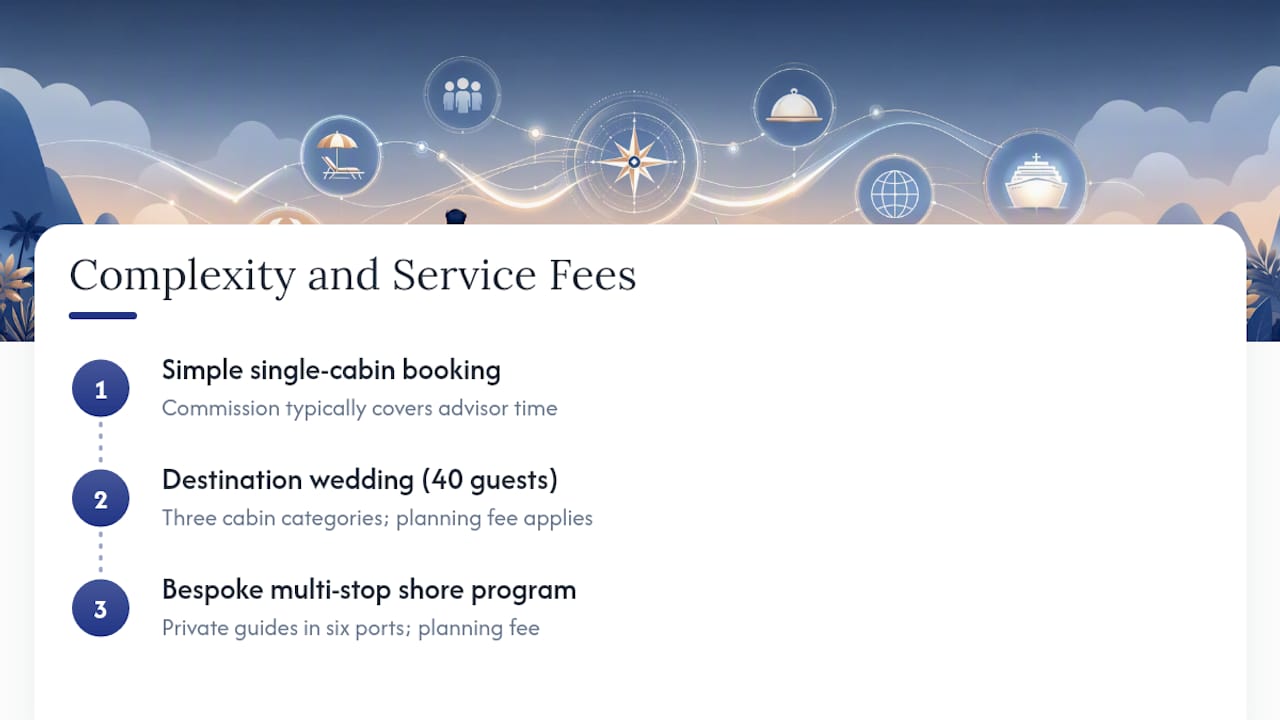
The honest answer is that service fees exist to cover the gap between what a cruise line pays an advisor and what a complex trip actually requires to plan well. For a simple, single-ship, single-cabin booking, that gap rarely exists. Commission alone typically covers the advisor’s time, and the client pays the same fare whether they book direct or through an agency, since the supplier pays the commission either way.
The gap widens fast once a trip gets complicated. A destination wedding cruise with 40 guests booked across three cabin categories, or a bespoke multi-stop shore program built around private guides in six ports, takes far more hours than a single-cabin Caribbean sailing. That’s the scenario where a planning fee shows up, not as a markup on the cruise, but as compensation for work the commission structure was never designed to fund.
Understanding this distinction changes how you should read any conversation about cruise price breakdowns. The fare, taxes, and port charges are set by the cruise line. Whatever an advisor charges on top of that is a separate line item for a separate service: expertise, advocacy, and access.
How Travel Advisors Typically Earn Money on Cruise Bookings
Cruise line commissions form the backbone of advisor income, and the range is wider than most travelers assume.
- Base commission: Most advisors earn 10% to 16% of the cruise fare, with the exact rate tied to their annual production with that specific line.
- Luxury premiums: Specialist advisors who consistently book high-end lines often earn 15% to 20%, a meaningful jump that changes the math on whether a fee is even necessary.
- Add-on commissions: Shore excursions, travel insurance, and specialty dining or spa packages generate smaller commissions, but they add up across a full itinerary.
- Volume overrides: High-producing agencies sometimes earn bonus commissions on top of the standard rate once they hit certain booking thresholds with a cruise line.
Here’s the part that surprises a lot of first-time luxury cruisers: the commission is baked into the fare you’d pay anyway. Cruise lines set one published rate, and whether you book through Elite Travel or call the cruise line directly, you’re paying that same rate. The advisor’s commission comes out of the cruise line’s marketing budget, not your wallet. That’s precisely why the 15% to 20% luxury commission tier matters so much: it often gives specialist advisors enough revenue to skip client fees entirely, even on demanding itineraries.
When Advisors Charge Fees, and What They Typically Cost
Fee-free bookings are the norm for straightforward itineraries. A single cabin, one departure port, standard cruise line, no unusual requests: that’s exactly the kind of booking where commission alone covers the advisor’s time.
Complexity is what triggers a fee. Here’s a rough map of where the fee lines typically fall:
- Simple single-cabin cruise bookings: Rarely any fee. Commission covers the work.
- Small group or multi-cabin family bookings: Occasionally a modest fee, often in the $50 to $150 range for the added coordination.
- Complex bespoke itineraries (multi-stop custom shore programs, back-to-back sailings, private charters): Fees frequently land between $100 and $500.
- High-touch bespoke luxury planning (destination wedding cruises, full-ship buyouts, extensive multi-generational group travel): Fees of $500 or more are common, reflecting dozens of hours of custom work.
- Basic ticketing or minor service tasks: Some agencies charge a small flat fee, often cited around $15 to $30, for standalone administrative requests.
Change and cancellation fees run separately from planning fees, and they vary by agency and by how close to sail date the change happens. Anything involving private yacht charters or exclusive shore arrangements, the kind of add-on you’d coordinate through a partner like Virgin Charter Yachts, almost always falls into the higher planning fee bands simply because of the custom vendor work involved.
What to Ask Your Advisor About Fees, and the Red Flags to Watch
Ask this, verbatim, on your first call: “Do you charge a planning fee for this type of trip, is your commission already built into the cruise fare, and if I pay a fee upfront, is any part of it credited toward my final booking?” A confident advisor answers all three questions without hesitation.
Request the following in writing before you commit:
- A written fee schedule, if one applies to your booking
- A plain statement of what the fee covers (research hours, vendor coordination, on-site advocacy)
- The refund or credit policy if you cancel or the trip changes after paying
- Confirmation of whether the advisor earns commission on your add-ons (excursions, insurance) in addition to any fee
Consumer guidance is consistent on this point: ask about fees before you book, not after, and look for advisors who disclose costs clearly and credit consultation fees against the final booking when a fee is charged.
Pro Tip: If an advisor is vague about whether they charge a fee, or dodges the question about what the commission structure looks like, that’s a signal worth taking seriously. Transparency on fees usually correlates with transparency everywhere else in the relationship.
Red flags to watch for: an advisor who charges a fee and won’t explain what it covers, one who won’t put refund terms in writing, or one who charges both a hefty fee and steers you toward the highest-commission cruise line rather than the best fit for your trip. Any of those suggests you should learn more about how travel agent fees typically work before signing anything.
When Paying a Fee Is Actually Worth It
A fee earns its keep when it buys something you couldn’t get on your own: guaranteed cabin upgrades, private shore arrangements no public excursion desk offers, or 24/7 advocacy if something goes sideways mid-voyage. For a trip running above roughly $3,000 per person, or one involving multiple ports with custom logistics, that value tends to outweigh the fee by a wide margin.
The math is straightforward. If a $400 planning fee secures a suite upgrade worth several times that, plus vetted local guides in ports where a wrong booking could ruin a day, the fee isn’t really a cost. It’s a hedge against expensive mistakes.
Luxury advisors often frame their fee as a consulting engagement, one that buys research depth, vetted on-the-ground partners, and support you can call at 2 a.m. from a foreign port. That framing only holds up when the advisor can point to specific deliverables the fee produced.
On refundability, push for a model where the fee is credited against your final booking rather than a flat nonrefundable charge, especially for trips still in the early planning stage. A credited fee protects you if plans shift; a nonrefundable design fee only makes sense once you’re committed to the destination and dates.
How Elite Travel Management Group, Inc. Handles Booking Fees
Elite Travel charges no service fees on any booking, cruise or otherwise, and backs every quote with a price-match guarantee. That policy rests on 35 years of luxury-focused commission relationships with cruise lines, the same 15% to 20% luxury tier that lets specialist agencies sustain a fee-free model without cutting corners on service.
The reason a fee-free policy works for complex bookings comes down to volume and specialization: sustained luxury commission tiers can fund the same depth of planning work that other agencies charge a fee to cover.
For most cruise bookings, from a single stateroom to a multi-cabin family sailing, that policy holds without exception. For unusually demanding consulting projects, such as a full-ship destination wedding buyout requiring months of vendor negotiation, Elite Travel may offer an optional refundable planning retainer, disclosed upfront and credited against the final booking. Nothing is hidden and nothing is added after the fact.
If you want a fee-free path to your next cruise, the first step is simple: reach out with your travel dates, guest count, and any must-have requests (private excursions, cabin category, special occasions), and expect a clear, no-fee quote in return.
A Planner’s View From Inside the Booking Process
Most of the fee confusion in this industry comes from clients not seeing the hours that happen between “I want a cruise” and a confirmed itinerary. Take a rebooking after a cruise line cancels a port call. That single change can trigger reshuffled shore excursions, updated dining reservations, and sometimes cabin category renegotiation, work that happens over phone calls and emails the client never sees. Or take a private shore arrangement in a port with no public excursion desk worth using. Finding a vetted local guide, confirming safety and reliability, and building a timeline that gets guests back to the ship on time takes real research, not a five-minute search.

None of that work should show up as a mystery charge. Any fee, when one applies, should be written down before you pay it, spelled out in plain terms, and billed exactly as agreed with no surprises at checkout.
If You Want a Fee-Free Concierge Booking Experience
Elite Travel’s no-service-fee model means your quote reflects the actual cruise fare, backed by a price-match guarantee and 24/7 advocacy if anything needs attention while you’re at sea. You get the same concierge-level itinerary work, curated shore arrangements, and VIP perks that other agencies bundle into a planning fee, without that line item ever appearing on your invoice.

Starting a conversation is simple. Reach out with your preferred sail dates, cabin preferences, and any special occasions tied to the trip (an anniversary, a milestone birthday, a destination wedding), and Elite Travel will build a fee-free quote around it. For travelers eyeing complex, multi-stop journeys across Europe’s luxury cruise routes, or those weighing an adventure-driven itinerary, the same no-fee policy applies from first call to final port.
Selected Primary Sources and Further Reading
- How Do Travel Agents Get Paid for Cruises: Commissions and Fees — covers standard commission ranges and typical planning fee amounts.
- Luxury Travel Agency Economics in 2026 — details luxury commission premiums and tiered fee structures.
- Luxury Travel Advisor: Cost & When It’s Worth It — outlines when a paid planning engagement delivers real value.
- Booking a Cruise with a Travel Advisor or Agent — consumer guidance on asking about fees before booking.
Sources
- How Do Travel Agents Get Paid for Cruises: Commissions and Fees – LegalClarity
- Luxury Travel Agency Economics in 2026: Planning Fees, Commission Premiums and the 20 Percent Threshold
- Luxury Travel Advisor: Cost & When It’s Worth It
- Booking a Cruise with a Travel Advisor or Agent – Cruise Critic
