




Choose the no-fee option whenever the fee would cost more than the perks are worth, and skip it when a paid product delivers real, usable value you’d otherwise pay for anyway. Annual fees on cards typically range from modest to higher amounts; account maintenance charges can add up to $180 a year on a checking account you barely touch. If you’re not using rewards, travel credits, or premium protections often enough to offset that cost, a no-fee option almost always wins.
- No-fee cards and accounts suit low-balance, infrequent-use, fee-averse consumers best.
- Fee-based products earn their keep only when perks exceed the fee’s dollar value.
- Fine print hides most fee traps: read the exceptions before you sign up.
Pro Tip: Before opening any account, run this three-question check: Is the “no fee” permanent or promotional? What triggers a fee (minimum balance, inactivity, foreign transaction)? What happens to fees if I need a refund or close the account early?
Key Takeaways
No-fee products save you money whenever the fee would exceed the value of the perks attached to it, but paid options can still win when expertise or rewards clearly outweigh the cost.
| Point | Details |
|---|---|
| Match the fee to your usage | Skip fee-based products you won’t use often enough to offset the annual cost. |
| Watch for fee-shifting | Zero-fee merchant programs often move the cost to you through surcharges or cash-discount pricing. |
| Check refund and exclusion terms | Confirm whether fees are waived permanently or only under conditions like minimum balances. |
| Some fees earn their keep | Frequent travelers and heavy reward redeemers often get more value than the fee costs. |
| Fee-free full service exists | Elite Travel charges no service fees because commissions from suppliers fund its concierge planning. |
Table of Contents
- Why Consider No Service Fees: What “Service Fee” Actually Means
- How No-Fee Options Cut Your Actual Costs
- What Hidden Costs Can Undo Your No-Fee Savings
- How Do You Know If a No-Fee Offer Is Real?
- When Is Paying a Fee Actually the Smarter Move?
- Practical Ways to Cut Service Fees Starting Now
- A No-Service-Fee Way to Plan Your Next Trip
- Frequently Asked Questions
- Sources
Why Consider No Service Fees: What “Service Fee” Actually Means
A service fee is a charge a business adds for maintaining, processing, or administering an account or transaction. It’s distinct from a tax, which a government mandates, and separate from a tip, which is voluntary and goes to a person rather than a company. Once you can tell the three apart, spotting a service fee buried in a statement gets a lot easier.
Service fees show up in more places than most people realize, and they rarely announce themselves clearly:
- Checking and savings accounts: monthly maintenance fees, often waived only if you keep a minimum balance or set up direct deposit.
- Overdraft charges: a flat fee, sometimes over $30, triggered the moment your balance dips below zero.
- ATM fees: charged by your own bank, the ATM owner, or both, sometimes stacking to $5 or more per withdrawal.
- Credit card annual fees: a yearly charge just to hold the card, separate from interest or late fees.
- Merchant processing fees: the cost a business pays to accept card payments, often 2% to 3.5% of the transaction.
- Subscription and service charges: recurring fees for account access, paper statements, or “convenience” processing on bill payments.
The same word covers wildly different situations. A checking account fee penalizes you for how you manage your money. A merchant processing fee is a cost of doing business that a retailer may or may not pass on to you at checkout. Recognizing which type you’re looking at is the first step toward deciding whether it’s avoidable.
How No-Fee Options Cut Your Actual Costs
The math behind fee-free choices is straightforward once you lay it out. Skip a $95 annual fee credit card and choose a no-fee alternative, and you’ve banked $95 before a single reward point matters. Avoid a $12 monthly checking fee and that’s $144 a year back in your pocket, no strings attached. Multiply either across five or ten years and the number stops looking small.
Card issuers make this case directly. American Express notes that no-annual-fee cards can still deliver fraud alerts and purchase protections, meaning you don’t have to trade safety for savings. Capital One defines a no-annual-fee card simply as one that charges nothing to open or maintain the account, while still offering rewards worth matching to your actual spending habits. Discover’s own no-fee checking guidance walks consumers through when skipping checking fees makes the most sense, particularly for people who keep lower balances or don’t travel enough to benefit from premium perks.
| Fee type | Typical annual cost | No-fee alternative |
|---|---|---|
| Credit card annual fee | $95+ | No-annual-fee card (Discover it, Capital One Quicksilver) |
| Checking maintenance fee | can be a moderate to higher yearly cost | No-fee checking account |
| Merchant processing pass-through | typically a few percent per transaction | Cash discount or debit payment |
A cardholder who carries a $95-fee travel card but rarely flies is paying for a benefit they never touch. CNBC’s breakdown points out that no-fee cards are often easier to qualify for and can carry competitive cashback or 0% intro APR offers, which matters more to someone rebuilding credit than a lounge pass ever will.

What Hidden Costs Can Undo Your No-Fee Savings
A “no fee” label doesn’t always mean no cost. Businesses and issuers that advertise zero fees frequently make up the difference somewhere else, and the shift is rarely obvious until you’re already committed.
Watch for these patterns before you assume you’re getting a genuinely free deal:
- Surcharges at checkout: a merchant adds a percentage on top of your card total instead of charging a stated fee.
- Elevated interest rates: a no-fee card sometimes carries a higher APR to make up for lost annual revenue.
- Other fees creep up: late fees, foreign transaction charges, or ATM fees can be higher on “free” products.
- Reduced perks and limits: no-fee accounts may come with lower credit lines, fewer rewards categories, or capped cashback.
- Nonrefundable service charges: some surcharges aren’t returned to you even when the underlying purchase is refunded.
Merchant-side fee shifting is its own category worth understanding. Zero-fee processing programs that businesses adopt typically move the processing cost onto customers through either a surcharge added at the point of sale or a cash-discount program that frames the card price as the “regular” price and the cash price as discounted. The distinction matters legally: surcharging is banned or restricted in some states and requires strict card-network disclosure, while cash-discounting is generally more compliant nationwide because it’s framed as a discount rather than a penalty.
A merchant that advertises “zero fees” for accepting cards hasn’t eliminated the cost. It’s relocated the fee to your receipt, and whether that’s legal depends on your state and how clearly it’s disclosed at the register.
Even when zero-fee processing is implemented correctly, it can eliminate a large share of what a merchant would otherwise pay in card fees, but flat monthly charges and debit-network costs often remain on the business side, which sometimes still trickles into pricing. Check your receipt and any posted signage before you tap your card; if the surcharge wasn’t disclosed clearly, that’s a compliance red flag, not just an inconvenience.
How Do You Know If a No-Fee Offer Is Real?
Run through this checklist before trusting any “no fee” claim, whether it’s a bank, a card issuer, or a retailer at checkout:
- Read the full fee schedule, not just the marketing headline. Banks bury monthly minimums and inactivity fees in separate disclosure documents.
- Check exclusions and exceptions. A “no fee” checking account might waive the charge only with $1,500 in the account or a qualifying direct deposit.
- Test a sample transaction if possible, especially for merchant surcharges, so you see the real total before committing to a purchase.
- Confirm refund handling. Ask whether a surcharge or fee is returned if you cancel or return the purchase.
- Verify which payment types are exempt. Debit and PIN transactions are sometimes surcharge-free even when credit is not.
Beyond the checklist, a few direct questions to customer service can save you from a surprise: Is this fee waiver permanent or promotional? Are there monthly minimums tied to the “free” account? What triggers the fee to kick back in?
Certain signals almost always mean a no-fee claim is softer than it sounds:
- An asterisk next to “no fees” that leads to a paragraph of conditions.
- A mandatory “program fee” or “membership fee” that isn’t technically labeled a service fee but functions like one.
- A long-term contract required to access the no-fee rate, with penalties for early exit.
When Is Paying a Fee Actually the Smarter Move?
Fee-free isn’t automatically the better deal. A fee-bearing product earns its cost when the benefits genuinely outweigh the number on the statement, and the way to check that is simple: take your expected annual benefits, subtract the fee, and see what’s left.
- Frequent travelers: airport lounge access, checked bag credits, and travel insurance can exceed a $95 or even $550 annual fee if you fly several times a year.
- Heavy spenders who redeem rewards: a 3% to 5% cashback category can outpace a card’s fee within a few months of normal spending.
- Business users with deductible fees: a fee that qualifies as a business expense costs less in practice once tax deductions are factored in.
- Situations where expertise beats the fee: full-service planning, whether for a complex insurance claim or a multi-country trip, can save more in avoided mistakes than the service costs. The Points Guy notes that even fee-free cards have their place here, since keeping one open long-term protects your credit history while a premium fee card handles the big spending categories.
Practical Ways to Cut Service Fees Starting Now
Switching accounts or cards doesn’t have to be disruptive if you sequence it right. Here’s a workable order of operations:
- Open the new account first, before closing anything, so you’re never without active banking access.
- Move recurring payments and direct deposits over a full billing cycle to avoid missed autopay charges.
- Keep your oldest card open even at zero usage; closing it can shorten your credit history and hurt your score.
- Confirm the old account has a zero balance before closing it to avoid a final maintenance fee.
Negotiating is underused. Call and ask directly: “I’ve been a customer for [X] years. Can you waive this fee or match a competitor’s no-fee offer?” Banks and issuers often have retention teams authorized to waive a fee on the spot rather than lose a customer.
A few behavioral habits also compound over time:
- Use debit or PIN transactions where merchants apply credit-card surcharges, since debit is frequently exempt.
- Enroll in autopay and low-balance alerts to sidestep late fees and overdraft charges entirely.
- Match spending categories to your card’s reward structure so any fee you do pay gets offset by real cashback or points.
Pro Tip: Keep a no-annual-fee card open indefinitely for credit-history length, and reserve premium fee-based cards for the specific months you’re traveling or making large purchases. You get the credit benefit without paying for perks you use twice a year.
Why Full-Service Providers Sometimes Waive Fees Entirely
Not every no-fee model relies on you avoiding perks. Full-service concierge providers can operate fee-free because they’re paid by suppliers, not clients. A luxury travel agency, for instance, earns its revenue from commissions paid by hotels, cruise lines, and tour operators, which means the client pays nothing extra for the planning itself.
- No service fee to the client, regardless of trip complexity.
- Commission-based revenue lets the agency prioritize the client’s best deal, not a fee-driven upsell.
- Price-match guarantees and round-the-clock support come bundled at no additional charge.
When an agency’s income comes from suppliers rather than clients, waiving the service fee isn’t a discount. It’s how the business model is built from the ground up.
This is precisely the structure Elite Travel Management Group uses for its concierge-level luxury travel planning, which matters when DIY fee-avoidance would otherwise cost you hours of research the expert can shortcut in a single call.
A Straight Take on Fee-Free Choices
Prioritizing net savings over sticker price is the only approach that holds up under scrutiny, and transparency about where the money actually goes matters more than the word “free” itself. Fee-free full-service options earn a real endorsement when the provider’s revenue comes from suppliers, not you, and a fee is worth paying only when its benefits clearly beat its cost on paper.
A No-Service-Fee Way to Plan Your Next Trip
Every example in this article, from no-annual-fee cards to no-fee checking, saves you money because someone else absorbs the cost instead of you. Elite Travel works the same way for travel planning: commissions from hotels, cruise lines, and tour operators fund the service, so you pay Elite Travel nothing extra for expert itinerary design, negotiation, or 24/7 support.

That means you get a concierge-level planner working destination weddings, milestone trips, or multi-country itineraries without adding a planning fee on top of your travel budget, plus a price-match guarantee so you’re not left wondering whether you overpaid. If a trip to Europe is on your radar, start by browsing Elite Travel’s Europe vacation packages and request a custom itinerary with no service fee attached.
Frequently Asked Questions
Why consider no service fees when choosing a bank or card?
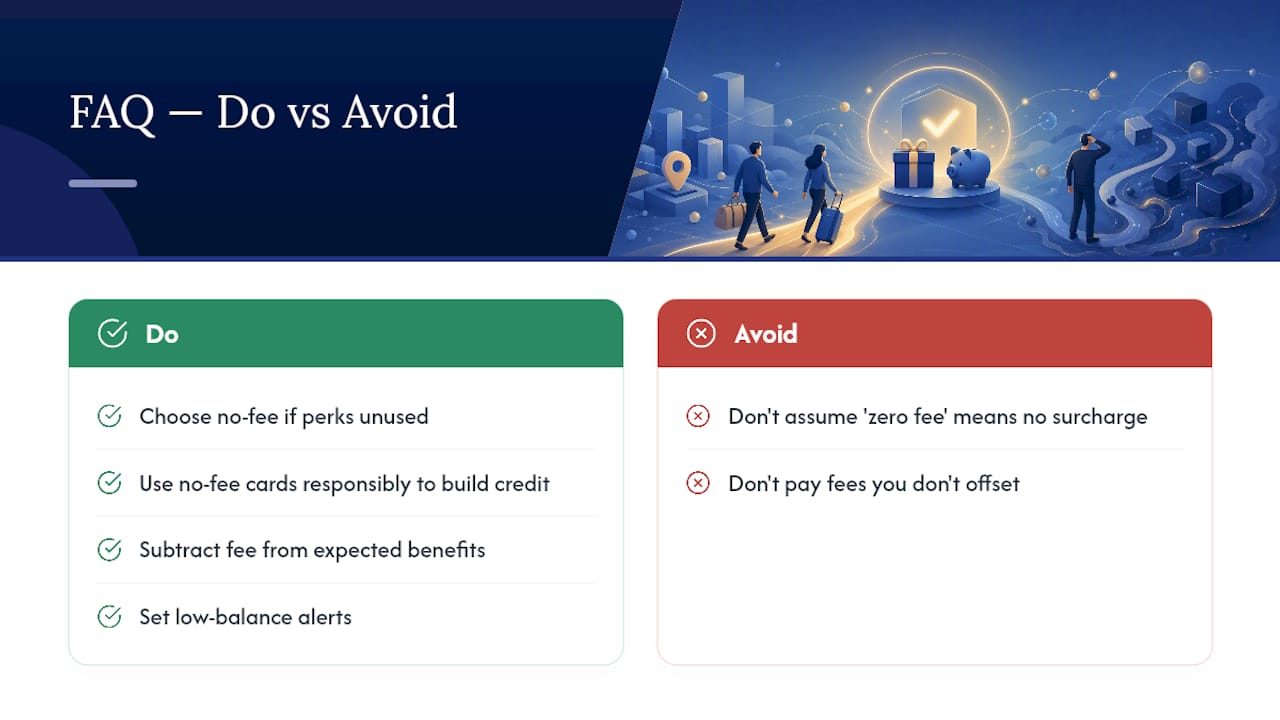
You avoid paying for perks you may never use, and the savings compound over years. A $95 annual card fee or $144 in yearly checking charges adds up fast if you’re not redeeming enough value to offset it.
Is a no-fee credit card worse for building credit?
No. Capital One’s guidance confirms no-annual-fee cards report to credit bureaus the same way fee-based cards do, so responsible use builds credit just as effectively.
Can a “zero fee” merchant program still cost me money?
Often, yes. Businesses that advertise zero fees frequently pass the processing cost to you through a surcharge or cash-discount structure, so check receipts and posted signage before assuming you’re paying nothing extra.
When does paying an annual fee make sense?
When the rewards, travel credits, or protections you actually use exceed the fee amount. A simple formula works: subtract the fee from your expected annual benefit, and if the result is positive, the fee is paying for itself.
How do I avoid overdraft and ATM fees specifically?
Set up low-balance alerts, use your own bank’s ATM network, and consider linking a savings account for automatic overdraft transfers, which usually cost far less than a standard overdraft charge.
This article is general information, not a substitute for advice from a qualified financial advisor. Consult a qualified financial professional about your own circumstances before acting on anything here.
Sources
- The Benefits of No Annual Fee Credit Cards
- 6 Reasons Why You Should Get A No-Annual-Fee Credit Card
- What Is a No-Annual-Fee Credit Card? | Capital One
- Free credit card processing explained (zero-cost processing)
- Is Zero Fee Credit Card Processing Legit? (2026 Truth) – Merchant Insiders
