



For most travelers, the best time to visit the Maldives is the dry northeast monsoon, roughly November to April, with February and March the most dependable months for sun and calm seas. But “best” shifts with what you want: the dry season wins on weather, the shoulder weeks on value, and the rainy months on manta rays and quiet resorts. Because the Maldives is a place where one wrong week can mean a rain-streaked honeymoon or a holiday-premium bill, we plan these trips around your priorities first and the calendar second.
TL;DR
- Best weather: the dry season, November to April. January to March has the clearest, calmest seas and about nine hours of sunshine a day.
- Best balance of weather and value: the weeks outside the Christmas and New Year window, such as March, April and the second half of November.
- Rainy season: May to October, with the southern atolls wettest. Showers are usually short, and the season has real rewards for divers and surfers.
- November: the hinge month. It is the last of the southwest monsoon, so expect showers between sunny stretches, with the weather improving as the month goes on.
- Biggest swing factor for cost: the Christmas to early January window, when resorts price at a premium and often set minimum stays.
Table of Contents
- How the Maldives seasons work
- The dry season, November to April
- The rainy season, May to October
- The Maldives in November
- Which month fits which trip
- What the season does to your budget
- Choosing the right atoll for your month
- Our perspective
- Plan your Maldives dates with us
- FAQ
- Sources
How the Maldives seasons work
The Maldives has a hot tropical climate all year. The official tourism board gives an average high of 31.5°C and a low of 26.4°C, and describes two seasons: a southwest monsoon from May to October that brings rain, and a generally sunny northeast monsoon from November to April.
That means temperature is not what you are choosing between. It sits in the mid-80s to low 90s °F in every month. What changes is rainfall, wind, sea conditions, underwater visibility and price.
Two terms you will see in resort material:
- Dry season (also called peak or high season): the northeast monsoon, with low rainfall and calm water.
- Green season (the wet or low season): the southwest monsoon. The name comes from the lush look of the islands, and it is when rates fall.
If you want a quick overview of how a Maldives resort holiday splits between the dry and rainy seasons, this guide to Maldives seasons and trip timing lays out the basic comparison.
The dry season, November to April
U.S. News Travel puts the best time to visit at November to April, when there is little rain and temperatures run from the high 70s to the mid-80s Fahrenheit. It is also the busiest stretch, with higher room rates. The same source notes that because every resort occupies its own island, the crowds feel far less intense than at other tropical destinations.
Inside that window, the months are not equal.
January to March: the most reliable weather
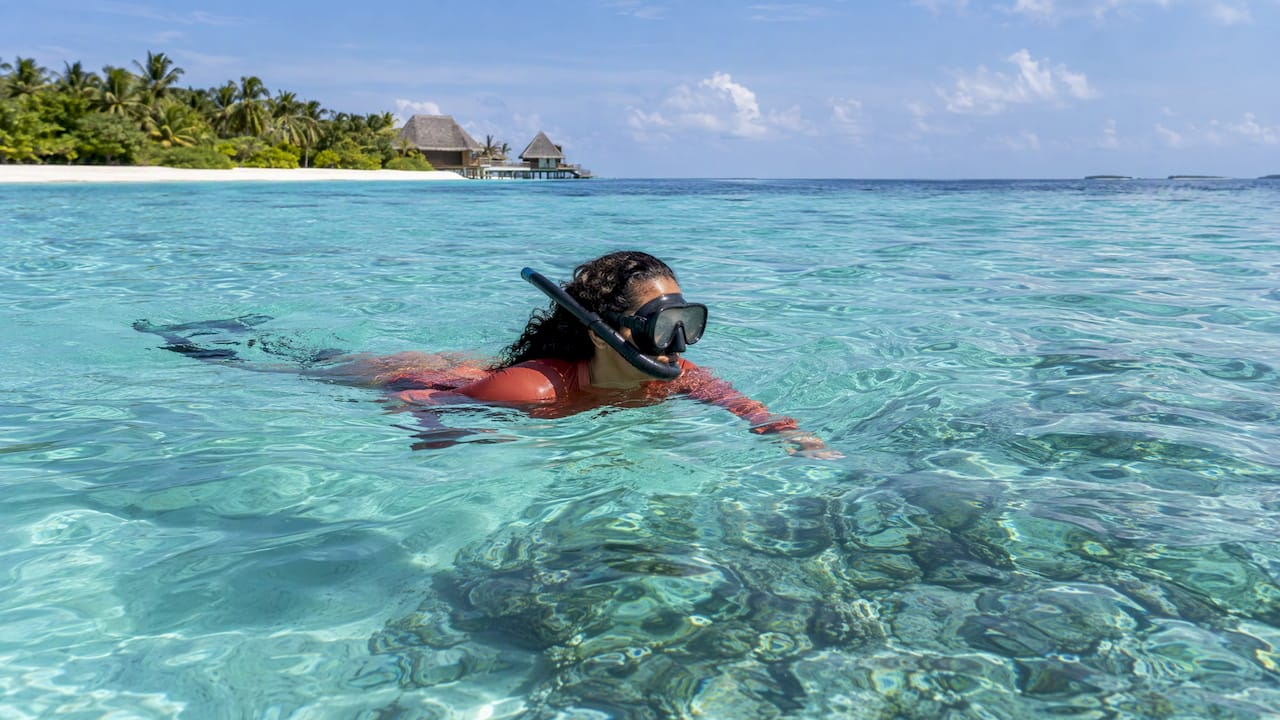
Lonely Planet describes January to March as the time of clearest, calmest seas, with around nine hours of sunshine a day at about 84°F, which makes it the strongest stretch for beaches, snorkeling and diving. If your trip has one non-negotiable (a wedding ceremony on the sand, a milestone birthday with a photographer, a honeymoon you will only do once), this is the window to aim for.
The trade-off is price. Lonely Planet notes rates creep up toward Christmas, and that pressure continues through the dry months. Booking early matters, because the best villas in the best atolls go first.
Christmas and New Year: the premium window
The holiday fortnight is the most expensive and the most restricted time to go. Resorts commonly set minimum stays and gala dinner supplements over the festive period, and rates run at multiples of the shoulder season. Many couples are happiest moving the trip a few weeks either side. If your dates are fixed by school holidays or a family tradition, plan early and decide where to spend, since a villa category and a transfer choice both move the total.
April: the quiet edge of the dry season
April still sits inside the northeast monsoon window that the official tourism board describes as generally sunny, and it tends to be gentler on rates than the months before it. Resorts are fully staffed, the water is warm and the holiday crush has passed. For travelers who want dry-season conditions without paying for the very peak, it is one of the smartest months to look at.
The rainy season, May to October
The southwest monsoon is not a month of gray skies. U.S. News Travel says May to October is the rainy season, with the southern atolls seeing the most rain, 7 to 8 inches a month and often strong winds, but showers tend to be short and followed by sunshine. July and August are the riskiest months for weather.
What you get in return:
- Lower prices and easier upgrades. Lonely Planet recommends April to August for travelers watching the budget, with notably lower airfares and room rates, fewer crowds and easier upgrades, while noting that water visibility is often reduced.
- Surf. Lonely Planet names June and July as the best surfing months, when waves are highest.
- Marine life. It also points to September to November as prime time for whale shark and manta ray sightings, especially around Raa Atoll near the Baa Atoll UNESCO Biosphere Reserve.
Travel + Leisure adds a useful caution for planners: a Maldives expert quoted there says that monsoon timing has become harder to predict over the past couple of decades. In practice, treat the seasons as strong tendencies and not guarantees, and choose a resort and dates with some flexibility in what you plan to do each day.
The Maldives in November
November is the month people ask about most, because it sits on the border between the two monsoons. The Dhiffushi Island Council, drawing on climate records for the capital, Malé, describes it as the final month of the southwest monsoon, with about 231 mm of rain over roughly 13 days. Highs are near 30°C, lows near 25°C, and the sea is 28 to 29°C. The same guide says rain usually arrives as short showers with sunny periods between, and that late November often feels calmer than early November.
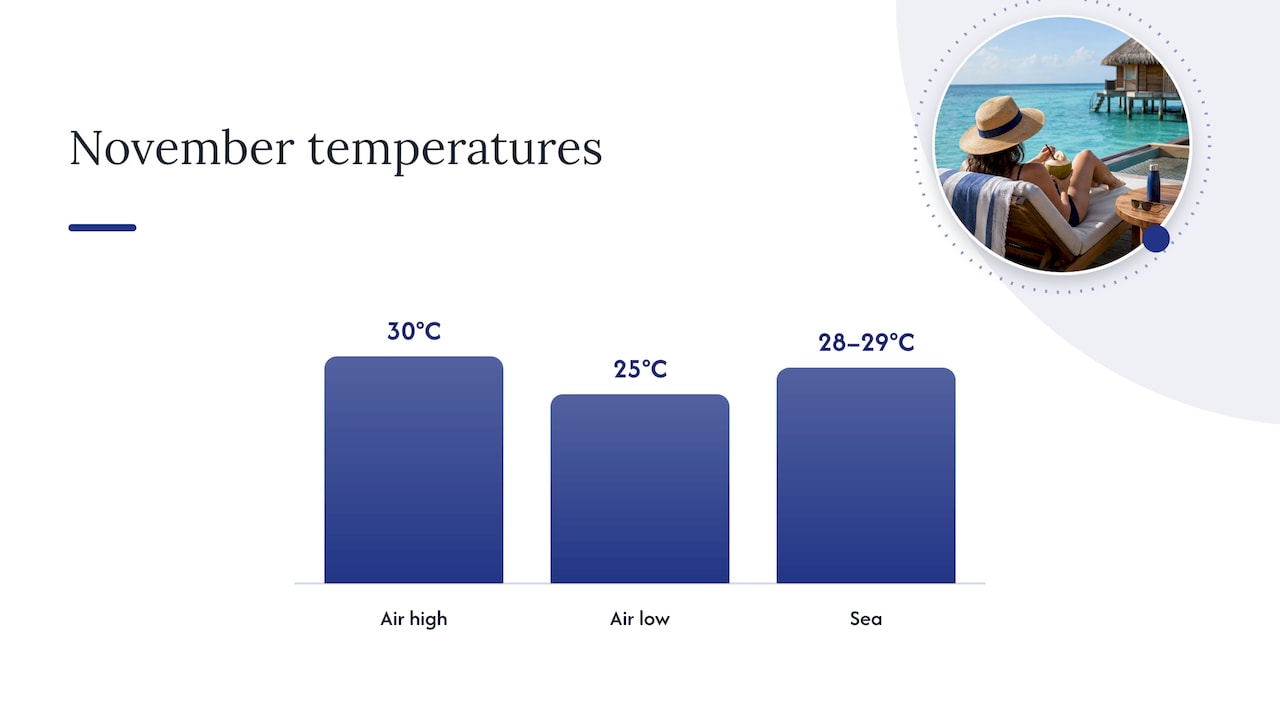
Those figures come from 1981 to 2000 climate normals, so they describe a long-run pattern, not a forecast for any given year. Weather Spark’s long-run data tells a similar story: highs around 86°F, lows around 80°F, a wet day roughly 46% of the time and water near 83°F, with humidity high throughout.
What this means for you:
- Early November: expect more showers. It suits flexible travelers who want warm water and lower rates and who are happy to read by the villa deck for an afternoon.
- Late November: the sweet spot for many couples. The skies are calming, the dry season is arriving, and you are ahead of the December price climb.
- Anyone with a hard weather requirement: shift to February or March.
Which month fits which trip
A single “best month” hides the fact that different trips need different things. Here is how we would steer common requests.
| Trip | Months to aim for | Why |
|---|---|---|
| Honeymoon, weather first | February to March | Clearest, calmest seas and the most sunshine |
| Honeymoon, value-aware | Late November, March or April | Dry or drying weather without the holiday-week premium |
| Family holiday | Late December only if school dates demand it; otherwise January to April | Calm water for children and reliable sun |
| Diving and snorkeling | January to March for visibility; September to November for whale sharks and mantas | Different marine highlights in each season |
| Surfing | June and July | Biggest waves of the year |
| Quiet, lower-rate escape | May to October | Fewer guests and lower rates, with showers to plan around |
| Destination wedding | February to April | Dependable weather for outdoor ceremonies and photographs |
If you are planning a ceremony, the weather window is only half the job. Our guide to destination wedding legal steps covers the U.S. paperwork to sort before you book.
What the season does to your budget
The season affects more than the nightly villa rate. A Maldives bill typically has several moving parts, and each responds differently to timing:
- The villa. The largest line, and the one most sensitive to the calendar. Rates climb through the dry season and peak around Christmas and New Year.
- Transfers. Resorts sit on their own islands, reached by seaplane, domestic flight or speedboat, and these are usually charged on top of the room. Seaplanes generally do not fly after dark, so a late arrival into Malé can mean an extra night on the mainland. Choose flights that land with plenty of daylight to spare.
- Meal plan. Half board, full board and all-inclusive plans change what you pay at the table, and the right one depends on how often you will want to leave the resort.
- Taxes and fees. These are added to the room rate and vary by resort.
Timing flights against transfer schedules is where trips most often unravel. Our approach to private airport transfers is built around avoiding missed handoffs between arrival and onward travel, which matters when the last seaplane leaves in daylight.
If budget is the priority, the green season and the shoulder weeks are where the savings are. Lonely Planet’s guidance is that April to August brings notably lower prices. If weather is the priority, spend where it counts: a better villa in February beats a cheaper villa in July for most couples.
Choosing the right atoll for your month
The Maldives is a chain of atolls, and weather is not identical across them. U.S. News Travel notes that the southern atolls receive the most rain in the wet season. If you are traveling between May and October and want the best odds of sunshine, ask which atoll group a resort sits in before you commit.
Resort size matters too. The same source suggests checking a resort’s villa count and island size to judge how tranquil it will feel. A small island with few villas keeps its quiet feel even in the dry season.
For travelers chasing marine life, the Baa Atoll is the standout. Travel + Leisure highlights snorkeling with hundreds of manta rays feeding at Hanifaru Bay as a reward of the off-season. That is a trip built around an experience, not a forecast, and it is a good example of why the calendar should follow your priorities.
Our perspective
We have spent 35 years designing high-end journeys, and the Maldives is a destination where timing and resort choice decide almost everything. The question we ask first is never “what month is cheapest?” It is “what must this trip deliver?” A honeymoon that needs a sunset ceremony on calm water is a different brief from a diving trip built around mantas.
That is why we build these trips one at a time. We know the destinations and the on-the-ground partners, and we use that to match the right resort, atoll, villa and transfer plan to your dates, so the season works for you and not against you.
We charge no service fees, we offer a price match guarantee so you can book with confidence, and we are open 24/7 because travel does not wait for office hours. If a delay, a weather change or a missed connection happens, you have a real person to call.
tammylevent@gmail.com
Plan your Maldives dates with us
If you are weighing February against late November, or a honeymoon against a dive trip, we can map the options to your dates and priorities. Our luxury vacation packages are customized one by one, with concierge-level support from the first conversation to your return home.

Celebrating something special? Our honeymoon vacation packages are designed around the moments you want most, and our team can help you choose the right season for them.
FAQ
Which month is best to visit the Maldives?
For the most reliable weather, February and March are hard to beat, with clear skies, calm seas and strong visibility. For a better balance of weather and value, late November, March and April are excellent choices. The right month depends on whether your trip is built around weather, diving, budget or a celebration.
When is the Maldives rainy season?
The rainy season is the southwest monsoon, May to October, according to the official tourism board. Rain tends to come in short showers followed by sunshine, and July and August carry the highest weather risk. The southern atolls see the most rain.
Is November a good time to go to the Maldives?
Yes, especially late in the month. November is the last month of the southwest monsoon, so showers are still common, but the weather settles as the month goes on, and you avoid the Christmas price climb. If sunshine is essential, February or March is a safer bet.
When is the Maldives cheapest?
The lower-rate months fall in the green season. Lonely Planet points to April to August as the stretch with significantly lower airfares and room rates. The expensive window is the Christmas to New Year period, so moving your dates even a few weeks can change the total considerably.
Is the Maldives hot all year?
Yes. The official tourism board gives an average high of 31.5°C and a low of 26.4°C across the year. What changes by season is rain, wind and sea conditions, not the heat.
Sources
- Visit Maldives: Travel Information
- Best Times to Visit Maldives, U.S. News Travel
- The Best Times to Visit the Maldives for Weather, Lonely Planet
- Maldives in November: weather, seas, holidays, Dhiffushi Island Council
- Maldives November Weather, Weather Spark
- How to Plan a Once-in-a-lifetime Trip to the Maldives, Travel + Leisure
- Maldives seasons and trip timing guide
