




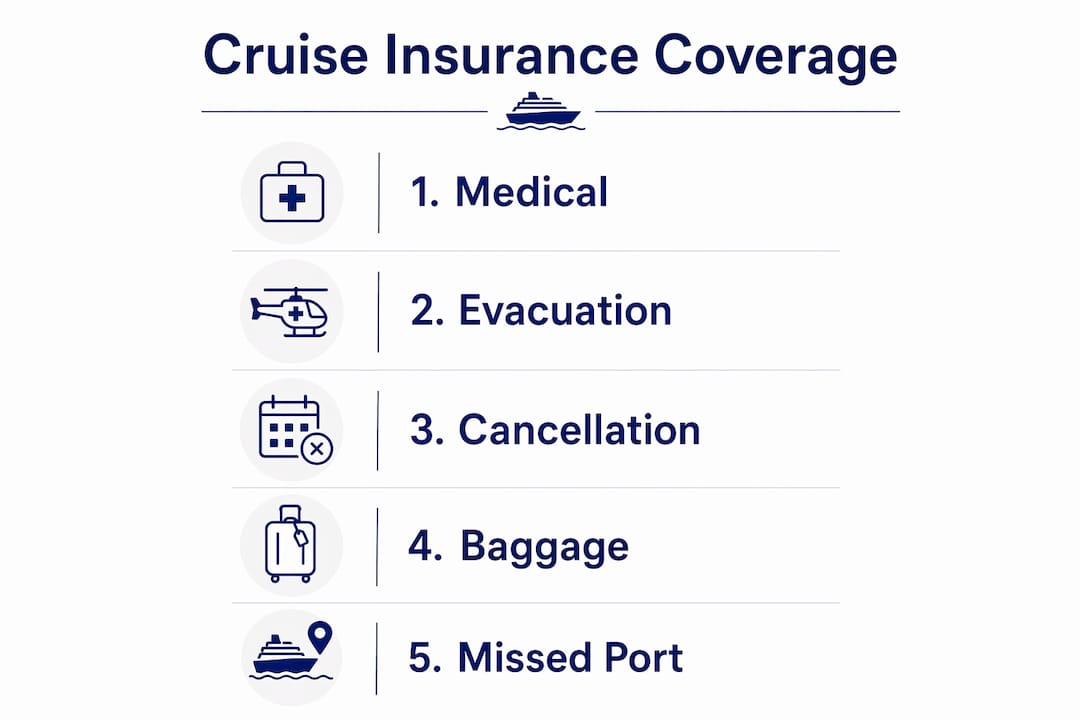
Cruise travel insurance is a specialized policy built around the specific risks of cruise travel, covering medical emergencies at sea, emergency evacuations, trip cancellations, missed port departures, and lost or damaged belongings. Unlike standard travel insurance, it accounts for the realities of being at sea: limited onboard medical facilities, strict departure schedules, and the fact that most U.S. health insurance plans won’t pay a single dollar for care received on a cruise ship. Coverage applies before you leave home, throughout the voyage, and during your return.
Core protections typically included in cruise insurance policies:
- Emergency medical coverage for illness or injury onboard or at ports of call
- Medical evacuation and repatriation, covering transport to the nearest adequate facility
- Trip cancellation and interruption for covered reasons like illness, injury, or job loss
- Missed port departure coverage when a covered delay causes you to miss embarkation
- Travel delay reimbursement for hotels and meals during unexpected holdups
- Lost, stolen, or delayed baggage protection
- Itinerary change and excursion cancellation coverage for weather or mechanical disruptions
- Financial default protection if a cruise line or travel supplier goes bankrupt
Providers like Travel Guard® and Seven Corners Travel Insurance offer plans designed specifically for cruise travelers, with benefit structures that address these gaps. The key distinction from general travel insurance is the inclusion of cruise-specific benefits: missed ship coverage, shore excursion reimbursement, and evacuation limits high enough to actually cover a real emergency at sea.
Table of Contents
- What does cruise travel insurance actually cover?
- What cruise travel insurance typically does not cover
- How much cruise travel insurance costs and when to buy it
- How to choose the right cruise insurance policy
- What experts say about cruise travel insurance
- How long does cruise travel insurance coverage last?
- How to file a claim for cruise travel insurance
- Cruise travel insurance vs. standard travel insurance
- Key Takeaways
What does cruise travel insurance actually cover?
The coverage components in a cruise insurance policy work together to address the financial exposure points unique to ocean travel. Here is what each one does in practice.
Emergency medical expenses cover the cost of treatment when you get sick or injured, whether that happens in the ship’s infirmary or at a hospital ashore. Medical care on cruise ships is billed privately, and most U.S. domestic health insurance plans offer no coverage at sea. Experts recommend minimum limits of $100,000 for medical coverage and $250,000 for evacuation.

Emergency evacuation is where costs can become catastrophic without insurance. A medical evacuation from a remote location can run anywhere from $25,000 to over $150,000 depending on where the ship is when the emergency occurs. A helicopter medevac from the middle of the Atlantic is not a hypothetical; it happens, and it is expensive.
Trip cancellation and interruption reimburse prepaid, nonrefundable costs when a covered event forces you to cancel or cut the trip short. Covered reasons typically include sudden illness or injury, a death in the family, involuntary job loss, and certain natural disasters. If your ship develops a mechanical failure mid-voyage and you’re forced to disembark early, trip interruption coverage picks up the hotel and flight costs the cruise line won’t cover.
Missed connection and missed port departure coverage pays to get you to the ship’s next port if a covered delay causes you to miss embarkation. This benefit is particularly valuable for cruises with tight flight connections to the departure port.
Additional protections worth noting:
- Baggage loss and delay: reimburses for lost or stolen items, and for necessary purchases (clothing, toiletries) when bags are delayed past a policy threshold
- Travel delay: covers meals and accommodations during extended delays
- Shore excursion cancellation: reimburses prepaid excursion costs when weather or itinerary changes force cancellations
- Financial default: protects your investment if a cruise line or supplier goes bankrupt before or during your trip
Pro Tip: When reviewing medical coverage limits, factor in your itinerary. A Caribbean cruise stays relatively close to major hospitals; an expedition to Antarctica or a remote Pacific crossing puts you much farther from adequate care. The more remote the route, the higher your evacuation limit should be.
What cruise travel insurance typically does not cover
Every policy has exclusions, and cruise insurance is no exception. Knowing what is not covered before you buy prevents unpleasant surprises at claim time.
Pre-existing medical conditions are excluded from most standard policies unless you purchase a waiver. That waiver is only available if you buy your policy within a specific window after your initial trip deposit, typically 14–21 days. Miss that window and a flare-up of a chronic condition may not be covered.
Change-of-mind cancellations are not a covered reason under standard trip cancellation benefits. If you simply decide you don’t want to go anymore, you won’t be reimbursed unless you have Cancel For Any Reason (CFAR) coverage. CFAR is an optional upgrade that reimburses 50–75% of prepaid costs for cancellations made for any reason, but it must be purchased within 14–21 days of the initial deposit and typically adds 40–60% to the base policy cost.
Common exclusions across most cruise insurance policies:
- War and military actions, declared or undeclared
- Pandemics, unless the policy includes a specific pandemic rider
- Financial default of the cruise line, often excluded or limited in cruise-line-provided plans
- Personal negligence, such as injuries sustained while intoxicated
- High-risk activities not listed as covered in the policy
- Cosmetic procedures or elective treatments sought during the trip
- Losses from illegal activity
The financial default exclusion deserves special attention. Cruise-line-provided insurance plans often exclude coverage for the cruise line’s own financial default, which is a meaningful gap. Third-party plans from independent providers typically handle this better.
Reading the full policy document, not just the marketing summary, is the only way to know exactly what you’re buying.
How much cruise travel insurance costs and when to buy it
Cruise travel insurance typically costs a variable percentage of the total insured trip value, resulting in a significant cost for comprehensive coverage. The range is wide because several factors push the price up or down.
Factors that influence your premium:
- Your age: older travelers pay more, sometimes significantly more, due to higher medical risk
- Trip cost: higher insured values mean higher premiums
- Coverage limits: policies with $500,000 evacuation limits cost more than those capped at $100,000
- Itinerary: remote destinations with limited medical infrastructure increase the risk profile
- Add-ons: CFAR coverage adds 40–60% to the base premium
When to buy matters as much as what you buy. Purchasing soon after your initial trip deposit unlocks critical protections such as the pre-existing condition waiver and eligibility for CFAR. Buy outside that window and these options may not be available. Cruise Critic’s guidance aligns with this, recommending purchase ideally within 15 days of booking to preserve the pre-existing condition waiver.
On the question of cruise-line insurance versus independent providers: cruise lines do sell their own plans at the point of booking, and the convenience is real. But these plans tend to carry lower coverage limits and reimburse in future cruise credits rather than cash. For most travelers, an independent third-party policy offers better value, more flexibility, and actual money back when something goes wrong.

How to choose the right cruise insurance policy
Choosing a policy is less about finding the cheapest option and more about matching coverage to your actual exposure. A few specific decisions drive most of the difference.
Cruise line plan vs. third-party plan. Cruise-line plans are convenient but limited. Independent providers generally offer broader coverage, higher limits, cash reimbursements, and the ability to customize. For a luxury or high-value cruise, the gap in protection can be substantial.
Primary vs. secondary coverage. Primary coverage pays immediately when a covered event occurs, before any other insurance. Secondary coverage requires you to exhaust other policies first, then reimburse the remainder. Primary is more expensive but far simpler to use in an actual emergency. In a package policy, trip cancellation is often primary while medical and baggage coverage may be secondary.
Medical and evacuation limits. The recommended minimums are $100,000 for medical and $250,000 for evacuation. For remote itineraries, expedition cruises, or travelers with existing health considerations, higher limits are worth the added premium.
Key factors to evaluate when comparing cruise insurance options:
- Covered cancellation reasons: does the list match your realistic risk scenarios?
- Missed connection benefit: is there a specific benefit for rejoining the ship at the next port?
- Excursion coverage: are prepaid shore excursions reimbursable if canceled?
- CFAR availability: can you add it, and what percentage does it reimburse?
- Provider reputation: check ratings through the U.S. Travel Insurance Association and the BBB
- Claim process: how are claims submitted, and what documentation is required?
- 24/7 assistance: does the provider offer round-the-clock emergency support?
Pro Tip: Match your coverage level to your trip cost and your health situation, not just the policy price. A traveler in excellent health on a week-long Caribbean cruise has a different risk profile than a 70-year-old on a 30-day world voyage. Buy accordingly.
For travelers booking luxury cruise experiences, where trip costs can run well into five figures, the case for comprehensive third-party coverage with high limits is especially strong.
What experts say about cruise travel insurance
The travel insurance industry and cruise professionals are consistent on one point: cruise travel insurance is optional in the technical sense, but the financial and medical risks of going without it are real.
The medical risk argument is particularly compelling. Most U.S. health insurance plans provide no coverage at sea, and the CDC’s vessel sanitation program data on cruise ship health incidents underscores how quickly a health situation can escalate in a confined shipboard environment. A serious cardiac event or stroke at sea may require a helicopter evacuation that costs more than the cruise itself.
Expert buying tips and common pitfalls:
- Buy within 14–21 days of your deposit. This is the single most important timing decision. Miss it and you lose CFAR eligibility and the pre-existing condition waiver.
- Don’t rely on the cruise line’s plan alone. Cruise-line plans often exclude the line’s own financial default and reimburse in credits, not cash.
- Verify that evacuation limits are high enough. A $50,000 evacuation limit sounds like a lot until you price an actual medevac from a remote port.
- Read the exclusions, not just the benefits summary. The summary tells you what’s covered; the exclusions tell you when it isn’t.
- Consider CFAR if your plans are uncertain. Life changes. A job shift, a family situation, or a change in travel companion’s health can all arise. CFAR is the only way to cancel for reasons outside the standard covered list.
How long does cruise travel insurance coverage last?
A cruise travel insurance policy typically covers the entire duration of your trip, from the moment you leave home to the moment you return. That means coverage is active during pre-cruise travel (flights, hotel stays before embarkation), throughout the voyage itself, at every port of call, and during your return journey.
The policy period is set at purchase based on your travel dates. If your trip runs 14 days, your coverage runs 14 days. Some policies allow you to extend coverage if your return is delayed due to a covered event, such as a medical emergency that keeps you hospitalized at a port. That extension benefit is worth checking for before you buy, particularly on longer voyages.
One nuance: trip cancellation coverage activates the moment you purchase the policy, even before you travel. If you buy insurance the day after your deposit and then get a diagnosis that forces you to cancel two months later, that cancellation is covered from day one of the policy. Medical and evacuation benefits, by contrast, only apply once you’ve departed.
How to file a claim for cruise travel insurance
Filing a claim is straightforward when you’ve kept good records. The process typically follows these steps.
Document everything as it happens. If your bag is lost, get a written report from the airline. If you see a doctor, keep every receipt and medical record. If your ship misses a port, get written confirmation from the cruise line. Documentation is the foundation of any successful claim.
Notify your insurer promptly. Most policies require you to report a claim within a specific timeframe, often 20–90 days of the incident. For medical emergencies, many providers have a 24/7 assistance line you should call as soon as possible, both to get help and to start the claims process.
Gather your documentation. Standard claim submissions typically require:
- Proof of trip cost (booking confirmations, receipts)
- Proof of loss (medical records, police reports, airline delay notices)
- Proof of payment for out-of-pocket expenses
- The completed claim form from your insurer
Submit and follow up. Most providers now accept digital submissions. After submitting, note the claim number and follow up if you haven’t received a response within the timeframe stated in your policy. Keeping copies of everything you submit protects you if documents are lost in processing.
The faster you act and the more complete your documentation, the faster your claim resolves. Waiting weeks to file, or submitting incomplete paperwork, is the most common reason claims are delayed or reduced.
Cruise travel insurance vs. standard travel insurance
The distinction matters more than most travelers realize. Standard travel insurance is a general-purpose product covering trip cancellation, medical emergencies, and baggage loss across any type of trip. Cruise travel insurance is built on that same foundation but adds a layer of protections specific to how cruises actually work.
The table below captures the key differences:
| Feature | Standard Travel Insurance | Cruise Travel Insurance |
|---|---|---|
| Emergency medical | Yes | Yes, often higher limits |
| Medical evacuation | Yes | Yes, with ship-to-shore specifics |
| Trip cancellation | Yes | Yes |
| Missed port departure | Rarely | Yes, standard benefit |
| Shore excursion reimbursement | No | Yes, in most cruise plans |
| Itinerary change coverage | No | Yes |
| Cruise line financial default | Varies | Often included |
| Quarantine coverage | Varies | Often included |
The missed port departure benefit is the clearest example of why cruise-specific coverage matters. A standard travel insurance plan may cover a missed flight connection, but it won’t necessarily pay to get you to the ship’s next port of call when you miss embarkation. Cruise insurance does. Similarly, shore excursion reimbursement and itinerary change coverage address scenarios that simply don’t exist in non-cruise travel.
For travelers booking exclusive cruise experiences with significant prepaid costs across flights, hotels, and excursions, the cruise-specific policy structure provides a much tighter fit than a generic travel plan. The premium difference between the two is usually modest; the coverage difference can be substantial.
Key Takeaways
Cruise travel insurance is the most practical financial protection available for cruise travelers, covering medical emergencies, evacuations, cancellations, and cruise-specific disruptions that standard health and travel insurance leave exposed.
| Point | Details |
|---|---|
| Buy within 14–21 days of deposit | This window unlocks CFAR eligibility and the pre-existing condition waiver. |
| Medical and evacuation limits matter | Experts recommend at least $100,000 medical and $250,000 evacuation coverage. |
| Third-party plans outperform cruise-line plans | Independent policies offer cash reimbursements, higher limits, and broader coverage. |
| Cruise insurance fills gaps standard policies miss | Missed port departure, shore excursion reimbursement, and itinerary changes are cruise-specific benefits. |
| Cost runs 4%–10% of trip value | A $10,000 cruise typically costs $400 to $1,000 to insure with comprehensive coverage. |
Planning a luxury cruise and want expert guidance on coverage, itinerary, and every detail in between? Elitetravelgroup has spent 35 years building the kind of trips that deserve protecting. Explore our luxury cruise packages or browse our adventure travel options to start planning with a team that’s available 24/7, charges no service fees, and knows exactly how to get it right.