




TL;DR:
- Creating a personalized itinerary ensures travel experiences align with individual preferences, increasing satisfaction by 40%.
- Multiple planning methods, including AI tools, professional planners, and DIY research, can be combined for optimal results.
Most travelers have felt it: you book a group tour, arrive at the destination, and spend three days being shuffled between attractions you didn’t choose, eating at restaurants picked for volume not flavor, and rushing past the very places you actually wanted to explore. A customized itinerary fixes all of that. Understanding what a customized itinerary is, and knowing how to build one well, is the difference between a trip you survive and one you remember for life. Custom itineraries yield 40% higher satisfaction than standard group tours, and the gap only widens with better planning tools available today.
Table of Contents
- Key Takeaways
- What is a customized itinerary, really?
- Core methods for building personalized travel plans
- How to create an itinerary that actually works
- The real benefits of custom itineraries
- Comparing the top tools for itinerary creation in 2026
- My take on where custom itineraries are headed
- Plan your next trip with Elitetravelgroup
- FAQ
Key Takeaways
| Point | Details |
|---|---|
| Personalization drives satisfaction | Custom itineraries deliver 40% higher traveler satisfaction compared to generic group tours. |
| Multiple methods exist | AI tools, professional planners, and manual research each offer different levels of control and cost. |
| Sequence and feasibility matter | Booking accommodations first and verifying logistics prevents on-the-ground surprises. |
| Flexibility beats rigidity | Planning 1 to 3 anchor activities per day with buffer time produces better trips than packed schedules. |
| Customized is not luxury-only | Modern AI tools and DIY research make personalized travel plans accessible at every budget level. |
What is a customized itinerary, really?
A customized itinerary is a travel plan built specifically around your preferences, pace, budget, and interests. It is not a template with your name dropped into it. It is a day-by-day framework that reflects how you actually want to spend your time, where you want to sleep, how you prefer to get around, and what kind of experiences matter most to you.
Standard package tours operate on a skeletal, technical model. One schedule serves forty people, which means it genuinely serves none of them particularly well. Attractions are chosen for broad appeal, meals for efficiency, and hotel locations for bulk pricing. A customized itinerary flips that logic entirely.
Here is what a truly personalized travel plan typically includes:
- Activities and experiences selected for your specific interests, from museum-heavy cultural deep dives to adventure sports and culinary tours
- Accommodations chosen based on location strategy, style preference, and budget priority rather than tour operator contracts
- Transportation planned around your comfort level, whether that means private transfers, trains, or renting a car
- Dining reservations at places you actually want to try, with enough spontaneity built in for happy discoveries
- Pacing that respects your energy, including rest days on longer trips and realistic daily timelines
One widespread misconception worth addressing: customized itineraries are not exclusively for luxury travelers. AI tools and DIY planning methods have made personalized travel plans accessible at every budget, from backpacker trips through Southeast Asia to high-end European escapes. The tailored holiday schedule you build does not need to cost more. It just needs to cost right for what matters to you.
Core methods for building personalized travel plans
There is no single right way to create a customized itinerary. The best approach depends on how much time you have, how much control you want, and what your budget allows. The three primary methods are AI-powered tools, professional travel planners, and manual DIY research.
AI-powered trip planning tools generate a full draft itinerary in minutes using your stated preferences, travel dates, and destination. They pull real-time data on pricing, weather patterns, and crowd levels. The speed is genuinely impressive, and the output is a solid starting point. The limitation is that AI tools sometimes suggest logistically awkward plans, like visiting opposite ends of a city on the same morning.
Professional travel planners bring expertise that no algorithm has replicated. A good planner knows which hotel on the same street outperforms the others by a mile, which restaurant requires booking two months in advance, and how to structure a week in Tuscany so you are not backtracking constantly. That knowledge has real monetary value. Planners typically charge fees or earn commissions, though elite agencies like Elitetravelgroup charge no service fees at all.
Manual DIY research using travel blogs, forums like Reddit’s travel communities, and tools like Google My Maps gives you complete control and often uncovers gems no AI knows about yet. The trade-off is time. Building a thorough itinerary this way can take twenty or more hours for a two-week trip.
The strongest approach by far is the hybrid method. AI and manual planning complement each other rather than compete. Use an AI tool to generate a structural first draft, then manually vet every suggestion against real traveler reviews, current hours, and geographic logic.
Pro Tip: Use AI to draft the skeleton, then spend two focused hours stress-testing each day against Google Maps. Look for instances where the AI has you crossing the city twice for no good reason, and cluster those activities geographically.

How to create an itinerary that actually works
A well-structured custom itinerary requires 3 to 5 hours of planning upfront but saves more than 10 hours of logistical stress during the trip itself. The process below is how experienced planners approach it.
Define your non-negotiables first. Before you research anything, write down the three to five experiences that would make this trip feel successful. Everything else is negotiable around those anchors.
Research broadly before committing. Build a long list of possible activities, neighborhoods, restaurants, and day trips. Pull from travel blogs, YouTube vlogs, and forum threads written by people whose travel style matches yours.
Set a budget framework. Decide where you want to spend generously and where you are happy to save. Some travelers splurge on accommodation and eat street food. Others prioritize once-in-a-lifetime experiences and stay in modest hotels. Neither is wrong. Allocating money intentionally prevents the regret of spending badly.
Book accommodations before anything else. Hotel location shapes your entire daily flow, determining transit time and convenience for every activity. Locking in where you sleep first means every subsequent planning decision becomes easier and more logical.
Use Google My Maps to cluster attractions. Drop every item on your long list as a pin, then build your days by geographic proximity. You will immediately see which attractions make sense together and which are too far apart to combine.
Verify feasibility before finalizing. Check opening hours, transit availability, and booking requirements for every major activity. Many travelers build beautiful plans around museums that are closed on Mondays.
Build day-by-day with 1 to 3 anchor activities. Plan 1 to 3 anchor activities daily with a 30 to 60 minute buffer between each. This is the single most important structural rule in itinerary planning.
Alternate high-energy and light days. Custom itineraries allow varying daily energy levels, balancing intensive sightseeing days with slower afternoons or full rest days. On trips longer than ten days, this is not optional. It is how you avoid burnout.
Here is a practical pacing reference to use during your planning:
| Trip length | Recommended rest days | Daily anchor activities |
|---|---|---|
| 3 to 5 days | 0 | 2 to 3 |
| 6 to 9 days | 1 | 2 to 3 |
| 10 to 14 days | 2 | 1 to 2 |
| 15+ days | 3 or more | 1 to 2 |
Pro Tip: Reviewing existing group tour itineraries for your destination is a surprisingly effective shortcut. Analyzing group tour flows reveals which attraction clusters make logical daily sense, giving you a structural framework to build from rather than starting with a blank page.
The real benefits of custom itineraries
The numbers make a compelling case. Personalized travel is forecast to reach $317 billion by 2029, which tells you something real about where traveler preferences are heading. But the benefits of custom itineraries go deeper than market trends.
- You control the pace. No more racing to catch a group bus. If you want to spend three hours in one gallery, you can.
- Your budget works harder. Money goes toward what matters to you, not toward a group’s average preferences.
- You find places generic tours never visit. Custom itineraries empower discovering hidden gems that never appear in standard packages, from a family-run trattoria in a Roman side street to a lesser-known hiking route with no crowds.
- Special needs get real attention. Accessibility requirements, dietary restrictions, mobility considerations, and family dynamics can all be built in from day one, not patched in as afterthoughts.
- Flexibility stays intact. AI tools optimize timing around weather and crowd levels with real-time updates, so you can adjust on the fly without losing the thread of your trip.
“The best trip you will ever take is the one designed around who you actually are, not who the average tourist is.”
For travelers considering organized luxury tour experiences, the difference becomes even clearer when you compare a curated personal experience against a one-size-fits-all group format.
Comparing the top tools for itinerary creation in 2026
Knowing what tools exist helps you choose the right one for your planning style. Here is a direct comparison of the main options:
| Tool type | Best for | Cost | Control level | Time investment |
|---|---|---|---|---|
| AI trip planners | Fast first drafts, real-time updates | Free to low | Medium | Low |
| Google My Maps | Geographic clustering, route logic | Free | High | Medium |
| Travel blogs and forums | Authentic local insight, hidden gems | Free | High | High |
| Professional planners | Expert-curated, stress-free luxury trips | Varies | Shared | Low |
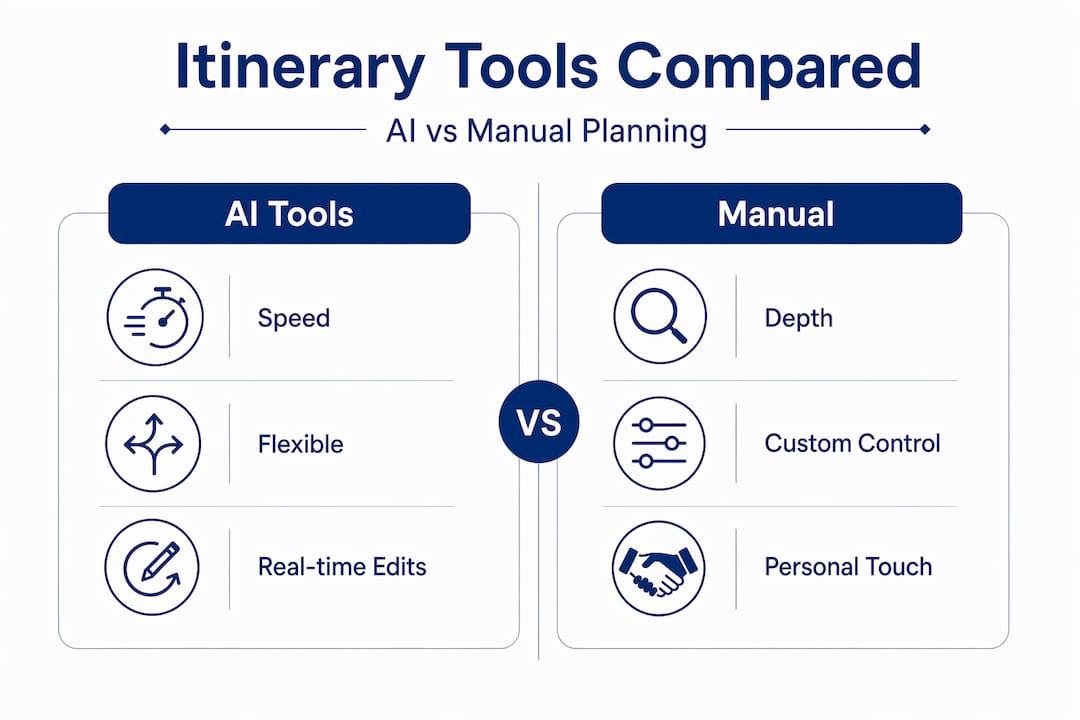
AI planners excel at speed and dynamic real-time plan refinements as new data comes in. Manual tools give you depth that AI cannot replicate. Professional planners at agencies like Elitetravelgroup bring 35 years of on-the-ground expertise, which is genuinely different from reading a review on a forum. The question is not which tool is best overall. It is which combination fits your trip.
Pro Tip: For any international trip longer than seven days, consider pairing an AI first draft with at least one consultation with a professional travel planner. The cost savings and logistical insights usually outweigh any planning fees, especially if your route involves multiple cities.
My take on where custom itineraries are headed
I have been around enough travel planning cycles to have a strong opinion here. The travelers who get the most out of their trips are not the ones who research the longest or spend the most. They are the ones who plan intentionally, build flexibility into every day, and verify their plans against reality before they leave home.
What I have seen change significantly is how accessible personalized travel plans have become. A few years ago, a truly customized approach required either deep personal expertise or a professional planner. Today, a hybrid of AI tools and selective expert input puts that level of personalization within reach of almost any traveler.
That said, the biggest mistake I watch people make is treating their itinerary as a finished product. The best trips I have seen built treat the plan as a strong starting point with room to breathe. Over-scheduling is the silent trip killer. You can learn more about how this shapes luxury trip design by thinking through what each day is actually meant to feel like, not just what it contains.
The future of fulfilling travel is personalized. Not because it is trendy, but because it works.
Plan your next trip with Elitetravelgroup
When the stakes are high, whether it is a honeymoon, a milestone birthday, or a trip you have been planning for years, the difference between a good trip and an extraordinary one comes down to the details behind the details.
Elitetravelgroup has spent 35 years building adventure and luxury vacation packages that are designed entirely around the traveler, not around a catalog. No service fees. No generic schedules. Just expert planners who know the destinations, the right hotels, and the experiences worth your time. Elitetravelgroup is available 24/7 and offers a price match guarantee, so you can plan with full confidence. If you are ready to move from scrolling to actually going, explore Europe vacation packages built with real expertise behind every day.
FAQ
What is the difference between a standard and a customized itinerary?
A standard itinerary follows a fixed schedule built for group efficiency, while a customized itinerary is designed around your specific preferences, pace, and budget. The personalized version consistently delivers higher satisfaction and more authentic experiences.
How long does it take to create a custom travel itinerary?
A well-built custom itinerary typically requires 3 to 5 hours of focused planning, though complex multi-destination trips may take longer. Using AI tools for a first draft significantly reduces that time investment.
What should I include in a custom itinerary?
A solid custom itinerary includes daily anchor activities, accommodation details, transportation logistics, dining reservations, and built-in buffer time. Verifying opening hours and booking requirements before finalizing is critical.
Are customized itineraries only for luxury travelers?
No. AI-powered planning tools and DIY research methods make personalized travel plans accessible at every budget level. Customization is about relevance to your preferences, not necessarily higher spending.
When should I hire a professional travel planner instead of going DIY?
Consider a professional planner for complex multi-country trips, high-stakes occasions like honeymoons or destination weddings, or whenever logistical expertise could meaningfully improve the trip. Agencies like Elitetravelgroup charge no service fees, which removes the main cost barrier.
