




TL;DR:
- A bespoke itinerary is a travel plan created from scratch around a traveler’s unique preferences and pace. It offers highly personalized experiences, exclusive access, and flexible timing, unlike standard package tours. This genuine customization leads to more authentic, memorable trips aligned completely with individual interests and emotional goals.
A bespoke itinerary is a travel plan designed from scratch around one traveler’s specific preferences, interests, and pace. No fixed templates. No borrowed routes. Every destination, activity, and booking reflects who you are and what you want from travel. This is the industry’s standard term for what many travelers now call a customized travel itinerary or personalized itinerary, and the distinction from a standard package tour runs much deeper than most people realize.
What is a bespoke itinerary, and how does it differ from a package tour?
A bespoke itinerary is a travel plan designed around an individual traveler’s specific preferences, interests, and pace, distinct from mass-market standardized schedules. The word “bespoke” comes from British tailoring, where a suit is cut for one body and no other. Applied to travel, it means your trip is built the same way.

A standard package tour works in reverse. The operator builds a fixed route, locks in hotels and activities, then sells the same experience to hundreds of travelers. You adapt to the trip. With a bespoke plan, the trip adapts to you.
The difference shows up in the details. A package tour to Tuscany might include a group wine tasting at a well-known estate, a bus transfer to Florence, and a fixed hotel. A bespoke version of the same region might open with a private lesson from a winemaker whose family has farmed the same vineyard for six generations, followed by a market visit with a local chef, and a stay at a restored farmhouse that never appears on booking engines. The route, timing, and every inclusion reflect your specific definition of a great trip.
True bespoke travel involves deep, intentional customization beyond superficial changes like date swaps or hotel tier upgrades. Travel advisor Mike Belobradic notes that misusing the word “bespoke” as a marketing label diminishes credibility and fails discerning travelers who expect genuine personalization.
Bespoke vs. standard travel: a direct comparison
| Feature | Standard package tour | Bespoke itinerary |
|---|---|---|
| Planning starting point | Fixed template | Blank slate |
| Route flexibility | Set in advance | Adjusted to your pace |
| Activity selection | Pre-chosen for groups | Chosen for your interests |
| Hotel selection | Contracted inventory | Matched to your style |
| Timing and pacing | Group schedule | Your personal rhythm |
| Customization depth | Surface level | Concept and detail level |
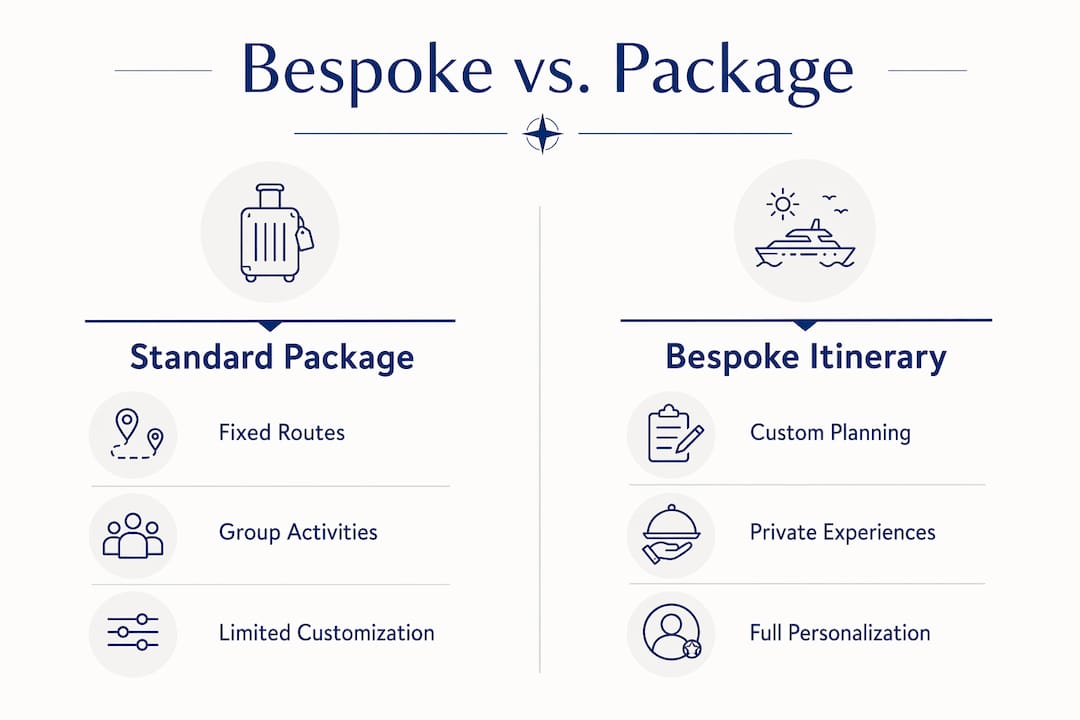
The table above shows why travelers who have experienced a genuine bespoke plan rarely return to packages. The gap is not about price. It is about fit.
What are the primary benefits of bespoke travel?
Tailored experiences aligned with personal interests, pace, and style lead to higher satisfaction and more memorable travel outcomes. That is the core benefit, and everything else flows from it.
Bespoke travel plans deliver several advantages that package tours structurally cannot match:
- Authentic experiences. You access venues, people, and moments that mass-market operators never include. A private cooking class in a Kyoto home, a dawn visit to Angkor Wat before the crowds arrive, or a guided walk through Rome’s Trastevere neighborhood with a local historian.
- Personal pacing. You decide how many days to spend in one place. If you fall in love with a coastal village in Croatia, you stay another night. No bus waits for you.
- Milestone alignment. A bespoke plan can be built around a specific theme: culinary mastery, wellness and restoration, family legacy, or a honeymoon that reflects both partners’ personalities rather than a generic romantic package.
- Exclusive access. Travel experts use local connections and industry knowledge to deliver experiences not available through generic booking engines.
- Genuine peace of mind. When every detail is planned for you specifically, you spend your trip experiencing it rather than managing it.
Pro Tip: Ask your travel advisor to name one experience on your itinerary that is not available to the general public. If they cannot answer that question, the plan is not truly bespoke.
For hospitality hosts, the benefits extend further. Providing personalized itinerary support tailored to guest interests boosts reviews and repeat bookings. The time invested in genuine customization pays back through loyalty and referrals.
What elements make up a truly bespoke itinerary?
The fundamental distinction of a bespoke itinerary lies in starting the planning process with no fixed template. Every route, booking, and timing is built for one traveler’s rhythms and preferences, not adapted from a standard package.
Building a genuine bespoke plan requires five core elements:
- Know Your Client (KYC) depth. A skilled travel designer asks about your emotional goals, not just your destination wish list. Do you want to feel challenged, restored, inspired, or connected? The answers shape every decision that follows.
- Concept-level customization. Genuine bespoke design works from themes such as healing, legacy, culinary mastery, thrill-seeking, or quiet luxury. The theme becomes the filter for every inclusion.
- Invisible luxury. A bespoke itinerary typically includes thoughtful details that enhance the experience without announcing themselves. Your favorite wine waiting in the room. A transfer timed perfectly to avoid a city’s rush hour. These touches make luxury felt rather than seen.
- Purposeful curation. Saying yes to everything is not bespoke. A skilled designer says no to activities that do not serve your specific goals, even if those activities are popular or impressive on paper.
- Expert local connections. The best bespoke plans rely on vetted on-the-ground partners who open doors that no booking platform can. A family-run trattoria that does not take reservations. A private museum access arranged through a curator relationship.
Pro Tip: When evaluating a travel advisor, ask how they would describe your trip’s central theme in one sentence. A designer who cannot articulate a theme is building a list, not a bespoke itinerary.
The difference between a good trip and an unforgettable one often comes down to this level of intentionality. Generic inclusions fill a schedule. Purposeful ones create memories.
How can you create or commission a bespoke itinerary?
Effective bespoke travel planning requires ongoing adjustments and deep communication rather than a one-size-fits-all package. Whether you plan independently or work with an advisor, the process follows a clear path.
- Define your travel identity. Write down your three most memorable travel experiences and identify what made each one exceptional. The pattern reveals your true travel style.
- Set a clear theme or emotional goal. “I want to see Italy” is a destination. “I want to understand how Italian food culture connects to family and place” is a theme. Themes produce bespoke itineraries. Destinations produce packages.
- Choose the right advisor. Look for a travel designer who asks more questions than they answer in your first conversation. Advisors who immediately pitch destinations or hotels are selling inventory, not designing for you.
- Engage in iterative refinement. Clients collaborating with designers often go through multiple rounds of adjustment to ensure the itinerary fits personal goals and logistics. Expect this process and welcome it.
- Verify authenticity. Ask your advisor to explain why each inclusion is on the plan. If the answer is “it’s popular” or “most clients love it,” that inclusion may not belong on your bespoke itinerary.
When self-planning, several practical steps protect the quality of your customized travel itinerary:
- Research bespoke itinerary examples across different travel styles to identify what resonates with you.
- Build in unscheduled time. A bespoke plan is not a packed schedule. Space for spontaneity is itself a design choice.
- Prioritize depth over breadth. Three days in one region done well outperforms seven cities in seven days every time.
- Confirm that your advisor has direct relationships with on-the-ground partners, not just contracts with regional operators.
The goal is a plan that feels like it could only have been made for you. If someone else could take the same trip without changing a single detail, it is not bespoke.
Key Takeaways
A bespoke itinerary delivers genuine value only when it starts from a blank slate, built around your specific identity, theme, and emotional goals rather than adapted from a standard template.
| Point | Details |
|---|---|
| Definition of bespoke | A travel plan built from scratch for one traveler’s preferences, pace, and goals. |
| Core distinction | Bespoke starts with no template; packages adapt a fixed route to fit you. |
| Primary benefit | Tailored experiences produce higher satisfaction and more memorable outcomes. |
| Key design element | Invisible luxury and purposeful curation separate genuine bespoke from marketing claims. |
| Planning approach | Iterative collaboration with a skilled advisor produces the best bespoke results. |
Why “bespoke” is the most misused word in travel right now
The travel industry has a credibility problem with the word “bespoke.” I have watched it get applied to trips that are nothing more than a standard European circuit with a different hotel swapped in. Travelers pay a premium expecting genuine personalization and receive a repackaged tour with their name on the cover page.
The misuse matters because it trains travelers to expect less. When “bespoke” becomes synonymous with “slightly adjusted package,” discerning travelers stop asking for real customization. They assume it does not exist or is not worth the effort.
What I have seen work consistently is the opposite approach. The best travel designers I know spend more time in the discovery phase than in the booking phase. They ask uncomfortable questions: What do you want to feel on the last night of this trip? What would make you consider this a failure? Those questions produce plans that no algorithm and no catalog can replicate.
Technology has a role here, but it is supporting, not leading. AI tools can surface options and flag logistics conflicts. They cannot replace the judgment of an advisor who has stood in a Moroccan riad at sunrise and knows exactly which traveler would be moved by that moment.
My honest view: the travelers who get the most from bespoke travel are the ones who invest in the discovery process. The more honestly you can describe what you want to feel, the better the plan. Vague inputs produce vague trips. Specific, personal inputs produce experiences you will describe for years.
How Elitetravelgroup designs your bespoke travel plan
Elitetravelgroup has spent 35 years building the kind of local relationships and destination knowledge that make genuine bespoke travel possible. Every plan starts with a real conversation, not a form.
From bespoke European itineraries to custom adventure travel across multiple continents, Elitetravelgroup designs trips around your specific goals, not a catalog of popular options. The agency charges no service fees, offers a price match guarantee, and is available 24/7. You work directly with an expert who knows the destinations, the right partners, and the timing that turns a good trip into one you will never forget. Reach out to start the conversation.
FAQ
What is a bespoke itinerary in simple terms?
A bespoke itinerary is a travel plan built specifically for one traveler or group, with every destination, activity, and booking chosen to match their personal preferences and goals. Nothing is borrowed from a standard template.
How is a bespoke itinerary different from a customized itinerary?
The terms are often used interchangeably, but “bespoke” implies a higher standard: the plan starts from a blank slate rather than modifying an existing package. True bespoke design begins with the traveler’s identity, not a destination catalog.
What does a bespoke itinerary typically include?
A genuine bespoke itinerary includes personalized routing, hand-selected accommodations, exclusive or private activities, and thoughtful logistical details matched to the traveler’s pace and style. It also includes invisible luxury touches felt throughout the trip rather than listed on a brochure.
How do I know if a travel advisor is offering real bespoke planning?
Ask them to describe your trip’s central theme in one sentence and name one experience on the itinerary that is not available to the general public. Advisors who cannot answer both questions are selling inventory, not designing a bespoke plan.
Is a bespoke itinerary worth the extra effort?
Yes, for travelers who value depth, authenticity, and personal alignment over convenience. The planning investment pays back in experiences that match exactly who you are and what you want from travel.
