




Seamless travel is a synchronized, door-to-door journey in which digital identity, biometrics, and connected systems remove repetitive document checks and manual handoffs at every stage. The OECD defines it as “the provision of a smooth, efficient, safe, secure and enjoyable travel experience from a traveler’s origin to a destination, within the destination, and back again.” For luxury travelers, that definition has a second layer: every transition, from curbside to cabin to villa, is anticipated, coordinated, and quietly managed before you ever notice a potential friction point.
The core elements that make a journey truly integrated:
- Door-to-door coordination — ground transfers, check-in, boarding, baggage, and arrival logistics linked as one continuous flow
- Digital identity and biometrics — one-time enrollment via programs like Global Entry or CLEAR, then facial recognition replaces repeated document presentations
- IATA One ID — the industry standard enabling a single verifiable passenger identity across participating airlines and airports
- API-connected bookings — airlines, hotels, and transfer operators sharing real-time data so changes cascade automatically
- Proactive disruption management — AI monitoring that flags delays and triggers rebooking before you land
- On-the-ground partners and 24/7 concierge — local teams and a live advisor available at any hour, anywhere
Elite Travel Management Group, Inc. builds every itinerary around these components, drawing on decades of supplier relationships and a global partner network to make the coordination invisible to the client.
Table of Contents
- What does a truly integrated trip look like in practice?
- Which systems and partners actually make it work?
- Why does it matter beyond personal convenience?
- How does a concierge planner actually deliver this?
- What affects price and lead time?
- How do you choose the right travel partner for this?
- Key Takeaways
- The part most travelers overlook
- Elitetravelgroup puts this into practice for you
- Useful sources and further reading
What does a truly integrated trip look like in practice?
Picture this: you clear customs at JFK using a biometric scan enrolled through Global Entry. Your bags are already tagged to transfer automatically to your connecting flight. A private car is waiting at the arrivals curb, its driver updated in real time by your concierge. You never touch a paper document.
Now add a disruption. Your first flight is delayed. Before you’ve refreshed your boarding app, your concierge has already rebooked the connection, alerted the hotel to push your check-in by two hours, and texted the villa chef to adjust dinner timing. You find out about the delay the same moment you find out it’s already handled.
The real measure of a seamless trip isn’t how smooth things go when everything works. It’s how invisible the recovery is when something doesn’t. A concierge who has designed the handovers in advance can absorb a disruption in minutes rather than hours.
For a bespoke honeymoon or milestone anniversary, the planning goes one step further. Elitetravelgroup builds in deliberate unscheduled time — an afternoon with no transfers, no reservations, no agenda — so that the structure of the trip creates space for spontaneity rather than eliminating it. That balance between precision and breathing room is what separates a truly luxury bespoke itinerary from a well-organized checklist.

Which systems and partners actually make it work?
The technology behind a frictionless journey is more layered than most travelers realize. Three categories carry most of the weight.
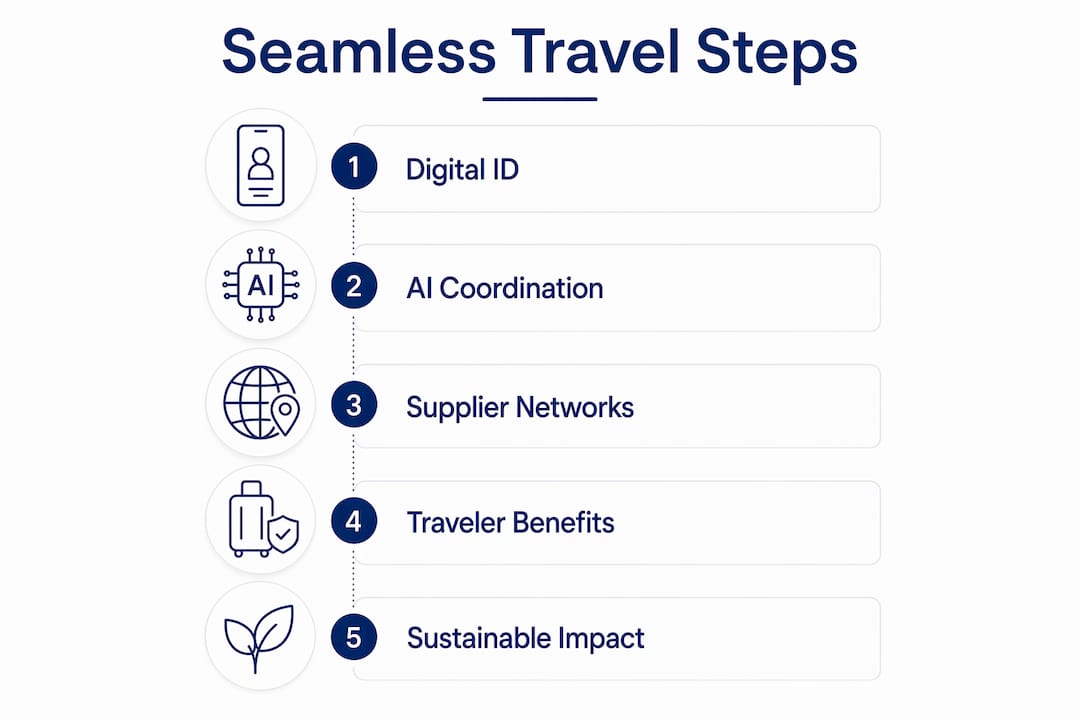
Digital identity and biometrics. IATA One ID is the industry’s push toward a single, cryptographically verified passenger identity that travels with you across airlines and airports. Enroll once, and facial recognition handles boarding, lounge access, and hotel check-in without a passport in hand. EU research confirms that document-free checkpoints reduce friction by aligning regulations, industry practices, and technology across borders.
AI orchestration and supplier APIs. Modern platforms monitor flights, weather, and ground logistics simultaneously, triggering rebooking and transfer updates automatically. Credentials travel in encrypted digital wallets; baggage messaging syncs across carriers. The result is a system where a missed connection doesn’t cascade into a lost day.
Supplier and partner networks. Technology only works when the humans behind it are integrated too. Airlines, private aviation operators, hotels, local transfer companies, and yacht operators must share data securely and operate from the same playbook. For crewed yacht charters, for instance, crewed service coordination is precisely what enables a smooth embarkation and real-time itinerary flexibility.
| Component | What it does | Traveler benefit |
|---|---|---|
| IATA One ID / biometrics | Single verifiable identity across airlines and airports | No repeated document checks |
| Encrypted digital wallet | Stores credentials cryptographically | Secure, contactless access |
| AI orchestration platform | Monitors and rebooks proactively | Disruptions resolved before you notice |
| Supplier API integration | Links airlines, hotels, and transfers in real time | Changes cascade automatically |
| On-the-ground partner network | Local teams execute logistics at destination | Human backup when tech isn’t enough |
Why does it matter beyond personal convenience?
The personal benefits are obvious: less time in queues, fewer forms, more energy for the actual experience. But the case for integrated travel extends well past individual comfort.
The OECD links seamless travel directly to roughly half of the United Nations Sustainable Development Goals, framing efficient movement as a policy tool that distributes tourism revenue to a wider range of destinations and communities, not just the most-visited hubs.
For the traveler, the practical gains compound quickly. Time saved at checkpoints is time spent at the destination. Reduced cognitive load — no scrambling for documents, no uncertainty about transfers — means you arrive calmer and more present. Security is stronger too: biometric verification is harder to spoof than a paper passport, and encrypted credential wallets reduce identity-theft exposure.
How does a concierge planner actually deliver this?
Turning the concept into a real trip requires a specific workflow. Here’s how Elitetravelgroup approaches it:
- Client intake — capture passport details, trusted traveler numbers (Global Entry, TSA PreCheck, CLEAR), dietary needs, medical considerations, and preferred communication style
- Identity enrollment guidance — advise on biometric programs available at departure airports and destination entry points
- Supplier confirmation — lock in airlines, hotels, private transfers, and on-the-ground partners with data-sharing agreements in place
- Pre-trip logistics brief — send a single, consolidated document covering every handoff: who meets you, where, with what credentials
- Real-time monitoring — 24/7 watch on flights, weather, and ground conditions with a live advisor ready to act
The planner’s checklist behind that workflow includes:
- Vetting every supplier for data-security practices and disruption-response capability
- Building a disruption playbook for each itinerary (alternate flights, backup hotels, emergency contacts)
- Scheduling deliberate white space so the trip has room to breathe
- Confirming baggage-transfer agreements across all carriers in the routing
Elitetravelgroup’s 35 years of agency experience and its global on-the-ground partner network compress the time it takes to vet suppliers and negotiate data-sharing arrangements. That institutional knowledge is the difference between a plan that looks good on paper and one that holds up when a flight cancels at midnight.
Pro Tip: Share your Global Entry or CLEAR membership numbers at the very first consultation. Your planner can build the entire identity-verification chain around those credentials, cutting checkpoint time at every stage of the trip.
What affects price and lead time?
Cost and timing vary significantly based on what “integrated” actually means for your specific trip.
The single biggest mistake luxury travelers make is booking too late. Private aviation, yacht charters, and exclusive villa blocks often require six to twelve months of lead time — and the best suppliers are gone well before that window closes.
Primary cost drivers include the level of supplier integration required, private ground transfers and air charters, bespoke on-the-ground programming, and premium airport services like meet-and-assist or private terminal access. Biometric enrollment programs like Global Entry have their own federal application timelines, so those need to start early.
A rough planning horizon:
- Private aviation or yacht charter: 6–12 months minimum for peak seasons
- Major events or destination weddings: 12–18 months for venue and accommodation blocks
- Standard luxury itinerary with concierge coordination: 3–6 months for full integration
- Short-notice VIP travel: possible with an established planner and pre-vetted supplier network, but at a premium
Longer lead times generally reduce both cost and complexity. Suppliers offer better availability and pricing when booked early, and your planner has more time to negotiate data-sharing arrangements and build the disruption playbook properly. For luxury travel planning that involves multiple countries or complex entry requirements, that runway matters enormously.
How do you choose the right travel partner for this?
Not every agency can deliver genuine end-to-end coordination. The gap between a planner who says “we handle everything” and one who actually does is wide.
Evaluation criteria worth pressing on:
- Documented supplier integrations (not just preferred-vendor lists, but actual data-sharing relationships)
- Verified 24/7 operations with a live advisor, not just an emergency voicemail
- A clear, written privacy and data-handling policy for biometric and identity information
- An on-the-ground partner network at your specific destinations
- A documented disruption workflow — ask to see it
Red flags to watch for: vague answers about how they handle a flight cancellation at 2 AM, no written data policy, or an inability to explain how they coordinate baggage transfer across carriers.
Five questions worth asking any prospective planner:
- How do you handle a major disruption — flight cancellation or medical emergency — outside business hours?
- Which specific suppliers at my destination do you have active relationships with?
- How do you store and protect my passport, biometric, and identity data?
- Can you coordinate biometric enrollment or trusted-traveler program guidance for my departure airport?
- What does your disruption playbook look like for this specific routing?
Key Takeaways
Seamless travel is a door-to-door, technology-enabled journey where every handoff is designed in advance, monitored in real time, and managed by a concierge with the supplier relationships to act fast when plans change.
| Point | Details |
|---|---|
| Core definition | Seamless travel eliminates repeated document checks through digital identity, biometrics, and connected supplier systems. |
| OECD policy value | The OECD links seamless travel to roughly half of the UN Sustainable Development Goals, framing it as a tool for distributing tourism benefits widely. |
| Lead time matters | Private aviation and yacht charters require 6–12 months of lead time; standard luxury itineraries need 3–6 months for full coordination. |
| Planner selection | Verify 24/7 live support, documented disruption workflows, and written data-privacy policies before committing to any agency. |
| Elitetravelgroup | With 35 years of experience, 24/7 support, a price match guarantee, and a global partner network, Elitetravelgroup operationalizes every element above for VIP travelers. |
The part most travelers overlook
Here’s what I find genuinely underappreciated about the integrated travel conversation: most people focus on the technology — the biometrics, the AI rebooking, the digital wallets — and miss the fact that the hardest part is designing the handovers between humans.
A facial scan at boarding is easy. Getting the private transfer driver, the hotel duty manager, and the yacht captain to operate from the same real-time information feed requires relationships built over years, not an app. The industry term for this is “owning the seams” — deliberately shaping the moments where one provider hands off to the next. Those seams are where trips fall apart, and they’re also where a great concierge earns every dollar.
The other thing worth saying plainly: white space is not a luxury add-on. It’s a structural requirement for a high-quality trip. A perfectly coordinated itinerary with no breathing room is just a very expensive schedule. The best VIP vacation planning builds in unscheduled time intentionally, because the point of removing friction is to give you back your attention — not to fill it with the next activity.
Elitetravelgroup puts this into practice for you
Thirty-five years of bespoke itinerary work means Elitetravelgroup has the supplier relationships, disruption playbooks, and 24/7 operations already in place. You don’t pay service fees. You get a price match guarantee. And you get a live advisor at any hour, not a chatbot.
Services that directly enable a fully coordinated trip include concierge enrollment guidance for Global Entry and CLEAR, private transfer and air charter coordination, real-time flight monitoring, and on-the-ground partner activation at your destination. Whether you’re planning a luxury Europe vacation or a high-complexity adventure travel package, the first step is a single conversation about your dates, destinations, and priorities.
Contact Elitetravelgroup to start your planning consultation — and bring your trusted traveler numbers. The sooner those are in the file, the faster the coordination chain comes together.
Useful sources and further reading
For readers who want to go deeper on policy, technology, or planning frameworks:
- OECD Safe and Seamless Travel Report — the primary policy document defining seamless travel and its links to the Sustainable Development Goals; use this for policy context and the official working definition
- Enabling Seamless Travel to the European Union (eu-LISA) — technical and regulatory overview of document-free checkpoints and cross-border alignment; best for understanding the regulatory framework
- Biometrics and Digital Identity: Seamless Passenger Flow in 2026 — practical explainer on biometric boarding, digital wallets, and IATA One ID; useful for understanding the technology layer
- Inside the Future of Seamless Travel Systems — covers AI orchestration, encrypted credentials, and the “own the seams” design philosophy
- Elitetravelgroup VIP Vacation Guide — practical planning resource for readers ready to engage a concierge and design a fully coordinated luxury trip
