




TL;DR:
- The modern honeymoon vocabulary offers useful shorthand for different trip styles based on time, budget, and desires. Couples should choose the label that matches their actual plans and use it to communicate clearly, rather than letting the terminology dictate their experience. Expert planners and travel advisors can make a significant difference, especially for complex, multi-stop, or premium trips that require early bookings and vendor relationships.
Modern honeymoon vocabulary has expanded well beyond “the trip after the wedding.” Here are the labels couples and travel advisors actually use, with a one-line meaning for each so you can pick yours right now.
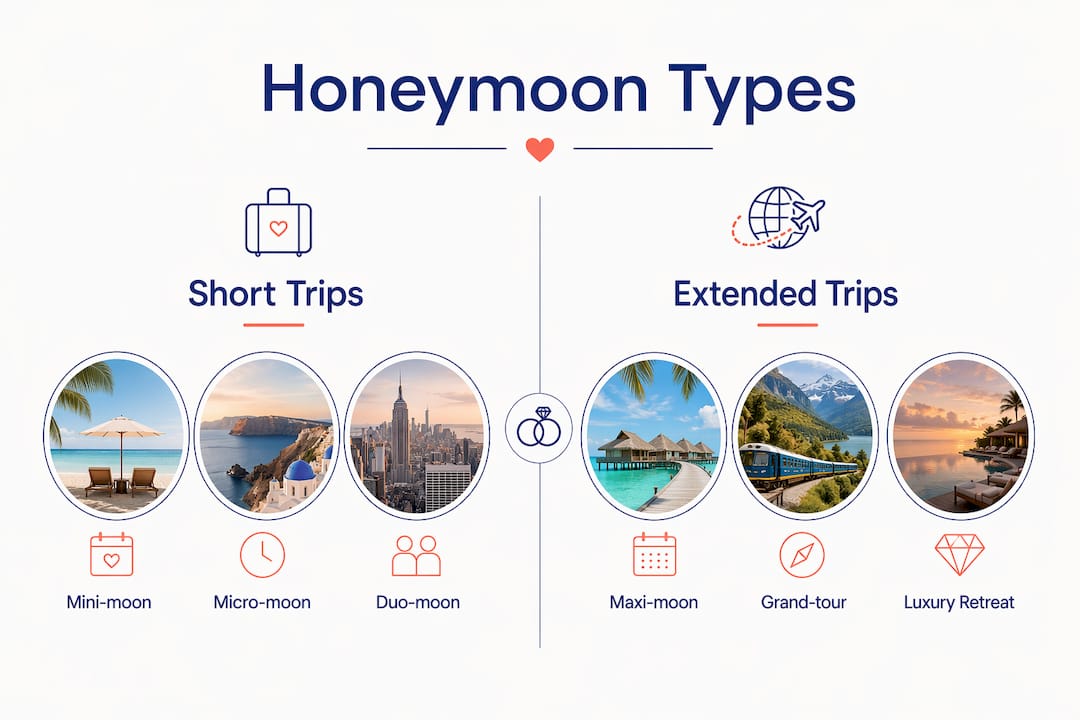
- Mini-moon: A short trip (2–4 days) taken right after the wedding, usually domestic or close to home.
- Micro-moon: Even shorter than a mini-moon, often just one overnight, sometimes within driving distance.
- Maxi-moon: An extended luxury trip of two weeks or more, usually to a far-flung destination.
- Duo-moon: Two separate honeymoon trips taken at different times, often a mini-moon now and a bigger trip later.
- Babymoon: A pre-baby getaway for expectant couples, not technically a honeymoon but frequently confused with one.
- Latermoon / Earlymoon: A delayed honeymoon taken months after the wedding (latermoon) or a trip taken before the wedding (earlymoon).
- Destination honeymoon: A trip where the location itself is the centerpiece, often requiring flights and advance planning.
- Staycation honeymoon: Celebrating at home or at a local hotel, skipping travel entirely.
- Second honeymoon: A romantic trip taken by an established couple to reconnect, not necessarily after a wedding.
- Group honeymoon (buddymoon): The couple travels with close friends or family, as Thrillist’s travel glossary notes, a trend that is growing especially among couples who want to share the celebration.
The Knot defines a honeymoon as the newlywed trip to celebrate marriage, but the modern reality is that couples increasingly split, delay, or multiply that trip to fit real-life constraints.
Table of Contents
- Honeymoon travel terminology explained: the full glossary
- How do you pick the right honeymoon type for your situation?
- What does each honeymoon type actually cost and how long does it take?
- Practical etiquette: telling hotels, registries, and pacing your trip
- When does a luxury travel advisor actually make a difference?
- How honeymoon terminology varies across cultures and regions
- How to communicate honeymoon preferences clearly to agents and family
- Key Takeaways
- The labels are useful, but don’t let them run the trip
- Elitetravelgroup: concierge-level honeymoon planning, no service fees
- Useful sources for further reading
Honeymoon travel terminology explained: the full glossary
Each term below includes a typical length, who it fits, and one concrete trip idea.
| Term | Typical Length | Best For | Example Trip |
|---|---|---|---|
| Mini-moon | 2–4 days | Budget-conscious couples, busy schedules | Napa Valley wine weekend |
| Micro-moon | 1–2 days | Couples with almost no time off | Overnight at a city boutique hotel |
| Maxi-moon | 14–21+ days | Couples with flexible schedules and larger budgets | Maldives + Sri Lanka circuit |
| Duo-moon | Two separate trips | Couples who want both immediacy and a big trip | Weekend in Asheville, then Tuscany in spring |
| Babymoon | 3–7 days | Expectant couples in the second trimester | Beach resort in the Caribbean |
| Latermoon | 7–14 days | Couples who delayed for off-season pricing or time off | Japan in October |
| Earlymoon | 5–10 days | Couples who want to travel before wedding stress peaks | Portugal in April |
| Destination honeymoon | 7–14 days | Couples for whom the place is the whole point | Safari in Kenya |
| Staycation honeymoon | 2–5 days | Couples who are exhausted or cash-strapped | Spa hotel close to home |
| Second honeymoon | 5–10 days | Established couples marking an anniversary | Amalfi Coast villa rental |
| Group honeymoon (buddymoon) | 5–7 days | Social couples who want to celebrate with their people | All-inclusive in Mexico with 10 friends |
Common confusions to clear up fast:
- Mini-moon vs. micro-moon: Length is the only real difference. A micro-moon is one or two nights; a mini-moon stretches to four. Both are short by design.
- Duo-moon vs. second honeymoon: A duo-moon is two trips by newlyweds as part of one honeymoon plan. A second honeymoon is a separate romantic trip taken years later by an established couple.
- Babymoon vs. latermoon: A babymoon is pregnancy-specific. A latermoon is simply a delayed honeymoon, no baby required.
Pro Tip: For maxi-moons involving overwater villas or top safari camps, start planning 12 months in advance for the best availability. Prime inventory in the Maldives and Bora Bora sells out far ahead of usual planning windows, especially for peak dates.
How do you pick the right honeymoon type for your situation?
Four questions cut through the noise fast.
1. How much time off do you actually have?
Four days or fewer points to a mini-moon or micro-moon. One to two weeks opens up a destination honeymoon or latermoon. Three weeks or more is maxi-moon territory.
2. What is your realistic budget ceiling?
Set the ceiling first, then choose destinations that fit it. Domestic staycations and mini-moons cost the least. Long-haul destination honeymoons and maxi-moons cost considerably more, per Travo’s honeymoon cost guidance. Choosing a dream destination and then cutting the budget is the most common planning mistake.

3. What pace do you want?
Rest-focused couples lean toward beach resorts and staycations. Activity-driven couples gravitate toward destination honeymoons with a mix of excursions and downtime. A bespoke itinerary can build both into one trip.

4. Do you want one trip or two?
Post-pandemic travel patterns favor the duo-moon approach: a short local trip right after the wedding, then a bigger trip once schedules and budgets align. Tinggly’s planning guide notes this multi-moon pattern has grown steadily since 2022.
Quick decision checklist:
- Days of PTO available: ___
- Total budget ceiling: $___
- Preferred vibe (rest / adventure / culture / mix): ___
- Passport valid 6+ months beyond return date? Yes / No
- Prefer one trip or two? ___
What does each honeymoon type actually cost and how long does it take?
According to Tinggly, most U.S. couples keep honeymoons to one week or less. Timing patterns fall into three buckets: leave immediately after the wedding, take a mini-moon now and a latermoon later, or delay the whole trip by months for off-season pricing.
Typical length by type (quick reference):
- Micro-moon: 1–2 nights
- Mini-moon: 2–4 days
- Staycation honeymoon: 2–5 days
- Babymoon: 3–7 days
- Destination honeymoon: 7–14 days
- Latermoon / earlymoon: 7–14 days
- Second honeymoon: 5–10 days
- Maxi-moon: 14–21+ days
Timing tip: Airlines typically open booking roughly 330 days in advance. For premium cabin seats on long-haul routes, that early window matters. US passport renewal takes 6–8 weeks for routine processing. If your passport is expiring or your name is changing, handle that before booking any international flights.
For luxury honeymoon booking, the optimal sequence is: passport first, flights at the 6-month mark, accommodation immediately after flights are locked, and activities last.
Practical etiquette: telling hotels, registries, and pacing your trip
Telling the hotel: Email the property directly after booking, mention your honeymoon dates, and keep the tone warm but brief. Polite notification increases the chance of small complimentary touches, but Strictly Weddings notes that true room upgrades usually require partner program relationships, not just a note in the file. Calling closer to arrival to reconfirm is worth the five minutes.
Registries and gifting: Experience-based registries through platforms like Honeyfund, Zola, or The Knot’s cash fund tool let guests contribute to flights, dinners, or spa treatments. Among couples surveyed by The Knot’s 2022 Real Weddings Study, 23% created a honeymoon fund as part of their registry.
Pacing: Structure the trip in three acts: one to two days of rest on arrival, a middle stretch of exploration and experiences, and a wind-down day before flying home. The honeymoon phase in travel is characterized by peak excitement on arrival, which means couples who over-schedule day one often burn out by day three.
Pro Tip: Schedule at least one full buffer day between the wedding and international departure. Couples who fly out the morning after the wedding almost universally say they wish they had waited.
When does a luxury travel advisor actually make a difference?
“The question you want to ask is, ‘What kind of a rhythm do we want for our honeymoon?’ Do you want it to be jam-packed? Or maybe this is more about us?” — Craig Zapatka, co-founder of Elsewhere, via The Knot
That framing matters because the biggest planning mistake is choosing a destination for its social media appeal rather than for the couple’s actual rhythm. A luxury advisor’s value is most concrete in three scenarios:
- Scarce inventory: Overwater villas in the Maldives and top-tier safari tents in Kenya book out 9–12 months ahead. An advisor with established vendor relationships can access waitlists and alternative properties that don’t appear in public searches.
- Multi-stop routing: A maxi-moon through Southeast Asia or a duo-moon with a European latermoon involves flight sequencing, visa timing, and transfer logistics that compound quickly.
- Upgrade access: Established agency relationships with programs like Virtuoso or Four Seasons Preferred Partner materially increase the likelihood of meaningful amenities, not just a “honeymoon” note in a booking file.
DIY works fine for a simple all-inclusive or a domestic staycation honeymoon. For anything involving premium inventory, complex routing, or a once-in-a-lifetime destination, a consultation is worth scheduling early.
How honeymoon terminology varies across cultures and regions
The word “honeymoon” itself traces back to Northern European traditions, as Wikipedia’s honeymoon entry documents, but the vocabulary around it shifts considerably by culture. In Japan, a post-wedding trip is called shinkon ryoko (新婚旅行), literally “newlywed travel,” with no equivalent for mini-moon or duo-moon in common usage. French couples use voyage de noces, a phrase that carries a formal, ceremonial weight that “mini-moon” simply does not. In South Asian wedding culture, the honeymoon is often delayed by weeks due to post-wedding family ceremonies, making the latermoon pattern the default rather than a trend. Scandinavian couples frequently skip the immediate post-wedding trip entirely, treating a longer summer vacation as the honeymoon equivalent. The English-language labels (mini-moon, babymoon, buddymoon) are largely a product of U.S. and UK wedding media and travel marketing, and they don’t map cleanly onto every cultural context. When communicating with international hotels or vendors, using plain descriptive language (“we are newlyweds celebrating our wedding”) travels better than niche terminology.
How to communicate honeymoon preferences clearly to agents and family
With a travel advisor, specificity beats enthusiasm. Instead of “we want something romantic,” say: “We want a beach destination, maximum two flights, seven nights, with at least two private dining experiences and no more than one excursion day.” That gives a planner something to work with. Share your budget ceiling upfront. Advisors can’t match a trip to a number they don’t know.
With family members contributing to a honeymoon fund, the clearest approach is a short wish list tied to specific experiences: “dinner on the beach in Phuket” or a boat tour excursion rather than a vague “travel fund.” Concrete experiences are easier to gift and more memorable to receive.
For hotels, the most effective communication is a brief pre-arrival email: your names, arrival date, room category, and a single line noting you are celebrating your honeymoon. Follow up by phone two days before check-in. Keep expectations realistic: a note increases recognition, not guaranteed upgrades.
Key Takeaways
Modern honeymoon labels are planning tools, not just social media captions. Pick the one that matches your time, budget, and pace, then act on it.
| Point | Details |
|---|---|
| Match label to time off | Mini-moon fits 2–4 days; maxi-moon needs 14+ days and a larger budget. |
| Set budget ceiling first | Choose destinations that fit your ceiling, not the other way around. |
| Book specialty rooms early | Overwater villas and safari camps are best booked a year in advance for the best selection. |
| Duo-moon is a real strategy | A short local trip now plus a bigger latermoon later suits most busy couples. |
| Elitetravelgroup adds value | For complex routing, premium inventory, or multi-stop honeymoons, Elitetravelgroup’s concierge-level planning and vendor relationships make a measurable difference. |
The labels are useful, but don’t let them run the trip
The proliferation of honeymoon vocabulary is genuinely helpful for one thing: shorthand. Saying “we’re doing a duo-moon” communicates a real plan in two words. That’s useful when talking to a travel advisor, a hotel, or a family member who wants to know what to contribute to your registry.
Where the labels go wrong is when couples choose a trip because of the label rather than using the label to describe a trip they actually want. “Maxi-moon” sounds impressive. So does “destination honeymoon in the Maldives.” But a couple who really just wants to sleep, eat well, and decompress after a year of wedding planning might be genuinely happier at a romantic coastal getaway three hours from home than at an overwater villa they spent six months stressing to afford. The label should describe the trip, not define it. Use the vocabulary to set expectations with vendors, family, and each other. Then let the actual experience be whatever it needs to be.
Elitetravelgroup: concierge-level honeymoon planning, no service fees
For couples who know what kind of trip they want but don’t have 40–60 hours to spend sourcing the right properties, routing the flights, and managing the details, Elitetravelgroup is the direct alternative to doing it yourself. With 35 years of experience and established relationships with top-tier hotels, safari camps, and on-the-ground partners worldwide, the team handles the logistics that matter most: premium inventory access, multi-stop sequencing, and 24/7 support from booking through return.

No service fees. A price match guarantee. And a planning process built around your actual vibe, not a template. Whether you’re planning a luxury European honeymoon or a multi-stop adventure itinerary, start with a consultation at stagingelite.elitetravelgroup.net.
Useful sources for further reading
- The Knot: What Is a Honeymoon? — authoritative definition and documentation of delayed and multi-trip honeymoon patterns.
- The Knot: Honeymoon Planning Timeline — month-by-month booking checklist and budget framework, including the honeymoon fund statistic.
- MyHoneymoonHotel: Complete Planning Guide — 12-month countdown and booking sequence for high-demand rooms.
- Tinggly: How to Plan a Honeymoon — post-pandemic trend data on mini-moon and duo-moon patterns; airline booking window guidance.
- Travo: Complete Honeymoon Planning Guide — U.S. cost bands and budget signposts by trip type.
- Strictly Weddings: How to Plan a Honeymoon — practical etiquette on hotel notification and upgrade expectations.
- Thrillist: Travel Jargon Explained — definitions of buddymoon, familymoon, solomoon, and minimoon from a mainstream travel glossary.
- Paperlust: 12-Month Honeymoon Planning Checklist — passport, visa, and booking sequence details; buffer day guidance.
