




Yes, most couples with more than 15 to 20 out-of-town guests should set up a wedding room block, and for most of them, a courtesy block is the smarter starting point. A courtesy block reserves rooms at a group rate with no financial obligation on your part, while a contracted block locks in deeper discounts and perks but makes you liable for unsold rooms if guests don’t book enough of them. The math only favors a contracted block when you’re confident about pickup, usually because you’ve hosted a similar-sized event before or you know your guest list travels reliably.
Your next move today:
- Contact two or three hotels near your venue and ask about their group rates and block minimums
- Ask directly whether they offer courtesy blocks, since many properties default to pitching contracts
- If the guest list tops 75 rooms or spans multiple cities, loop in a travel advisor before you sign anything
Key Takeaways
A courtesy block protects couples from financial liability while a contracted block trades that safety for deeper discounts, and the right choice depends on pickup confidence, not guest count alone.
| Point | Details |
|---|---|
| Choose courtesy blocks by default | Reserve a contracted block only when you’re confident guests will fill 75% to 90% of it. |
| Size with the divide-by-two rule | Take out-of-town guests, divide by two, and add a small buffer for solo travelers. |
| Cap properties at three | More hotels means more cutoffs and rooming lists than most couples can manage cleanly. |
| Get the attrition formula in writing | Confirm the exact percentage threshold and damages calculation before signing anything. |
| Consider an advisor for complex blocks | Elitetravelgroup manages RFPs, negotiations, and post-event reconciliation for destination weddings. |
Table of Contents
- Do You Actually Need a Hotel Room Block for Your Wedding?
- How Do You Size a Wedding Block and Pick the Right Hotels?
- What Should Be in Your Room Block Contract?
- How Do You Track and Manage Your Room Block?
- How Do You Reconcile and Audit Your Block After the Wedding?
- When Is a Travel Advisor Worth It for Room Blocks?
- What Conventional Room Block Advice Gets Wrong
- Let Elite Travel Handle Your Wedding Room Block
- Sources
Do You Actually Need a Hotel Room Block for Your Wedding?
Not every wedding needs one. If fewer than 15 guests are traveling from out of town, a curated list of two or three hotels with an embedded booking link on your wedding website usually does the job without any contract risk at all. Room blocks earn their complexity when the numbers get real: a destination wedding, a guest list where half your attendees are flying in, or a venue in a town with limited hotel inventory during peak wedding season.
Local weddings tend to be more forgiving because guests have more lodging options and less urgency. Destination weddings flip that: rooms sell out faster, rates spike around local events you might not even know about, and your guests need one obvious, trusted booking path. A rough guideline many planners use is converting your out-of-town guest count directly into a room estimate, since most guests double up as couples or travel companions.
- Under 15 out-of-town guests: skip the block, share a curated hotel list instead
- 15 to 50 out-of-town guests: a small courtesy block at one or two hotels
- 50+ out-of-town guests, or a destination wedding: a formal block, likely contracted, possibly across two properties
Pro Tip: If you’re unsure which category you fall into, count RSVPs first. Guessing at guest travel patterns before invitations go out is the single biggest cause of oversized, wasted blocks.
How Do You Size a Wedding Block and Pick the Right Hotels?
Sizing a block is arithmetic, not guesswork. Start with your out-of-town guest count, divide by two on the assumption that most guests pair up in a room, then add a small buffer for solo travelers and last-minute additions. Some planners instead work from a percentage: 30% to 40% of your out-of-town guest count, which usually lands in a similar range.
- Count confirmed and likely out-of-town guests from your save-the-date responses or early RSVPs.
- Divide that number by two, then add three to five rooms as a buffer.
- Compare the result against 30% to 40% of your total out-of-town count as a sanity check.
- Round down, not up, if the two methods disagree. You can almost always add rooms later; shedding them is harder.
Discounted wedding lodging works better across multiple price points than a single luxury property. Offer a mid-range hotel and a budget-friendly option so guests aren’t priced out, and cap yourself at two, or at most three, properties. A practical ceiling of three hotels exists for a reason: every extra property means a separate cutoff date, a separate rooming list, and more confused guests asking which hotel has availability.
One number to know before you call anyone: hotels commonly set a minimum block size around 10 rooms before they’ll even discuss group rates, and discounts off rack rate typically run 10% to 40%. If your estimated block falls below that minimum, a courtesy arrangement or a simple booking link will serve you better than trying to force a formal contract.
What Should Be in Your Room Block Contract?
This is where couples get burned, almost always because they signed a document without asking what “pickup” actually means. A wedding room block contract needs to spell out inventory, dates, and financial exposure in numbers, not vague language.
The core distinction: a courtesy block carries no penalty if rooms go unsold, while a contracted block sets an attrition threshold, often between 75% and 90% of the block, below which you owe the hotel money for the shortfall. The formula usually looks something like 0.75 times the group rate times the number of unsold rooms, though the exact multiplier and threshold are negotiable. Ask the sales manager to write the formula into the contract in plain numbers, not just a percentage buried in boilerplate.
Wedding room block contract checklist:
- Nightly rate grid for every room type included in the block
- Cutoff date, exact time, and time zone for guest bookings
- Definition of “pickup,” specifically whether it counts booked nights, occupied nights, or paid nights
- Attrition threshold and the exact damages formula if pickup falls short
- A review date, ideally 60 to 90 days out, when you can adjust block size without penalty
- Number of complimentary rooms earned per rooms booked, and how they’re calculated
- Deposit schedule, payment terms, and whether charges route to a master account or individual guests
| Contract Term | What to Confirm |
|---|---|
| Cutoff date | Exact date, time, and time zone guests must book by |
| Attrition threshold | Percentage of block that must sell before penalties apply |
| Review date | Date you can shrink or grow the block without a fee |
| Complimentary rooms | Ratio of free rooms earned per rooms booked |
| Billing structure | Master account versus individual guest payment |
Pro Tip: Never accept a contract that defines “pickup” ambiguously. Push the hotel to specify booked, occupied, or paid nights in writing, since each one changes your liability calculation.
Red flags worth pushing back on: no stated review date, an attrition formula that isn’t written as an actual equation, or a hotel that won’t commit block minimums in the initial rate grid. Any of those should stop you from signing until it’s clarified.
How Do You Track and Manage Your Room Block?
Once the block is live, the job shifts from negotiating to monitoring. Real-time visibility into pickup is what separates a block that quietly resolves itself from one that triggers an unpleasant invoice after the wedding.
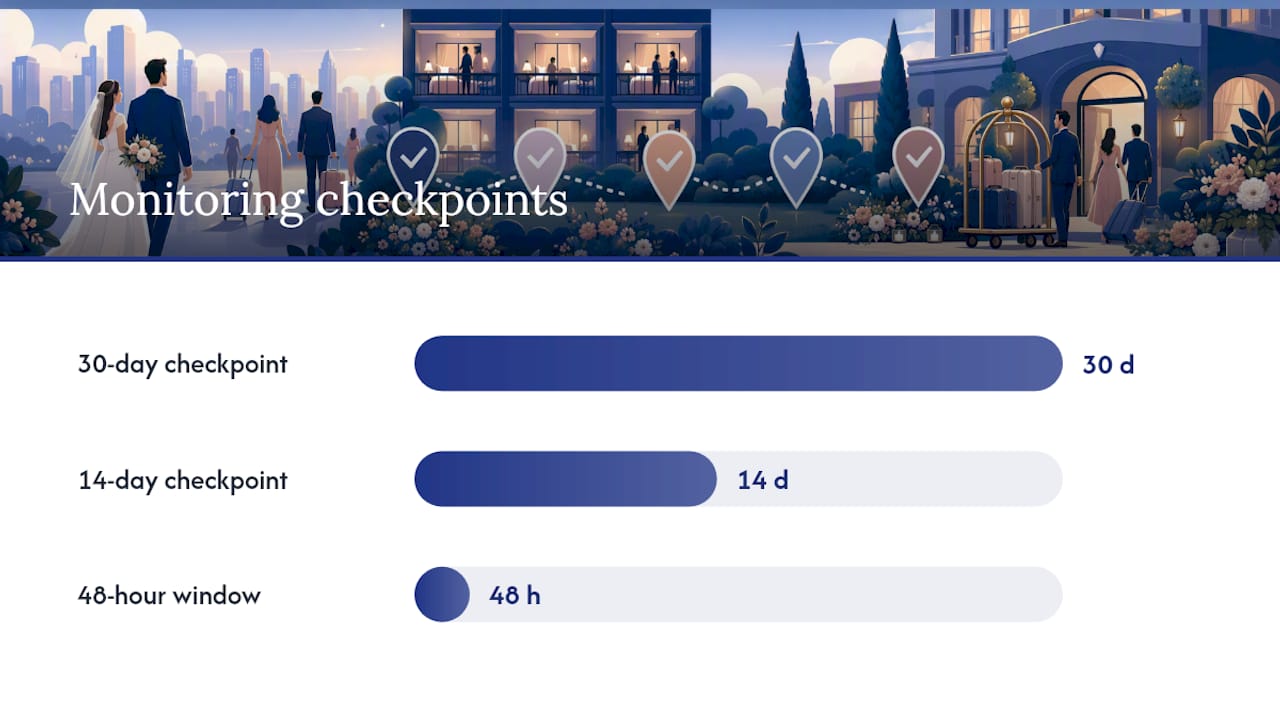
- At 30 days before cutoff, request a pickup report from each hotel and compare booked rooms against your target.
- At 14 days before cutoff, request a second report. This is your last real window to act if numbers are lagging.
- Send a save-the-date style reminder with the hotel name, booking link, and rate as soon as the block opens.
- Send a 30-day reminder that repeats the cutoff date and flags that rooms may sell out or revert to standard rates after that point.
- Send a final 14-day reminder emphasizing urgency, especially if pickup is below 70% of your target.
The first 48 hours after each reminder tends to reveal how the rest of the window will go, so treat a quiet response in that window as an early warning, not a fluke.
If pickup lags going into the final stretch, you have three real options: ask the hotel to add rooms to the block if inventory allows, open a small block at a second property for overflow, or request the review-date clause you should have negotiated up front to shrink the block before attrition penalties apply. A digital reservation system that shows live booking status across properties makes this monitoring far less manual than chasing spreadsheets by email.
How Do You Reconcile and Audit Your Block After the Wedding?
Within days of your event, the hotel should issue a final report showing total pickup, cancellations, no-shows, and the exact room types consumed against your block. Read it against your contract’s attrition formula before accepting any invoice at face value.
- Compare the final report’s room count against your original block size and any adjustments made at the review date
- Recalculate attrition liability yourself using the contract’s stated formula, then check it matches the hotel’s invoice
- Flag any discrepancy in room type or rate immediately. Miscoded room categories are a common, correctable error
- Request documentation for every no-show or late cancellation charged against your block
- Ask for a credit in writing if the hotel’s math doesn’t match your own calculation
Attrition thresholds commonly sit between 75% and 90% of the block, meaning even a well-managed block can trigger a modest penalty if the final stretch underperforms. Catching an error at this stage, rather than after payment, is usually the difference between a quick credit and a drawn-out dispute.
When Is a Travel Advisor Worth It for Room Blocks?
Hiring an advisor makes the most sense once your block spans multiple properties, crosses into destination-wedding territory, or involves more rooms than you have bandwidth to track weekly. The tasks are specific: running the request-for-proposal process across competing hotels, comparing concessions like complimentary rooms and upgraded room types, negotiating attrition thresholds down before you sign, and reconciling the final invoice against the contract after the event.
A professional advisor’s real value shows up in the parts couples underestimate: comparing three hotel proposals line by line, catching an attrition clause that’s stricter than the property down the street offers, and auditing the final bill before you pay it.
That kind of oversight matters most for destination weddings, blocks over 50 rooms, or any event coordinating guests across two or three properties at once. Elitetravelgroup’s destination wedding workflow builds this reconciliation step into the process from the first hotel conversation, backed by 35 years of concierge travel planning and support available around the clock. A travel advisor’s negotiating leverage with hotel groups often produces concessions individual couples never get offered outright.
What Conventional Room Block Advice Gets Wrong
Most guides on wedding room block policies treat sizing and contract terms as the whole problem. They’re not. The bigger risk is almost always behavioral: couples overestimate how many guests will actually book inside the block, then sign a contracted deal sized for optimism rather than the RSVP data sitting right in front of them.
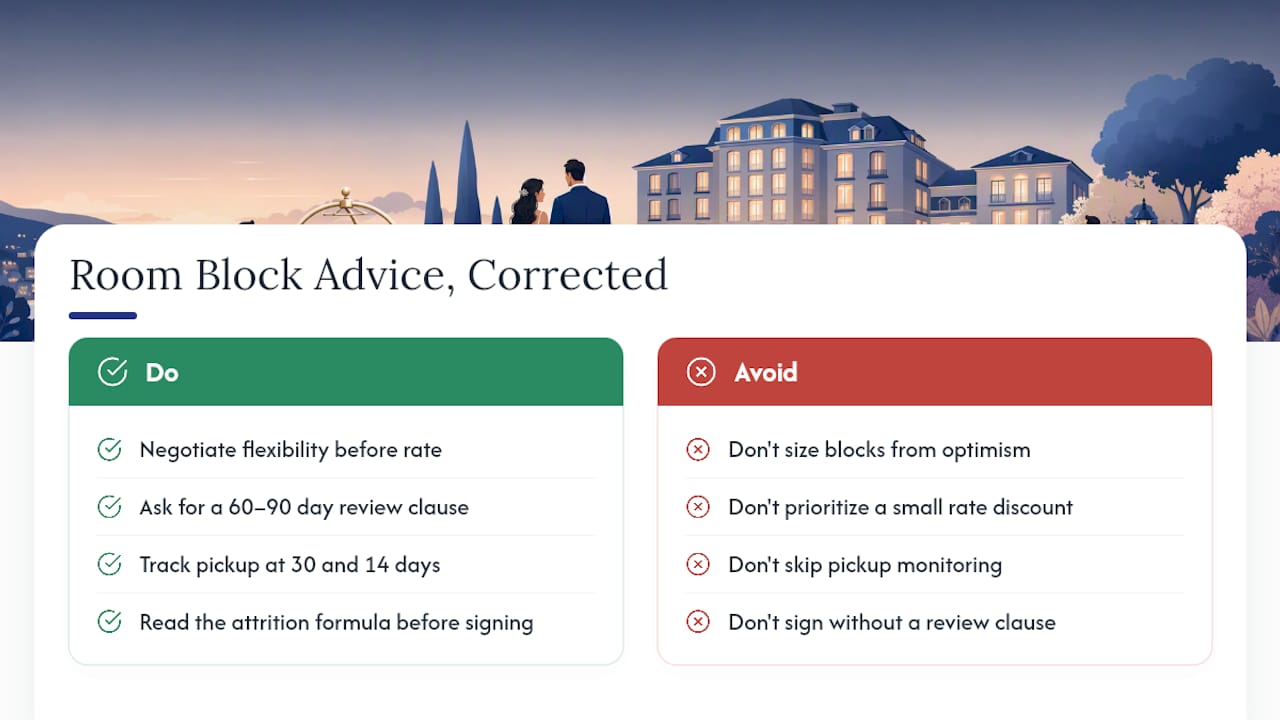
The conventional advice to “negotiate the best rate” undersells a more useful instinct: negotiate for flexibility first, rate second. A review date at 60 to 90 days out is worth more than an extra 5% off the nightly rate, because it lets you shrink a block before attrition math turns against you. Most couples never ask for one because they don’t know it’s a standard, negotiable clause.
What actually protects couples is the boring stuff: tracking pickup at 30 and 14 days, reading the attrition formula before signing rather than after a surprise invoice, and defaulting to courtesy blocks unless the guest list gives real evidence of confident travel. A managed approach, whether self-run with discipline or handled by an advisor, saves far more in avoided penalties than any single negotiated discount.
— tammylevent@gmail.com
Let Elite Travel Handle Your Wedding Room Block
Elitetravelgroup is the alternative to juggling hotel spreadsheets, cutoff dates, and attrition math yourself. A destination wedding often means negotiating with hotels across a country you’ve never worked with, tracking pickup across time zones, and reconciling an invoice in a currency you don’t check daily. That’s exactly the work a concierge advisor absorbs on your behalf.

With 35 years of experience arranging destination weddings and milestone celebrations, Elitetravelgroup runs the request-for-proposal process across hotels, negotiates attrition thresholds and complimentary room ratios before you sign anything, and audits the final invoice against your contract after the event. There’s no service fee for this work, a price match guarantee backs every booking, and support is available 24/7 since wedding planning rarely stays inside business hours. If your guest list is heading overseas, explore Elite Travel’s destination wedding packages and get a proposal built around your actual guest count, not a generic hotel quote.
Sources
- How to Book a Hotel Block for a Wedding: Ultimate Guide
- How Do Wedding Hotel Blocks Work? Everything to Know
- Standard hotel contract sample (excerpt)
