



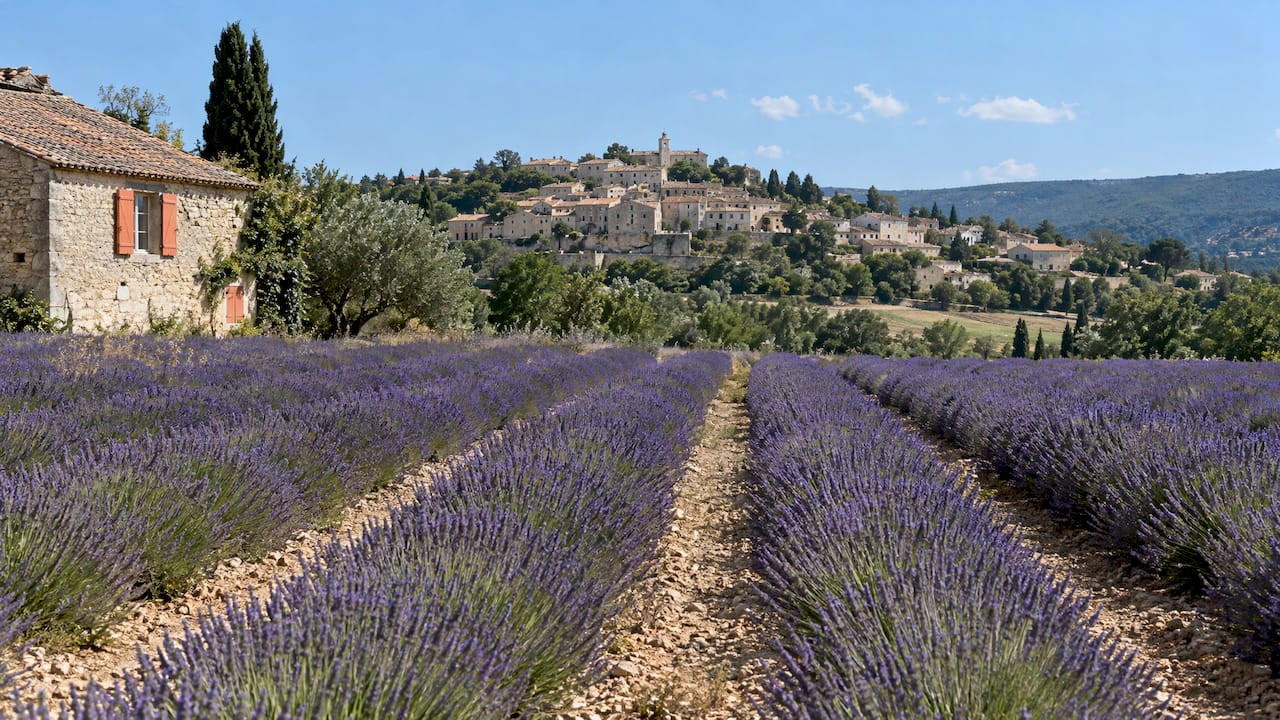
Provence suits you if you want light, lavender, perched villages and a looser, more rustic rhythm. Tuscany suits you if you want Renaissance art, a tidier landscape and a table built around simple, superb ingredients. Both reward a well-timed trip, and the right pick depends less on which region is “better” than on who is traveling, in which month, and what the trip is for. After 35 years designing high-end journeys, we plan this choice around those three questions before a single hotel is named.
TL;DR
- Choose Tuscany for art, a polished countryside, wine-led days, multi-generational groups and a first villa stay.
- Choose Provence for light, lavender, markets, Roman ruins, hilltop villages and design-forward stays.
- Timing matters more than region: May, June and September are the best months for both. July and August are hot and crowded in each.
- Do not combine them casually. They are about 348 miles apart, a 6.5 to 7 hour drive, with no direct Marseille to Florence flights.
- Weddings and honeymoons: both work, but the guest list, season and logistics should decide, not the photos.
Table of Contents
- The core difference: two kinds of beauty
- Scenery and towns
- Food and wine
- When to go: season beats region
- Getting around, and why you should not combine them
- Which region suits which trip
- What each trip costs, and how to read the numbers
- How to decide in five minutes
- Why plan this with a specialist
- Plan your Tuscany or Provence trip with us
- FAQ
- Sources
The core difference: two kinds of beauty
The cleanest way to understand the choice is to treat it as a choice of mood. A Times comparison describes Tuscany as a landscape “painted into place”: cypress avenues, tiered gardens, olive groves, vines and vertical little towns, with more great art and architecture per square mile than anywhere else. Provence, by contrast, wins on sensual light, lavender, perched villages and a rougher-edged history.
In practice that means:
- Tuscany feels composed. The land is farmed and ordered, the towns are layered with Renaissance culture, and days tend to move from a museum or a village to a long lunch.
- Provence feels sun-washed and loose. Days revolve around markets, terraces, hilltop lanes, rosé and the quality of the afternoon light.
The Canberra Times pits the two regions against each other with a deliberately partisan eye. Its facts are useful, though: Provence produces about 75% of France’s rosé, and Grasse, its perfume capital, makes more than two-thirds of France’s eau de parfum and eau de toilette. Florence, meanwhile, was the birthplace of the Renaissance, and the article cites UNESCO’s estimate that the city holds 60% of Europe’s greatest art.
If you are deciding between them for a once-in-a-decade trip, that contrast is your first filter. Do you want to be moved by a painting or by a field?
Scenery and towns
Tuscany: hill towns and Renaissance cities
Tuscany’s draw is a combination of city and countryside. Florence and Siena anchor the art and architecture, while Chianti, Val d’Orcia and the hills around Montalcino and Pienza deliver the postcard roads. Towns such as San Gimignano, Montepulciano and Pienza sit on hilltops and work best with a car and a driver or a rental.
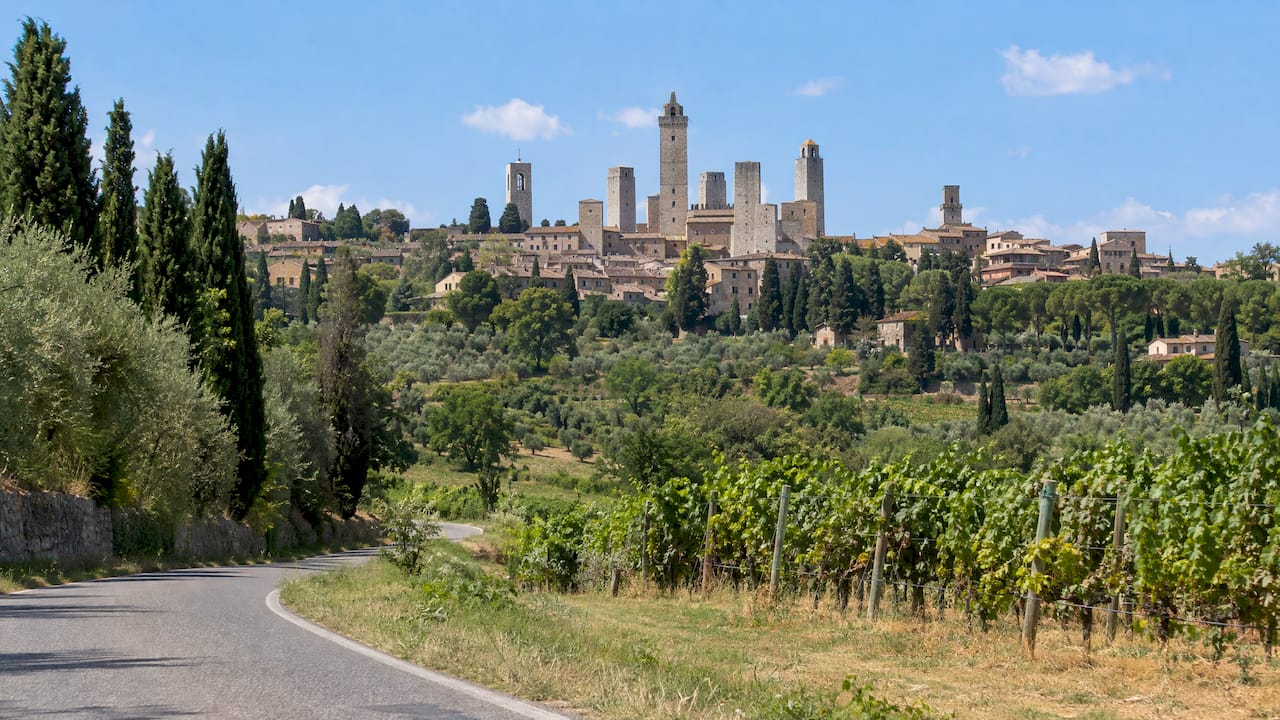
One point that surprises first-time visitors: the classic villa areas are inland. If a beach day matters to you, plan a separate coastal stop, because the best sand is a long drive from Chianti or Val d’Orcia.
Provence: lavender, Roman ruins and perched villages
Provence is a geographic and cultural region in southeastern France, running from the lower Rhône to the Italian border. Marseille’s tourism office describes a Mediterranean climate with almost 300 days of sunshine per year, and a mix of cities (Marseille, Aix-en-Provence, Arles, Avignon), natural sites (the Calanques, Porquerolles, the Camargue, the Alpilles) and monuments.
A frequent point of confusion: Aix-en-Provence is a city inside Provence, not another name for the region. France.fr places it about 30 km from Marseille and notes it is Cézanne’s birthplace, with Mont Sainte-Victoire appearing in 87 of his paintings. The same guide places the lavender season from mid-June to August, at 400 to 800 meters around Sault, Forcalquier and Valensole, with Luberon hilltop villages and the Camargue rounding out the region.
Food and wine
Both regions are serious about the table, but they express it differently.
| Tuscany | Provence | |
|---|---|---|
| Cooking style | Simple, ingredient-driven | Layered with herbs and flavors |
| Signature dishes | Bistecca alla Fiorentina, pappa al pomodoro | Ratatouille, bouillabaisse, tapenade |
| Wines | Chianti, Brunello | Côtes de Provence rosé, Bandol reds |
| Seasonal draw | Harvest, white truffles | Rosé on a terrace, markets |
The dishes and wines above come from the Times comparison. For a Tuscany trip built around wine, a private estate visit with a driver is a very different day from a tasting-room stop, and we have written up how to plan a private Tuscany wine tour properly.
If food is the main reason you are traveling, it helps to think about what kind of experience you want before choosing a region. This guide to culinary experiences lays out how travelers can think about eating well on the road, whether that is a market lunch in Provence or a long farm table in Chianti.
When to go: season beats region
The single most useful planning fact is that the shoulder seasons beat the summer peak in both places.
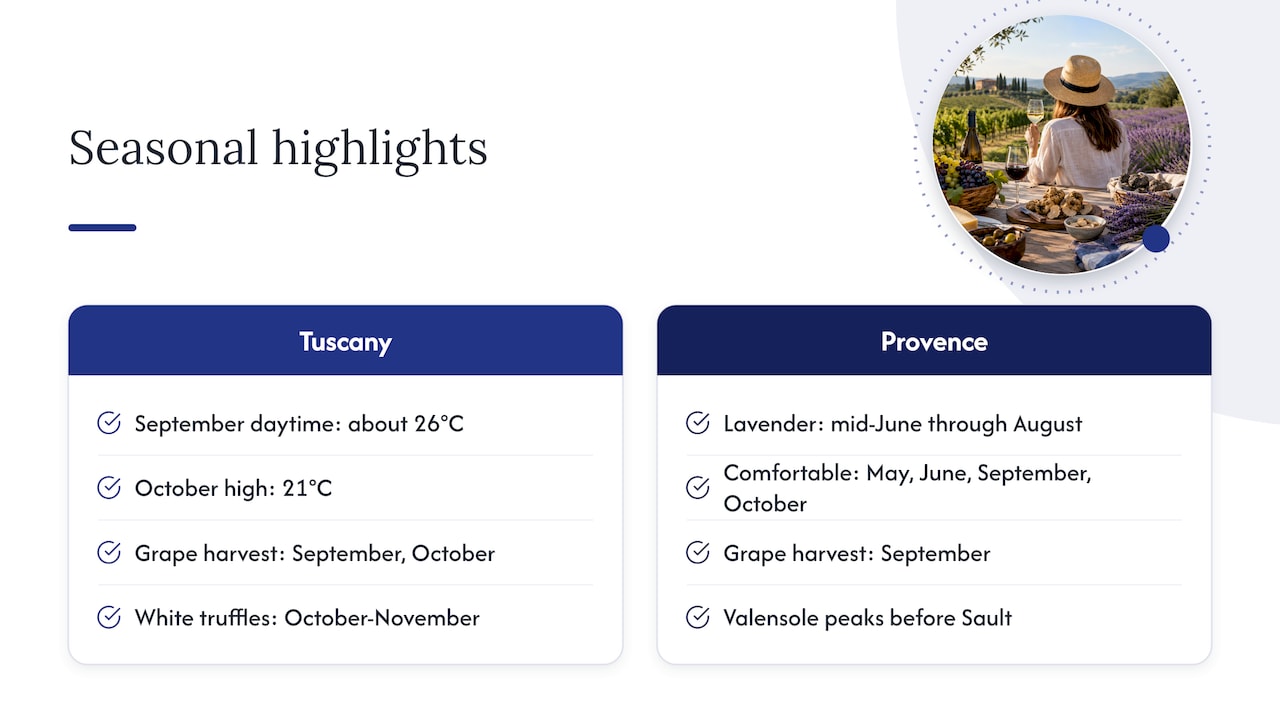
Tuscany. Lonely Planet calls spring a good, possibly underrated time to be outdoors, with September and October as the grape-harvest months. Average daytime temperatures run about 26°C (79°F) in September and a high of 21°C (70°F) in October, with crowds thinning. July and August bring peak heat and tourism, and August adds millions of vacationing Italians. The same guide lists October to November white truffle season around San Miniato and the Palio horse race in Siena on July 2 and August 16.
Provence. Lavender is the headline, and its window is short. France.fr places flowering from mid-June through August depending on altitude, and the Valensole plateau typically peaks earlier than Sault. If lavender is non-negotiable, build the whole trip around that window and book early, because it is also when the region is busiest. For everything else, May, June, September and October are the comfortable months, and September adds the grape harvest.
Both regions share the same trap: in July and August, much of France and Italy is on holiday, and prices and crowds rise with the heat. Our month-by-month guide to the best time to visit Italy covers the Italian side in more detail.
A practical rule we use when planning: choose your month first if your dates are fixed, then choose the region that is at its best in that month. A June trip leans Provence if you want lavender beginning to bloom. A late September or October trip leans Tuscany for harvest and truffles.
Getting around, and why you should not combine them
The two regions look close on a map of Europe. They are not. TripSavvy puts the distance at 348 miles (560 km): about 6.5 to 7 hours by car, roughly 9.5 hours by train and just over 10 hours by bus, with no direct Marseille to Florence flights. That is a lost day, and it eats into the very thing you came for.
Our view: pick one region per trip, or pair each with a neighbor that is genuinely close. Tuscany pairs naturally with Rome, Umbria or the Italian coast (see our comparison of Tuscany and Umbria). Provence pairs with Paris or the Riviera.
On the ground:
- Both regions are best with a car or a private driver. Regional trains serve many Tuscan cities and towns, and Visit Tuscany notes buses reach places trains cannot. The hilltop villages that make the trip special, however, are most comfortable with your own transport.
- Italian historic centers have restricted traffic zones, called ZTLs. These are camera-enforced, and a private rental car entering one without authorization can be fined. A driver, or a hotel that registers your plate in advance, removes the risk. This is one of the quiet reasons a private transfer is worth having in Florence and Siena.
- Provence adds its own seasonal quirks, such as summer fire-risk closures of forest trails and the mistral wind in winter and spring, so it pays to have someone on the ground who knows the day-to-day conditions.
Flying from the U.S. is similar for both. Most East Coast travelers connect through a major European hub, so the extra transfer time into the region matters more than the headline flight time.
Which region suits which trip
Luxury villa stays and multi-generational families
Tuscany is the easier recommendation for a first villa holiday and for multigenerational groups: it offers a lot to do for every age within a short drive, from Florence’s museums to farm stays where children can meet the animals. Provence suits families with younger children who need open space and outdoor time. If you are considering a villa, our concierge-ready Tuscany villa shortlist matches properties to the goal of the trip.
Luxury hotels
The hotel styles differ too. Tuscany leans on heritage: restored castles and large wine estates, such as Rosewood Castiglion del Bosco on a 5,000-acre Montalcino estate or Belmond Castello di Casole, as listed by HotelsForKings. Provence leans design-forward, with properties such as Villa La Coste and La Bastide de Gordes on its village cliff. Rooms in both regions book out well ahead in peak months, which is a point in favor of planning early.
Honeymoons
Both work. Tuscany gives you a romantic, slow-paced rhythm with wine at the center, and it combines neatly with Rome and Venice. For a full plan, see our 12-night Italy honeymoon itinerary and the Italy honeymoon cost breakdown. Provence suits couples who prefer a quieter, sunlit pace built around villages, markets and long lunches.
Destination weddings
Both regions deliver the setting, and the numbers are close. Aisle’s destination wedding guide estimates a three-day, 70-guest wedding weekend at about €78,000 in Tuscany and about €84,500 in Provence, with the best months in May, June and September for both. Treat those as planning ranges, not quotes: guest count, venue type and season move them substantially. The decision usually comes down to venue style and guest travel. Tuscany offers villas, castles and Florence options (see our guide to Tuscany wedding venues), and U.S. guests often reach Italy through Rome.
Incentive and group travel
For corporate groups and milestone celebrations, Tuscany tends to be the simpler fit: culture, food and wine give a program built-in variety, and private dining in a castle or on an estate is a strong closing evening. Provence works well for smaller groups that want a relaxed, design-led retreat. In both cases, the on-the-ground partner matters more than the region.
What each trip costs, and how to read the numbers
Published figures vary widely by season and style, so use them to compare, not to budget. One travel content site puts a five-day Tuscany itinerary covering Florence, Siena and Chianti at about USD 950 per person, but that describes a mid-range trip. A luxury trip is priced by hotel category, private guiding, transfers and dining, and it moves a lot with the month.
What holds true in both regions is the seasonal pattern: shoulder-season dates (late May, June, September) are materially cheaper than July and August for lodging and often give you better weather and fewer people. That combination is why we steer most clients to those weeks.
How to decide in five minutes
- Fix your month. If it is July or August, plan around heat and crowds, with a pool and early starts. If it is May, June or September, both regions are strong.
- Name the one thing you cannot miss. Lavender points to Provence in late June and July. Renaissance art or truffles point to Tuscany.
- Count your group. Larger, multigenerational parties usually do better in Tuscany. Couples and small groups who want slow days suit either.
- Choose one region. The 348-mile gap makes a combined trip a compromise.
- Decide how you want to move. If you want a driver, private guides and no ZTL worries, plan that from the start rather than patching it in later.
Why plan this with a specialist
The differences above are exactly the kind that are hard to judge from a forum thread or a comparison table: which village is worth the drive on your dates, which estate opens its cellar to private visits, which hotel has the right rooms for a multigenerational group. We charge no service fees and offer a price match guarantee, so you do not pay extra for that planning. We are open 24/7, so if a flight changes or a dinner needs rearranging, someone is available whatever time it is in France or Italy.
Our perspective
We have spent 35 years building high-end journeys, and the question we hear most about these two regions is which one is better. Our answer is that the better region is the one that matches the people in the car. A couple who wants to wander a market and watch the light change on a hillside is happiest in Provence. A family of three generations that wants a castle, a cooking class and a day in Florence is happiest in Tuscany.
What separates a good trip from an exceptional one is rarely the region. It is the timing, the right hotel for the group, a driver who knows the roads and the restricted zones, and a table booked at the right estate. That is where a concierge-level approach earns its place, and it is why we design each itinerary around the traveler rather than a template.
We know the destinations and we work with on-the-ground partners we trust, so the details that make a trip feel seamless are handled before you arrive.
tammylevent@gmail.com
Plan your Tuscany or Provence trip with us
Elite Travel Management Group designs customized luxury travel across Europe and beyond, including honeymoons, destination weddings, milestone celebrations, VIP vacations and curated group trips. For Tuscany, you can start from our 7-day Tuscany tour or our 8-day Siena and Chianti package, then tailor it. Tell us your month, your group and your priorities, and we will shape a plan through our luxury vacation packages.
FAQ
Is Provence or Tuscany better for a first trip to Europe?
For most first-time visitors, Tuscany is the easier introduction because Florence and Siena provide art and history while the countryside supplies the scenery. Provence suits travelers who already know they want a slower, sunlit trip built around villages, markets and lavender. Either way, plan for May, June or September.
Is Aix-en-Provence the same as Provence?
No. Provence is the wider region in southeastern France, and Aix-en-Provence is one city within it, about 30 km from Marseille. It is known for its Mazarin district and as Cézanne’s birthplace, and it makes a strong base for exploring the region.
Can I visit both Provence and Tuscany in one trip?
You can, but the two are about 348 miles apart, which is a 6.5 to 7 hour drive or roughly 9.5 hours by train. Most travelers get more from one region in a week or more than from rushing both. If you want both, we would plan them as two distinct stays with a private transfer between them.
When is the lavender in bloom in Provence?
It flowers from mid-June into August depending on altitude, with the Valensole plateau typically earlier and Sault later. The window is short and shifts with the weather each year, so confirm the timing close to your dates and book accommodation early.
Do I need a car in Tuscany and Provence?
It helps in both, because the hilltop villages are hard to reach otherwise. In Italian historic centers, restricted traffic zones make a private driver or a hotel-registered plate the safer choice. A driver also lets you enjoy the wine without watching the clock.
Sources
- Provence vs Tuscany, The Times
- Provence vs Tuscany: Battle of Mediterranean idylls, The Canberra Times
- Rediscover the French region of Provence, France.fr
- Provence, Marseille Tourism
- The Best Times to Visit Tuscany, Lonely Planet
- How to Get From Provence to Tuscany, TripSavvy
- Getting around, Visit Tuscany
- Tuscany vs Provence: Which for a Trip?, HotelsForKings
- Best destination wedding locations by budget, Aisle
- Tuscany Itinerary: 5 and 7 Days
