

TL;DR:
- Honeymoon travel in 2026 emphasizes personalized, multi-destination experiences that combine culture, adventure, and luxury. Couples now invest more in unique, authentic trips, prioritizing sustainability, off-peak travel, and bespoke itineraries over standard resorts. They increasingly split trips into immediate short getaways and longer, carefully planned dream journeys for greater satisfaction.
Honeymoon travel trends 2026 are defined by a clear shift away from passive beach resorts toward personalized, multi-destination experiences that combine luxury, cultural immersion, and meaningful adventure. Couples now treat the honeymoon as a major investment, with budget allocation rising to 26% of total wedding spend. That figure reflects a fundamental change in priorities: the honeymoon is no longer an afterthought. Elitetravelgroup has tracked this evolution firsthand, watching couples move from standard resort bookings to fully bespoke itineraries built around who they are as a couple. Understanding these shifts before you plan gives you a real advantage.
What are the top honeymoon travel trends shaping 2026?
The defining characteristic of 2026 romantic travel is the rejection of the single-destination, one-size-fits-all trip. Couples want variety, depth, and experiences that feel personal rather than packaged.
Multi-destination and layered itineraries have replaced the classic two-week resort stay. Couples now combine two or three contrasting locations, such as a cultural city followed by a remote beach, to create a richer overall experience. Multi-destination honeymoons mixing adventure and relaxation are increasingly popular, and the logic is straightforward: variety prevents the monotony that can set in during a long stay in one place.
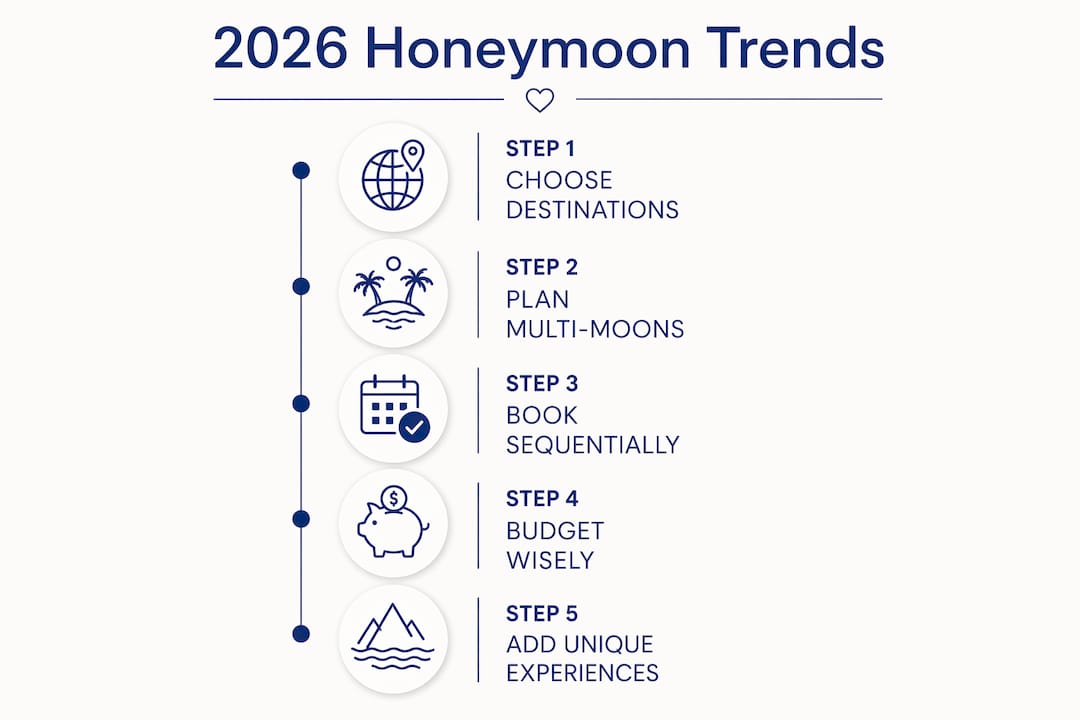
The “multi-moon” format is one of the most practical trends gaining traction. Couples split their romantic travel into two phases: a short, immediate getaway right after the wedding, followed by a longer dream trip weeks or months later. Multi-moon honeymoons reduce post-wedding fatigue and increase overall satisfaction. The immediate trip handles the emotional need to celebrate, while the delayed trip allows for better planning and a bigger budget.
Experiential and cultural travel now defines what “luxury” means for honeymooners. Modern honeymooners prioritize authentic experiences like local cooking classes and cultural exploration over traditional resort stays. This is a meaningful shift: luxury is no longer measured by thread count alone. It is measured by the quality of the story you bring home.
Other major trends shaping 2026 romantic getaways include:
- Eco-conscious destination choices: Couples actively select accommodations and destinations with strong sustainability credentials, from solar-powered lodges in Costa Rica to low-impact safari camps in Kenya.
- Off-peak and shoulder-season travel: Booking outside peak season is now a standard planning strategy, not just a budget hack.
- Boutique over branded: Smaller, locally owned properties are winning over large international resort chains for couples who want authenticity.
- Wellness integration: Spa retreats, yoga sessions, and digital detox stays are being woven into itineraries rather than treated as optional add-ons.
Pro Tip: Book your primary destination first, then build secondary stops around it. Trying to plan all legs simultaneously is the fastest way to create a disjointed itinerary.
Which honeymoon destinations and experiences are trending in 2026?
Destination choices in 2026 reflect the broader shift toward experiences that feel earned and specific. The Maldives, Italy, Japan, Greece, Hawaii, the Caribbean, and New Zealand remain the most requested destinations, but the way couples experience them has changed completely.
Japan is the standout growth destination for 2026. Couples are drawn to its combination of ancient culture, world-class food, and dramatic natural scenery. A Tokyo-to-Kyoto itinerary paired with a ryokan stay offers the kind of cultural depth that no beach resort can replicate. New Zealand is gaining similar momentum for adventure-focused couples who want to combine hiking, scenic flights, and luxury lodge stays in one trip.

Safari honeymoons in East Africa, particularly in Kenya and Tanzania, are attracting couples who want something genuinely unforgettable. Combining a Serengeti safari with a Zanzibar beach stay is now a well-established format that delivers both adrenaline and relaxation. For couples considering luxury adventure travel, this combination represents the clearest expression of the 2026 multi-destination trend.
The Maldives continues to lead for pure romance. Private overnight stays on natural sandbanks offer intimate, restorative experiences that no overwater villa can match. Resorts like Fushifaru Maldives have built entire programs around this concept, placing couples under open skies with nothing but the ocean around them.
| Destination type | Top locations | Best for |
|---|---|---|
| Beach and island | Maldives, Hawaii, Caribbean | Pure relaxation and romance |
| Cultural immersion | Japan, Italy, Greece | Food, history, and local connection |
| Adventure and nature | New Zealand, Kenya, Tanzania | Hiking, safari, and active exploration |
| Eco-luxury | Costa Rica, Bhutan, Rwanda | Sustainability-focused couples |
| Domestic escape | Pacific Northwest, Montana, Vermont | Budget-conscious or time-limited couples |
Pro Tip: Japan’s cherry blossom season (late march to mid-april) books out 12 months in advance. If that window is on your list, treat it as a hard deadline, not a preference.
Couples planning a European honeymoon should look beyond the obvious. Croatia’s Dalmatian Coast, Portugal’s Alentejo wine region, and Slovenia’s Lake Bled are all gaining popularity as alternatives to the crowded Italian and Greek circuits. Elitetravelgroup’s Europe vacation packages cover many of these emerging routes with on-the-ground expertise that generic booking platforms cannot match.
How are couples budgeting and planning honeymoon travel in 2026?
Honeymoon budgets are rising across every income bracket. The average couple now spends $6,500 on their honeymoon, and 64% of luxury honeymoon clients spend $10,000 or more, with 15% investing $20,000 or more on once-in-a-lifetime experiences. That top tier is not just spending more. They are spending differently, prioritizing private guides, exclusive access, and bespoke itineraries over standard packages.
Smart budgeting in 2026 follows a clear set of principles:
- Set your total budget before choosing a destination. The destination should fit the budget, not the other way around. Couples who fall in love with a destination first consistently overspend.
- Book shoulder-season travel. Shoulder-season bookings save 20–30% compared to peak travel windows. September in the Mediterranean and April in Southeast Asia offer near-perfect conditions with significantly fewer crowds.
- Build in a 10% contingency fund. A 10% contingency within your honeymoon budget covers unplanned costs like airport transfers, spontaneous excursions, and gratuities. Couples who skip this step consistently report stress during the trip.
- Consider the multi-moon split. Allocating 30–40% of your budget to an immediate short trip and saving the rest for a later dream trip gives you flexibility without sacrificing the celebration.
- Use a travel advisor for complex itineraries. Multi-destination trips with multiple flight legs, visa requirements, and accommodation types are where self-planning breaks down. A specialist saves both money and time.
Technology is changing how couples plan. AI-powered itinerary tools can generate draft schedules in minutes, but they lack the local knowledge and negotiating power that a specialist agency brings. Elitetravelgroup’s bespoke itinerary approach combines the speed of modern planning tools with 35 years of destination expertise.
Pro Tip: Always confirm your honeymoon budget includes travel insurance. A single medical evacuation in a remote destination can cost more than the entire trip.
What unique honeymoon experiences define 2026’s travel trends?
The most memorable honeymoons in 2026 share one quality: they are built around experiences that cannot be replicated at home or found in a standard travel catalog. Couples are moving away from passive relaxation and toward active, meaningful engagement with the places they visit.
Restorative travel is one of the most significant shifts in this space. Experiences designed to foster genuine disconnection, such as private sandbank nights in the Maldives, off-grid glamping in Patagonia, or silent forest retreats in Japan, are being sought out specifically because they remove the noise of daily life. Restorative travel fosters intimacy in ways that a poolside cocktail simply cannot.
Unique experiences couples are choosing in 2026 include:
- Private cooking classes with local chefs in Bologna, Oaxaca, or Chiang Mai
- Guided night-sky photography sessions in Iceland or Namibia
- Sunrise hot air balloon rides over Cappadocia or the Serengeti
- Chartered sailing trips along the Greek islands or Croatian coast
- Cultural textile workshops in Kyoto or Marrakech
The shift from large resorts to boutique and locally owned properties is accelerating this trend. A 12-room family-run hotel in the Umbrian countryside delivers a fundamentally different experience than a 400-room international chain. Experiential travel with local cultural immersion is redefining what luxury means for honeymooners. The story you tell when you return home is the real measure of a great honeymoon.
“The best honeymoons are not the ones with the most expensive rooms. They are the ones where every day felt like something you could not have planned yourself, because someone who knew the destination deeply planned it for you.”
Sustainability is woven into these choices, not bolted on. Couples selecting boutique properties, local guides, and low-impact activities are making eco-conscious decisions as a natural byproduct of wanting authenticity. For couples who want to complete the full picture of their celebration, pairing the honeymoon with a romantic lingerie guide adds a personal touch that extends the experience beyond the destination itself.
Key Takeaways
The single most important shift in 2026 honeymoon planning is that couples now treat the trip as a bespoke experience built around their values, not a standard package selected from a brochure.
| Point | Details |
|---|---|
| Budgets are rising fast | Average honeymoon spend is $6,500, with 64% of luxury clients spending $10,000 or more. |
| Multi-destination trips dominate | Combining contrasting experiences like culture and beach creates richer, more satisfying honeymoons. |
| Shoulder-season travel saves 20–30% | Booking off-peak cuts costs significantly while improving the overall experience. |
| The multi-moon format reduces burnout | Splitting travel into two phases improves satisfaction and gives couples more planning flexibility. |
| Experiential beats passive | Local cooking classes, private sandbank stays, and cultural tours outperform standard resort packages for lasting memories. |
What I have learned after years of watching honeymoon trends evolve
The couples who have the best honeymoons are rarely the ones who spent the most. They are the ones who planned with intention. After watching hundreds of couples move through the planning process, the pattern is clear: the trips that generate the most joy are built around a specific shared value, whether that is food, adventure, culture, or pure stillness.
The trend toward multi-destination itineraries is genuinely exciting, but it carries a real risk. Couples sometimes pack so many stops into two weeks that they spend more time in transit than in the places they came to see. My honest recommendation is to resist the urge to add one more destination. Two locations done deeply will always beat four locations done quickly.
The multi-moon format is the most underrated planning tool available right now. A short, immediate trip right after the wedding handles the emotional need to celebrate without the pressure of executing a complex itinerary while exhausted. The dream trip, planned calmly three to six months later, becomes something both partners genuinely look forward to rather than something they survive.
Sustainability is not a trend. It is a permanent shift in how couples think about travel. Choosing a locally owned property over a global chain, hiring a local guide instead of joining a group tour, and selecting destinations in their shoulder season are all choices that improve the experience while reducing impact. That alignment between personal values and travel choices is what makes a honeymoon feel meaningful rather than just expensive.
How Elitetravelgroup brings 2026 honeymoon trends to life
Planning a honeymoon that reflects the best of 2026 trends requires more than a good idea. It requires the right connections, the right timing, and someone who has been to the destination and knows which boutique hotel is worth the splurge.
Elitetravelgroup has spent 35 years building exactly that kind of expertise. From luxury honeymoon packages in the Maldives and Italy to multi-destination itineraries combining East African safaris with Indian Ocean beach stays, every trip is designed around the couple, not a catalog. Elitetravelgroup charges no service fees, offers a price match guarantee, and is available 24/7 from first inquiry to return flight. Couples who want a honeymoon built around who they actually are, not who a brochure assumes they are, can start the conversation at stagingelite.elitetravelgroup.net.
FAQ
What is the average honeymoon budget for 2026?
Couples now allocate about 26% of their wedding budget to the honeymoon, averaging $6,500 in total spend. Luxury couples frequently exceed $10,000, with 15% investing $20,000 or more.
What are the most popular honeymoon destinations in 2026?
The Maldives, Japan, Italy, Greece, New Zealand, and East Africa top the list for 2026. Japan and New Zealand are seeing the strongest growth among couples seeking cultural depth and adventure.
What is a multi-moon honeymoon?
A multi-moon splits romantic travel into two trips: a short immediate getaway after the wedding and a longer dream trip planned for later. This format reduces post-wedding fatigue and increases overall satisfaction.
How much should I save for unexpected honeymoon costs?
Budget a 10% contingency on top of your total honeymoon spend. This covers unplanned costs like transfers, tips, and spontaneous excursions without adding financial stress to the trip.
When is the best time to book a honeymoon to save money?
Shoulder-season travel saves 20–30% compared to peak windows. Booking in september for Mediterranean destinations or april for Southeast Asia delivers favorable weather with fewer crowds and lower prices.
