



Expect to pay roughly $7,500–$45,000+ per person for an Antarctica cruise, depending on ship class, cabin category, and itinerary length. For a luxury-minded traveler doing a 10–12 day Antarctic Peninsula voyage, the realistic all-in budget on a mid-range expedition ship commonly falls between about $12,000 and $25,000 per person once you add international flights, charter transfers, medical evacuation insurance, gratuities, and onboard extras; budgets can be significantly higher for premium suites on small luxury vessels.
Here is the short version before the details:
- Entry-level berths on larger expedition ships: $7,500–$10,000 per person (twin-share, 10–11 days)
- Mid-range expedition fares: $10,000–$20,000 per person
- Luxury and ultra-luxury suites: $14,800–$45,000+ per person
- Realistic all-in mid-range budget: $12,000–$25,000 per person, per industry cost reporting
- Solo traveler premium: add 50%–100% to the fare for single-occupancy cabins
The U.S. Department of State advises American travelers heading to polar regions to register their itinerary and review consular guidance before departure, which also affects how you structure your insurance and emergency planning budget. The British Antarctic Survey provides the most reliable science-backed data on wildlife seasonality, which matters when you are choosing a departure month. Elitetravelgroup’s Antarctica vacation packages are built around these realities, with all-in budgets assembled from the first call.
Key Takeaways
A realistic all-in budget for a luxury Antarctica cruise runs $17,000–$35,000+ per person once flights, insurance, gratuities, and onboard extras are added to the base fare.
| Point | Details |
|---|---|
| Base fare range | Advertised fares run $7,500–$45,000+ per person; mid-range all-in totals land at $12,000–$25,000. |
| Fly-cruise premium | Flying over the Drake Passage adds roughly $1,500–$3,000 per person but shortens the itinerary by two days. |
| Key extras to budget | Add flights, polar medevac insurance, gratuities (~$16/day), and optional activities to every fare estimate. |
| Best savings lever | Book 12–18 months early or choose a November/late-February departure for 10%–20% lower fares. |
| Elitetravelgroup advantage | No service fees, price-match guarantee, and 24/7 support make the agency a net cost-neutral planning resource for complex polar itineraries. |
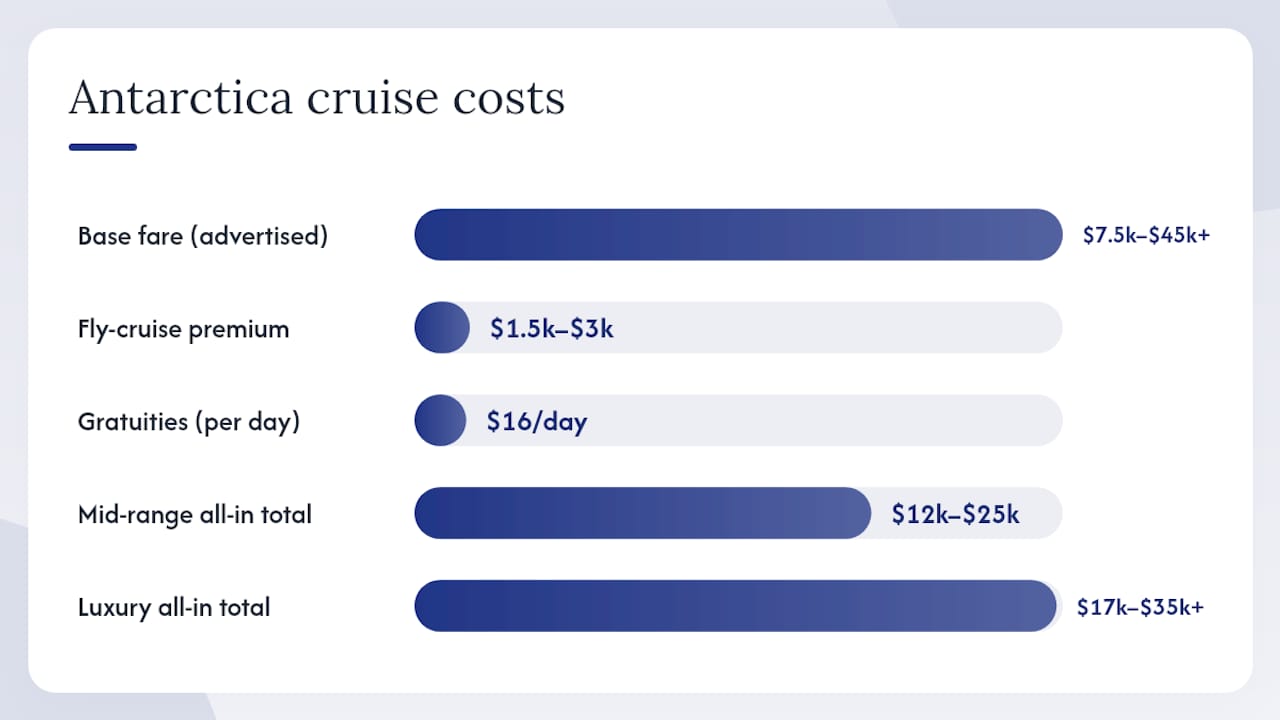
Table of Contents
- What does an Antarctica cruise actually cost? Price bands explained
- The main factors that drive your Antarctica expedition cost
- What your fare includes and what you will pay extra for
- Sample budgets for four common trip profiles
- Fly the Drake or sail it? The real cost and comfort tradeoff
- Where to save and where to splurge on an Antarctica trip
- How a luxury travel advisor changes the cost and value equation
- A practical checklist to finalize your booking and budget
- Plan your Antarctica cruise with Elitetravelgroup
- Sources
What does an Antarctica cruise actually cost? Price bands explained
Advertised starting fares for 10–11 day Antarctic Peninsula voyages frequently begin around $7,500–$8,995 per person. Mid-range expedition ships often list $10,000–$20,000, and luxury expedition fares start near $14,800 before climbing well above $30,000 per person for premium suites. Those are the advertised numbers. The all-in reality is always higher.
Trip length matters as much as ship class. The three most common itinerary formats are:
- 8–11 day Antarctic Peninsula (the most common, most affordable): Ushuaia or Punta Arenas embarkation, Drake Passage crossing, Peninsula landings
- 10–14 day Drake crossing with extended Peninsula time: more landing days, more wildlife exposure, higher fare
- 18–23 day Antarctic Circle expedition: crosses the Circle, dramatically longer at sea, fares typically $20,000–$50,000+
| Tier | Typical Fare (per person, twin-share) | Itinerary Length | Ship Style |
|---|---|---|---|
| Entry-level | $7,500–$10,000 | 10–11 days | Larger expedition (200+ passengers) |
| Mid-range | $10,000–$20,000 | 10–14 days | Mid-size expedition (100–200 passengers) |
| Luxury | $14,800–$30,000 | 10–14 days | Small luxury ship (under 100 passengers) |
| Ultra-luxury suite | $30,000–$45,000+ | 10–14 days | Boutique expedition vessel |
On a $15,000 cabin, the single-occupancy supplement may add a significant premium for the same berth occupied by one person. Some operators offer a cabin-share program to reduce that premium, though availability is limited on luxury ships.
The main factors that drive your Antarctica expedition cost
Ship class is the single biggest lever. A 200-passenger expedition vessel with shared facilities and a basic lecture program costs a fraction of a 100-passenger boutique ship with a 1:1 staff-to-guest ratio, private balconies, and a Michelin-caliber chef. The experience gap is real, and so is the price gap.
Ranked by cost impact:
- Ship class and size: small luxury ships cost 2–3x more than large expedition vessels for comparable itineraries
- Cabin category: an interior cabin versus a suite on the same ship can differ by $10,000–$20,000 per person
- Fly-cruise vs. sail: flying over the Drake Passage adds roughly $1,500–$3,000 per person for the charter flight
- Itinerary length and route: each additional day at sea adds cost; Antarctic Circle routes cost significantly more than Peninsula-only
- Season and departure month: peak season (December–January) commands the highest fares; shoulder months (November, February–March) can offer better pricing with some wildlife trade-offs
- Embarkation point: Ushuaia (Argentina) is the most common and typically least expensive hub; Punta Arenas (Chile) is the fly-cruise gateway
Secondary cost drivers include onboard beverage packages (often $50–$120 per person per day when not included), private transfers between airport and port, single supplements, and port taxes and fees that operators sometimes list separately from the headline fare.
Pro Tip: Book a mid-deck cabin on a small luxury ship rather than an interior cabin on a larger vessel. You get the small-ship experience, the expert naturalist team, and the intimate landings, at a price point that often beats a suite on a bigger ship. The cabin grade matters less than the ship grade.
Wildlife is still exceptional: penguin colonies are active throughout the season, and the British Antarctic Survey’s penguin distribution data confirms that Peninsula colonies are accessible from late October through March.
What your fare includes and what you will pay extra for
Most expedition cruise fares include accommodation, all onboard meals, guided Zodiac landings, lectures by naturalists and scientists, basic expedition gear (rubber boots, parkas on some ships), and port fees. What they do not include is where budgets get surprised.
Typically included in the fare:
- All onboard accommodation and meals
- Zodiac landings and guided shore excursions
- Lectures and educational programming
- Basic expedition gear (varies by operator)
- Port taxes and Antarctic Treaty landing fees on most ships
Typically excluded and what to budget:
- International round-trip flights to South America (Ushuaia or Punta Arenas)
- Charter flight for fly-cruise itineraries
- Comprehensive travel insurance with medical evacuation coverage
- Gratuities for ship crew and expedition staff
- Optional activities: kayaking, camping, paddleboarding, private excursions
- Alcoholic beverages (unless a premium beverage package is included)
- Specialty dining or private chef experiences on ultra-luxury ships
- Pre- and post-cruise hotel nights in Buenos Aires, Santiago, or Ushuaia
| Extra Cost Item | Typical Budget Range |
|---|---|
| International flights (round-trip, U.S. to South America) | $850–$1,500 per person |
| Charter flight (fly-cruise, Punta Arenas to King George Island) | $1,500–$3,000 per person |
| Medical evacuation insurance (polar-rated policy) | $200–$350 per person per trip |
| Gratuities | add daily gratuities |
| Optional activities (kayaking, camping, etc.) | $200–$1,500 per person |
| Pre/post-cruise hotel (2–3 nights) | $200–$1,000 per person |
Operators are required to carry medical facilities onboard, but polar medevac, the cost of evacuating a passenger to a hospital in South America or beyond, is not covered by standard travel insurance. Confirm your policy covers polar medical evacuation before you depart. The U.S. Department of State’s polar travel guidance specifically recommends reviewing consular information and registering your travel plans, which is also a practical step for emergency planning.
Pro Tip: Ask your operator for a “total trip cost” estimate in writing before you book, not just the headline fare. The gap between the advertised starting fare and the realistic all-in number is often $3,000–$8,000 per person once flights, insurance, and tips are added.
Sample budgets for four common trip profiles
These four profiles cover the most common ways affluent travelers approach an Antarctica expedition. All figures are per person. Twin-share assumes two people sharing a cabin; solo figures reflect a single-occupancy supplement.
Assumptions behind each profile:
- Budget twin-share: 10–11 day Peninsula, larger expedition ship, interior or lower-deck cabin, economy flights, November departure
- Mid-range twin-share: 10–12 day Peninsula, mid-size expedition ship, mid-deck cabin, economy-plus flights, December departure
- Luxury suite (twin): 10–12 day Peninsula, small luxury vessel, suite with veranda, business-class flights, peak January departure
- Fly-cruise (solo): 8–10 day fly-cruise itinerary, mid-range ship, solo occupancy, economy-plus flights, February departure
For families planning a polar trip together, the luxury family travel planning guide from Elitetravelgroup covers how to structure multi-cabin bookings and manage the logistics of traveling with children in a remote environment.
Fly the Drake or sail it? The real cost and comfort tradeoff
Flying over the Drake Passage instead of sailing it cuts roughly two days of rough open-ocean crossing in each direction. That sounds straightforward. The tradeoffs are more nuanced.
What fly-cruise adds to your budget:
- Charter flight surcharge of roughly $1,500–$3,000 per person on top of comparable sailing fares, per industry cost reporting
- Fly-cruise itineraries are typically 8–10 days rather than 10–12, so you get fewer landing days in Antarctica itself
- Charter flights from Punta Arenas to King George Island are weather-dependent and subject to delays or cancellations; some travelers end up waiting in Punta Arenas for 24–48 hours, which adds unplanned hotel costs
What fly-cruise saves you:
- Two days of Drake Passage crossing each way (the Drake can be rough, even on large ships)
- Reduced seasickness risk for travelers who are sensitive to motion
- A shorter total trip length, which matters for executives or travelers with tight schedules
Where sailing the Drake wins:
- The Drake crossing itself is a genuine wildlife experience: albatrosses, petrels, and other seabirds follow the ship for days
- Sailing itineraries typically include more total time in Antarctic waters
- Lower total cost, often by $3,000–$5,000 per person when the charter flight surcharge is factored in
Pro Tip: If you have 12–14 days and no serious motion-sickness history, sail the Drake. You will spend more time in Antarctica, pay less, and experience one of the world’s great ocean crossings. If your window is 10 days or fewer, or if rough seas are a dealbreaker, the fly-cruise premium is worth it.
Where to save and where to splurge on an Antarctica trip
The biggest mistake luxury travelers make is spending money in the wrong places. An expensive cabin on a mediocre ship is a worse outcome than a mid-deck cabin on an exceptional small vessel.
Tactics that lower cost without hurting the experience:
- Book 12–18 months in advance for the best cabin selection and early-booking discounts; some operators offer 10%–15% off for early commitments
- Consider November or late February departures. Fares are lower, crowds are smaller, and wildlife is still abundant
- Choose a mid-deck cabin on a small luxury ship over a suite on a larger expedition vessel; the ship quality matters more than the cabin grade
- Bundle international flights with your cruise through a travel advisor; operators and advisors sometimes access air-inclusive rates that beat booking separately
- Skip the onboard beverage package if you are a light drinker; it rarely pays off unless you are consuming several drinks daily
High-impact splurges worth every dollar:
- A suite or veranda cabin on a small ship (under 100 passengers): the private outdoor space in Antarctica is extraordinary, and the small-ship service ratio is incomparable
- Private or semi-private Zodiac excursions: getting a dedicated Zodiac with a naturalist guide rather than sharing with 12 other passengers changes the landing experience entirely
- Expert-led polar photography workshops: several small-ship operators embed professional wildlife photographers who run dedicated sessions; the images you bring home are worth the premium
- Extended pre-cruise time in Buenos Aires or Patagonia: two or three nights in Torres del Paine or Tierra del Fuego before boarding adds context and beauty that most travelers wish they had built in
For travelers considering gifting an expedition cruise or booking through a corporate incentive program, luxury cruise certificates offer a structured way to present the experience before the itinerary is finalized.
Pro Tip: Ask your travel advisor about flexible payment options and deposit structures. An advisor can sometimes negotiate extended deposit terms or cabin holds, which gives you time to finalize travel insurance and flights without losing your preferred cabin.
How a luxury travel advisor changes the cost and value equation
Booking an Antarctica cruise directly through an operator is possible. It is rarely the smartest financial move for a trip of this complexity and cost.
A seasoned luxury travel advisor does not just save you time. They access fares, cabin holds, and bundled packages that are not available on the operator’s public booking page. On a $20,000+ trip, the difference between an advisor’s net rate and the rack rate can cover your flights entirely.
Here is what working with an advisor like Elitetravelgroup concretely delivers:
- Access to exclusive fares and upgrades: advisors with preferred-partner status at polar operators can access cabin categories and pricing not listed publicly
- Bundled air and cruise pricing: Elitetravelgroup can often package international flights with the cruise fare at rates that beat booking separately
- Price-match guarantee: if you find a lower published rate after booking, Elitetravelgroup matches it, per the agency’s publicly stated policies
- 24/7 support during disruptions: charter flight delays, weather-related itinerary changes, and medical situations in remote locations require an advocate who answers the phone at 2 AM
- No service fees: Elitetravelgroup earns through supplier commissions, not client fees, so the planning expertise costs you nothing extra
- Insurance vetting: the agency reviews polar medevac policy terms and flags gaps before you depart, not after something goes wrong
Elitetravelgroup’s luxury cruise planning services cover the full scope: operator selection, cabin negotiation, flight bundling, pre- and post-cruise hotel arrangements, insurance review, and a detailed all-in budget built from the first conversation. The agency’s 35 years of luxury travel experience means the team has navigated charter cancellations, itinerary changes, and last-minute cabin upgrades on behalf of clients who needed someone in their corner.
A practical checklist to finalize your booking and budget
Once you have a realistic all-in number in mind, the booking process follows a clear sequence. Polar operators fill up fast, particularly for peak December–January departures on small luxury ships.
- Step 1: Choose your itinerary and ship class. Peninsula vs. Antarctic Circle, fly-cruise vs. sail, ship size and passenger count. These decisions set your fare range.
- Step 2: Confirm cabin category. Decide between interior, mid-deck, or suite. Get the total fare including single supplement if applicable.
- Step 3: Build your all-in budget. Add flights, charter flight if fly-cruise, insurance, gratuities, optional activities, and pre/post hotel.
- Step 4: Secure polar medical evacuation insurance. Confirm the policy covers evacuation from Antarctic waters to a hospital in South America. Do not rely on standard travel insurance for this.
- Step 5: Pay your deposit. Most polar operators require 20%–30% at booking. Mark your calendar for the final payment deadline.
- Step 6: Book international flights. Do not book non-refundable flights until after your deposit is confirmed and you understand the cancellation policy.
- Step 7: Reconfirm transfers and logistics. Airport to port transfers, pre-cruise hotel, and any gear rentals should be locked in 60–90 days before departure.
- Step 8: Register with the U.S. Department of State. Use the STEP program to register your travel plans; it is free and ensures the embassy can reach you in an emergency.
Pro Tip: Final payment on most polar expedition cruises is due 90–120 days before departure. Cancellations after that window typically result in partial or full forfeiture of the fare. Book your travel insurance the same day you pay your deposit, not after, so the pre-existing condition waiver applies and your cancellation coverage is active from day one.
Elitetravelgroup’s concierge team can walk you through every step of this timeline, from operator selection to insurance review, at no service fee. Reach the team through the Antarctica vacation packages page to start building your itinerary.
What actually makes an Antarctica cruise worth the price
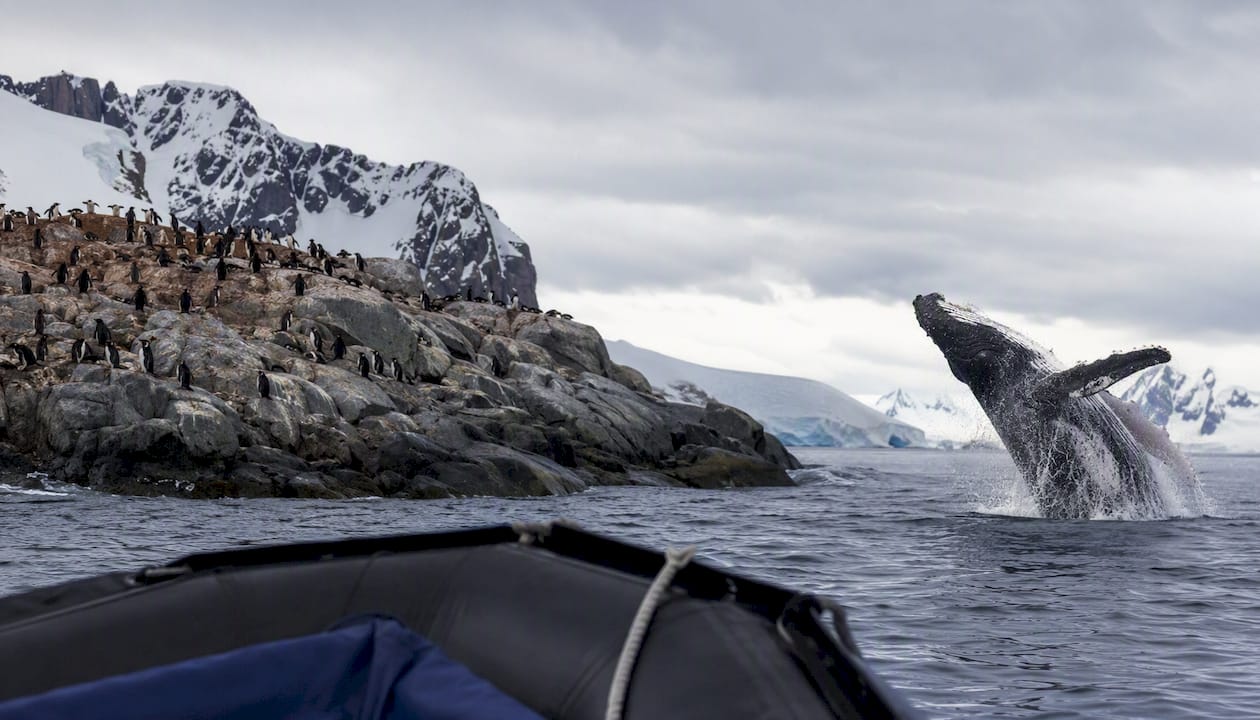
The honest answer is that Antarctica is not a destination you visit for the amenities. You go for the wildlife, the silence, and the sheer improbability of standing on the seventh continent. A penguin colony of 100,000 birds, a humpback whale surfacing 20 feet from your Zodiac, a glacier calving into still water at midnight in the austral summer: these moments do not have a price ceiling that feels unreasonable once you are there.
What I find most underestimated is the value of the onboard expertise. On a well-chosen small ship, your expedition team includes marine biologists, ornithologists, glaciologists, and photographers who give lectures every evening and lead every landing. That depth of interpretation transforms what could be a scenic boat ride into something genuinely educational and moving. The ship size matters enormously here: a 200-passenger vessel simply cannot deliver the same landing access or naturalist ratio as a 90-passenger boutique expedition ship.
The one honest caution: weather-dependent logistics mean flexibility is not optional, it is required. Charter flights get delayed. Landings get cancelled due to wind. Itineraries shift. Travelers who need a rigid schedule or who cannot tolerate uncertainty will find Antarctica stressful rather than exhilarating. Book with a flexible cancellation policy, buy comprehensive insurance, and work with an advisor who has managed polar disruptions before. Elitetravelgroup’s 35 years of luxury travel experience includes exactly that kind of contingency planning.
Plan your Antarctica cruise with Elitetravelgroup
Antarctica is one of the most logistically complex trips a traveler can take, and the difference between a good experience and an exceptional one often comes down to who built the itinerary. Elitetravelgroup specializes in exactly this: assembling the full picture, fare, flights, insurance, transfers, and onboard extras, into a single all-in budget with no surprises.
The agency’s Antarctica vacation packages are built around your priorities: the right ship for your travel style, the right cabin for your budget, and the right departure month for the wildlife you want to see. With 35 years of luxury travel experience, no service fees, and a price-match guarantee, Elitetravelgroup gives you the expertise of a seasoned polar travel specialist without adding to your trip cost. The team is available 24/7, which matters when a charter flight gets delayed or a cabin upgrade becomes available at 11 PM.
To get a bespoke all-in quote for your Antarctica expedition, visit the benefits of luxury travel planning page or contact the concierge team directly to start building your itinerary.
Sources
The figures and guidance in this article draw from the following primary sources:
