




TL;DR:
- Seamless travel planning integrates all trip stages into a coordinated system, reducing manual gaps and disruptions.
- Using AI tools for sequencing and organization enhances personalization, flexibility, and contingency planning, especially for complex trips.
Seamless travel planning is the practice of coordinating every trip component, from initial research through post-trip follow-up, into one unified experience that eliminates manual gaps and friction. The industry term for this approach is end-to-end travel management, and it removes the “seams” between airlines, hotels, transfers, and activities so travelers move through each stage without scrambling to reconnect the pieces. Tools like Jenova and TripIt now sit at the center of this shift, while AI adoption is accelerating how quickly personalized itineraries get built. For anyone planning a complex trip, understanding this methodology is the difference between a trip that flows and one that constantly requires damage control.
What is seamless travel planning, and why does it matter?
Seamless travel planning is defined as the full integration of pre-trip planning, booking, pre-departure preparation, in-trip support, and post-trip reconciliation into a single coordinated process. Each stage hands off cleanly to the next, so you never face a gap where one vendor’s information contradicts another’s. The result is what Forbes describes as fewer interruptions and wait times, enabled by backend coordination that technology quietly automates.
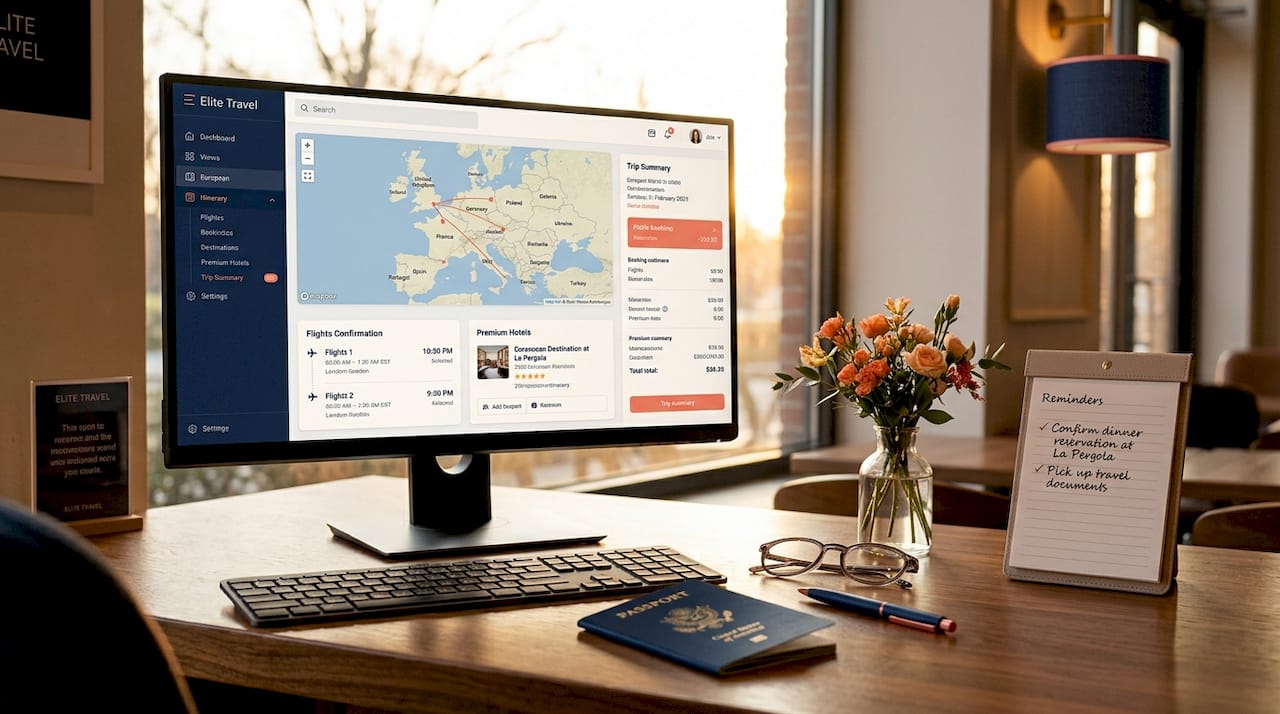
What separates this from ordinary trip planning is the deliberate design of handover points. You are not trying to make transitions invisible. You are making them smooth. A well-coordinated airport transfer that meets you at baggage claim, a hotel check-in pre-loaded with your preferences, a restaurant reservation timed to your arrival flight: these are the markers of a trip built with integration in mind, not assembled from disconnected bookings.
The practical payoff is significant. When disruptions occur, such as a delayed flight or a hotel overbooking, a properly integrated plan has contingency layers already in place. Proactive in-trip support with response times under 90 seconds is the standard that separates reactive travel management from truly effortless travel experiences. That speed matters most when things go wrong at 11 p.m. in an unfamiliar city.
What components and stages make up a seamless trip?
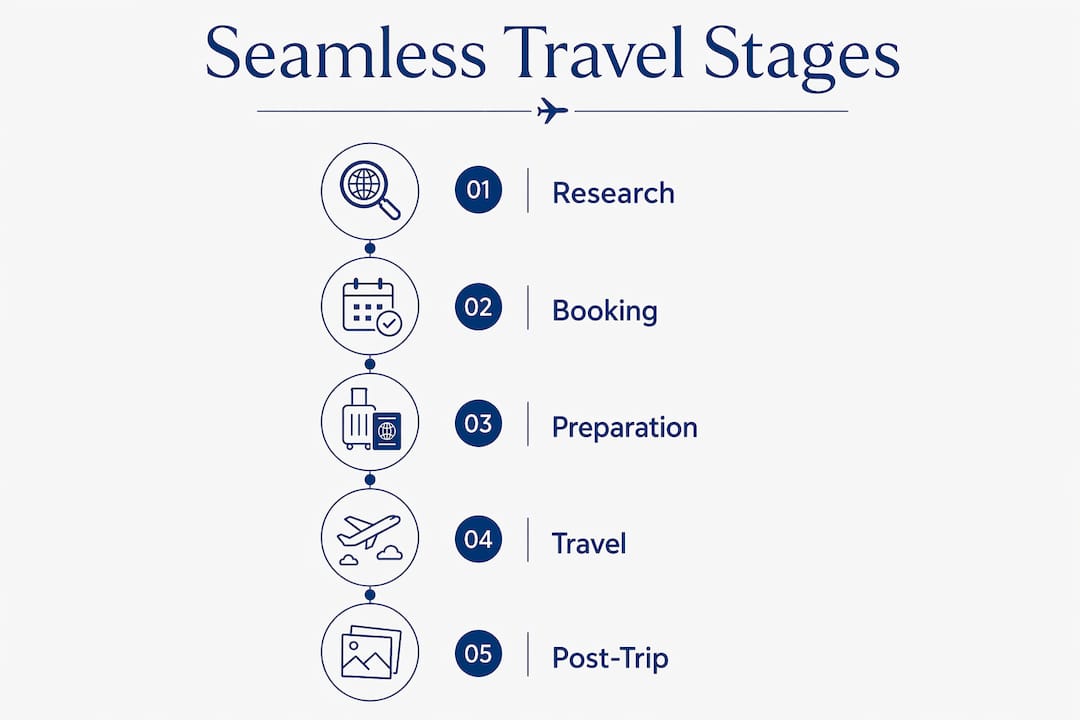
The five stages of end-to-end travel management each carry specific responsibilities. Understanding where friction typically enters helps you design it out before departure.
| Stage | Traditional approach | Seamless approach |
|---|---|---|
| Pre-trip planning | Separate searches across multiple sites | Unified research with AI-generated routing |
| Booking | Manual coordination across vendors | Integrated booking with shared data |
| Pre-departure prep | Last-minute document checks | Automated reminders and health/visa timelines |
| In-trip support | Call center hold times | Proactive alerts and sub-90-second response |
| Post-trip follow-up | No structured reconciliation | Expense review, feedback loops, future planning |
The pre-trip stage is where most travelers lose the most time. Searching flights on one platform, hotels on another, and activities on a third creates three separate data streams that never talk to each other. A seamless model pulls these into one view, either through a travel management platform or a concierge service that owns the coordination.
Booking is where data fragmentation becomes dangerous. When your airline record, hotel confirmation, and transfer booking each live in separate systems, a single change, such as a flight reschedule, requires manual updates across all three. Integrated booking platforms or a dedicated travel advisor eliminate that cascade of manual fixes.
Pre-departure preparation is the most underestimated stage. Passport validity, visa requirements, travel insurance activation, and health documentation all have deadlines that arrive faster than most travelers expect. Service integration between traveler, agencies, and vendors defines what the industry now calls Travel 3.0, and it starts with getting these logistics locked in well before the airport.
How do AI and technology enhance the planning process?
AI travel planning and itinerary organizing are two distinct functions that travelers frequently conflate. An itinerary organizer like TripIt consolidates existing bookings into an accessible timeline but does not generate routing logic or optimize sequencing. An AI travel planner like Jenova generates coherent, sequenced day-by-day plans based on your preferences, budget, and constraints, actively reducing backtracking and aligning activity transitions.
The distinction matters because using only an organizer gives you better access to what you already booked. Using an AI planner gives you a smarter plan to begin with. The best approach combines both: generate a well-sequenced itinerary with an AI tool, then import confirmed bookings into an organizer like TripIt for real-time access during the trip.
Personalization is where AI adds the most value that traditional planning cannot replicate at scale. A well-trained AI planner accounts for your travel pace, dietary restrictions, preferred activity intensity, and budget ceiling simultaneously. It also adapts in real time when conditions change, rerouting a day’s activities around a museum closure or a weather event without requiring you to rebuild the entire schedule manually.
Pro Tip: For multi-destination trips spanning three or more cities, use an AI planner to generate the routing sequence first, before booking any transportation. Locking in flights before optimizing the city order is one of the most common and expensive mistakes in complex trip planning. A tool like Jenova or Trip.Planner can identify the most logical sequence before you commit to any tickets.
For luxury transportation between destinations, AI-enhanced concierge services now integrate directly with itinerary platforms, so ground transfers update automatically when flight times shift.
What practical steps produce a well-coordinated trip?
Building a trip that holds together under real-world conditions requires a specific sequence of decisions. Here is the framework that works consistently for international travel.
Start 6 to 12 months out for international trips. Early planning for international travel secures better flight and hotel availability, allows time for visa processing, and removes the pressure that compresses decision quality. For Europe in peak season, 9 to 12 months is the realistic minimum for premium options.
Audit your documents before anything else. Passport validity, visa requirements, and vaccination records should be confirmed before you book a single flight. Many countries require six months of passport validity beyond your return date, a detail that invalidates bookings if discovered at check-in.
Secure travel insurance at the time of first booking. Coverage for pre-existing conditions and trip cancellation typically requires purchase within 14 to 21 days of your initial deposit. Waiting until the week before departure eliminates most meaningful protection. Elitetravelgroup’s travel insurance guide covers the coverage types worth prioritizing.
Build a tiered itinerary with fixed anchors and flexible layers. Tiered itinerary structures combine fixed anchors such as flights and hotel check-ins with preferred activities and backup options for each day. This structure absorbs disruptions without collapsing the entire plan.
Use an AI planner for sequencing, then an organizer for access. Generate your routing logic first, confirm bookings second, and import everything into a centralized organizer for in-trip use. This two-tool approach covers both the planning and execution phases.
Assign a single point of contact for disruption management. Whether that is a travel advisor, a 24/7 agency, or a travel management platform, having one number to call when something breaks is worth more than any app feature. Fragmented support across multiple vendors is where most travel experiences fall apart.
What challenges prevent truly frictionless travel?
The biggest structural obstacle to effortless travel planning is data fragmentation across the industry. Nearly half of airlines cite data integration as their primary technology challenge, which means that even when travelers do everything right, the systems behind their bookings are not always talking to each other. High technology investment alone does not produce coordination without the data infrastructure to support it.
For travelers, this fragmentation shows up as:
- Flight delay notifications that do not automatically trigger hotel or transfer updates
- Loyalty program data that does not carry across partner properties
- Visa and health requirement changes that are not pushed to travelers proactively
- Booking confirmations that use different name formats, creating check-in friction
The second challenge is a conceptual one. Seamless travel is not about making every transition invisible. As TTG Asia notes, smooth handovers between operators define the standard, not the elimination of transitions themselves. A transfer between a train and a hotel is always going to exist. The goal is that the driver knows your train number, the hotel knows your arrival time, and nobody asks you to repeat information you already provided.
Current AI tools also have real limits. They generate strong routing logic but cannot always account for local knowledge, seasonal nuances, or the kind of on-the-ground intelligence that comes from a travel advisor who has personally visited a destination. AI-generated itineraries work best as a starting framework that a knowledgeable human refines, not as a finished product.
Pro Tip: When evaluating whether a travel plan is truly well-coordinated, ask one question: if my first flight is delayed by four hours, what breaks? If the answer is more than one thing, the plan needs more contingency layers before you leave.
Key takeaways
Seamless travel planning works because it integrates every trip stage into one coordinated system, replacing manual fixes with proactive design and real-time support.
| Point | Details |
|---|---|
| Define the approach correctly | End-to-end travel management unifies all five trip stages to eliminate coordination gaps. |
| Use AI for sequencing first | Generate routing logic with tools like Jenova before locking in any transportation bookings. |
| Build tiered itineraries | Combine fixed anchors with flexible backups to absorb disruptions without rebuilding the plan. |
| Start planning 6 to 12 months out | Early timelines secure better options and allow document and visa prep without pressure. |
| Design for smooth handovers | The goal is not invisible transitions but well-coordinated ones where information flows between operators. |
Why I think most travelers are solving the wrong problem
After years of working in and around luxury travel, the pattern I see most often is travelers investing heavily in the right tools and still ending up with a fragmented experience. They have TripIt, a flight tracker app, a hotel loyalty app, and a restaurant reservation platform, and they spend the trip switching between five screens. The problem was never a lack of tools. It was a lack of integration.
The travelers who consistently report the best experiences are not the ones with the most apps. They are the ones who made a single decision early: to put one person or one system in charge of the whole trip. That might be a concierge-level travel advisor, a well-configured travel management platform, or a combination of an AI planner and a human expert who knows the destination personally.
What I have also found is that flexibility is not the enemy of planning. It is the product of good planning. When your anchors are locked in and your contingencies are mapped, you can move freely within the trip because you know the structure will hold. The travelers who feel most stressed mid-trip are usually the ones who over-planned the activities and under-planned the logistics. Flip that ratio and the experience changes completely.
The benefits of luxury travel planning go beyond comfort. They are about reclaiming your attention during the trip itself, because someone else has already solved the problems you have not encountered yet.
Plan your next adventure with Elitetravelgroup
Elitetravelgroup has spent 35 years building the kind of trip infrastructure that makes every stage feel effortless. From the first itinerary conversation to the moment you return home, every detail is coordinated by advisors who know the destinations, the partners, and the timing that turns a good trip into an exceptional one.

Elitetravelgroup charges no service fees, offers a price match guarantee, and operates 24/7 because disruptions do not follow business hours. If you are ready to experience what fully coordinated travel actually feels like, explore Elitetravelgroup’s luxury adventure travel packages and see how a properly integrated itinerary changes everything about how you travel.
FAQ
What is seamless travel planning in simple terms?
Seamless travel planning is the coordination of all trip stages, from research and booking through in-trip support and post-trip follow-up, into one unified process that eliminates manual gaps. The goal is that each stage hands off cleanly to the next without requiring the traveler to reconnect the pieces.
How is AI travel planning different from an itinerary organizer?
An AI travel planner like Jenova generates sequenced, optimized day-by-day itineraries based on your preferences and constraints. An organizer like TripIt consolidates bookings you have already made into an accessible timeline but does not create routing logic or optimize your schedule.
How far in advance should I start planning an international trip?
Start 6 to 12 months before departure for international travel, particularly for Europe during peak season. This timeline allows for visa processing, document checks, better flight and hotel availability, and travel insurance purchase within the required window for full coverage.
What is the biggest obstacle to truly frictionless travel?
Data fragmentation across airlines, hotels, and vendors is the primary barrier. Nearly half of airlines identify data integration as their top technology challenge, which means that even well-planned trips can break down when systems fail to communicate changes automatically.
Do I need a travel advisor if I use AI planning tools?
AI tools provide strong routing logic and personalization at scale, but they lack local knowledge, seasonal nuance, and real-time human judgment. The most effective approach combines AI-generated itineraries with a customized itinerary expert who can refine the plan and manage disruptions when they occur.
