




TL;DR:
- Destination management involves the strategic coordination of infrastructure, governance, visitor experience, and sustainability to ensure a destination’s long-term competitiveness and livability. It extends beyond marketing, focusing on planning, stakeholder engagement, and environmental stewardship, often through DMO strategic leadership and DMC local execution. Effective destination management balances growth with environmental and community needs, preventing over tourism and ensuring authentic experiences.
Most people assume destination management is just a fancier term for destination marketing. It is not. What is destination management, really? It is the strategic coordination of every element that shapes a place — infrastructure, governance, visitor experience, community well-being, and environmental impact — all working together to make a destination competitive and livable over the long term. If marketing answers “How do we attract visitors?”, management answers “What happens when they arrive, and is any of this sustainable?”
Table of Contents
- Key takeaways
- What destination management really means
- Destination management vs. destination marketing
- DMOs and DMCs: who actually does the work
- Destination management in practice
- Future trends shaping destination management
- My take: why most destination failures are management failures
- How Elitetravelgroup applies destination management expertise
- FAQ
Key takeaways
| Point | Details |
|---|---|
| More than marketing | Destination management covers infrastructure, governance, and resident well-being far beyond promotional campaigns. |
| DMOs lead strategy | Destination management organizations provide strategic leadership, governance, and performance monitoring for entire destinations. |
| DMCs execute locally | Destination management companies handle on-the-ground logistics, supplier networks, and local expertise for specific events or trips. |
| Partnerships drive success | Public-private-community partnerships consistently outperform government-only models in resource integration and long-term planning. |
| Sustainability is central | Effective destination management balances visitor growth with environmental limits and the needs of local communities. |
What destination management really means
Destination management explained at its core: it is the process of coordinating all the moving parts that determine whether a place thrives or gets overwhelmed by its own popularity. The destination management framework encompasses infrastructure, environmental health, resident well-being, and visitor experience, not just marketing campaigns.
The main pillars of destination management include:
- Governance: Who makes decisions, how policies get set, and how different organizations share authority over a destination.
- Planning and product development: Creating experiences, attractions, and services that align with what a destination wants to be known for.
- Sustainability and regenerative practices: Going beyond “minimizing harm” to actively restoring ecosystems and strengthening local communities.
- Monitoring and performance measurement: Tracking visitor satisfaction, environmental indicators, and economic outcomes to course-correct in real time.
What does destination management involve in practice? It means a city deciding to cap cruise ship passenger arrivals. It means a mountain town investing in trail restoration alongside its tourism marketing budget. It means a region consulting with local residents before building new resort infrastructure. None of that is marketing. All of it is management.
Pro Tip: If you are evaluating a destination for a major trip, milestone event, or group experience, check whether it has a published destination management plan. It tells you immediately whether the place is thinking long-term or just chasing visitor numbers.
Destination management vs. destination marketing
This distinction matters more than most people realize, and the confusion between the two causes real problems for destinations.
Destination marketing is a focused discipline. It targets specific visitor segments, builds brand awareness, runs advertising campaigns, and drives bookings. Done well, it fills hotels and generates economic activity. Done without management behind it, it can overwhelm a place.
Destination management is the broader operating system underneath. Here is how the two roles divide:
- Destination marketing creates demand and shapes how a place is perceived externally.
- Destination management shapes the conditions that make a destination worth visiting repeatedly.
- Marketing answers to visitor acquisition metrics like bookings, arrivals, and revenue per trip.
- Management answers to resident satisfaction scores, environmental carrying capacity, infrastructure quality, and long-term competitiveness.
- Marketing typically operates on campaign cycles of months. Management operates on planning cycles of five to ten years.
The clearest real-world illustration of why this distinction matters is overtourism. Cities like Venice and Dubrovnik invested heavily in destination marketing for decades, attracting record visitor numbers. Without proportional investment in destination management, those numbers became a crisis. Overcrowded streets, priced-out residents, degraded cultural sites. The UN Tourism framework now identifies strategic leadership, governance, and implementation as the three critical performance areas for destinations trying to reverse these effects.
Management without marketing leaves a destination invisible. Marketing without management leaves it broken. The two need each other, but they are not the same thing.
DMOs and DMCs: who actually does the work
Two types of organizations carry most of the operational weight in destination management, and mixing them up leads to real planning mistakes.
| DMO (Destination Management Organization) | DMC (Destination Management Company) | |
|---|---|---|
| Scope | Entire destination or region | Specific event, program, or client group |
| Role | Strategic leadership, policy, long-term planning | On-the-ground logistics, supplier coordination |
| Funding | Public, membership-based, or mixed | Fee-for-service, private |
| Accountability | Destination stakeholders, government | Client paying for the program |
| Examples | Visit California, NYC Tourism | Local event production company in Rome |
DMOs function as the governing intelligence of a destination. They set strategies, align stakeholders, manage data, and advocate for policy changes. Strategic leadership and governance are now considered the core KPIs that define whether a DMO is actually performing or just producing marketing collateral.

DMCs are where strategy meets execution. A destination management company operating in, say, the Amalfi Coast knows which suppliers can actually deliver, which permits take three weeks versus three days, and which local guides will make your group feel like insiders rather than tourists. DMCs coordinate 20 to 50 local suppliers for a single program, compressing what would take an outside planner months into a few calls. For complex international events, DMC local regulatory knowledge is simply not replicable by remote planners. This is why organizations planning incentive trips, corporate retreats, or high-stakes group experiences typically work with both: a DMO that tells them about the destination’s priorities and a DMC that makes things happen on the ground.
Research shows that a public-private-community partnership model consistently produces better outcomes than government-led models alone. With 271 participants studied, that research demonstrated how diverse stakeholder perspectives, when genuinely integrated, create stronger resource allocation and value for everyone involved, residents included.
Pro Tip: When planning a luxury group trip or corporate incentive program, always ask your travel partner whether they work with an established local DMC at your destination. The difference between a good trip and an exceptional one often comes down to who actually knows the place.
Destination management in practice
The benefits of destination management become tangible when you look at specific examples. Vermont offers one of the clearest recent illustrations. In 2026, the state launched its first formal destination management plan, built through public engagement and designed to grow tourism sustainably across a five to ten year horizon. Tourism already supports 9% of Vermont’s GDP, generating $4.2 billion and drawing 16 million visitors annually. Without active management, those numbers could easily become a liability.
The key elements of effective destination management in action look like this:
- Stakeholder mapping: Identifying every group with a stake in the destination’s success, from hotel operators and tour guides to farmers, schools, and neighborhood associations.
- Carrying capacity analysis: Determining how many visitors specific sites, trails, or neighborhoods can absorb without degrading the experience or the environment.
- Data-driven decision making: Using visitor flow data, sentiment analysis, and economic indicators to adjust strategies in real time rather than reacting to crises after they occur.
- Community integration: Building local residents into the planning process, not as an afterthought but as a foundational voice in what kind of tourism the destination wants.
For travelers and organizations, understanding destination management strategies gives you a practical edge. Destinations with active management plans tend to have better-organized visitor experiences, clearer booking systems, more authentic cultural programming, and less of the overcrowding that turns a dream trip into a frustrating one. Local partners who understand the destination’s management priorities can open doors that standard bookings simply cannot.
Future trends shaping destination management
The field is changing fast. Two forces are reshaping how destinations think about management right now.
The first is digital transformation. Destination managers increasingly rely on predictive analytics, real-time crowd monitoring, and AI-powered visitor flow tools to make decisions that used to take months. However, scalable, modular technology platforms are not yet standard across the industry. Experts note that funding models and partnerships with universities and NGOs are needed to close the technology gap between well-resourced destinations and emerging ones.
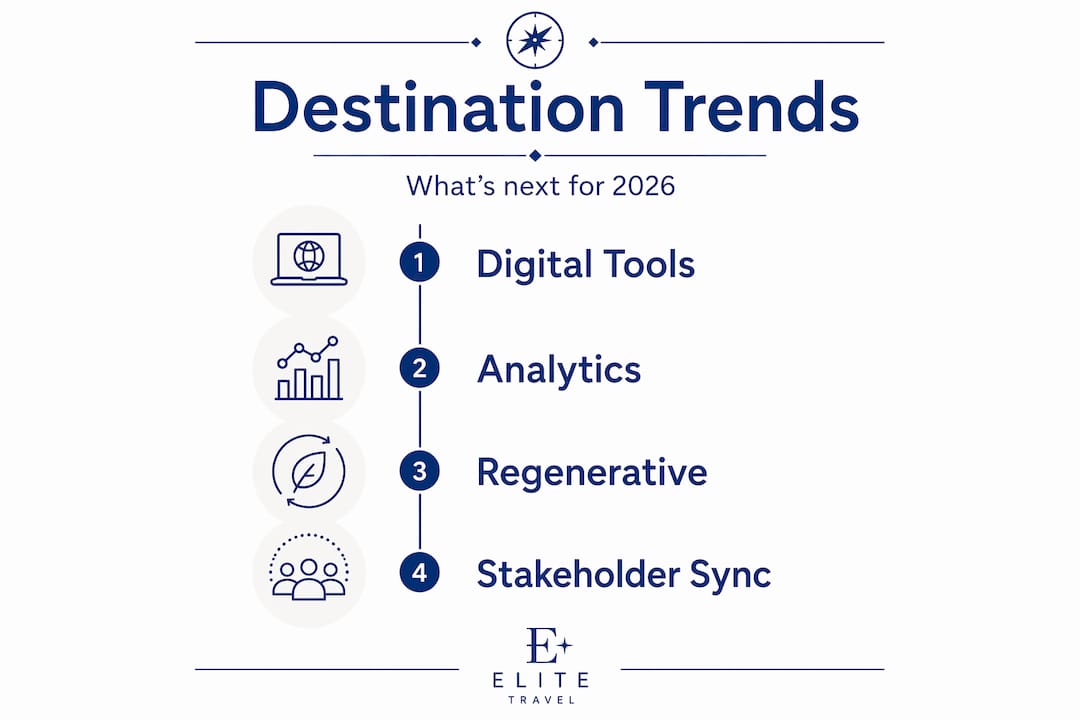
The second is the shift toward regenerative tourism. This is the idea that tourism should leave a destination measurably better, not just intact. Destinations adopting regenerative frameworks are designing visitor programs that actively fund habitat restoration, support local artisans, and require operators to meet environmental standards as a condition of participation.
The biggest obstacle to both? Not money. Weak inter-institutional coordination consistently limits destination development more than budget constraints do. Getting a transport authority, a hotel association, an environmental agency, and a local government to agree on priorities and act together remains the hardest problem in the field.
My take: why most destination failures are management failures
I have watched destinations chase marketing metrics while quietly eroding the things that made them worth visiting in the first place. The pattern is painfully predictable. A destination gets hot, marketing budgets increase, visitor numbers spike, and no one has a governance plan for what comes next.
What I find most valuable about genuine destination management is that it forces honesty. You cannot have an infinite number of visitors and a pristine natural environment at the same time. You cannot promise an authentic cultural experience and also allow unchecked resort development. Management makes those trade-offs explicit and allocates responsibility for them.
From my perspective, travelers benefit enormously from choosing destinations that take management seriously, even if they never know the term. When a place feels organized, authentic, and unhurried, that is almost always the result of deliberate management strategy, not luck. And for organizations planning group experiences or incentive programs, knowing how to leverage destination management expertise, through the right DMC, with support from an experienced travel partner, is often the difference between a trip people remember and one they merely survive.
The importance of destination management is not abstract. It shows up in whether your hotel is worth the price, whether the local experiences feel real, and whether the destination will still be worth visiting in ten years.
How Elitetravelgroup applies destination management expertise
Knowing what destination management involves is one thing. Having a travel partner who has already done that work on your behalf is something else entirely.
Elitetravelgroup has spent 35 years building relationships with the right local partners, the kind of on-the-ground experts who make destination management real rather than theoretical. Whether you are planning a luxury adventure trip, an incentive program for your top performers, or a milestone celebration in Europe, Elitetravelgroup connects you with vetted DMC networks and locally-sourced experiences that reflect how each destination actually works. For corporate groups, our incentive travel programs are designed with destination priorities in mind, not just logistics. No service fees, a price match guarantee, and 24/7 support mean you get expert-level destination access without any of the usual trade-offs. Reach out and let us show you the difference that real destination knowledge makes.
FAQ
What is destination management in simple terms?
Destination management is the strategic coordination of all elements that shape a travel destination, including infrastructure, governance, visitor experience, and sustainability. It goes far beyond marketing to address how a place remains competitive and livable over time.
What is the difference between a DMO and a DMC?
A DMO (destination management organization) provides strategic leadership and long-term planning for an entire destination, while a DMC (destination management company) handles on-the-ground logistics and supplier coordination for specific events or client programs.
Why does destination management matter for travelers?
Destinations with active management plans tend to offer better-organized experiences, less overcrowding, and more authentic cultural programming. Understanding which destinations invest in management helps travelers choose places that will genuinely deliver.
What are the key elements of destination management?
The core elements include governance and policy, product development, stakeholder engagement, sustainability planning, and performance monitoring. These work together to balance visitor growth with environmental and community health.
What is a destination management plan?
A destination management plan is a formal document that sets goals, strategies, and timelines for how a destination will develop its tourism sector. Vermont’s 2026 plan, for example, was built through public engagement to guide sustainable tourism growth over five to ten years.
