




TL;DR:
- Travel assistance provides real-time, human support for emergencies like flight cancellations, medical issues, and document theft. It differs from insurance by actively coordinating solutions during crises rather than reimbursing costs afterward. Having a dedicated, multilingual, and authorized support team enhances travel security, especially in complex or urgent situations.
There is a moment every traveler knows: a flight canceled at midnight in a foreign city, a lost passport two days before a connection, a child running a fever in a hotel where nobody speaks your language. In those moments, you discover exactly why use 24/7 travel support is not a luxury add-on but a genuine necessity. The industry term for this is travel assistance, which covers real-time emergency coordination, rebooking, and logistical intervention. Digital apps and booking platforms are impressive, but they stop short when the situation gets personal, complicated, or urgent.
Table of Contents
- Key Takeaways
- Why use 24/7 travel support: what it actually covers
- Benefits of having a real person on call
- Why automation cannot replace a live agent
- How support differs for luxury, family, and corporate travelers
- How to choose and get the most from a support service
- My honest take on why this changed how I travel
- Elite Travel has your back around the clock
- FAQ
Key Takeaways
| Point | Details |
|---|---|
| Real-time help beats reimbursement | Travel assistance resolves crises as they happen; insurance pays back costs afterward. |
| Human judgment fills automation gaps | Live agents handle priority rebooking, medical coordination, and language barriers that apps cannot manage. |
| Every traveler type benefits differently | Luxury, family, and corporate travelers each face unique risks that round-the-clock support is designed to address. |
| Proactive prep maximizes the service | Register with your provider before departure and save contact details to access help faster in a real emergency. |
| Provider quality varies widely | Evaluate coverage scope, multilingual staffing, and rebooking authority before choosing a support service. |
Why use 24/7 travel support: what it actually covers
Most travelers assume “24/7 support” means a chatbot or an automated phone tree. Real travel assistance is something different. It is a live, human-staffed operation available around the clock through phone, dedicated app, and email, with the authority and resources to act on your behalf the moment something goes wrong.
The types of assistance a quality provider offers include the following:
- Emergency medical coordination: Connecting you to local hospitals, arranging medical evacuation when needed, and translating between you and local healthcare providers.
- Trip disruption and rebooking: Securing alternative flights, hotels, or ground transport when your original plans fall apart, often before alternatives sell out.
- Document and fraud recovery: Helping you report a stolen passport, replace travel documents, and access emergency funds. Services like Assist America cover members traveling more than 100 miles from home for up to 90 days, including fraud and document recovery support.
- Language assistance: Providing real-time interpretation so a language barrier does not turn a manageable problem into a serious one.
- Continuous monitoring: Tracking active disruptions, weather events, and political situations that could affect your itinerary.
One distinction every traveler needs to understand: travel assistance versus insurance are not the same product. As AXA Travel Insurance explains, assistance provides real-time coordination during an emergency while insurance reimburses eligible costs afterward. Waiting weeks for a reimbursement check does nothing for you when you are stranded at 2 a.m. needing a hotel room tonight.
Here is a quick comparison of what each service does in practice:
| Scenario | Travel Assistance | Travel Insurance |
|---|---|---|
| Flight canceled at midnight | Books alternative flight immediately | Reimburses cancellation cost later |
| Medical emergency abroad | Coordinates hospital, arranges evacuation | Covers eligible medical bills after filing |
| Lost passport overseas | Guides replacement process in real time | May reimburse emergency travel document fees |
| Language barrier with local provider | Live interpreter on the call | No coverage applies |
The access methods matter too. A provider worth having gives you a direct phone number with no hold queue, an in-app chat option, and email for non-urgent issues. Anything that routes you through a general customer service line first is not genuine round-the-clock travel help.
Benefits of having a real person on call
The core benefits of 24/7 travel assistance become clearest when you compare the outcome of having support against the outcome of not having it.

Consider a family rerouted through a secondary airport after a weather cancellation. Without live support, they spend two hours on hold with the airline, get offered seats on a flight 36 hours later, and pay out of pocket for two hotel nights. With an active travel assistance contact, an agent is already working alternative routings during that hold time, often securing seats on partner carriers the airline’s own app never surfaces.
The direct benefits break down like this:
- Faster resolution cuts the time between a problem appearing and a solution being in place, which directly limits cascading delays in complex itineraries.
- Cost containment matters more than most travelers realize. Immediate agent intervention prevents the kind of escalation that turns a missed connection into a $900 walk-up fare and two unplanned nights in a hotel.
- Proactive monitoring means your agent may call you before you realize there is a problem, alerting you to a gate change, a strike affecting your route, or a weather delay building at your destination.
- Reduced stress is a real, measurable benefit. Knowing that someone is already handling the situation changes the emotional experience of a disruption entirely.
- Medical confidence for travelers with pre-existing conditions, families traveling with children, or older travelers is significant. Integrated assistance workflows combining medical coordination, communication help, and document support reduce the number of separate calls a traveler must make during a crisis.
Pro Tip: Save your travel assistance number as a contact in your phone before you leave home, not after something goes wrong. When stress is high, the last thing you need is to search through emails for a hotline number.
Why automation cannot replace a live agent
The travel industry has invested heavily in apps, AI rebooking tools, and automated alerts. These tools handle routine tasks well. They fail predictably in complex situations, and travel emergencies are almost always complex.
Consider what actually happens when a flight cancels and 300 passengers all need to rebook simultaneously. An app can show you available seats. It cannot call the airline’s priority desk on your behalf, advocate for a traveler with a medical need, or negotiate a hotel rate through a corporate account while simultaneously arranging ground transport to a different terminal. Human judgment in real-time is what separates a resolved situation from a prolonged ordeal.
Four specific areas where automation consistently falls short:
- Priority access. Corporate and VIP travelers often have negotiated rebooking tiers. Accessing those tiers requires an agent with account credentials and the authority to use them. An app cannot do this.
- Special accommodations. Medical equipment transport, dietary-specific hotel arrangements, and accessible room requirements all need human verification and follow-through.
- Cultural and language nuance. A live agent who understands local business customs and speaks the language closes situations faster and with less friction.
- Emotional support. A frightened traveler dealing with a medical emergency or a family with a sick child needs reassurance alongside logistics. That is not something any algorithm delivers.
“Critical travel decisions often must be made with incomplete information. 24/7 support ensures immediate action to prevent cascading disruptions in complex itineraries.” — ATPI
The strongest providers today use AI to improve efficiency, flagging disruptions faster and routing cases to the right specialist. But the resolution is always human. That combination is where the real value lives.
How support differs for luxury, family, and corporate travelers
Round-the-clock travel help is not one-size-fits-all. Different traveler profiles face different vulnerabilities, and a strong provider calibrates their approach accordingly.
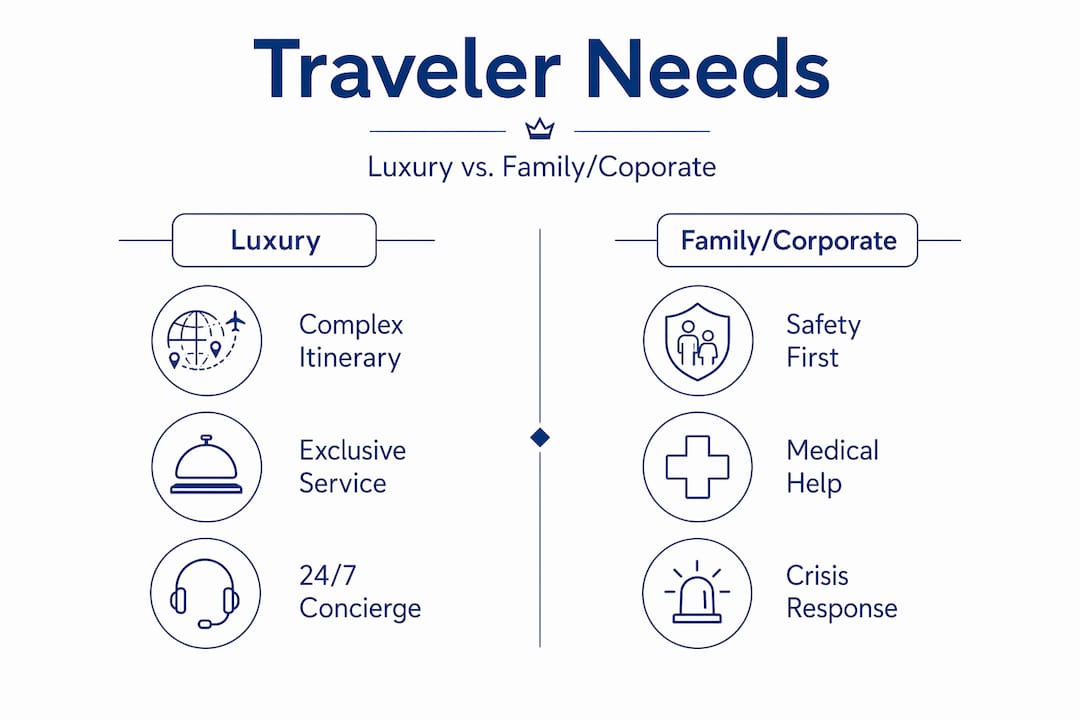
| Traveler Type | Primary Risk | What 24/7 Support Provides |
|---|---|---|
| Luxury | Complex itinerary disruption, privacy expectations | Discreet, priority rebooking; concierge-level alternative arrangements |
| Family | Medical emergencies, multi-party logistics, language gaps | Pediatric-aware medical coordination; multi-leg rebooking for the whole group |
| Corporate | Duty of care, business continuity, compliance | Duty-of-care compliance; real-time location tracking; policy-compliant rebooking |
Luxury travelers booking through an expert travel advisor have typically assembled intricate itineraries with timed experiences, private transfers, and reserved tables that cannot simply be rescheduled through an app. When a connecting flight goes down, the support team needs to understand the downstream effects immediately and preserve as much of the original experience as possible.
For families, the calculus is different. A private villa rental adds comfort and control, but the unfamiliar environment around it still requires backup. Multi-party rebooking when four or six tickets need to stay together, combined with pediatric medical support in a country where the healthcare system is unfamiliar, requires the kind of coordinated response only a live team can provide.
Corporate travel sits in its own category entirely. For industries like energy, marine, and mining, where specialist sector travel demands continuity and safety compliance, a missed connection is not just inconvenient. It can delay an operation, breach a duty-of-care requirement, or trigger regulatory issues.
Pro Tip: If you are booking a multi-generational family trip or a corporate group, confirm that your support provider has explicit experience with group rebooking. Rebooking a single traveler and keeping eight people on the same itinerary are entirely different operations.
How to choose and get the most from a support service
Not every service that calls itself “24/7” delivers genuine round-the-clock travel help. The quality gaps are significant, and knowing what to look for saves you from finding out too late that your provider cannot actually help when it counts.
When evaluating a provider, prioritize these factors:
- Rebooking authority: Can the agent actually ticket alternative flights on your behalf, or do they just advise you on options? There is a major difference.
- Multilingual staffing: A support line staffed only in English is not genuinely global. Confirm the languages covered and the hours each language is available.
- Medical coordination depth: Does the service handle only information referrals, or does it actively coordinate evacuation and hospital admissions? Real assistance goes well beyond giving you a phone number to call.
- Contact methods: Phone, app, and email access during all hours is the standard worth holding providers to.
- Coverage geography: Some services have gaps in coverage in certain regions. Confirm your specific destinations are included.
Once you have a provider, prepare before every trip. Register your travel details with the service if they offer a traveler profile or itinerary upload. Know the direct number. Brief any travel companions on how to reach support independently. These steps take five minutes before departure and can save hours during a disruption.
Avoid the common mistake of assuming your credit card travel benefit constitutes full travel assistance. Many card benefits are limited to information services only, with no actual rebooking or medical coordination authority.
My honest take on why this changed how I travel
I have been planning and taking complex trips for years, and I will tell you plainly: the moment I stopped treating 24/7 support as optional, my relationship with travel stress changed fundamentally. Not because disruptions stopped happening. They did not. But because the outcome of a disruption stopped being determined by how lucky I was or how long I could wait on hold.
The situation I remember most clearly was a multi-city Europe itinerary, two flights canceled in the same day due to an ATC strike. On my own, I was looking at a 28-hour gap with no hotel and a tour group that could not wait. With a live agent already working the phones while I stood in line at the airport, we had a workable alternative within 40 minutes. The apps showed me nothing useful. The agent knew which carriers had open seats on routes the apps had not surfaced yet.
What I have learned is that the emotional dimension matters as much as the logistical one. Knowing someone is already on it, that you do not have to figure it all out yourself in a language you do not speak in a city you do not know, is worth more than most travelers give it credit for. I actively look for luxury travel planning that builds this support in from the start rather than bolting it on as an afterthought.
My advice: stop thinking of round-the-clock support as insurance you hope you never use. Think of it as the thing that keeps a difficult day from becoming a ruined trip.
Elite Travel has your back around the clock
At Elitetravelgroup, 24/7 availability is not a feature we added. It is the way we have operated since day one, because travel does not respect business hours and neither do the clients we serve.

When you plan a luxury vacation, a milestone family trip, or a high-stakes corporate itinerary with Elitetravelgroup, a real expert is available around the clock from the moment you book until you are home. Whether you are looking at Europe vacation packages with complex multi-city routing or adventure travel packages in remote destinations, we bring 35 years of experience, zero service fees, and a price match guarantee together with live concierge-level support. When something unexpected happens, we are already working on it.
FAQ
What does 24/7 travel support actually include?
Travel assistance covers real-time emergency help including flight rebooking, medical coordination, document recovery, and language support. It is distinct from travel insurance, which reimburses costs after the fact rather than resolving situations as they happen.
Why can’t a travel app replace a live support agent?
Apps can display options but cannot negotiate priority rebooking, advocate for special accommodations, or provide the real-time human judgment needed in complex or medical emergencies. Live support remains critical precisely because emergencies are rarely simple.
Is 24/7 travel support worth it for family trips?
Yes. Families face compounded risks including multi-party logistics, pediatric medical situations, and language gaps. Round-the-clock assistance handles group rebooking and emergency coordination in a way that individual booking apps cannot replicate.
How do corporate travelers benefit from continuous travel support?
Corporate travelers need duty-of-care compliance and business continuity when disruptions occur outside office hours. Immediate intervention by a live agent prevents costly delays and keeps travelers aligned with company travel policies.
What should I look for when choosing a 24/7 support provider?
Prioritize actual rebooking authority, multilingual staffing, medical coordination depth, and confirmed coverage in your specific destinations. A provider that only offers information referrals rather than direct action is not delivering genuine travel assistance.
