




TL;DR:
- Personalized travel creates more satisfying and memorable journeys by matching itineraries to individual preferences. It increases traveler trust, satisfaction, and perceived value while supporting mental wellbeing through tailored pacing and comfort. Effective personalization requires early planning, detailed preferences, and ongoing adjustments to ensure an authentic and emotionally fulfilling experience.
Trip personalization is the practice of customizing travel experiences to match individual preferences, priorities, and emotional goals, producing measurably more satisfying and memorable journeys. 74% of travelers want personalized trips, and 73% say they are more likely to book when an itinerary fits their profile. That data alone answers why prioritize trip personalization: it is not a luxury add-on but the single most reliable driver of traveler satisfaction. Elitetravelgroup has built 35 years of expertise on exactly this principle, designing one-of-a-kind itineraries that reflect each client’s life, not a generic catalog.
Why prioritize trip personalization: the satisfaction and value case
Travelers using custom trip planners report 40% higher satisfaction and save 20–30% compared to package tours. That gap exists because personalization lets you spend money where it matters most to you, not where a tour operator’s margins dictate.
The mechanics behind that satisfaction boost are worth understanding. AI-driven personalization increases trust and perceived value, which then leads directly to higher traveler satisfaction. Trust is the relational mechanism that makes a customized trip feel worth every dollar. When you believe the itinerary was built for you, not assembled from a template, the entire experience registers differently.

Personalization also changes how you allocate your budget. A traveler who loves food but dislikes guided museum tours can redirect funds from entrance fees toward a private cooking class with a local chef. That reallocation is only possible when the plan is yours to shape. Package tours bundle costs in ways that hide this flexibility entirely.
Specific personalized attributes that consistently drive satisfaction include:
- Room preferences and early check-in/late check-out: Personalization features like room selection and flexible check times generate measurable value for travelers and hotels alike.
- Flexible scheduling: The ability to linger at a market or skip a crowded attraction without penalty changes the emotional tone of a trip.
- Local, interest-specific experiences: A private wine tasting in Burgundy or a sunrise hike in the Dolomites lands differently than a group bus tour to the same location.
- Personalized welcome amenities: Small details, like a favorite bottle of wine or a curated local gift, signal that someone paid attention.
Pro Tip: Before booking anything, write down your top three non-negotiable experiences and your top three things you want to avoid. Share both lists with your travel advisor. That single exercise eliminates the most common source of post-trip regret.
How does personalization affect mental wellbeing during travel?
41% of travelers prioritize mental wellbeing and actively seek trips that reduce cognitive load and deliver a genuine mental health reset. That figure reflects a real shift in what travelers expect from time away. A trip that forces you to navigate unfamiliar logistics, crowded group schedules, and mismatched activities does not restore you. It depletes you.
Personalized travel addresses this directly. When your itinerary matches your pace, your interests, and your comfort level, the mental effort of being on the road drops significantly. You are not constantly problem-solving or compromising. You are simply present.
Personalized travel shifts the experience from transactional to emotional, centering identity, values, and lifestyle alignment rather than a checklist of sights. A traveler who values silence and nature gets a fundamentally different trip than one who wants nightlife and urban energy. Both are valid. Neither is served well by the same package.
Personalized features that directly support wellbeing include:
- Sleep optimization: Choosing hotels based on noise levels, mattress quality, and blackout curtains is a real preference that affects how you feel every day of a trip.
- Flexible pacing: Building in unscheduled afternoons reduces decision fatigue and creates space for spontaneous discoveries.
- Comfort-based routing: Avoiding long layovers, choosing direct flights, or selecting train routes with scenic value all contribute to a calmer travel experience.
- Emotional safety: Staying in neighborhoods that feel walkable and familiar, rather than unfamiliar or isolating, matters more than most travelers admit before they go.
Pro Tip: Leave at least 30% of each day unscheduled. That buffer is where the best travel memories are made, and it is the single most underused tool in trip planning.
Personalized trips vs. package tours: what actually differs
The differences between a customized itinerary and a standard package tour go well beyond flexibility. They affect cost transparency, authenticity, crowd exposure, and how well the trip actually fits your life.
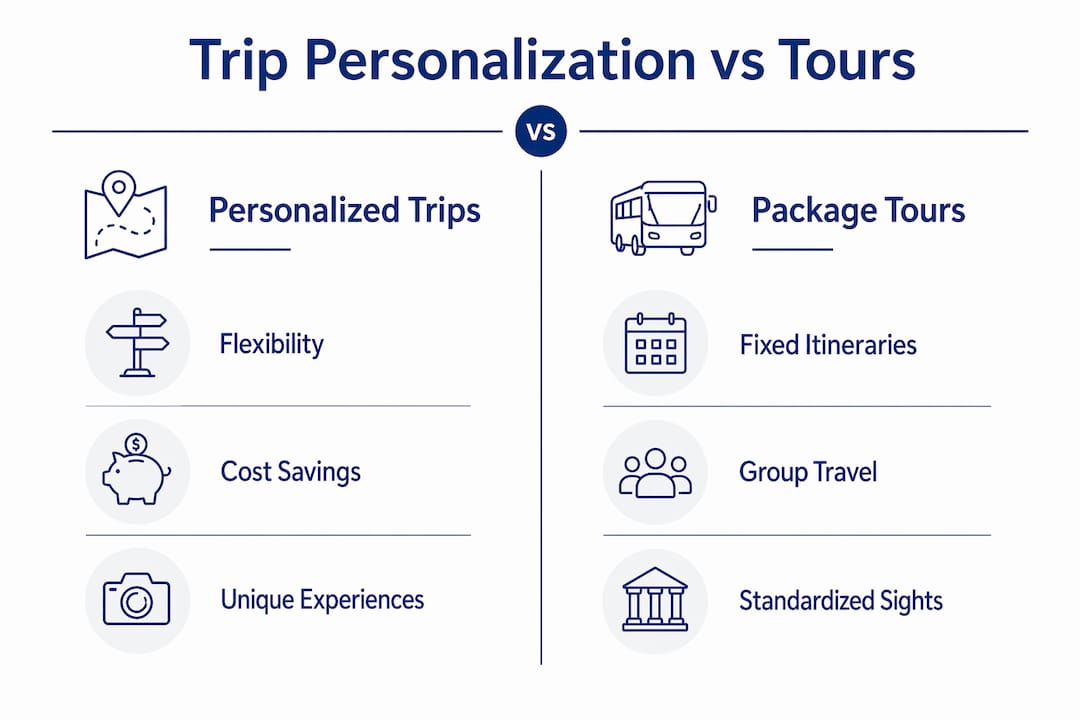
| Factor | Personalized trip | Package tour |
|---|---|---|
| Customization level | Built around your specific interests and pace | Fixed itinerary designed for the average traveler |
| Itinerary flexibility | Adjustable at any point, including during the trip | Locked in at booking; changes carry fees or are impossible |
| Cost transparency | You see exactly where money goes | Bundled pricing hides margins and unnecessary inclusions |
| Crowd avoidance | Timed visits and off-peak access are plannable | Group schedules align with peak hours by default |
| Authentic local access | Private guides, local restaurants, and hidden sites are standard | Attractions are chosen for group logistics, not depth |
| Response to change | Customized itineraries adapt instantly to weather, events, or mood | Disruptions affect the entire group with no individual remedy |
The crowd avoidance point deserves emphasis. Package tours, by design, move groups through the same sites at the same times. A personalized itinerary can schedule the Uffizi Gallery at 8:00 AM on a Tuesday, when foot traffic is a fraction of what it is at noon on a Saturday. That single scheduling decision changes the quality of the experience entirely.
True hyper-personalization begins in the planning phase with a deep understanding of traveler intent, not just service delivery. That means the best customized trips are shaped before departure, not patched together on arrival.
How to personalize your trip effectively: practical steps
Customizing travel experiences well requires more than picking a destination. It requires a clear method, enough lead time, and honest self-knowledge about what you actually want from time away.
Start 3–6 months ahead. The best hotels, private guides, and exclusive experiences book out early. Starting late forces compromises that undermine the entire point of personalization.
Document your preferences in detail. Pace, budget, mobility needs, dietary restrictions, interests, and deal-breakers all belong in a brief before any planning begins. Vague preferences produce vague itineraries.
Choose the right planning method. AI-based planning tools work well for straightforward trips with clear parameters. Professional travel advisors, like those at Elitetravelgroup, add value when the trip involves complex logistics, high stakes, or destinations where on-the-ground relationships matter. DIY planning suits experienced travelers with flexible schedules and low complexity.
Match your travel style to your itinerary structure. Wellness travelers need slower pacing and recovery time built in. Adventure travelers need contingency days for weather. Culture-focused travelers need depth over breadth, meaning fewer cities with more time in each.
Build in flexibility for spontaneity. Hyper-personalization incorporates traveler motivation and responsiveness as core design principles. An itinerary that cannot bend when you discover a local festival or a perfect afternoon is not truly personalized.
Revisit and adjust. A good personalized plan evolves. Check in with your advisor or review your itinerary 4–6 weeks before departure to incorporate new information, changed preferences, or updated travel conditions.
The benefits of personalized travel compound when you treat planning as an ongoing conversation rather than a one-time transaction. The travelers who get the most from customization are the ones who stay engaged with the process.
Pro Tip: After every trip, write down the three moments you would repeat and the three you would skip. That debrief becomes the foundation for your next personalized itinerary, and it gets sharper every time.
Key Takeaways
Trip personalization is the most reliable path to higher satisfaction, better value, and genuine mental restoration from travel.
| Point | Details |
|---|---|
| Satisfaction gap is measurable | Custom trip planners produce 40% higher satisfaction and 20–30% cost savings versus package tours. |
| Trust drives perceived value | AI-driven and advisor-led personalization builds trust, which directly increases how valuable a trip feels. |
| Mental wellbeing is a real goal | 41% of travelers seek trips that reduce cognitive load; personalized pacing and comfort choices deliver this. |
| Flexibility separates custom from package | Personalized itineraries adapt to weather, mood, and local events; package tours cannot. |
| Planning depth determines outcome | Starting 3–6 months ahead with detailed preferences produces the best customized results. |
What I have learned from watching personalization change travel
The most common mistake I see travelers make is treating personalization as an upgrade rather than a foundation. They book a standard itinerary and then ask for small tweaks. That is not personalization. That is decoration.
Real customization starts before a single hotel is chosen. It starts with understanding what kind of traveler you actually are, not the traveler you imagine yourself to be. I have seen people book adventure itineraries because they liked the idea, then spend the trip exhausted and resentful. I have seen culture-focused travelers pack six cities into ten days and remember none of them clearly.
The identity-driven shift in travel that researchers describe is real, and it is not just a trend. It reflects something travelers have always wanted but rarely been given: a trip that feels like it was made for them specifically. The emotional payoff of that experience is not subtle. Travelers who get it right come back changed in a way that generic tours simply do not produce.
The mental wellbeing dimension surprises people most. They expect to feel rested after a vacation. When they do not, they blame the destination. Almost always, the real cause is a mismatched itinerary. Personalization fixes that at the source. And the best personalized travel keepsakes from a well-matched trip carry weight precisely because the trip itself meant something specific to the person who took it.
My honest advice: invest more time in the planning conversation than you think you need to. The travelers who do that consistently come home with the stories worth telling.
How Elitetravelgroup builds trips around you
Elitetravelgroup has spent 35 years doing exactly what this article describes: building itineraries from the traveler outward, not from a catalog inward. Every client conversation starts with preferences, pace, and purpose before a single destination is confirmed.
Whether you want a luxury adventure travel package built around active experiences or a bespoke European itinerary shaped around art, food, and private access, Elitetravelgroup’s advisors bring 35 years of on-the-ground relationships to every plan. There are no service fees, a price match guarantee, and 24/7 support from first conversation to return flight. The result is a trip that fits your life, not someone else’s average.
FAQ
What is trip personalization in travel?
Trip personalization is the practice of customizing a travel itinerary to match an individual traveler’s specific preferences, pace, interests, and goals. It produces measurably higher satisfaction than standard package tours.
How much can personalized travel save compared to package tours?
Travelers using custom trip planners save 20–30% compared to package tours by allocating budget to high-value experiences rather than bundled inclusions they do not want.
Does personalization really improve mental wellbeing during travel?
Yes. 41% of travelers actively seek trips that reduce cognitive load and support mental health. Personalized pacing, comfort-based routing, and flexible scheduling all contribute directly to that outcome.
When should I start planning a personalized trip?
Start 3–6 months before departure. The best private guides, exclusive experiences, and preferred hotels book out early, and starting late forces compromises that reduce the quality of the final itinerary.
Is a travel advisor necessary for trip personalization?
A travel advisor is not always necessary, but adds clear value for complex trips, high-stakes occasions, or destinations where local relationships and on-the-ground knowledge matter. For straightforward trips with simple logistics, experienced travelers can personalize effectively on their own.
