




TL;DR:
- Local travel partnerships involve collaborations with local communities, artisans, and guides to create authentic and sustainable experiences. They enhance visitor engagement by offering unique cultural insights while ensuring economic benefits stay within the destination. Effective governance, clear benefit-sharing, and meaningful participation are essential for building lasting, equitable partnerships.
Local partnerships in travel are defined as structured collaborations between tourism operators, local businesses, artisans, guides, and communities that shape both the visitor experience and the economic health of a destination. These alliances are not a soft add-on to trip planning. They are the architecture beneath every authentic, sustainable travel experience. The World Economic Forum, UNESCO, and the International Social Tourism Organisation (ISTO) all point to the same conclusion: when local communities are genuine partners, tourism delivers more value to more people. This article breaks down how those partnerships work, why they matter, and how to build them well.
How does the role of local partnerships in travel shape visitor experience?
Local partnerships are the single most reliable source of authentic, differentiated travel experiences. A hotel can replicate luxury finishes anywhere in the world. What it cannot replicate is a third-generation ceramicist in Oaxaca teaching guests her family’s glazing technique, or a Maasai elder guiding a walking safari through land his community has managed for generations. Those moments exist only through deliberate collaboration with local people.
The impact shows up across every travel category. In luxury travel, destination specialists who maintain deep local relationships can secure access to private estates, closed archaeological sites, and family-run restaurants that never appear in public booking channels. In adventure travel, local guides carry knowledge of terrain, weather, and wildlife behavior that no international operator can match. In cultural tourism, partnerships with heritage bearers ensure that what travelers encounter is living tradition, not a staged performance.
The core benefits of community collaboration in travel for the visitor include:
- Authenticity: Experiences co-designed with local communities reflect genuine culture rather than a curated version of it.
- Exclusivity: Local partners unlock access that mass tourism channels cannot provide.
- Safety and context: Local guides interpret environments, social norms, and history with accuracy that outside operators lack.
- Memorability: Travelers consistently rate human connection and cultural depth as the defining factor in their most meaningful trips.
- Sustainability alignment: Travelers who care about responsible tourism can verify that their spending reaches the people who made the experience possible.
Pro Tip: When evaluating a travel itinerary, ask your agency to name the specific local partners involved and describe how those relationships were built. Vague answers signal a marketing claim, not a real partnership.
What economic and social benefits do local partnerships bring?
The economic case for local alliances in the travel industry is structural, not anecdotal. Up to 80% of tourism’s economic value flows to SMEs and local communities when partnerships are designed to prioritize local supply chains. That figure means the difference between tourism that enriches a destination and tourism that extracts from it.
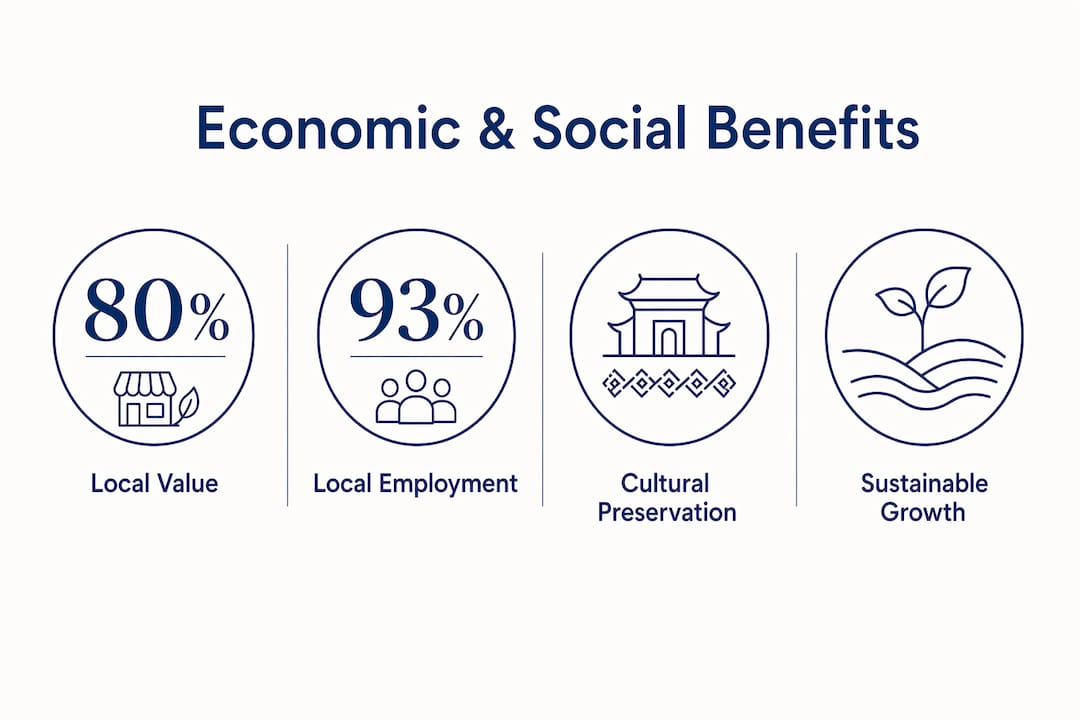
Two case studies illustrate what this looks like in practice.
In AlUla, Saudi Arabia, heritage restoration and local sourcing keep tourism revenues circulating within the community. Local artisans, guides, and small food producers are embedded in the visitor experience by design. The result is measurable income distribution and a preserved cultural identity that becomes the destination’s primary competitive asset.
At Witsieshoek Mountain Lodge in South Africa, the model is even more explicit. 93% of employees are from local communities, and 2% of annual turnover is deposited into a community trust. That trust functions as a financial buffer during low seasons and economic shocks. It also gives the community a direct stake in the lodge’s long-term success, which changes the entire dynamic of the relationship.
| Partnership Model | Economic Mechanism | Community Outcome |
|---|---|---|
| AlUla heritage sourcing | Local artisans and guides embedded in visitor programs | Income distribution, cultural preservation |
| Witsieshoek Mountain Lodge | 93% local employment, 2% turnover to community trust | Financial resilience, community ownership |
| Kemiren Tourism Village, Indonesia | Pentahelix model with government, academia, and media | MSME growth, promotional reach |
The social benefits extend beyond income. Employment in tourism gives communities agency over how their culture is presented and monetized. Profit-sharing structures like community trusts create local ownership models that outlast any single operator or season.
Pro Tip: When structuring a local partnership, define the benefit-sharing mechanism before the marketing plan. A community trust or local employment target written into the contract is worth more than any mission statement.
How do local partnerships enable sustainable tourism governance?
Governance is where most tourism partnerships either succeed or collapse. The difference between a genuine local alliance and a tokenistic one comes down to who holds decision-making power and how that power is exercised.

UNESCO’s approach in Eswatini’s Matsanjeni Cultural Landscape sets a clear standard. Community-led co-creation involves local leaders, government officials, and cultural stakeholders working together to write the sustainability plan itself. Communities are not consulted after decisions are made. They set the priorities, define the timelines, and hold coordination roles. This is co-governance, not co-branding.
The steps for building this kind of governance structure follow a clear sequence:
- Map stakeholders by role: Classify partners by authority (policy and regulation), direct impact (residents and businesses), and support (academics, media, NGOs). This framework, developed through ecotourism management research in Indonesia, prevents role confusion and ensures every group contributes where it has real capacity.
- Assign explicit responsibilities: Each partner needs a written role covering decisions they control, resources they manage, and outcomes they are accountable for.
- Build communication infrastructure: Briefings, shared calendars, and update channels are operational requirements, not administrative extras. The GSTC certification process in Trentino, Italy found that communication failures were the primary barrier to meaningful stakeholder involvement.
- Establish benefit-sharing terms contractually: ISTO warns that partnerships without explicit benefit controls risk “folklorization,” where community culture becomes a product controlled by outside interests while residents receive minimal return.
- Review and adapt: Governance structures need scheduled review points where all partners assess whether roles, benefits, and outcomes still reflect the original agreement.
“Inviting local stakeholders isn’t enough. Enabling their meaningful participation requires intentional information sharing and proactive engagement strategies.” — GSTC research, Trentino, Italy
The pentahelix model from Kemiren Tourism Village in Banyuwangi, Indonesia demonstrates what multi-stakeholder governance produces at scale. Government, community, academics, travel agencies, and media each held defined roles in a partnership that simultaneously addressed planning gaps, promotional reach, and local MSME development. No single actor could have produced that outcome alone.
How can travel professionals build effective local partnerships?
Building local partnerships that hold up over time requires more than goodwill and a handshake agreement. The process starts before the first conversation with a potential partner.
Identify partners by function, not just familiarity. The most visible local business is not always the right partner. Map the destination’s ecosystem: who controls access to key experiences, who employs the most residents, who holds cultural authority, and who has the logistics capacity to deliver consistently. Sourcing from local artisans, guides, and small businesses requires understanding that ecosystem before making commitments.
The distinction between marketing collaboration and governance collaboration matters here. Marketing collaboration means a local business appears in your promotional materials and receives referral bookings. Governance collaboration means that business has a seat at the table when itineraries are designed, pricing is set, and sustainability standards are defined. Both have value. Conflating them is where most partnerships go wrong.
Pitfalls to avoid include:
- Power asymmetries: When one partner controls all client relationships and revenue flow, the local partner becomes dependent rather than collaborative. Distribute client contact and revenue streams where possible.
- Folklorization: Presenting local culture as a fixed, exotic product rather than a living practice. This happens when outside operators control the narrative without community input.
- Token participation: Inviting local partners to meetings without giving them decision-making authority. Meaningful participation requires that community voices change outcomes, not just appear in the process.
- Benefit concentration: Routing most revenue to a single local intermediary rather than distributing it across the community. Structured employment targets and community trust contributions prevent this.
For travel professionals designing itineraries, destination management principles provide a framework for integrating local partnerships at the planning stage rather than adding them as an afterthought. UNESCO’s Latin America and Caribbean program demonstrates that community-based approaches can scale across multiple countries and stakeholder groups when the governance model is sound from the start.
Pro Tip: Build a partnership review into every annual contract. Ask local partners directly whether the arrangement is working for their community, not just for your clients. That conversation will tell you more than any satisfaction survey.
Key takeaways
Local partnerships are the structural foundation of sustainable tourism, not a marketing feature, and destinations that embed them into governance and benefit-sharing outperform those that treat them as optional.
| Point | Details |
|---|---|
| Economic impact is structural | Up to 80% of tourism value reaches local communities when partnerships prioritize local supply chains. |
| Governance requires explicit roles | Co-creation models like UNESCO’s Matsanjeni program assign clear responsibilities and timelines to every partner. |
| Communication is an operational requirement | Shared calendars and briefing cadences prevent the stakeholder disengagement that derails GSTC-certified destinations. |
| Benefit sharing must be contractual | Community trusts and local employment targets, like Witsieshoek’s 93% local hiring, create resilience that goodwill cannot. |
| Folklorization is a real risk | Partnerships without community control over narratives and benefits concentrate value outside the community. |
Why i think most tourism partnerships are still getting this wrong
After years of watching how travel agencies and destination operators describe their “local partnerships,” I’ve noticed a consistent gap between the language and the reality. The word “partnership” gets applied to everything from a referral agreement with a local driver to a decade-long co-governance arrangement with an indigenous community trust. Those are not the same thing, and treating them as equivalent does real harm.
The most important shift I’ve seen in destinations that get this right is the move from partnership as marketing to partnership as governance. AlUla and Witsieshoek are not exceptional because they found good local vendors. They are exceptional because they built structures where local communities hold financial stakes and decision-making authority. That is a fundamentally different design.
The uncomfortable truth for travel professionals is that genuine community collaboration takes longer to build, costs more to maintain, and requires giving up some control over how experiences are packaged and presented. Most operators are not willing to do that. The ones who are will define what premium travel looks like in the next decade, because travelers are getting better at telling the difference.
My advice: stop counting local partners as a feature and start treating them as co-authors of the experience. The trips that transform how travelers see the world are always the ones where local people had real creative and economic authority.
How Elitetravelgroup builds travel around real local connections
Elitetravelgroup has spent 35 years building the kind of on-the-ground relationships that turn a well-planned trip into something genuinely unforgettable. The agency works directly with local artisans, specialist guides, heritage property owners, and community-based operators across Europe and beyond, selecting partners based on cultural depth and community standing, not just availability.

Whether you are planning a private adventure travel experience in a remote destination or a curated Europe vacation built around access that standard booking channels cannot provide, Elitetravelgroup’s concierge approach means every local connection is vetted, briefed, and aligned with your specific itinerary. No service fees, a price match guarantee, and 24/7 support mean you travel with confidence from the first conversation to the final day. Reach out to start designing a trip where local expertise is built in from the start.
FAQ
What is the role of local partnerships in travel?
Local partnerships in travel connect visitors with authentic experiences while keeping economic value within host communities. They function as both an experience design tool and a sustainable development mechanism.
How do local partnerships improve traveler satisfaction?
Local guides, artisans, and community-based operators provide access, context, and cultural depth that standardized tourism products cannot replicate. Travelers consistently rate these human connections as the most memorable part of their trips.
What economic benefits do community partnerships deliver?
Up to 80% of tourism’s economic value reaches SMEs and local communities when partnerships prioritize local supply chains, according to the World Economic Forum. Structured models like community trusts and local employment targets amplify that impact.
How can travel agencies avoid exploitative partnership structures?
ISTO identifies power asymmetries and lack of transparency as the primary risks. Agencies should define benefit-sharing terms contractually, give local partners decision-making authority, and conduct annual reviews with community representatives.
What is folklorization in tourism partnerships?
Folklorization occurs when outside operators control how local culture is presented and monetized, reducing living traditions to static, commercialized performances. Preventing it requires community control over narratives, branding, and benefit distribution from the start.
Recommended
- The Role of Local Partners in Luxury Cruises
- The Role of Expert Partnerships in Travel Planning
- Expert Partners Shape Unforgettable Luxury Honeymoons
- How local partners transform your luxury travel experience
