




TL;DR:
- Effective itinerary design transforms travel bookings into a coherent, enjoyable experience by managing logistics, pacing, and emotional flow. It balances fixed anchors with open time, clusters activities geographically, and incorporates buffers to prevent delays from cascading, ensuring a stress-free trip. Personalization and strategic planning maximize meaningful moments while minimizing decision fatigue and travel anxiety.
Itinerary design is the practice of structuring a travel schedule to manage logistics, shape the traveler’s experience, and reduce the mental load of decision-making on the road. Most people treat it as a simple checklist. The best travel planners treat it as a craft. The role of itinerary design goes far beyond booking confirmations. It determines how rested you feel on day three, how much of a city you actually see, and whether a delayed flight derails your entire trip or barely registers. Done well, it turns a collection of reservations into a coherent, enjoyable experience.
How does itinerary design manage logistics and build confidence?
A well-built itinerary does one thing most travelers underestimate: it converts raw bookings into a trusted promise. According to The Travel Institute, including day summaries and specific logistics like airport-to-hotel transfers and pickup meeting points builds measurable client confidence and reduces pre-trip anxiety. That specificity matters because uncertainty is the primary source of travel stress.
Think about what a complete itinerary actually contains. It names the driver service meeting you at Charles de Gaulle, the hotel check-in time at a Marrakech riad, and the exact dock where your Amalfi Coast boat tour departs. Each detail removes a question you would otherwise carry in your head for days.
The Travel Institute also notes that trusted supplier partnerships with destination management companies (DMCs) and tourism bureaus are fundamental to delivering reliable itineraries. These relationships give planners vetted, firsthand information that generic booking platforms cannot replicate. Elitetravelgroup has built exactly this kind of partner network over 35 years, which is why their itineraries read like a local expert wrote them.
Presentation reinforces trust as much as content does. Structured itinerary presentation with clear headings, daily summaries, and visual aids like maps and icons improves comprehension and signals professionalism. A traveler who can scan their day at a glance feels in control. That feeling of control is the foundation of a genuinely relaxing trip.

Pro Tip: When reviewing any itinerary, check that every transfer includes a named provider, a pickup time, and a contact number. If any of those three are missing, ask for them before you travel.
Why does balancing structure and flexibility matter?
The most common itinerary mistake is over-scheduling. Filling every hour feels productive during planning but creates exhaustion and frustration on the ground. The proven fix is a 60/40 split: plan about 60% of trip time with fixed anchors and leave 40% open for spontaneity and rest. That open time is not wasted. It is where the best travel memories are made.
Here is how to apply this structure in practice:
- Lock in your anchors first. Flights, hotel check-ins, pre-booked tours, and restaurant reservations are non-negotiable fixed points. Schedule these before anything else.
- Build open blocks around anchors. A free afternoon in Lisbon or an unscheduled morning in Kyoto gives you room to follow a recommendation from a local or simply sit in a café without guilt.
- Group optional activities by interest, not urgency. List three or four things you want to do in each open block, then choose on the day based on energy and weather.
- Protect rest time explicitly. Write “rest” or “no plans” into the schedule. If it is not on the itinerary, it will get filled.
- Review the daily pace before you finalize. No day should require more than three major activities. Two is often better.
This approach directly addresses decision fatigue. When you arrive tired after a long flight, you do not want to choose between twelve options. You want to know exactly where you are sleeping and what time breakfast is. The 40% open time handles everything else.
Pro Tip: Schedule your most physically demanding activities for days two and three of any trip, not day one. Your body needs one full day to adjust to a new time zone and environment before you tackle a full-day hike or a packed museum schedule.
Does geographic clustering actually save time?
Geographic clustering is one of the highest-impact itinerary design best practices, and most travelers ignore it entirely. The principle is simple: group each day’s activities by neighborhood or zone rather than by category or interest. Clustering activities by neighborhood can cut transit and commute time by 30–50%. That is one to two hours per day returned to actual experience.
The table below shows the difference between a scattered day and a clustered day in Rome:
| Approach | Morning | Afternoon | Evening | Total Transit Time |
|---|---|---|---|---|
| Scattered | Colosseum (east) | Vatican (west) | Trastevere (southwest) | ~2.5 hours |
| Clustered | Colosseum (east) | Palatine Hill (east) | Testaccio (southeast) | ~40 minutes |
The scattered day is not wrong in terms of what you see. It is wrong in terms of how you feel by 6 p.m. The clustered day leaves you with energy for dinner and a walk instead of a taxi and a headache.
VoyagerNest recommends using anchor points and zones rather than rigid timestamps to organize daily flow. You plan around a neighborhood, not a minute-by-minute clock. This keeps the day flexible while still eliminating unnecessary cross-city travel. Digital tools like Google Maps, TripIt, and Wanderlog all support zone-based visual planning and make clustering straightforward even for first-time planners.
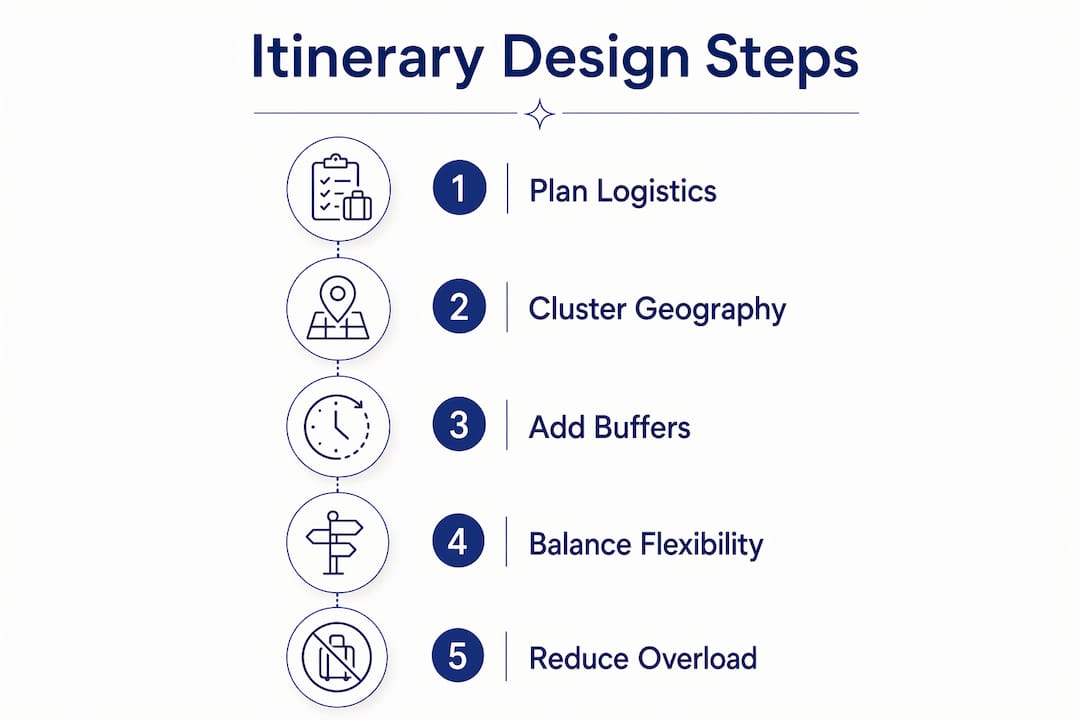
How do buffers and pacing prevent itinerary collapse?
A schedule without buffers is a schedule waiting to fail. Buffer times between activities of 30–45 minutes absorb the delays that are inevitable in real travel: a slow restaurant, a longer museum queue, a taxi that arrives late. Without them, one delay cascades into the rest of the day.
The key buffer placement principles are:
- Arrivals and departures: Add 60 minutes of buffer around any airport or train station transfer. These are the highest-risk points in any itinerary.
- Between major activities: A 30-minute gap between a museum visit and a lunch reservation prevents the panic of running late.
- Budget buffer: Reserve 10–15% of your trip budget for unexpected costs. This applies to time as well as money.
- End-of-day buffer: Leave the last hour of each evening unplanned. Fatigue is unpredictable, and a forced late dinner after a long day is rarely enjoyable.
Buffers are strategically placed around the most uncertain pressure points in travel, such as arrivals, long transfers, and border crossings, to maximize itinerary robustness. This is not pessimism. It is the difference between a trip that flows and one that grinds.
The tiered activity structure adds another layer of resilience. For each destination, prepare three categories: anchor activities you will definitely do, preferred activities you want to do if time allows, and backup options for bad weather or unexpected closures. This three-tier approach means you are never stuck with nothing to do and never disappointed when a plan falls through.
Pro Tip: For international trips, build a full free day into every five-day block. Call it a “recovery day” in your itinerary. You will either use it to catch up on rest, or you will fill it with the best spontaneous experience of the trip.
How does itinerary design reduce cognitive overload?
Travel planning feels overwhelming for a structural reason, not a personal one. Working memory has hard limits, and trying to hold flights, hotels, activities, transfers, and currency exchange in your head simultaneously exceeds those limits. Good itinerary design externalizes all of that information into a clear framework, freeing your brain to actually enjoy the trip.
The table below shows how itinerary design maps to cognitive load reduction:
| Planning Challenge | Itinerary Design Solution | Result |
|---|---|---|
| Too many decisions at once | Separate inspiration, decision, and preparation phases | Reduced overwhelm |
| Forgetting key logistics | Structured checklists and daily summaries | Fewer errors and missed details |
| Anxiety about unknowns | Named suppliers, times, and contact points | Increased confidence |
| Decision fatigue on the road | Pre-made activity tiers and open blocks | Better in-the-moment choices |
Destination Decider’s research confirms that breaking planning into stages with a clear dependency order reduces cognitive burden significantly. You research destinations first, then decide on dates, then book anchors, then fill in activities. Each phase has a defined scope. You are never trying to do everything at once.
One often-overlooked element is emotional sequencing. World Via Travel Network’s research shows that placing emotional peaks around two-thirds through a trip enhances overall traveler satisfaction. The narrative shape of your itinerary affects how you remember the trip, not just how you experience it day to day. A well-designed itinerary builds toward a highlight rather than front-loading everything and fading out.
Key takeaways
Effective itinerary design combines logistics precision, geographic intelligence, and cognitive structure to transform a list of bookings into a genuinely satisfying travel experience.
| Point | Details |
|---|---|
| Logistics build confidence | Naming transfers, pickup times, and suppliers removes uncertainty and reduces pre-trip anxiety. |
| The 60/40 rule prevents burnout | Fix 60% of your schedule with anchors and leave 40% open for rest and spontaneity. |
| Geographic clustering saves hours | Grouping activities by zone cuts daily transit time by 30–50%, preserving energy for experiences. |
| Buffers protect the whole schedule | Place 30–45 minute gaps at high-risk points to absorb delays without cascading disruption. |
| Externalizing decisions reduces stress | Structured checklists and tiered activity plans free working memory and improve in-trip decision-making. |
What 35 years of itinerary work has taught me
Most travelers think the goal of a good itinerary is to see as much as possible. That is the wrong goal. The real goal is to feel as present as possible. I have seen beautifully planned trips fall flat because every hour was accounted for, and I have seen simple three-day itineraries become life-changing because there was room to breathe.
The biggest mistake I encounter is what I call “highlight stacking.” Someone visits Paris and tries to fit the Louvre, the Eiffel Tower, Versailles, Montmartre, and a Seine cruise into two days. They see everything and feel nothing. The itinerary that drops Versailles, adds a free afternoon in Le Marais, and ends with a quiet dinner near the Palais Royal produces a far richer memory.
The other thing most articles will not tell you: the emotional arc of your trip matters more than the activity count. Placing your most anticipated experience on day four of a seven-day trip, rather than day one, gives the whole trip a shape. You build toward something. That structure is not accidental. It is the mark of a planner who understands that travel is an experience, not a checklist.
The benefits of personalized itinerary design are most visible in the moments you did not plan. A great itinerary creates the conditions for those moments. It handles the logistics so thoroughly that you forget logistics exist.
Let Elitetravelgroup design your next trip
Knowing the principles of great itinerary planning is one thing. Having a 35-year expert apply them to your specific trip is another.

Elitetravelgroup specializes in luxury adventure travel packages and bespoke European vacations built around exactly the frameworks described in this article: geographic clustering, buffer planning, emotional sequencing, and trusted on-the-ground partners. Every itinerary is personalized to your travel style, your pace, and your priorities. There are no service fees, and the team is available 24/7 from your first conversation to your return home. If you want a trip that feels effortless, it starts with a plan that is anything but.
FAQ
What is the role of itinerary design in travel planning?
Itinerary design structures a trip’s logistics, pacing, and activity sequence to reduce stress and maximize enjoyment. It transforms bookings into a coherent plan that builds traveler confidence and prevents decision fatigue on the road.
How much of a trip should be pre-planned?
Planning roughly 60% of trip time with fixed anchors and leaving 40% open is the recommended balance. This approach preserves spontaneity while providing enough structure to prevent overwhelm.
Why does geographic clustering improve a travel itinerary?
Grouping daily activities by neighborhood or zone can reduce transit time by 30–50%, which returns hours of each day to actual experiences rather than commuting between distant attractions.
How long should buffer times be between activities?
A 30–45 minute buffer between activities is the standard recommendation, with 60 minutes around airport and train station transfers. Budgeting an additional 10–15% of total trip time for unexpected delays keeps the full schedule resilient.
What is a tiered activity structure in itinerary planning?
A tiered structure organizes activities into three categories: anchors you will definitely do, preferred options if time allows, and backups for closures or bad weather. This method keeps the trip flowing smoothly regardless of what changes.
