




TL;DR:
- Destination specialists provide expert planning, crisis management, and exclusive access far beyond simple bookings. Their deep local knowledge ensures smooth logistics, swift problem-solving, and tailored experiences for high-stakes trips and events. Engaging specialists early and focusing on niche expertise enhances trip quality, especially during disruptions and complex group arrangements.
Most travelers assume destination specialists are a fancier name for a travel agent who books flights and hotels. That assumption costs people far more than they realize. The role of destination specialists extends well beyond reservations. They manage crises, negotiate exclusive access, coordinate multi-vendor international events, and apply years of on-the-ground knowledge that no algorithm can replicate. Whether you are planning a honeymoon in Europe, a destination wedding in the Caribbean, or a corporate incentive trip across multiple countries, understanding what destination specialists actually do will change how you plan every trip from this point forward.
Table of Contents
- Key takeaways
- The role of destination specialists: core responsibilities explained
- When things go wrong: the specialist advantage in a crisis
- Group travel and events: where coordination becomes everything
- Why niche specialization makes specialists better at their jobs
- How to work effectively with a destination specialist
- My take: the specialist’s real value shows up when plans break
- Plan your next experience with Elitetravelgroup’s specialists
- FAQ
Key takeaways
| Point | Details |
|---|---|
| More than booking | Destination specialists manage logistics, crises, vendor networks, and cultural nuances that go far beyond reservations. |
| Crisis response is critical | Specialists use local networks to reroute, rebook, and resolve problems in real time when travel plans fall apart. |
| Event planning requires deep expertise | Group and wedding travel involves cross-border logistics, multi-phase coordination, and legal requirements that specialists handle from start to finish. |
| Niche focus benefits you | Specialists with a defined niche deliver stronger supplier relationships, faster problem-solving, and more confidence-inspiring service. |
| Start earlier than you think | For destination weddings and complex group trips, engaging a specialist 12 to 18 months ahead is the standard, not a luxury. |
The role of destination specialists: core responsibilities explained
When you hire a destination specialist, you are not hiring someone to search Expedia faster than you can. You are hiring a professional whose entire career is built around knowing a specific destination, travel category, or client type better than anyone else in the room.
At the foundation, destination specialists handle personalized trip planning with deep local knowledge. They know which hotel on the Amalfi Coast gives you a sunrise view versus a sunset view. They know which private guide in Kyoto speaks English and tells stories instead of reciting facts. That specificity is the product you are actually buying.
Beyond personalization, the destination specialist roles include:
- Coordinating complex logistics for destination weddings, incentive trips, and group travel across multiple vendors and time zones
- Securing exclusive access to experiences, properties, and local experts that are not available through standard booking channels
- Negotiating group rates and perks with hotels, airlines, and ground operators on behalf of clients
- Managing cultural and legal requirements relevant to international events, including permits, contracts, and local customs
- Providing pre-trip intelligence on conditions, weather patterns, political climates, and timing so clients arrive informed
The benefits of using destination specialists become especially clear when you contrast a specialist-planned trip with a self-booked one. A specialist who focuses on luxury experiences brings supplier relationships built over years, which translates directly into room upgrades, priority reservations, and access to sold-out experiences.
Pro Tip: Ask your destination specialist to name three specific experiences at your destination that are not listed on any public booking site. Their answer will tell you immediately whether you are working with a true specialist or a generalist with a good website.
Niche specialization matters more than most travelers realize. A specialist focused exclusively on luxury travel will have deeper operator partnerships, faster turnaround on requests, and a stronger reputation with the properties you actually want to stay at. Generalists are fine for simple trips. For high-stakes travel, you want someone who has visited your destination multiple times and has relationships with the people who run it.
When things go wrong: the specialist advantage in a crisis
This is where the importance of destination specialists becomes impossible to ignore. No travel app in the world can replicate what a well-connected specialist does when a flight cancels at midnight, a political situation develops overnight, or a vendor falls through three weeks before a 150-person wedding.
Local intelligence from ground teams allows specialists to anticipate disruptions before they hit the news cycle. That is not a small advantage. It means your specialist may already be rerouting you before you have even opened your phone.

Consider a real scenario: a traveler flying from Jaipur to an international connection experiences a last-minute cancellation. A destination specialist rerouting from Jaipur to Delhi to catch an alternative flight is not a dramatic story. It is a Tuesday for someone with the right network. Without that specialist, that traveler is standing in an airport line hoping a call center agent in another country has the authority to help.
What destination management experts actually provide during a crisis includes:
- Supplier relationships that allow direct calls to hotel managers, airline reps, and ground operators rather than waiting in public queues
- Pre-established contingency plans with rerouting options, backup vendors, and escalation pathways
- Real-time communication to keep travelers calm and informed with accurate updates, not generic reassurances
- Medical and safety protocol knowledge specific to the destination, including which hospitals, embassies, and local contacts to engage
“The real value of travel specialists emerges most during disruptions, where their quick action and local confidence are truly indispensable.” Condé Nast Traveler
Pro Tip: Before confirming any specialist, ask specifically: “What is your contingency plan if a key vendor cancels 72 hours before my event?” and “Who is your local contact on the ground?” Vague answers are a red flag. Specific names and protocols are what you need to hear.
Online tools offer convenience. They do not offer crisis preparedness strategies built from years of experience in a specific region. That gap is exactly what separates a trip that recovers gracefully from one that falls apart.
Group travel and events: where coordination becomes everything
Planning a destination wedding or corporate incentive trip is not a bigger version of planning a personal vacation. It is a categorically different challenge, and the destination specialist roles required to manage it are far more operationally complex.
Destination wedding specialists handle cross-border logistics that include vendor sourcing across multiple countries, international legal requirements for marriage recognition, contract negotiations with resorts, and communication across multiple time zones. A couple in Chicago planning a wedding in Tuscany is not just planning a party. They are managing an international legal event with 80 to 150 guests who all need travel arrangements, accommodations, and event programming.
Here is how the event planning timeline typically breaks down with a specialist involved:
- 12 to 18 months out: Destination selection, resort or venue comparison, room block negotiation, and establishing the overall guest travel strategy
- 6 to 12 months out: Vendor contracting, budgeting, and coordinating all supplier agreements across catering, florals, entertainment, and photography
- 3 to 6 months out: Guest travel coordination, including flight recommendations, accommodation assignments, and pre-trip logistics communication
- Final weeks: Final confirmations, contingency briefings, and handoff documentation for on-site execution teams
- On-site: The specialist’s role transitions to oversight and escalation support, while a separate on-site coordinator handles day-of execution
That last point is one the industry does not explain well enough. Specialists differ from on-site coordinators in a specific and important way: specialists handle all the strategic pre-event work while on-site coordinators execute the day itself. Confusing the two leads to coverage gaps that show up at the worst possible time.
| Role | Primary focus | When they are most active |
|---|---|---|
| Destination specialist | Strategic planning, vendor negotiation, guest travel | 12 to 18 months before the event |
| On-site coordinator | Day-of execution, timeline management, logistics flow | Day of the event and final days before |
| Destination management expert | Full lifecycle oversight, escalation, client advocacy | Throughout all phases |
Event managers in destination planning act as the primary client contact from initial contracting through final execution, which means clients have one consistent point of accountability through a process that can involve dozens of vendors across multiple countries. That single-point-of-contact model is what prevents things from slipping through the cracks.
Why niche specialization makes specialists better at their jobs
There is a tempting assumption that a generalist travel advisor who “does everything” is more useful because they cover more ground. The data says otherwise.
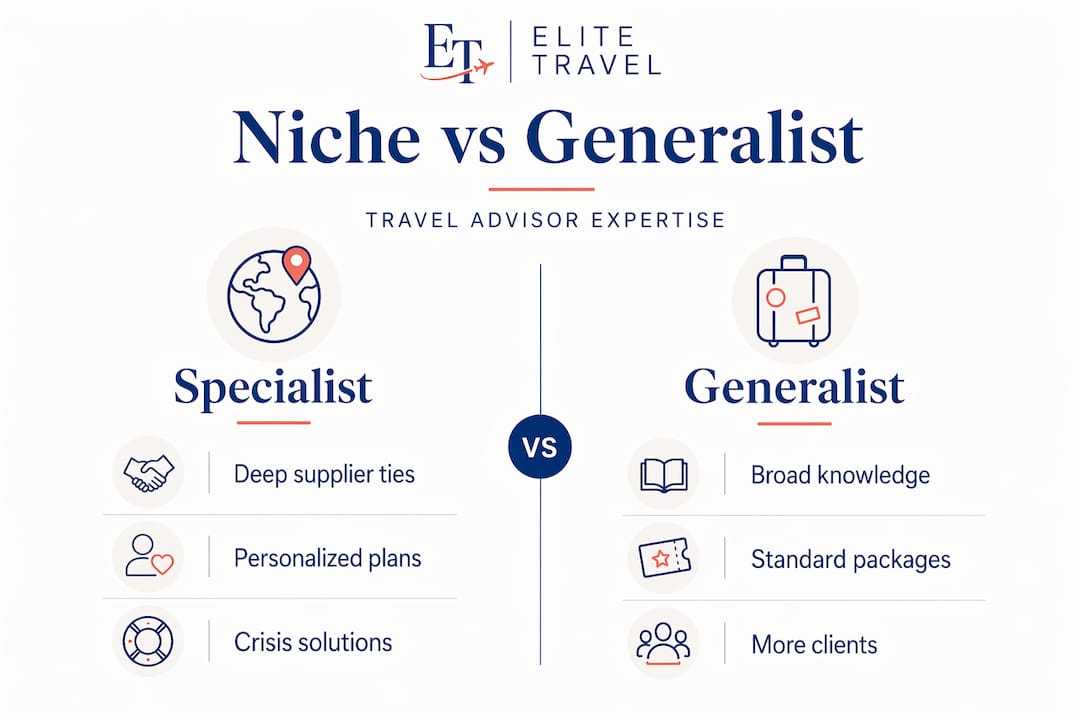
Niche specialization builds credibility and customer confidence in ways that generalist practice simply cannot. When a specialist has spent five years focused exclusively on luxury Italy travel, they have visited the same properties repeatedly, attended private supplier events, and built personal relationships with hotel managers and local guides. That depth is what produces the experiences clients remember and talk about.
From a practical standpoint, the benefits of using destination specialists who have a defined niche include:
- Faster problem-solving because they have handled the same types of situations in the same destination before
- Better supplier terms because volume and loyalty to specific operators creates negotiating leverage
- Shorter planning timelines because they already know what works and what does not for their niche
- Higher-confidence recommendations because they have firsthand experience with every property and vendor they suggest
Travel advisors with niche expertise also attract more suitable clients, which means less time educating clients on basics and more time delivering results. For you as a traveler or event planner, that focus directly improves your experience.
Pro Tip: When evaluating a destination specialist, look at their portfolio and marketing materials. If they claim expertise in 15 different destinations and 10 different travel categories, they are likely a generalist. A specialist should be able to name their top three focus areas without hesitation.
Common and high-value niches include luxury leisure travel, adventure travel, destination weddings, honeymoons, European cultural tours, and incentive group travel. Each requires different supplier networks, different timing considerations, and different cultural knowledge. Matching your travel type to a specialist’s actual niche is one of the most underrated decisions in the planning process.
How to work effectively with a destination specialist
Knowing that destination specialists provide genuine value is only useful if you know how to work with one well. Most clients either engage too late or come in without enough information to get the most out of the relationship.
Here is how to set up the engagement for success:
- Start earlier than feels necessary. For destination weddings, engaging specialists 12 to 18 months ahead is standard practice. For luxury group travel, 9 to 12 months gives specialists enough time to secure the best supplier terms and room blocks.
- Clarify roles from day one. If you are planning a wedding or event, establish in writing who handles pre-event logistics versus day-of coordination. Do not assume the same person does both.
- Share your full context. Budget parameters, group dynamics, accessibility needs, dietary requirements, and past travel experiences all shape what a specialist recommends. The more you share, the more precisely they can deliver.
- Ask about disruption protocols directly. A well-prepared specialist will have specific contingency plans that include backup vendors, rerouting options, and escalation contacts.
- Leverage their access. Ask specifically for experiences that are not publicly bookable. Private winery dinners, after-hours museum access, and chef’s table reservations at fully booked restaurants are exactly where a specialist’s network pays off.
What to avoid is equally important. Do not book individual components separately and then ask a specialist to manage the pieces. That eliminates much of the leverage they have with suppliers. And do not assume that a lower specialist fee or no-fee model means lower quality. Elitetravelgroup, for example, charges no service fees while still delivering premium personalized planning backed by 35 years of experience.
My take: the specialist’s real value shows up when plans break
I’ve spent enough time in this industry to tell you that the most revealing moment for any destination specialist is not when everything goes right. It’s when something goes wrong at 11 PM and there are 80 guests asleep in a foreign country counting on someone to fix it by morning.
What I’ve learned is that travelers and event planners consistently underestimate the importance of destination specialists until they need them urgently. Then they understand it completely. The couples who engaged a specialist 14 months before their Santorini wedding had a detailed vendor backup list and a resort contact on speed dial. The ones who hired a coordinator three months out did not.
My contrarian view: niche expertise is not a marketing strategy. It is an operational necessity. I’ve seen generalist advisors fumble requests that a niche specialist would have solved in 20 minutes because the specialist already had the relationship, the history, and the protocol. That gap does not shrink with effort. It only closes through repeated, focused experience in one area.
The future of destination specialization is going to reward depth over breadth even more aggressively. Travelers are getting more sophisticated. They know when they are getting templated itineraries versus genuinely customized experiences. The specialists who survive and thrive will be the ones who know their destination or niche so thoroughly that clients feel it immediately in the quality of every recommendation.
If you are a traveler reading this, stop looking for the advisor who can do everything. Find the one who does your kind of travel exceptionally well. That single decision will change the quality of every experience that follows.
Plan your next experience with Elitetravelgroup’s specialists
If this article clarified what destination specialists can actually do for you, the next step is working with ones who have 35 years of practice doing exactly that.
Elitetravelgroup’s destination management experts design luxury adventure travel experiences and destination wedding packages with the same concierge-level precision described throughout this article. No service fees. A price match guarantee. And specialists who answer at any hour because travel does not keep business hours. Whether you are planning a milestone celebration in Europe, a multi-country group itinerary, or the wedding of a lifetime abroad, Elitetravelgroup brings the local knowledge, supplier relationships, and crisis-ready planning infrastructure that separates an unforgettable trip from a stressful one. Start your consultation and see what a real destination specialist brings to the table.
FAQ
What does a destination specialist actually do?
A destination specialist handles personalized trip planning, vendor coordination, logistics management, and crisis response using deep local knowledge and supplier relationships. Their role goes far beyond booking and includes everything from resort negotiations to real-time rerouting during travel disruptions.
How are destination specialists different from regular travel agents?
Destination specialists focus on a specific destination, travel category, or client type, which produces deeper supplier relationships, more precise recommendations, and faster problem-solving than a generalist travel agent can provide.
When should I hire a destination specialist for a wedding?
Certified specialists recommend engaging 12 to 18 months before your destination wedding to allow time for venue comparison, room block negotiation, guest travel coordination, and full vendor contracting.
What is the difference between a destination specialist and an on-site coordinator?
A destination specialist handles strategic pre-event planning, vendor negotiations, and guest travel logistics, while an on-site coordinator manages day-of execution. Both roles are necessary for a well-run destination wedding or large event.
Do destination specialists charge fees for their services?
Fee structures vary widely. Some specialists charge planning fees, while others, like Elitetravelgroup, operate with no service fees and a price match guarantee, making expert-level planning accessible without an additional cost barrier.
