




TL;DR:
- Expert travel partnerships provide exclusive access, local expertise, and high-quality service that surpass direct bookings. These alliances, including consortia, DMCs, and sustainable tourism groups, are essential for complex, luxury, and responsible travel experiences. Building and maintaining trusted local networks ensure travelers receive personalized, reliable, and impactful trips.
Expert partnerships in travel are strategic collaborations between travel advisors, local specialists, and industry suppliers that unlock exclusive access, insider knowledge, and service quality no solo booking can replicate. The industry term for the most structured form of these alliances is “destination management collaboration,” though travelers and planners encounter them through three primary channels: travel consortia like Virtuoso and Travel Leaders Network, Destination Management Companies (DMCs), and sustainable tourism alliances such as the UNESCO and TUI Care Foundation partnership. In 2026, these structures have moved from optional add-ons to the backbone of how serious travel planners deliver results. Understanding how they work gives you a direct advantage when planning any high-stakes trip.
How do expert partnerships enhance travel experiences and trip planning?
The role of expert partnerships in travel is most visible in the concrete perks they generate for you at the booking stage. Travel agencies that belong to consortia negotiate commissions of 10 to 20% and secure exclusive traveler perks like complimentary breakfasts, room upgrades, and property credits that are simply unavailable when you book directly. That gap between what a consortium member can access and what a direct booking delivers is not marginal. It is often the difference between a standard room and a suite, or between a checkout at noon and a late departure that fits your flight.
DMCs add a second layer of value that no booking platform can replicate. DMCs act as strategic partners with daily, real-time local insight, making them indispensable for complex or curated itineraries. If a private vineyard tour gets rained out in Tuscany, a well-connected DMC pivots to an alternative within hours. A traveler who booked independently waits on hold with a call center.
The benefits of travel partnerships also extend to operational peace of mind. When your advisor has a trusted local contact on the ground, you are not navigating a foreign emergency alone. That network is the product, not just the itinerary.
- Exclusive rates and perks unavailable through direct booking channels
- Real-time itinerary adjustments through local DMC contacts
- Access to reserved hotel allotments during peak seasons when public inventory shows sold out
- Curated experiences assembled by specialists who work a destination year-round
- Reduced risk during disruptions, with human contacts who can act immediately
Pro Tip: When evaluating a travel advisor, ask specifically which consortia they belong to and which DMCs they work with in your destination. Membership in Virtuoso or Travel Leaders Network signals access to a supplier network that took years to build.
What are the common types of expert partnerships in the travel industry?
Three partnership models define how expert collaborations in tourism are structured today. Each serves a different function, and the best travel experiences typically draw on all three.

Travel consortia are membership organizations that aggregate independent travel agencies to give them the buying power of a large corporation. Consortia members gain access to proprietary booking platforms, CRM systems, and preferred supplier networks. For you as a traveler, this means your independent advisor can negotiate like a major agency while still delivering personalized service. Virtuoso, Ensemble Travel Group, and Signature Travel Network are the three most recognized names in this space.
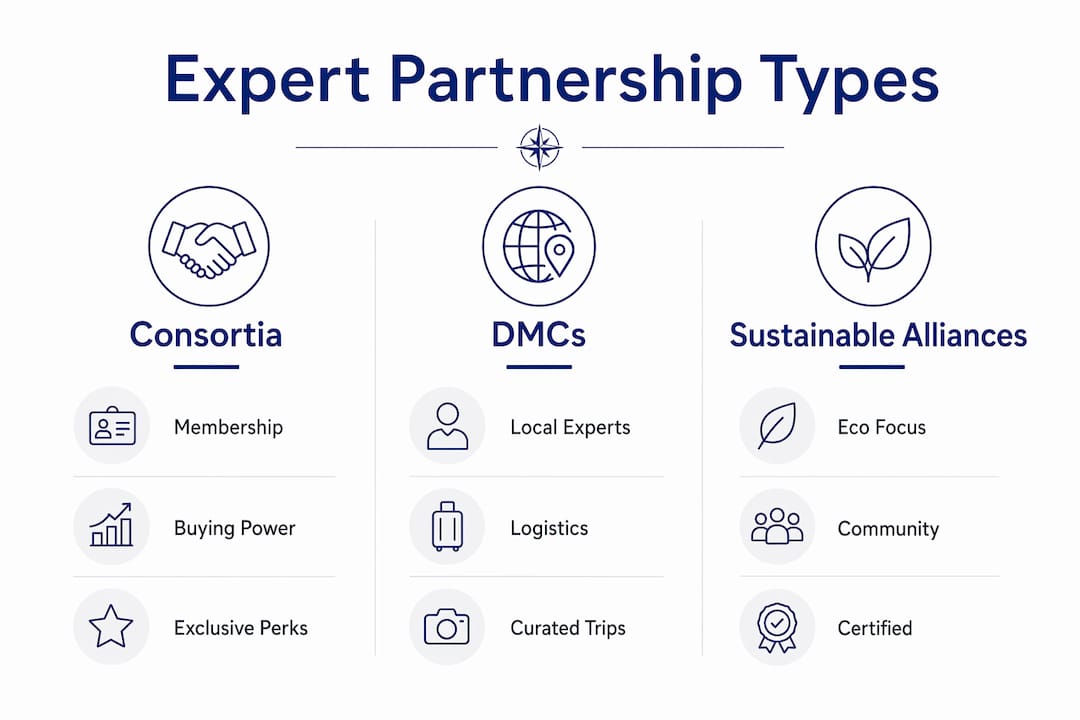
DMCs are the on-the-ground operators who execute what advisors design. They are not suppliers in the traditional sense. They are local intelligence hubs that manage logistics, source authentic experiences, and maintain relationships with hotels, guides, and vendors that no outsider could replicate. The distinction matters: a supplier sells you a product, while a DMC shapes the entire context around it.
Sustainable tourism alliances represent the newest and fastest-growing category. UNESCO and the TUI Care Foundation formalized a partnership in 2026 to train artisans and guides at Morocco’s Ait Ben Haddou, building economic resilience directly into the travel experience. When your trip is routed through one of these alliances, your spending supports community livelihoods rather than extracting value from them.
| Partnership type | Core function | Key benefit for travelers | Typical agreement structure |
|---|---|---|---|
| Travel consortia | Aggregate agency buying power | Exclusive rates, upgrades, and perks | Membership fees plus preferred supplier contracts |
| DMCs | On-the-ground operations and logistics | Custom itineraries and real-time problem solving | Per-trip service agreements with local operators |
| Sustainable tourism alliances | Community-integrated travel programs | Authentic experiences with positive local impact | Formal NGO or foundation partnerships with tour operators |
Pro Tip: Ask your advisor whether their DMC relationships are exclusive or shared with dozens of other agencies. Exclusive or semi-exclusive DMC access means your group gets priority attention during high-demand periods.
What challenges and pitfalls exist in managing travel expert partnerships?
Travel industry expert alliances fail more often than most travelers realize, and the reasons are predictable. Partnership fatigue arises from misaligned goals or values, and it surfaces most visibly during disruptions when partners need to make fast, shared decisions. An advisor whose DMC partner prioritizes volume over quality will discover that misalignment the moment something goes wrong on your trip.
The structural issues are equally important to understand. Partnership agreements distinguish between “allotment” and “free-sale” booking methods, and that distinction directly affects what you can access. Allotment terms mean reserved inventory that appears sold out to the public but remains bookable through expert partners. Free-sale means live availability that anyone can access. If your advisor does not have allotment agreements with key hotels in your destination, you may lose access to the best properties during peak season even though your advisor claims to have strong local connections.
Here are the four most common pitfalls in travel partnership management and how to protect yourself:
- Misaligned values between advisor and DMC. A luxury-focused traveler paired with a DMC that primarily handles budget group tours will receive a diluted experience. Verify that your advisor’s partners specialize in your travel category.
- No formal written agreements. Verbal commitments between advisors and local partners create ambiguity during disputes. Ask your advisor whether their DMC relationships are governed by written contracts.
- Volume-based success metrics. Some partnerships are evaluated purely on booking volume, which incentivizes quantity over quality. The most effective partnerships succeed by sharing operational values and using quarterly reviews to adapt to changing local conditions.
- Outdated partner networks. A DMC relationship that was strong three years ago may have deteriorated. Advisors who do not conduct regular reviews of their local partners are working with stale intelligence.
Understanding these risks does not mean avoiding partnerships. It means knowing which questions to ask before you commit to a planner or agency.
How can travelers and planners leverage expert partnerships for better trips?
The impact of partnerships on travel is only realized when you actively engage with the structure rather than treating your advisor as a booking intermediary. The most effective approach starts with selecting an advisor whose value proposition is their partner network, not just their personal travel history.
Successful travel advisors market their vetting capability, partnering closely with local experts rather than claiming personal expertise everywhere. An advisor who says “I have not been there myself, but my local partner works there constantly” is giving you a more honest and more useful answer than one who claims to know every destination personally. The shift from broad personal expertise to curated, vetted partner networks is the defining trend in how top advisors operate in 2026.
When planning a trip, use these strategies to extract maximum value from expert collaborations in tourism:
- Request a partner disclosure. Ask your advisor to name the specific DMC, consortium, and local suppliers they will use for your trip. Vague answers signal weak networks.
- Ask about allotment access. Confirm whether your advisor has reserved inventory at your preferred hotels, particularly for peak travel dates.
- Prioritize sustainability-aligned partnerships. Trips routed through alliances like the UNESCO and TUI Care Foundation model deliver richer cultural experiences and support local economies directly.
- Verify consortium membership. Membership in Virtuoso or Travel Leaders Network is publicly verifiable. Cross-check your advisor’s claims before booking.
- Engage early. The best allotment inventory and exclusive experiences are claimed months in advance. Advisors with strong partner networks can access these only if you give them enough lead time.
The value of local partner networks compounds with trip complexity. A weekend city break requires less partnership depth than a three-week multi-country itinerary. Scale your expectations accordingly.
Pro Tip: When vetting a travel advisor, ask: “Who is your DMC partner in this destination, and how long have you worked together?” Tenure matters. A five-year DMC relationship means your advisor has seen that partner perform under pressure.
Key takeaways
Expert partnerships in travel deliver measurable advantages through consortium perks, DMC local intelligence, and sustainable tourism alliances, but only when advisors maintain formal agreements, shared values, and active partner reviews.
| Point | Details |
|---|---|
| Consortia unlock exclusive perks | Consortium membership gives advisors access to upgrades, credits, and rates unavailable through direct booking. |
| DMCs provide irreplaceable local depth | DMCs offer real-time on-the-ground management that no booking platform or personal expertise can substitute. |
| Allotment access changes availability | Expert partners hold reserved inventory that appears sold out to the public during peak seasons. |
| Partnership health requires active management | Quarterly reviews and formal written agreements prevent the misalignment that causes partnerships to fail during disruptions. |
| Vetting capability beats personal expertise | The best advisors build trusted local networks rather than claiming firsthand knowledge of every destination. |
Why the “who” behind your trip matters more than the “where”
I have watched the travel advisory industry change significantly over the past decade, and the shift I find most telling is this: the advisors who consistently deliver exceptional client outcomes are not the ones who have visited the most destinations. They are the ones who have built the deepest local partner networks.
There is a tendency among travelers to evaluate advisors based on personal travel experience. “Have you been to Japan?” feels like a reasonable qualifying question. But collaboration embedded in core business operations creates sustained value in ways that personal visits simply cannot. A DMC partner who works a destination 365 days a year knows things that a twice-annual visitor never will: which hotel manager will personally handle a complaint, which restaurant has declined in quality since last season, which private experience is genuinely exclusive versus widely marketed as exclusive.
The advisors I respect most are the ones who are transparent about this. They say “my partner on the ground handles this” rather than pretending omniscience. That honesty is not a weakness. It is the product. The future of travel advisory is not about knowing more destinations personally. It is about maintaining a network of trusted specialists who do.
How Elitetravelgroup puts expert partnerships to work for you
Elitetravelgroup has spent 35 years building the kind of partner network that makes the difference between a good trip and one you talk about for years. Through relationships with top consortia, vetted DMCs across Europe and beyond, and local specialists who know their destinations at the level of daily operations, Elitetravelgroup delivers access that no direct booking can match.
Whether you are planning a honeymoon in the Amalfi Coast, a milestone celebration in Southeast Asia, or an adventure travel package that requires serious on-the-ground coordination, Elitetravelgroup’s partner network is the infrastructure behind every detail. No service fees, a price match guarantee, and 24/7 availability mean you get expert partnership access without the typical agency friction. Your next trip deserves the right people behind it.
FAQ
What is the role of expert partnerships in travel?
Expert partnerships in travel are structured collaborations between travel advisors, DMCs, consortia, and local suppliers that provide travelers with exclusive rates, reserved inventory, and on-the-ground expertise unavailable through direct booking. They are the primary mechanism through which luxury and complex travel experiences are assembled and delivered.
How do travel consortia benefit travelers?
Travel consortia like Virtuoso and Travel Leaders Network give member agencies the buying power to negotiate commissions of 10 to 20% and secure perks such as room upgrades, complimentary breakfasts, and property credits that direct bookings do not include.
What is a DMC and why does it matter for trip planning?
A Destination Management Company (DMC) is a local operator that manages logistics, curates experiences, and provides real-time problem-solving on the ground. DMCs hold relationships and local knowledge that allow advisors to deliver complex itineraries and handle disruptions that would otherwise derail a trip.
What is the difference between allotment and free-sale booking?
Allotment booking means an expert partner holds reserved hotel or service inventory that the public cannot access, even when availability appears sold out online. Free-sale means live inventory open to anyone. Advisors with allotment agreements can secure bookings during peak seasons that direct bookers cannot.
How do I know if my travel advisor has strong expert partnerships?
Ask your advisor to name their specific DMC partners, confirm their consortium membership (Virtuoso membership is publicly verifiable), and inquire about the tenure of their local relationships. Advisors with genuine networks answer these questions specifically. Those without them answer vaguely.
