




TL;DR:
- A well-designed concierge travel workflow uses modular AI tools and human checkpoints to rapidly craft personalized itineraries at scale. It separates tasks into preference capture, research, drafting, approval, and booking, reducing errors and building client trust through incremental validation. Combining automation with human expertise ensures efficient, accurate, and customized travel planning.
A concierge travel planning workflow is a structured sequence of coordinated tasks, technologies, and human checkpoints designed to rapidly craft, validate, and book personalized travel itineraries at scale. For travel professionals, this workflow is the difference between reactive order-taking and proactive, high-value client service. Research confirms that travel planning is fundamentally an orchestration challenge, not a search problem. The concierge acts as the coordinating layer that sequences and validates experiences into coherent plans. Modern implementations combine AI tools like GPT-4o and n8n with human expertise to deliver what clients actually want: precision, personalization, and zero surprises.
What are the essential components of a concierge travel planning workflow?
A well-designed luxury travel workflow separates into five distinct modules, each with a specific function and clear handoff point. Modular workflows that separate profile reading, destination research, itinerary drafting, client approval, and booking retries reduce complexity and increase reliability compared to monolithic approaches. The common failure mode is collapsing all five functions into a single prompt or process, which makes debugging nearly impossible and client trust fragile.
Here are the five core modules every effective workflow requires:
- Preferences reader: Captures client data including travel style, dietary restrictions, budget range, past trip history, and preferred hotel brands. This module feeds every downstream decision.
- Destination researcher: Pulls live data from APIs like Amadeus for flights, SkyScanner for fare comparisons, Yelp for dining, and TripAdvisor for experiences. It cross-references availability with client preferences before any itinerary is drafted.
- Itinerary builder: Constructs day-by-day plans using the research output. Pause-and-verify loops that present one day’s plan for approval before proceeding dramatically reduce errors and increase client confidence.
- Booking manager: Executes reservations with reflect-and-retry logic. When a booking fails, the system attempts alternative options rather than returning an error to the client.
- Feedback loop: Collects post-approval and post-trip input to refine future preference profiles and improve itinerary accuracy over time.
The human-in-the-loop checkpoint sits between the itinerary builder and booking manager. This is where a travel professional reviews AI-generated plans before any financial commitment is made. Session states that persist across multiple interactions allow clients to pause and resume planning without repeating information, which is critical for complex, multi-destination trips.
Pro Tip: Never skip the preferences reader module, even for returning clients. Travel preferences shift with life stage, and a 60-second preference refresh at the start of each engagement prevents costly misalignment later.

How to design and implement a concierge travel planning workflow step-by-step
Building a functional workflow starts with intake design, not technology selection. The tools serve the process, not the other way around. Here is a proven implementation sequence for travel professionals:
- Conduct the initial client consultation. Capture hard constraints first: travel dates, budget ceiling, group composition, and any non-negotiables. Then gather soft preferences: pace of travel, interest categories, and past experiences they want to replicate or avoid. Store this in a structured preference profile.
- Configure your API connections. Connect to live data sources before drafting anything. Amadeus covers flights and hotel inventory. SkyScanner provides fare benchmarking. Google Places, Yelp, and TripAdvisor cover dining and activities. Without live data, your itinerary is a guess.
- Draft the itinerary in day-by-day segments. Present Day 1 to the client for approval before building Day 2. This pause-and-verify method prevents compounding errors across a multi-day plan. It also gives clients a natural decision point to adjust direction without feeling locked in.
- Run the booking manager with retry logic. Booking failures occur roughly 20% of the time in automated systems. Build exponential backoff and alternative selection into your booking layer so failures resolve silently rather than surfacing as client-facing errors.
- Maintain session state throughout. Record approved days, current planning position, research findings, and preference updates in a persistent state object. This allows any team member to pick up where another left off without client friction.
The following table maps each workflow stage to its primary tool category and the responsible party:
| Workflow stage | Primary tool category | Responsible party |
|---|---|---|
| Preference capture | CRM or structured intake form | Human advisor |
| Destination research | Travel APIs (Amadeus, SkyScanner) | AI agent |
| Itinerary drafting | GPT-4o or n8n workflow | AI with human review |
| Client approval | Communication platform | Human advisor |
| Booking execution | Booking APIs with retry logic | AI agent |
| Post-trip feedback | Survey or CRM follow-up | Human advisor |
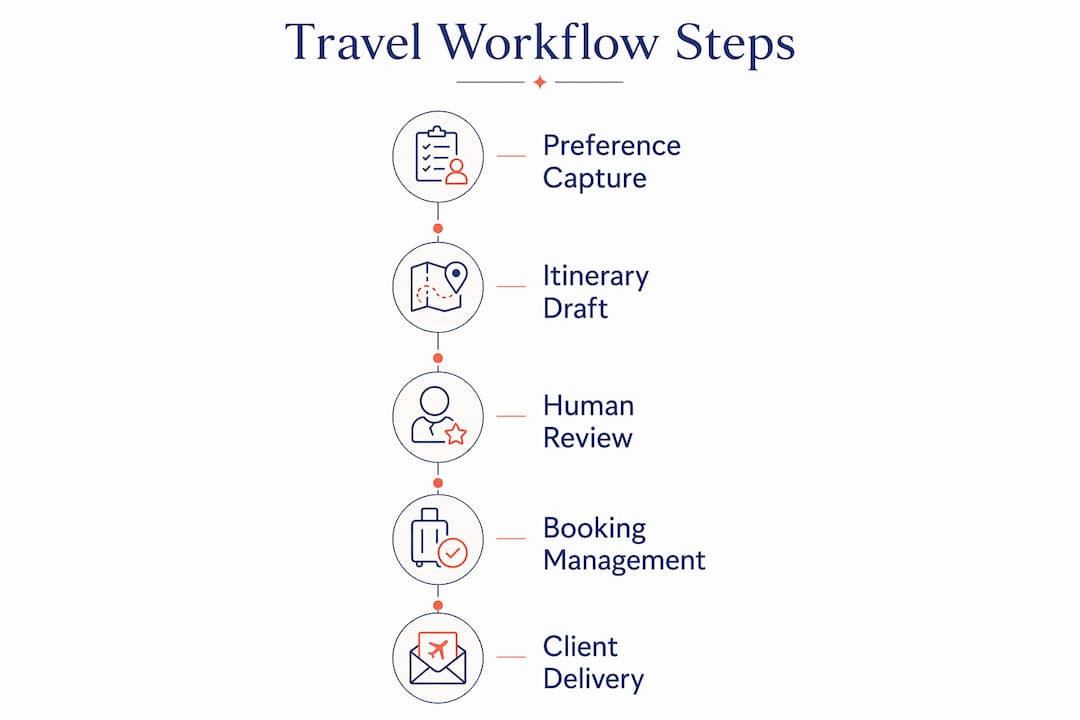
Combining AI orchestration tools like n8n with human expertise is the model that delivers both speed and the personalization clients expect from premium travel concierge services. The table above makes clear that humans own the relationship touchpoints while AI handles data-intensive tasks.
What are common challenges in concierge travel workflow management?
The most damaging mistake in workflow design is architectural: building a single, monolithic agent that handles preferences, research, drafting, and booking in one pass. When something goes wrong, and it will, there is no clean way to isolate the failure. Modular design with clear agent handoffs is the structural solution, and it also supports scalability as client volume grows.
Beyond architecture, these are the challenges travel professionals encounter most often:
- API latency and rate limits. SkyScanner and Amadeus both impose rate limits that can stall real-time itinerary generation. Cache frequently requested routes and hotel inventory during off-peak hours to reduce live query volume during client sessions.
- Client communication gaps. Workflows that generate complete itineraries without interim approval create a single high-stakes approval moment. Clients who feel overwhelmed at that point often disengage. Incremental approval loops distribute the decision-making and keep clients engaged throughout.
- Hallucinated recommendations. AI models occasionally generate plausible-sounding but incorrect details, such as a restaurant that has closed or a hotel that does not offer the amenity described. Cross-referencing every AI-generated recommendation against a live API call before presenting it to the client eliminates this risk.
- Session continuity failures. When a client returns after a two-day gap and the system has lost their preference context, trust erodes immediately. Hierarchical multi-agent architectures that maintain session state across journey phases, from inspiration through in-trip support, solve this at the infrastructure level.
Pro Tip: Build a “minimum viable itinerary” test into your workflow before client delivery. Run the full plan through your booking APIs to confirm availability on every item before presenting it. A beautiful itinerary with three unavailable components destroys credibility faster than a slower delivery would.
How do AI-augmented workflows compare to traditional manual planning?
The efficiency gap between traditional and AI-augmented concierge travel assistance is not incremental. It is structural. AI-powered workflows generate personalized, bookable itineraries in under 60 seconds, compared to the 10 hours a skilled human planner typically invests in a 5-day trip. That time savings does not replace the human advisor. It frees the advisor to focus on relationship management, upselling, and handling exceptions.
Traditional manual planning relies on a planner holding multiple browser tabs open simultaneously, cross-referencing flight search tools, hotel booking platforms, and destination guides in parallel. The cognitive load is high, errors are common, and the process does not scale beyond a fixed client-to-planner ratio. AI-augmented workflows replace the tab-switching with structured API calls and present the planner with pre-validated options rather than raw search results.
The comparison table below captures the operational differences across five key dimensions:
| Dimension | Traditional manual planning | AI-augmented workflow |
|---|---|---|
| Itinerary generation time | Up to 10 hours per 5-day trip | Under 60 seconds |
| Booking error handling | Manual retry by planner | Automated reflect-and-retry logic |
| Client approval process | Single full-plan review | Day-by-day incremental approval |
| Session continuity | Dependent on planner memory or notes | Persistent session state across interactions |
| Scalability | Limited by planner capacity | Scales with API and compute resources |
The one dimension where traditional planning retains an advantage is nuanced judgment. A planner who has visited the Amalfi Coast personally knows that a client who hates crowds should avoid Positano in July regardless of what the data says. The role of the concierge in luxury travel planning remains irreplaceable for that layer of contextual intelligence. AI handles the data. The expert handles the judgment.
Key takeaways
A concierge travel planning workflow delivers superior client outcomes when it combines modular AI orchestration with deliberate human checkpoints at every relationship-critical stage.
| Point | Details |
|---|---|
| Modular design is non-negotiable | Separate agents for research, drafting, approval, and booking prevent cascading failures and support debugging. |
| Pause-and-verify loops build trust | Day-by-day client approval reduces errors and keeps clients engaged throughout the planning process. |
| Retry logic protects booking reliability | Automated reflect-and-retry handles the roughly 20% booking failure rate without surfacing errors to clients. |
| Session state enables continuity | Persistent preference and approval data allows any team member to resume planning without client friction. |
| Human judgment remains the differentiator | AI handles data-intensive tasks; experienced advisors provide the contextual intelligence that data cannot replicate. |
Why the workflow conversation is the one our industry keeps avoiding
I have spent years watching travel professionals resist the word “workflow” as if it implies their work is mechanical. It is the opposite. A well-designed vacation planning process is what makes genuine personalization possible at any volume beyond a handful of clients per month.
The industry shift toward agentic, modular AI frameworks is not a threat to experienced planners. It is the first technology in decades that actually matches the complexity of what good concierge travel assistance requires. The planners I see struggling are not the ones who adopted AI tools. They are the ones still managing everything through email threads and personal memory.
What I find most underappreciated is the value of the feedback loop module. Most workflow discussions focus on intake and delivery. The post-trip data collection is where the real personalization compounds. A client who returns for their fifth trip with a planner who has four years of preference data is experiencing something no AI alone can replicate. The workflow makes that data collection systematic instead of accidental.
The future belongs to hierarchical multi-agent systems that handle the full journey arc from inspiration through in-trip support. But the planners who will use those systems best are the ones who understand why the human-in-the-loop checkpoint exists. It is not a concession to client anxiety. It is the mechanism that keeps the entire system honest.
How Elitetravelgroup puts this workflow into practice
Elitetravelgroup has spent 35 years refining the concierge travel planning process that this article describes in architectural terms. Every client engagement begins with a structured preference consultation, moves through expert-curated research, and delivers itineraries built on verified availability with a dedicated advisor reviewing every detail before anything is confirmed.

Whether you are planning a milestone anniversary in Europe, a luxury adventure vacation, or a VIP group experience, Elitetravelgroup’s team applies the same modular, high-touch approach that turns a good trip into an exceptional one. There are no service fees, a price match guarantee, and 24/7 advisor access. Explore Europe vacation packages designed with this level of precision, or connect with an advisor to start building your client’s next itinerary today.
FAQ
What is a concierge travel planning workflow?
A concierge travel planning workflow is a structured, modular sequence of coordinated tasks covering preference capture, destination research, itinerary drafting, client approval, and booking execution. It functions as the operational backbone of personalized travel concierge services.
How long does it take to build a travel itinerary with AI?
AI-powered workflows generate bookable itineraries in under 60 seconds, compared to up to 10 hours for manual planning of a 5-day trip. The time savings allows advisors to focus on client relationships rather than data assembly.
What is a pause-and-verify loop in travel planning?
A pause-and-verify loop presents one segment of an itinerary, typically a single day, for client approval before the system proceeds to the next. This method reduces errors and maintains client control throughout the planning process.
Which APIs are commonly used in concierge travel workflows?
Amadeus covers flights and hotel inventory, SkyScanner provides fare benchmarking, and platforms like Yelp and TripAdvisor supply dining and activity data. These integrations give the workflow access to live availability rather than static recommendations.
When should a human advisor intervene in an automated travel workflow?
Human advisors should review AI-generated itineraries before any booking is confirmed, handle client communication at approval checkpoints, and apply contextual judgment that data sources cannot provide. The human-in-the-loop role in luxury travel remains the primary differentiator between a good trip and a genuinely exceptional one.
