




TL;DR:
- Effective luxury family travel planning involves gathering detailed profiles and verifying logistics before creating flexible, personalized itineraries.
- Incorporating buffer times, unstructured moments, and responsive backup plans ensures smooth trips that accommodate diverse needs and unexpected disruptions.
- Partnering with expert travel managers enhances the experience with tailored solutions, VIP access, and dynamic adjustments, delivering truly seamless journeys.
Planning a luxury family vacation should feel exciting, not overwhelming. But even the most well-intentioned trip can unravel fast when a single logistical detail gets missed: the museum is closed on Mondays, the restaurant requires a three-week advance booking, or the drive between two destinations takes three hours instead of one. High expectations and diverse family needs create real complexity, and a basic packing checklist won’t solve it. What you need is a proven workflow that transforms raw ideas into a seamless, personalized journey every family member will remember for years.
Table of Contents
- What you need before you start: Essentials for a luxury family travel workflow
- Building your itinerary workflow: Step-by-step process explained
- Managing complexity: Logistics checks and tailored solutions for families
- Finalizing, presenting, and revising your family itinerary
- Expert perspective: Why a strict plan can fail and what actually works
- Get expert help: Seamless luxury travel for your family
- Frequently asked questions
Key Takeaways
| Point | Details |
|---|---|
| Prioritize feasibility checks | Verify opening hours, booking requirements, and travel times before locking in your plans. |
| Embrace buffer time | Leave space in your schedule to handle surprises and keep everyone relaxed and happy. |
| Tailor to all generations | Address child-safety, accessibility, and varying activity levels for the whole family. |
| Client-friendly presentation | Present itineraries in a clear format and review from the traveler’s perspective to ensure a seamless experience. |
| Flexibility leads to luxury | A well-designed workflow allows easy revisions, turning unexpected changes into memorable moments. |
What you need before you start: Essentials for a luxury family travel workflow
To lay a solid foundation, it’s essential to gather all requirements and set the stage for customized planning. Think of this phase as your discovery session. Before a single hotel is booked or a flight is confirmed, you need a clear picture of who is traveling, what they need, and what success looks like.
Information to gather first:
- Full traveler profiles: ages, mobility requirements, dietary restrictions, and activity preferences
- Non-negotiable dates: school calendars, work commitments, and milestone occasions
- Passport and visa expiration dates for every traveler
- Health considerations, including prescription needs and insurance coverage
- Budget thresholds per category: accommodations, dining, excursions, and transport
The family travel planning process for luxury trips goes well beyond picking destinations. It requires you to map out every touchpoint, from airport transfers to dinner reservations, so nothing is left to chance. The effort you put in at this stage directly determines how smooth everything else will be.
Once you have your traveler profiles, shift attention to logistics. Verify opening days and hours for key attractions. Confirm which experiences require advance booking, often weeks or months ahead. Research realistic travel times between locations, including traffic, parking, and walking distances. As feasibility and logistics verification is a best-practice step in any solid itinerary workflow, skipping it is one of the most common reasons even expensive vacations disappoint.
For families interested in high-end vacation rentals, this phase is also the right moment to evaluate villa or estate options, since the best properties book out months in advance, especially during school holidays.
Tools that make this phase easier:
- Shared cloud documents so every family member can review and contribute
- Digital itinerary platforms for real-time updates
- Communication apps with offline functionality for international travel
- Personal travel binders for offline reference and printed confirmations
| Preparation task | Why it matters | When to complete it |
|---|---|---|
| Gather traveler profiles | Personalization starts here | First week of planning |
| Check passport validity | Avoid last-minute panic | Immediately after decision |
| Verify attraction hours | Prevents wasted travel days | 4 to 6 weeks before departure |
| Book high-demand experiences | Limited spots fill fast | 6 to 12 weeks out |
| Confirm transport logistics | Smooth arrivals and departures | 2 to 4 weeks out |
Pro Tip: Create a shared “trip bible” document that every traveling adult can access. Include emergency contacts, booking confirmations, and a daily overview. It saves significant stress when questions arise on the ground.
Building your itinerary workflow: Step-by-step process explained
Once you’ve established what your family needs, it’s time to translate those requirements into a concrete, flexible plan. This is where planning luxury family travel becomes an art form. You’re not just filling in time slots. You’re orchestrating experiences that flow naturally and leave room for the unexpected.

Step 1: Define non-negotiables and wish-list items. Sit down with your family and separate must-do experiences from nice-to-haves. Grandma’s bucket-list vineyard tour is a non-negotiable. The kids’ request to visit a second theme park goes on the wish list. This clarity prevents overpacking and helps you make trade-offs confidently.
Step 2: Run a feasibility check. Before building the day-by-day structure, verify that your non-negotiables are actually achievable within your dates, geography, and budget. Balancing activities and downtime is essential at this stage. A day that looks fine on paper can become punishing when you account for jet lag, lunch stops, and the natural pace of traveling with children or older relatives.
Step 3: Build the broad structure. Assign destinations or themes to each day before adding specific activities. Think of it as your trip’s skeleton. Day one might be “arrival and settle in.” Day two could be “city exploration.” Day five might be “day trip to the coast.” This prevents the chaos of trying to schedule everything at once.
Step 4: Add detailed scheduling. Now fill in specific times, bookings, and transport. Be realistic about pacing. A morning museum visit followed by a two-hour lunch and an afternoon cooking class is a full day. Adding an evening boat tour on top of that almost always leads to tired, unhappy travelers.
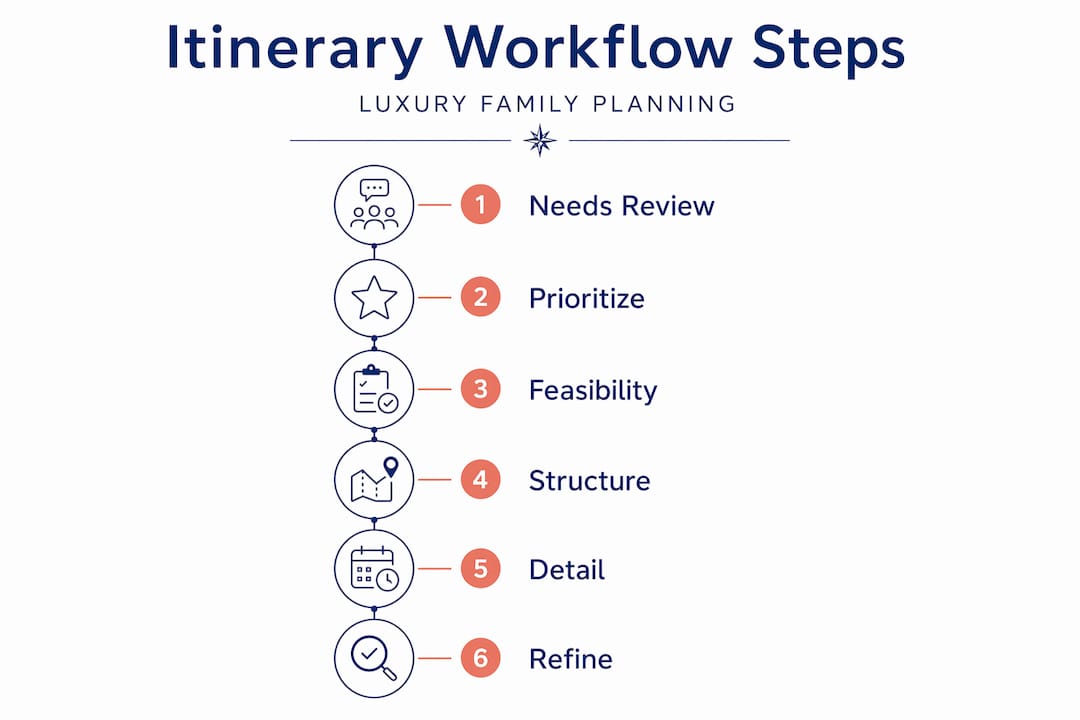
Step 5: Insert buffer time deliberately. Every well-designed luxury itinerary includes breathing room. Build in at least 30 to 60 minutes of buffer between activities. Schedule one fully unstructured afternoon per destination. This is not wasted time. It’s where the best memories often happen, whether that’s a spontaneous gelato stop, a sunset stroll, or simply relaxing at a beautiful hotel pool.
Step 6: Review and refine. Read through the entire itinerary as if you’re living it. Does the pacing feel right? Are there any back-to-back logistical challenges? Would a different sequence reduce transit time?
| Planning approach | Best for | Limitations |
|---|---|---|
| Manual spreadsheet planning | Budget-conscious, detail-oriented families | Time-intensive, harder to update on the go |
| Digital itinerary tools | Tech-savvy families, group coordination | Requires internet access for full functionality |
| Full-service travel agency | Complex, multi-destination luxury trips | Requires clear communication of preferences |
| Hybrid approach | Most luxury families | Needs consistent version management |
Pro Tip: Plan your most physically demanding activities for mid-trip, not on day one or the final day. Arrival and departure days should always be lighter to account for travel fatigue and transfer times.
Managing complexity: Logistics checks and tailored solutions for families
With your baseline itinerary in place, the next challenge is to tailor your plan for real-life complexities and diverse family needs. Multi-generational travel is genuinely wonderful, but it introduces a level of logistics that simpler trips don’t require.
Addressing generational differences in activity needs:
- Young children need nap schedules, snack access, and short activity windows
- Teenagers need autonomy, engagement, and ideally some screen-free adventure
- Adults want cultural depth, culinary experiences, and genuine relaxation
- Older travelers may need slower pacing, accessible accommodations, and proximity to medical services
Understanding accessibility in luxury travel is critical when planning for grandparents or any family member with mobility considerations. This means verifying elevator access at hotels, cobblestone-free walking routes at heritage sites, and wheelchair-accessible transport options. These details should be confirmed directly with every vendor, not assumed.
For families traveling with kids, safety logistics require a different kind of attention. This includes childproofing accommodations, confirming pool fencing at villas, identifying the nearest pediatric medical facility, and packing a solid first aid kit. Luxury travel doesn’t eliminate these concerns. It simply means you have more options and resources to address them well.
“Expert workflow explicitly manages edge cases: differing needs across generations, accessibility and child-safety logistics, and responsive rebooking when disruptions occur.”
Responsive solutions for disruptions deserve their own planning focus. Weather cancellations, unexpected closures, and health incidents happen on real trips. Build a short list of backup activities for each destination. Identify your key vendor contacts so you can reach them quickly. Know your travel insurance policy terms before you depart, not after an incident occurs. This level of preparation is what separates a good trip from a great one.
Disruption response checklist:
- Save direct phone numbers for every hotel, tour operator, and transport provider
- Keep electronic and printed copies of all confirmations
- Identify backup dining options in every city in case of reservation issues
- Know your travel insurance claim process and 24-hour emergency line
- Have a list of alternative indoor activities for rain or extreme heat days
Finalizing, presenting, and revising your family itinerary
Tailoring your itinerary for personal needs is just the start. Ensuring it’s clear, collaborative, and adaptable is how you achieve a truly luxury experience.
The final review phase is where most amateur planners cut corners, often to their regret. Itinerary presentation and collaboration matter enormously: a well-structured, client-friendly format reviewed for gaps ensures every family member understands the plan and can flag concerns before departure.
Finalization checklist:
- Verify pacing: does each day have a realistic number of hours allocated?
- Confirm all bookings are secured and confirmation numbers are recorded
- Check that dietary needs are noted at every dining reservation
- Review transport timing between each activity, including check-in and security time at airports
- Distribute the final itinerary to all adults traveling and any local emergency contacts
- Schedule a final walkthrough call or meeting two weeks before departure
For format, consider both digital and printed options. Digital itineraries shared via app or cloud document allow real-time updates if plans change. Printed copies are invaluable in areas with limited connectivity or when traveling with older family members who prefer physical references. Many luxury travelers use both.
Empirical itinerary benchmarks suggest that well-structured travel plans significantly improve traveler satisfaction and reduce decision fatigue on the ground. When every family member knows what to expect and when, the trip runs more smoothly, and more energy is freed up for genuine enjoyment.
| Itinerary format | Advantages | Best used for |
|---|---|---|
| PDF or printed document | Easy offline access, shareable | All family members, backup reference |
| Digital shared platform | Real-time updates, interactive | Active trip management |
| Mobile app itinerary | GPS integration, alerts | Navigation and day-of logistics |
| Concierge-managed plan | Expert oversight, 24/7 support | High-complexity luxury trips |
On-trip revision is not failure. It’s smart travel. Weather shifts, a spontaneous local festival, or simply discovering that your family prefers one destination over another are all valid reasons to adapt. Build psychological permission to adjust into your planning mindset. The goal is an extraordinary experience, not perfect adherence to a document. Customizing luxury journeys means staying responsive throughout the trip, not just during the planning phase.
Pro Tip: Use a shared notes app during the trip so family members can log preferred restaurants, wish-list items for the next visit, and real-time changes. It becomes a travel journal and a practical tool at the same time.
For families planning seamless luxury journeys, the finalization phase is also a good time to confirm any VIP arrangements, private transfers, or surprise experiences planned for special occasions.
Expert perspective: Why a strict plan can fail and what actually works
After 35 years of designing luxury family itineraries, we’ve seen a pattern that surprises most first-time luxury travelers: the families who follow their itinerary most rigidly often have the least satisfying trips. That might sound counterintuitive given everything we’ve covered, but there’s an important distinction between a structured plan and an over-scripted one.
The best itineraries we create aren’t airtight schedules. They’re intelligent frameworks. They identify the key experiences, handle all the logistics, and then deliberately leave space for a family to breathe, wander, and respond to what actually moves them in the moment. We’ve seen families abandon a planned Michelin-starred dinner because a local chef at a market stall changed their entire perspective on the destination. That pivot was only possible because the evening wasn’t already locked into three follow-on commitments.
Too much upfront scripting can actively collapse a family trip. When every hour is assigned and every deviation feels like a failure, the emotional tone of the vacation shifts from joy to management. Children can’t sustain scheduled joy. Older travelers hit unexpected walls of fatigue. Adults want moments of genuine connection, not the next item on a to-do list.
The best luxury family travel strategies build what we call “white space.” These are intentional gaps where nothing is booked, nothing is required, and the family can decide together what they want in that moment. White space is not inefficiency. It’s the ingredient that makes a trip feel alive rather than managed.
Experienced planners also know when to hold firm and when to flex. Non-negotiables stay protected. But a second castle tour on day four? That can become a pool afternoon if the family needs recovery. The mark of a truly skilled itinerary is that it bends without breaking.
Get expert help: Seamless luxury travel for your family
Applying these strategies yourself is empowering, and the results can be genuinely impressive. But there’s a reason families return to us year after year: exceptional luxury travel requires not just knowledge but deep relationships with the right partners on the ground, the kind that get your family the private villa upgrade, the after-hours museum access, or the chef’s table reservation that’s technically “fully booked.”

At Elite Travel Management Group, we handle every layer of your family’s journey, from the first preference conversation to the final transfer home. Whether you’re looking at adventure travel packages for active families or multi-generational celebrations across multiple countries, our team brings 35 years of expertise, zero service fees, and a price match guarantee to every itinerary we design. We’re available 24/7 because your trip doesn’t follow business hours, and neither do we. Explore what’s possible when Elite Travel luxury experts build your next family journey, or start by reviewing our approach to customized luxury journeys to see exactly how we bring each itinerary to life.
Frequently asked questions
What is the most common mistake in family travel itinerary planning?
The most common mistake is over-scheduling without adequate downtime, which leads to exhaustion and missed opportunities. Building in buffer time and unstructured periods is essential to prevent planning overload and keep energy high throughout the trip.
How do you handle last-minute schedule changes for a luxury family trip?
Build flexibility into the itinerary from the start, including a list of backup activities and responsive support contacts for each destination. Expert workflows explicitly plan for disruptions, including responsive rebooking options when unexpected changes occur.
What tools do luxury travel experts use to build family itineraries?
Experts combine shared digital planning platforms, printed backup documents, and thorough logistics verification steps. Client-friendly itinerary formats reviewed for pacing gaps and accessibility considerations are the standard for high-quality luxury travel planning.
How do itinerary workflows differ for multi-generational luxury trips?
Multi-generational workflows must address mobility accommodations, child-safety logistics, varied activity pacing, and proactive disruption management across all age groups. Multi-generational travel planning requires explicit edge-case management that standard itinerary templates simply don’t cover.
